
Seedance 2.0 vs Sora vs VEO3 vs Runway, Which AI Video Model Is Best for Creators in 2026?
Seedance 2.0 vs Sora vs VEO3 vs Runway ML in 2026, which AI video model is best for creators? Complete comparison covering quality, access, cost, and a content-type model selection framework.

Searching for which AI video model is best for creators in 2026?
The AI video generation landscape has matured dramatically. Seedance 2.0, Sora (OpenAI), VEO3 and VEO3.1 (Google DeepMind), and Runway ML Gen-3 are all producing footage that was science fiction two years ago. The question is no longer "which model generates the best-looking clip?", they all generate impressive footage in different ways. The question is: which model is right for your specific content type, your access situation, and your production workflow?
This guide answers that question directly. Not a beauty contest between models, but a practical decision framework, the specific characteristics of each model, where each one dominates, where each one falls short, and how to choose the right tool for each job in a real faceless channel production workflow.
Executive Summary
This guide is for faceless content creators who want to understand the 2026 AI video model landscape and make informed decisions about which model to use for which content type. It covers the state of AI video generation in 2026, a detailed breakdown of Seedance 2.0's specific strengths and content dominance areas, Sora's quality ceiling alongside its real-world access and cost limitations, VEO3 and VEO3.1's photorealism advantage and creator access through Clippie AI, Runway ML Gen-3's creative control capabilities and the workflow complexity they require, and a complete model selection framework for every major faceless channel content type. By the end, you will have a clear, practical guide for matching the right model to every scene you need to generate.
Table of Contents
The AI Video Model Landscape in 2026, What Has Changed and Why It Matters
Seedance 2.0, What It Does Best and Which Content Types It Dominates
Sora (OpenAI), Quality Ceiling, Access Limitations, and Real-World Creator Usability
VEO3 and VEO3.1 (Google DeepMind), Photorealism, Documentary Footage, and Creator Access
Runway ML Gen-3, Creative Control, Motion Direction, and Workflow Complexity
The Model Selection Framework, Which AI Video Model to Use for Which Content Type
Frequently Asked Questions

1. The AI Video Model Landscape in 2026, What Has Changed and Why It Matters
Twelve months ago, the practical question for faceless content creators was whether AI video generation was good enough for professional channel use. In 2026, that question is settled. Every major model produces footage that exceeds stock footage quality for the content types faceless channels most commonly need.
The question that actually matters in 2026 is different: which model is optimised for which creative need, and how does access and workflow integration affect which model a solo creator can realistically use at production volume?

The Four Models That Define the 2026 Landscape
Seedance 2.0 (ByteDance): The most capable narrative and character-forward AI video model optimised for faceless channel production. Multi-modal inputs, UGC-style generation capability, multi-shot generation, and approximately 30% faster output than Seedance 1.0. Integrated directly into Clippie AI.
Sora (OpenAI): The highest quality ceiling in the commercial market for complex scene physics, multi-character interaction, and temporal consistency. Access through ChatGPT Plus ($20/month) and Pro ($200/month), or API at $0.10–$0.50 per second. Significant cost and generation volume limitations at the creator price point.
VEO3 and VEO3.1 (Google DeepMind): The benchmark for photorealistic documentary-style footage, natural environments, urban settings, and factual visual contexts. Integrated into Clippie AI alongside Seedance 2.0, enabling both photorealistic and filmic footage generation within the same production session.
Runway ML Gen-3: The most feature-complete standalone AI video generation platform with advanced motion controls, camera direction tools, and visual effects capabilities. The standard for creative professionals who want maximum generation control. Credit-based pricing with significant workflow overhead as a standalone tool.
What Has Changed That Makes This Comparison Different From 2025
Quality parity has arrived for standard use cases: All four models now produce footage that is publishable and professional for the content types faceless channels produce. The quality differences between models are real but smaller than they were twelve months ago, and are increasingly context-specific rather than across-the-board.
Access and integration matter as much as quality: A model that requires a $200/month subscription and produces 100 videos per month is accessible for one use case. A model integrated into a complete production platform at $34.99/month and producing 20 complete videos per month serves a different use case more efficiently. The model selection decision is increasingly about workflow fit alongside visual quality.
Specialisation has become clearer: Each model has developed clearer areas of dominance. Choosing the wrong model for a specific scene type produces worse results than choosing the right model at a slightly lower quality ceiling. Understanding specialisation is now more important than knowing which model has the highest average quality.

2. Seedance 2.0, What It Does Best and Which Content Types It Dominates
Seedance 2.0, released by ByteDance in early 2026, is the most capable AI video generation model for narrative, character-forward, and UGC-style content, the content types that dominate faceless channel production.

Core Technical Capabilities
Higher visual fidelity than Seedance 1.0: Improved output resolution and detail preservation across foreground subjects and background environments. Fine textures, fabric, skin, environmental surfaces, maintain sharpness throughout the clip duration.
Better character consistency: Characters maintain stable appearance and natural, independent motion across the full clip. Multi-character scenes with independent motion paths are now reliable where Seedance 1.0 was inconsistent.
Advanced multi-modal inputs: Seedance 2.0 accepts four input types, text prompts, still images, existing video clips (up to 15 seconds), and audio (up to 15 seconds). This multi-modal architecture enables capabilities that text-only generation cannot access.
Motion cloning from reference clips: Seedance 2.0 analyses the camera motion, pacing, and visual energy of a reference clip and grafts that motion style onto new generations. Creators can establish a signature camera style and maintain it consistently across every video in their catalogue.
Multi-shot generation: A single Seedance 2.0 generation can include multiple camera angles and shot transitions, the equivalent of an edited sequence rather than a single continuous take. For narrative content depicting events with natural shot changes, this reduces generation requirements significantly.
Native audio generation: Environmental and ambient audio generates alongside the visual content, crowd sounds, nature ambience, and atmospheric texture, without requiring separate audio sourcing.
Approximately 30% faster generation: Compared to Seedance 1.0, generation time is reduced by approximately 30% at equivalent quality settings.
Where Seedance 2.0 Dominates
Narrative storytelling and Reddit story content: Seedance 2.0's character consistency and multi-shot generation capability makes it the strongest model for narrative content where events unfold across multiple characters and camera positions. Reddit story, moral dilemma, relationship conflict, and dramatic narrative content all benefit from Seedance 2.0's specific strengths.
True crime and thriller atmospheric content: Dramatic lighting, emotionally staged scenes, tension-building environmental footage, Seedance 2.0's filmic aesthetic and improved low-light rendering make it the dominant model for true crime atmospheric footage.
Motivational and aspirational content: Aspirational character scenes, figures achieving goals, overcoming obstacles, dawn running sequences, summit arrival moments, are generated with cinematic compositional intent that stock footage cannot match.
UGC-style product content: Seedance 2.0's UGC-style generation mode creates footage with the organic, handheld aesthetic that performs best for product promotion on TikTok and Instagram Reels. This is a capability no competing model currently offers within the same platform, making Seedance 2.0 uniquely positioned for AI UGC production.
Dark cartoon and stylised aesthetic content: Creators producing dark cartoon or stylised visual content benefit from Seedance 2.0's filmic interpretation of scene descriptions, the output leans toward deliberately composed aesthetics rather than photographic realism.
Creator Access
Seedance 2.0 is integrated within Clippie AI alongside VEO3.1. Access requires only a Clippie AI subscription, no separate ByteDance account, no separate credit system, no API integration. All three plans (Lite at $19.99, Creator at $34.99, Pro at $69.99) include Seedance 2.0 generation within the platform's video export capacity.
3. Sora (OpenAI), Quality Ceiling, Access Limitations, and Real-World Creator Usability
Sora is OpenAI's video generation model, the platform that triggered the current wave of serious AI video generation development when it demonstrated its capabilities in early 2024. In 2026, Sora 2 represents the current state of OpenAI's video generation offering.
Core Technical Capabilities
Physics-aware scene generation: Sora's most discussed capability is its understanding of real-world physics, objects interact with environments in physically plausible ways, fluid dynamics behave correctly, and complex multi-element scenes maintain physical coherence. This physics awareness is more developed than any competing model for specific scene types.
Multi-character complex interaction: Sora handles multiple characters interacting simultaneously within the same frame with stronger consistency than most competing models, particularly for scenes involving physical interaction between characters.
Temporal consistency at longer durations: Sora can generate videos up to a minute long while maintaining visual quality and adherence to the user's prompt. For creators who need longer uninterrupted clips, this duration capability exceeds most competing models.
Complex camera motion: Sora demonstrates sophisticated camera movement, natural handheld motion, smooth tracking shots, and complex camera paths that feel intentionally directed rather than algorithmically generated.
Synchronized audio (Sora 2): Sora 2 introduces synchronized audio generation, natural dialogue syncs and sound effects match what's happening on screen.

The Access and Cost Reality
This is where Sora's practical usability for faceless creators diverges significantly from its technical capability.
As of January 10, 2026, free users can no longer generate videos with Sora. Only Plus ($20/month) and Pro ($200/month) subscribers retain access.
Sora 2 is accessible through ChatGPT Plus at $20/month (approximately 12 ten-second 720p videos) and ChatGPT Pro at $200/month.
The generation volume problem:
ChatGPT Plus provides 1,000 monthly credits shared across Sora 2 and other generation features. At 80 credits per 720p video, this gives approximately 12 videos per month at an effective cost of $1.67 per video, significantly more expensive per output than alternatives. ChatGPT Pro's 10,000 credits yields approximately 125 videos monthly but at $200/month, most individual creators generating fewer than 125 videos monthly are overpaying relative to alternatives.
The iteration problem:
1,000 credits sounds ample until you factor in iteration, generating three or four versions to get the perfect shot quickly burns through your monthly allocation.
For a faceless creator producing 10 videos per month with 6 clips each, 60 clip generations per month at 80 credits each consumes 4,800 credits, nearly 5x the ChatGPT Plus monthly allocation. At ChatGPT Pro rates, 60 clips per month at $200/month equals a per-clip cost of $3.33, expensive for volume production without considering the remaining production stages (voiceover, captioning, assembly) that still require separate tools.
API pricing: Sora 2 costs $0.10/second for 720p videos. Sora 2 Pro costs $0.30/second for 720p or $0.50/second for 1024p.
A 10-second Sora 2 clip via API at $0.10/second costs $1.00. For a production requiring 60 such clips per month, the API cost alone is $60/month, before adding voiceover, captioning, and assembly tools.
Real-World Creator Usability Assessment
Where Sora is the right choice:
Creative filmmakers and directors producing low-volume, high-investment cinematic content where per-clip cost is not the primary constraint
Creators who already pay for ChatGPT Pro for other AI uses and receive Sora access as an additional benefit
Productions requiring physics-accurate complex scene generation where the specific physical accuracy is essential to the content
Where Sora is not the right choice:
Faceless channel creators producing 8–20 videos per month who need cost-predictable, high-volume generation
Creators who need voiceover, captioning, and assembly integrated with their footage generation
Any creator where generation volume variability creates budget management risk

4. VEO3 and VEO3.1 (Google DeepMind), Photorealism, Documentary Footage, and Creator Access
VEO3 and VEO3.1 are Google DeepMind's AI video generation models, the benchmark for photorealistic, documentary-style footage that looks captured by a camera in the real world rather than generated by an AI model.
Core Technical Capabilities
Photorealism as the primary output characteristic: VEO3.1's defining capability is the visual indistinguishability of its output from high-quality camera footage in its strongest categories. Natural landscapes, urban environments, water and atmospheric phenomena, and architectural settings generate with a photographic quality that competing models in their filmic aesthetic categories do not match.
Environmental accuracy and naturalism: Where Seedance 2.0 and Runway produce footage that looks like a film was shot there, VEO3.1 produces footage that looks like the environment was filmed directly. Clouds move naturally. Water behaves physically. Light falls correctly across surfaces. Architectural details maintain geometric accuracy.
Documentary-style camera behaviour: VEO3.1's camera motion reflects the natural behaviour of a real camera, slight instability in handheld shots, smooth mechanical movement in crane and dolly equivalents, and naturalistic focus transitions. This documentary authenticity is difficult to prompt into models with more stylised output tendencies.
Strong prompt responsiveness for geographic and period specificity: VEO3.1 handles geographically and temporally specific prompts reliably, "ancient Mediterranean coastline with limestone architecture," "English countryside farmland at dawn," "New York financial district at night", producing footage that reflects the specific visual characteristics of each context.
Where VEO3.1 Dominates
History and documentary channels: Period-appropriate environmental footage for historical content, ancient civilisations, WWII settings, medieval environments, colonial-era locations, generates with naturalistic quality that serves documentary aesthetic requirements better than Seedance 2.0's filmic interpretation.
Finance and business explainer content: Professional urban environments, financial district footage, corporate building exteriors, and workplace interiors generate with photographic authenticity that communicates the seriousness that finance content audiences expect.
Science explainer and educational content: Laboratory environments, natural phenomena, geographic features, and scientific settings generate with the factual, photographic quality that educational credibility requires.
Nature and environmental content: Landscapes, ocean footage, forest environments, weather events, and natural phenomena are VEO3.1's highest-performing category, photorealistic natural footage that rivals professional nature documentary stock.
Creator Access
VEO3.1 is integrated within Clippie AI alongside Seedance 2.0, accessible through any Clippie AI plan (Lite at $19.99, Creator at $34.99, Pro at $69.99). Direct Google API access to VEO3.1 requires Google Cloud integration and separate API management, Clippie AI's integration removes this technical barrier entirely.

5. Runway ML Gen-3, Creative Control, Motion Direction, and Workflow Complexity
Runway ML is the most feature-complete standalone AI video generation platform, designed for creative professionals who want maximum control over every element of the generated footage.
Core Technical Capabilities
Multi-motion brush and element control: Runway's motion brush allows creators to specify the direction, speed, and type of motion for individual elements within the frame, a specific object moves left while the background remains static, a character walks while the environment pans. This element-level motion control is unique to Runway and enables creative compositing that prompt-only generation cannot achieve.
Camera direction tools: Runway provides explicit camera motion controls, pan direction and speed, tilt, zoom, orbit, and camera path, specified through interface controls rather than relying entirely on prompt language interpretation. This precision camera control produces more consistent, intentional camera movement than models that interpret camera direction from text descriptions.
Advanced visual effects: Runway includes generation capabilities beyond standard footage, visual effects, style transfer, background extension, and video-to-video generation that applies new visual aesthetics to existing footage.
High generation quality: Runway's Gen-3 Alpha model produces footage with strong temporal consistency, natural motion quality, and cinematic composition, competitive with the highest quality outputs from competing models for specific scene types.
The Workflow Complexity Reality
Pricing: Runway Standard is $12/month as an entry point if you prioritise cinematic quality over volume. Higher-tier plans provide more credits for higher generation volumes.
What Runway does not provide: Like Sora, Runway is a generation tool, not a production platform. A complete faceless video production workflow using Runway requires:
Separate AI voiceover tool (ElevenLabs or equivalent)
Video editor for assembly of generated clips with voiceover
Separate captioning tool
Platform-specific export configuration
The same multi-tool overhead that applies to Higgsfield AI and Sora applies equally to Runway, 3–4 additional tools, 30–50 minutes of additional assembly time per video, and $60–$130+ in combined monthly subscriptions.
Where Runway is the right choice: Creative filmmakers and visual artists who require element-level motion control, visual effects integration, or video-to-video style transfer within a more complex creative production pipeline where the generation tool is one component of an existing workflow.
Where Runway is not the right choice: Solo faceless channel creators producing 8–20 videos per month at sustainable cost and time, the workflow complexity and combined subscription cost of a Runway-based production stack does not serve this use case as efficiently as an integrated platform.

6. The Model Selection Framework, Which AI Video Model to Use for Which Content Type
This framework provides the definitive selection guidance for every major faceless channel content type based on the specific capabilities documented above.
Decision Principle 1: Match the Aesthetic to the Content
The most important model selection criterion is aesthetic alignment, not quality ranking in the abstract. A model that produces the wrong aesthetic for the content type produces worse usable results than a model with a lower quality ceiling but the right aesthetic.
Filmic/cinematic aesthetic (Seedance 2.0): Narrative, dramatic, emotionally staged, UGC-style
Photorealistic/documentary aesthetic (VEO3.1): Educational, documentary, factual, environmental
Maximum creative control (Runway ML): Experimental, effects-heavy, custom motion-controlled
Physics-accurate complex scenes (Sora): Multi-character physical interaction, complex physics scenarios
Content Type Selections, Complete Framework
True Crime and Mystery Channels → Seedance 2.0 Primary
Why: True crime requires atmospheric, emotionally staged footage with tension-building environments and character presence. Seedance 2.0's filmic aesthetic, improved character consistency, and multi-shot generation capability are exactly what this content type needs.
VEO3.1 secondary role: For location-based establishing shots (crime scene geography, neighbourhood context, city environment footage) where photorealism communicates factual accuracy.
History and Documentary Channels → VEO3.1 Primary
Why: Historical content requires footage that looks captured, period-appropriate environments that feel authentic rather than cinematically styled. VEO3.1's photorealism produces ancient civilisation environments, historical battlefield landscapes, and period architecture that reads as documentary rather than feature film.
Seedance 2.0 secondary role: For scenes depicting historical figures or narrative moments where character presence and emotional staging are appropriate, the human element of historical stories.
Reddit Story and Narrative Channels → Seedance 2.0 Primary
Why: Reddit story content is character-driven dramatic narrative, domestic environments with emotional staging, workplace conflict scenes, relationship tension. Seedance 2.0's multi-character motion handling and filmic composition serve this exactly.
VEO3.1 secondary role: Minimal, Reddit story content is primarily about character and environment staging rather than photographic naturalism.
Finance and Business Explainer Channels → VEO3.1 Primary
Why: Finance content audiences expect professional, credible visual environments. VEO3.1's photorealistic business district and professional interior footage communicates the authority that finance content requires.
Seedance 2.0 secondary role: For human-element footage, a figure reviewing documents, a person making a financial decision, where character presence reinforces the personal relevance of the financial topic.
Motivational and Self-Improvement Channels → Seedance 2.0 Primary
Why: Motivational content needs aspirational character scenes with cinematic compositional intent, the dawn runner, the summit achiever, the person at a turning point. Seedance 2.0's filmic aesthetic elevates this content above generic stock footage quality.
VEO3.1 secondary role: Establishing landscape shots, mountain ranges, open roads, dawn horizons, where photorealistic scale communicates aspiration through natural grandeur.
Science and Technology Explainer Channels → VEO3.1 Primary
Why: Educational science content requires factual visual credibility. VEO3.1's photorealistic laboratory environments, natural phenomena, and technological settings communicate scientific accuracy that the filmic aesthetic of Seedance 2.0 does not serve as effectively.
Seedance 2.0 secondary role: For narrative science content, depicting a scientist at work, a historical discovery moment, where human presence and emotional staging are appropriate.
E-Commerce and Product Ad Content → Seedance 2.0 Primary (UGC Mode)
Why: E-commerce content performing best on TikTok and Reels uses the UGC-style aesthetic, organic, handheld, authentic-feeling. Seedance 2.0's dedicated UGC-style generation mode produces this aesthetic specifically. No competing model within an integrated production platform provides this capability.
VEO3.1 secondary role: Lifestyle and aspirational product context shots where photorealistic environmental quality is appropriate.
AI UGC for Skincare and Beauty Brands → Seedance 2.0 Primary (UGC Mode + Image-to-Video)
Why: Beauty and skincare UGC requires both organic-feeling demonstration footage and product animation from existing product photography. Seedance 2.0's UGC mode and image-to-video animation capability serve both requirements.
Dark Cartoon and Stylised Content → Seedance 2.0 Primary
Why: Dark cartoon and stylised content benefits from Seedance 2.0's filmic interpretation of scene descriptions, the compositional intent and colour palette control that Seedance 2.0's prompt responsiveness enables.
Creative Filmmaking and Visual Art → Runway ML
Why: Runway's element-level motion control, camera direction precision, and visual effects capabilities are specifically designed for creators who want maximum control over the generated footage as a creative medium. The workflow complexity is justified when the creative control itself is the primary value.
When to Consider Sora
Sora is the right choice when:
You already subscribe to ChatGPT Plus or Pro for other AI uses and want to explore Sora's capabilities without additional subscription cost
The specific scene requires physics-accurate multi-character interaction that no competing model handles as well, and the per-clip cost is acceptable
You are producing low-volume, high-investment cinematic content where quality ceiling matters more than production volume economics
Sora is not the right choice when:
Production volume requires 6+ clips per video at 8–20 videos per month
Budget predictability is a priority
The production workflow needs integration with voiceover, captioning, and export
The Clippie AI Integrated Advantage
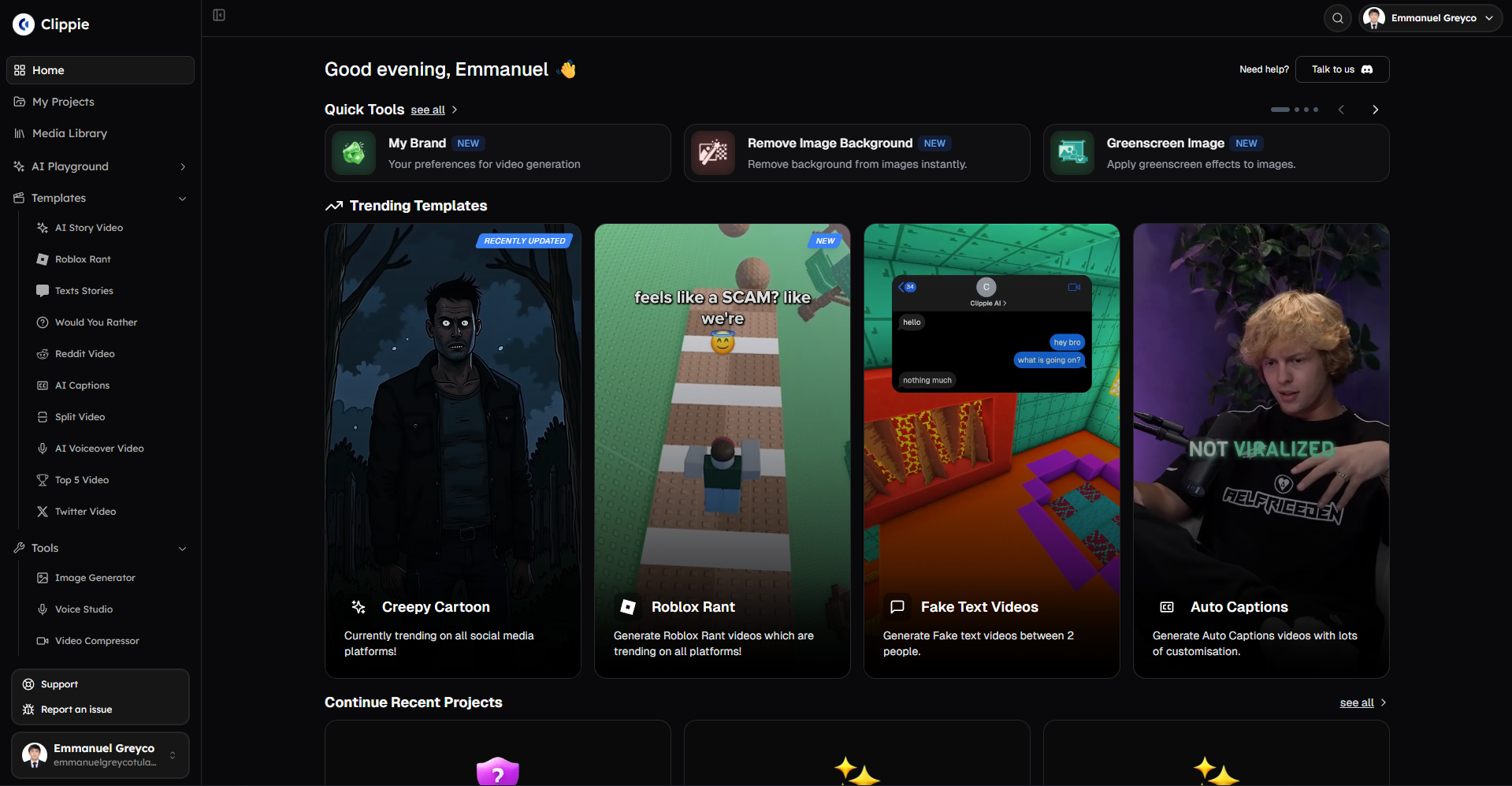
For faceless creators building YouTube and TikTok channels, the model selection framework above is most practically deployed within Clippie AI, where both VEO3.1 and Seedance 2.0 are accessible within the same production session, selected clip-by-clip based on each scene's specific requirements.
The practical production workflow becomes:
Environmental establishing shot → select VEO3.1 → generate
Narrative character scene → select Seedance 2.0 → generate
Static concept illustration → use AI image generation
Voiceover → same session
Captions → same session
Export (9:16 and 16:9) → same session
All within Clippie AI's integrated workflow. No separate Sora account. No separate Runway subscription. No footage download and import into an editor. No separate captioning tool.
Clippie AI Plans, Supporting the Full Model Selection Framework
Lite: $19.99/month
30 mins video export (~3–5 videos/month)
30 mins AI voice generation
30 mins speech-to-subtitles
100 AI images
1 custom voice
Captions in 102+ languages
50+ AI voices
24/7 support
Creator: $34.99/month
120 mins video export (~8–12 videos/month)
120 mins AI voice generation
120 mins speech-to-subtitles
500 AI images
10 custom voices
Captions in 102+ languages
50+ AI voices
24/7 support
Pro: $69.99/month
250 mins video export (~15–25 videos/month)
250 mins AI voice generation
250 mins speech-to-subtitles
1,000 AI images
30 custom voices
Captions in 102+ languages
50+ AI voices
24/7 support
No free tier is available on Clippie AI.
💡 For the complete Seedance 2.0 guide covering every new capability and the full prompt framework for 2026, read our guide on Seedance 2.0 is now live in Clippie AI, what's new and what you can build in 2026
💡 For the complete VEO3.1 and Seedance prompt framework covering every content type, read our guide on how to use VEO3 and VEO3.1 to create cinematic AI videos in 2026
💡 Access both Seedance 2.0 and VEO3.1 within Clippie AI's complete production workflow today →
Conclusion: The Right Model Is the One That Fits the Scene, Not the One With the Most Impressive Demo
The 2026 AI video model landscape has moved beyond the question of which model is generally best. Every major model produces impressive footage. The question that matters is which model is optimised for the specific scene being generated, and which access model allows that generation at sustainable production volume within a complete workflow.
For faceless channel creators producing 8–20 videos per month:
Sora's quality ceiling is real but its access economics at production volume are challenging
Runway's creative control is genuine but its workflow overhead is significant
VEO3.1 and Seedance 2.0 within Clippie AI provide the model quality required for every standard faceless channel content type within an integrated workflow at $34.99/month
The model selection framework in this guide, Seedance 2.0 for narrative and character content, VEO3.1 for documentary and photorealistic content, mixed-model approach for long-form content, is the practical standard for faceless creators who want the right footage for every scene without paying for premium access to models that are not calibrated for their specific content type.
7. Frequently Asked Questions
Q1: Which AI video model produces the highest quality footage overall in 2026?
Quality is not a single dimension, each model dominates in specific areas. Sora demonstrates strong physics awareness and can generate complex scenes with multiple characters, specific types of motion, and accurate environmental details. VEO3.1 leads for photorealistic documentary-style footage. Seedance 2.0 leads for narrative, character-forward, and UGC-style content. Runway ML leads for creative control and visual effects. The correct answer to "which model is best?" is always "best for which content type?", and the framework in this guide answers that question for every major faceless channel content category.
Q2: Is Sora available to all creators or are there access restrictions?
As of January 2026, free users can no longer generate videos with Sora. Only ChatGPT Plus ($20/month) and Pro ($200/month) subscribers retain access. API access is available at $0.10/second for standard 720p videos. ChatGPT Plus provides approximately 12 ten-second 720p videos per month, significantly less than what most faceless channel creators need for consistent weekly publishing.
Q3: Can I use both Seedance 2.0 and VEO3.1 in the same video within Clippie AI?
Yes, Clippie AI provides access to both Seedance 2.0 and VEO3.1 within the same production session. Model selection happens at the individual clip level, each clip in a production session can use either model based on that specific scene's requirements. A 10-minute history video can use VEO3.1 for environmental establishing shots and Seedance 2.0 for character-present narrative scenes within the same Clippie AI session without any file management between tools.
Q4: Why does Runway ML have so many advanced features but require additional tools for a complete faceless video?
Runway ML is designed for creative professionals who want AI video generation as a component of a more complex creative workflow, filmmakers, visual artists, and agencies who have existing production pipelines for voiceover, editing, and captioning. Its advanced motion controls, camera direction tools, and visual effects capabilities are specifically valuable in this context. For solo faceless channel creators whose production system begins at the script level and needs to end at a published video with no intermediate tool management, Runway's generation-only scope requires adding 3–4 tools to complete what Clippie AI handles in one integrated session.
Q5: What is the real monthly cost difference between using Sora for faceless production versus Clippie AI?
At ChatGPT Plus ($20/month), Sora 2 provides approximately 12 ten-second 720p videos per month, at an effective per-video cost of $1.67. A faceless creator producing 10 videos per month with 6 clips each needs 60 clip generations, consuming roughly 4,800 credits, nearly 5x the ChatGPT Plus monthly allocation. At ChatGPT Pro ($200/month), the same 60 clips represent approximately $160 in subscription cost before additional tools (voiceover, captioning, editor). Clippie AI Creator at $34.99/month covers all production stages, Seedance 2.0 and VEO3.1 footage, voiceover, captioning, and export, for 8–12 complete videos per month within one subscription.
Q6: Which Clippie AI plan supports the mixed Seedance 2.0 and VEO3.1 model selection approach for a channel posting twice weekly?
The Creator plan at $34.99/month is the right fit for a channel posting 2 videos per week (8 per month). Its 120-minute export capacity supports 8 videos at 15 minutes average length, the 500 AI images cover 6–8 images per video alongside the generated footage, and both Seedance 2.0 and VEO3.1 are accessible within the plan's video generation capacity. The 10 custom voice clones allow maintaining the channel's audio identity consistently across all content. For channels posting 3–4 times per week (12–16 videos per month), the Pro plan at $69.99/month provides 250 minutes of capacity sufficient for the higher output.
Read more

How to Post One Faceless Video to TikTok, Reels and Shorts
One vertical export works on all three platforms, but the rules don't. Lengths, payout thresholds, caption styles and what you should never cross-post.

Best AI Tools for Faceless YouTube Channels in 2026
A faceless YouTube channel needs one good tool per stage, not thirty. Research, scripting, voice, video and thumbnail picks, plus three stacks by budget

Best AI Video Tools for Faceless Content in 2026
The right tool depends on what you make: story shorts, prompt-to-video, repurposing, captions or avatars. Honest picks for each, plus where each one fails.