
How to Use VEO3 and VEO3.1 to Create Cinematic AI Videos in 2026 (Creator's Guide)
Learn how to use VEO3 and VEO3.1 to create cinematic AI videos in 2026, prompt writing guide, step-by-step Clippie AI workflow, best content formats, and full production system for faceless creators.

Searching for how to actually use VEO3 and VEO3.1 to create cinematic AI videos as a content creator in 2026?
Most guides explain what VEO3 is. Very few explain how to use it practically, the right prompts, the right workflow, and how to integrate it into a real production system without spending hours generating footage that doesn't match your content.
This guide gives you the complete operational framework. From understanding what VEO3 and VEO3.1 actually do differently, to writing prompts that produce cinematic output on the first attempt, to accessing both models inside Clippie AI and building a full video production workflow around them.
Executive Summary
This guide is for faceless content creators who want to use VEO3 and VEO3.1 to produce cinematic-quality AI video for YouTube, TikTok, and Instagram Reels in 2026. It covers what VEO3 and VEO3.1 are, how they differ and which to use for different content types, how to write prompts that generate broadcast-quality footage, how to access both models through Clippie AI, which content formats benefit most from cinematic AI video, and how to build a complete production workflow. By the end, you will have a clear, executable system for producing cinematic faceless video content at scale.
Table of Contents
What VEO3 and VEO3.1 Are, And Why Every Faceless Creator Needs to Know About Them
VEO3 vs VEO3.1, What Changed and Which One Should You Use
How to Write Prompts That Generate Cinematic AI Video With VEO3
How to Access and Use VEO3.1 Inside Clippie AI (Step-by-Step)
The Best Content Formats for VEO3-Generated Video in 2026
How to Build a Full Cinematic Faceless Video Workflow Using Clippie AI and VEO3.1
Frequently Asked Questions
1. What VEO3 and VEO3.1 Are, And Why Every Faceless Creator Needs to Know About Them
VEO3 is Google DeepMind's most advanced AI video generation model. It converts text prompts into photorealistic, motion-consistent video footage, and in 2026, it has crossed the threshold from "impressive experiment" to "production-ready tool."
Understanding what this means for faceless creators specifically is important before getting into the technical details.
The Problem VEO3 Solves for Faceless Creators
Every faceless video needs visual content. Before AI video generation, creators had three options:
Stock footage libraries: Generic, expensive, limited to footage that already exists, and visually identical to footage on thousands of other channels
Screen recordings: Useful for tutorial content but restricted to what can be shown on a screen
AI-generated images: Static images work but create a slideshow aesthetic, no motion, no cinematic quality, no sense of depth or environment
VEO3 adds a fourth option that none of the above can match: custom, photorealistic, motion-rich video footage generated specifically for your video's content, on demand, in minutes, at a fraction of the cost of stock libraries.
What this means practically:
A creator making a video about ocean conservation can generate original underwater footage of coral reefs. A finance channel covering economic trends can generate footage of bustling financial districts. A history channel covering ancient civilisations can generate atmospheric footage of temples, landscapes, and period-appropriate environments, footage that does not exist in any stock library because it was generated specifically for that video.
This is the creative and competitive advantage that VEO3 gives faceless creators in 2026.

Why VEO3 Matters for Channel Quality and Retention
Visual quality directly impacts viewer retention, and retention is YouTube's primary ranking signal.
The retention impact of VEO3-generated footage:
Cinematic, motion-rich footage holds visual attention more effectively than static AI images or generic stock video
Custom footage that matches the specific content of each section prevents the visual disconnect that occurs when stock footage is only loosely related to the narration
High visual quality signals production value, viewers associate cinematic footage with authoritative, trustworthy content, particularly in high-CPM niches like finance, history, and science
The competitive advantage:
Most faceless creators are still using the same stock libraries. A channel using VEO3-generated custom footage looks distinctly different from channels using generic stock. That visual differentiation improves CTR, retention, and subscriber conversion, all compounding over time.
Who VEO3 Is Built For in the Creator Space
VEO3 is not a tool for every creator in every situation. It performs best for:
Documentary and explainer channels, where environmental and atmospheric footage conveys authority
History and science channels, where footage of events, locations, and phenomena cannot be sourced from stock libraries
Finance and business channels, where abstract economic concepts benefit from cinematic visual metaphors
Narrative and storytelling channels, where scene-setting footage reinforces the emotional arc of the content
Motivational and self-improvement channels, where aspirational visual landscapes match the inspirational tone of the content
For tutorial content, screen recordings, or product comparisons, standard AI image generation inside Clippie AI is typically more efficient. VEO3 earns its place when the content benefits from genuine cinematic visual storytelling.

2. VEO3 vs VEO3.1, What Changed and Which One Should You Use
VEO3.1 is Google DeepMind's updated version of VEO3, released with significant improvements to the areas where the original model most frequently fell short for production use.
What VEO3 Introduced
VEO3 was the first iteration of this model class to cross the threshold of genuine production usability. Its core capabilities:
Photorealistic scene generation from text prompts
Multi-second footage with coherent motion, objects, environments, and lighting hold together across the clip duration
Strong performance on natural environments, landscapes, weather, water, sky, foliage
Native audio generation, ambient sound and environmental audio generated alongside the video
Prompt-responsive composition, specific instructions about camera angle, lighting conditions, and scene elements are followed reliably
Where VEO3 had limitations:
Complex motion sequences (crowds, fast movement, physical interactions) occasionally produced artefacts
Temporal consistency, maintaining coherent object appearance across multiple seconds, broke down on some clips
Long-duration generation (beyond 8 seconds) showed quality degradation
What VEO3.1 Improved
VEO3.1 addressed the most impactful limitations of VEO3 for production-level use:
Improved temporal consistency: Objects, environments, and lighting maintain coherent appearance across the full clip duration. A person walking through a scene in VEO3.1 maintains consistent clothing, posture, and proportions throughout, something VEO3 occasionally failed to deliver.
More accurate prompt following: VEO3.1 follows compositional instructions more precisely. Camera angles, depth of field, lighting conditions, and subject placement specified in prompts are rendered more accurately in the output.
Better motion quality: Complex motion, crowd scenes, dynamic weather, fast movement, produces fewer visual artefacts. VEO3.1 handles these scenes with significantly higher consistency.
Extended generation capability: VEO3.1 maintains quality across longer clip durations, making it more suitable for the 8–15 second footage clips that work best in long-form YouTube video production.
Native audio improvements: Audio quality and synchronisation with visual elements improved, ambient sound, environmental noise, and atmospheric audio are more accurately matched to the scene being generated.
Which Model to Use for Which Content
Use VEO3.1 as your default, it outperforms VEO3 across every dimension that matters for faceless video production. The only reason to use VEO3 over VEO3.1 is credit cost, if VEO3.1 carries a higher generation cost in your plan, weigh quality improvement against volume requirements.
When VEO3 is sufficient:
Static or slow-panning nature scenes where motion complexity is low
Simple architectural or landscape establishing shots
Abstract or atmospheric visuals where precision is less critical
When VEO3.1 is worth the additional cost:
Any content featuring movement, people, vehicles, weather, water in motion
Scenes where temporal consistency across 8+ seconds matters
Content where visual quality directly impacts credibility, finance, documentary, educational
Flagship or featured videos where production quality is the differentiator
3. How to Write Prompts That Generate Cinematic AI Video With VEO3
Prompt quality determines output quality more than any other variable. A well-constructed VEO3 prompt consistently produces usable footage in one or two generations. A vague or poorly structured prompt produces footage that requires many iterations before becoming usable, wasting both time and generation credits.
The Anatomy of a High-Quality VEO3 Prompt
Every effective VEO3 prompt contains five elements. Missing any one of them increases the probability of output that does not match your intended footage.
Element 1: Subject
What is the primary focus of the footage? Be specific.
Weak: "city at night"
Strong: "a busy financial district street at night, glass skyscrapers with lit windows, light rain, shallow depth of field"
Specificity in the subject gives the model clear compositional instructions. Vague subjects produce generic, interchangeable footage.
Element 2: Camera Style and Movement
How should the camera behave?
Effective camera direction terms for VEO3:
"slow cinematic pan left", gradual horizontal movement
"gentle drone aerial shot", overhead perspective with slight drift
"slow push-in", camera gradually moves toward the subject
"static wide shot", no camera movement, full scene visible
"shallow depth of field", subject in focus, background blurred
"rack focus from foreground to subject", focus shifts during the clip
Including camera direction transforms a static scene description into a cinematic shot. This is the single most impactful addition most creators make to their prompts after their first few generations.
Element 3: Lighting Conditions
Lighting creates mood and determines how cinematic the output looks.
High-impact lighting descriptors:
"golden hour warm sunlight", warm, cinematic, elongated shadows
"overcast diffused lighting", even, documentary-style
"blue hour twilight", cool, atmospheric, transitional
"dramatic side lighting", strong directional light, high contrast
"neon signs reflecting on wet pavement", urban, cinematic aesthetic
"soft morning light through windows", warm, intimate
Lighting specification is what separates footage that looks cinematic from footage that looks flat. Always include it.
Element 4: Atmosphere and Mood
What emotional register should the footage convey?
"cinematic, authoritative, documentary-style"
"aspirational, warm, optimistic"
"tense, dramatic, high-stakes"
"peaceful, meditative, natural"
"energetic, dynamic, urban"
Mood descriptors influence colour grading, pacing of motion, and the overall aesthetic of the output.
Element 5: Technical Quality Descriptors
Always include quality and resolution specifications:
"4K cinematic quality"
"photorealistic"
"film grain texture"
"professional cinematography"
"broadcast quality"
These terms bias the model toward higher-quality output and away from the lower-resolution, artificial-looking generation that early prompts sometimes produce.
Example Prompts by Content Category
Finance and Business Content
For economic growth or investment topics: "Slow cinematic aerial drone shot over a modern financial district at dawn, glass skyscrapers reflecting warm golden light, light mist over the city, photorealistic 4K quality, broadcast quality cinematography"
For personal finance and savings topics: "Close-up of hands placing coins into a glass jar on a wooden table, warm natural window light, shallow depth of field, slow push-in camera movement, cinematic colour grading, 4K quality"
For market volatility or economic uncertainty topics: "Time-lapse of a busy stock exchange trading floor, fast movement, dramatic overhead lighting, intense atmosphere, professional cinematography, 4K"
History and Documentary Content
For ancient civilisation topics: "Slow cinematic pan across a desert landscape at golden hour, ancient stone ruins visible on the horizon, warm dusty atmosphere, cinematic depth of field, documentary-style lighting, 4K quality"
For 20th century history topics: "Aerial view of a European city in soft morning light, historic architecture, cobblestone streets, cinematic wide shot, photorealistic 4K quality"

Nature and Environment Content
For climate or environmental topics: "Slow motion close-up of waves breaking on a rocky coastline at sunset, dramatic orange and purple sky, natural sound, cinematic depth of field, photorealistic 4K quality"
For wildlife or conservation topics: "A majestic eagle soaring above a mountain range, slow motion, dramatic cloud formations, golden afternoon light, aerial perspective, cinematic 4K footage"
Motivational and Self-Improvement Content
For achievement and success topics: "Person standing at the summit of a mountain at sunrise, arms outstretched, dramatic sky with clouds breaking, warm golden light, wide establishing shot transitioning to slow push-in, cinematic 4K"
For productivity and focus topics: "Clean modern desk with morning sunlight streaming through large windows, warm atmosphere, soft focus background, slow gentle camera movement, cinematic and aspirational, 4K"
What to Avoid in VEO3 Prompts
These prompt elements consistently produce poor output:
Named real people, VEO3 avoids generating realistic depictions of named individuals
Copyrighted locations or branded environments, footage of specific trademarked places is unreliable
Text within the generated footage, VEO3 does not reliably render readable text on signs, screens, or documents
Overly complex multi-subject scenes, "a crowd of 50 people doing different activities" produces artefacts; simpler scenes produce better output
Contradictory lighting conditions, "bright sunlight and dramatic storm clouds" creates inconsistent output

4. How to Access and Use VEO3.1 Inside Clippie AI (Step-by-Step)
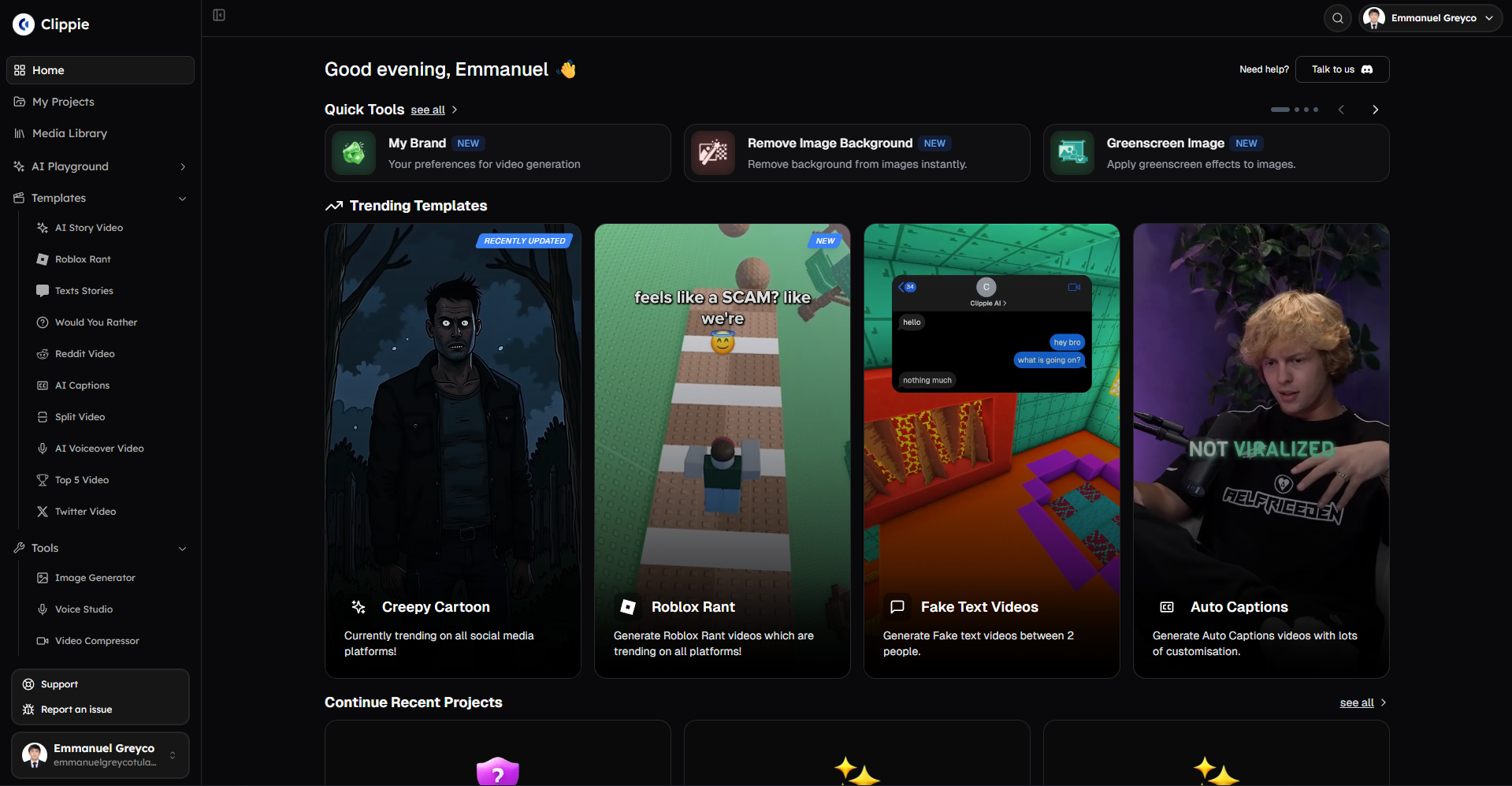
Clippie AI integrates VEO3 and VEO3.1 directly into its video creation workflow, meaning you can generate cinematic footage without a separate Google account, separate billing, or the technical setup that direct API access requires.
This is Clippie AI's most significant differentiation from both standalone AI video tools and traditional stock library workflows: VEO3.1-generated footage, AI voiceover, auto-captions, and video export in a single integrated platform.
Step 1: Access the AI Video Generation Feature in Clippie AI
Log into your Clippie AI account
Navigate to the AI video generation section of the platform
Confirm that VEO3 and VEO3.1 are listed as available generation models
Note on credits: VEO3.1 generation uses AI credits within Clippie AI. Credits are separate from the base subscription plan capacity. Check your available credit balance before beginning a generation session for a new video project.
Step 2: Select VEO3.1 as Your Generation Model
From the model selection menu:
Select VEO3.1 for content requiring the highest output quality, particularly any footage with motion, people, or complex environments
Select VEO3 for simpler landscape or atmospheric shots where the quality difference is less impactful and credit efficiency matters
For most production use cases, VEO3.1 is the correct default selection.
Step 3: Enter Your Prompt
Using the prompt framework from Section 3:
Write your prompt following the five-element structure: Subject + Camera Style + Lighting + Atmosphere + Technical Quality
Keep prompts between 40–80 words, longer prompts do not consistently improve output and can introduce contradictions that confuse the model
Review the prompt for any elements from the "what to avoid" list before generating
Step 4: Generate and Review
Generate the clip. VEO3.1 generation typically takes 30–90 seconds depending on clip complexity.
Reviewing generated output, what to check:
Does the scene match the subject described in your prompt?
Is the motion coherent across the full clip duration (no warping, morphing, or artefacts)?
Does the lighting match the description?
Is the clip long enough for its intended position in the video?
Does it feel tonally consistent with your channel's visual aesthetic?
If the output does not meet these criteria, adjust the prompt and regenerate. The most common prompt adjustment is adding more specific camera direction or more explicit lighting description.
Step 5: Integrate Into Your Video
Once the clip is approved:
Add it to the relevant section of your video in Clippie AI's editor
Pair it with the corresponding voiceover segment that was generated in the same session
Ensure captions are synced to the voiceover across this section
Proceed to the next section of the video and repeat
For a standard 8–10 minute video, plan for 6–10 VEO3.1 clips, one establishing shot, one or two clips per major section, and one closing shot.
Step 6: Export
Export the completed video with VEO3.1 footage integrated:
Long-form YouTube: 16:9, 1080p minimum, MP4
Shorts / TikTok / Reels: 9:16, 1080 x 1920, MP4
The VEO3.1 footage exports at the same quality settings as the rest of the Clippie AI production, no separate rendering or quality adjustment required.

5. The Best Content Formats for VEO3-Generated Video in 2026
VEO3 footage performs differently depending on the content format it is used in. Understanding where it adds the most value, and where simpler visuals are more efficient, prevents over-using credits on footage that does not meaningfully improve the video's performance.
Format 1: Documentary-Style Explainer Videos (Highest Impact)
Documentary-style explainers use VEO3 footage to establish scenes, convey atmosphere, and reinforce the authority of the information being delivered.
Where VEO3 footage fits:
Opening establishing shot, sets the visual tone for the entire video
Section transitions, a 3–5 second atmospheric clip between major sections maintains visual momentum
Concept visualisation, footage that represents abstract concepts (economic growth, historical events, natural phenomena)
Why this format benefits most from VEO3: The credibility signals that VEO3 footage provides, cinematic quality, environmental realism, professional-grade visual production, align directly with the trust requirements of documentary and educational content. Viewers associate high production value with authoritative information.
Format 2: History and Geography Channels (Strongest Competitive Advantage)
History and geography content relies heavily on atmospheric, period-appropriate, and location-specific footage. Stock libraries are limited in this area, they primarily contain modern footage of contemporary locations. VEO3 generates footage of environments, landscapes, and architectural styles that stock libraries cannot provide.
VEO3 use cases for history content:
Ancient or historical landscape footage
Period-appropriate environmental scenes
Geographic and terrain footage for locations that are difficult to source from stock
This is the content category where VEO3 provides the most significant quality advantage over any alternative visual approach.
Format 3: Finance and Economics Videos (Highest CPM Impact)
Finance content benefits from VEO3 footage primarily in the establishing and transitional shots that frame the content's authority. A finance video that opens with cinematic footage of a global financial hub reads as more credible than one that opens with generic stock office footage.
VEO3 use cases for finance content:
Opening establishing shots of financial districts, markets, or economic environments
Concept visualisation clips, representing growth, stability, market movement
Closing aspirational shots that reinforce the video's motivational takeaway
Format 4: Motivational and Self-Improvement Content (Highest Share Rate)
Motivational content benefits from VEO3's ability to generate aspirational visual environments, mountain peaks, open landscapes, sunrise cityscapes, that stock libraries have in abundance but that VEO3 can customise to precise atmospheric and compositional requirements.
VEO3 use cases for motivational content:
Custom aspirational landscape shots with specific lighting and mood requirements
Transitional clips between motivational sections
Closing cinematic shots that leave viewers with a strong emotional impression
Format 5: Short-Form TikTok and Reels Content (Highest Discovery Potential)
Short-form content using VEO3 footage stands out immediately in feeds dominated by standard stock video. A 30–45 second clip with a cinematic opening shot captures scroll-stopping attention in a way that static images or generic stock cannot.
VEO3 use cases for short-form:
Full-screen cinematic backgrounds for text-overlay content
Opening 3–5 second establishing shots that create immediate visual impact
Looping atmospheric clips for ASMR or ambient content formats
💡 For the complete guide on which content formats perform best across all platforms for faceless creators, read our breakdown of why short-form content is dominating in 2026 and how to win

6. How to Build a Full Cinematic Faceless Video Workflow Using Clippie AI and VEO3.1
Integrating VEO3.1 into a production workflow requires planning the footage requirements before the production session begins. Generating footage reactively, deciding what footage you need while producing, wastes credits and slows down the workflow significantly.
Here is the full production system for a cinematic faceless video using Clippie AI and VEO3.1.
Pre-Production - Footage Planning (Before Opening Clippie AI)
Step 1: Script section mapping
Read through the completed script and identify every section that needs footage. For each section, note:
What concept or environment should the footage represent?
How many seconds of footage does this section require?
What camera style and lighting best match the tone of this section?
For a 10-minute video with 5 main sections, this produces a footage brief of 6–10 clips, one opening shot, one per section, and one closing shot.
Step 2: Prompt drafting
Write a VEO3.1 prompt for each identified clip using the five-element framework: Subject + Camera Style + Lighting + Atmosphere + Technical Quality Descriptors
Draft all prompts before opening Clippie AI. This makes the production session focused and efficient, you are executing a plan, not making creative decisions in real time.
Production Session - Inside Clippie AI
Block 1: VEO3.1 footage generation (20–35 minutes for a 10-minute video)
Open Clippie AI's AI video generation tool
Select VEO3.1 as the generation model
Enter the first prompt and generate
Review the output against the criteria from Step 4 of the previous section
If approved, move to the next prompt
If not approved, adjust the prompt and regenerate
Repeat for all planned clips
Target: 6–10 approved clips in one focused generation session.
Block 2: Voiceover generation (5–8 minutes)
Paste the complete script into Clippie AI's voiceover tool
Select custom cloned voice or pre-built voice
Generate full narration
Review for pacing and pronunciation accuracy
Block 3: Auto-captioning (3–5 minutes)
Clippie AI auto-syncs captions to the generated voiceover
Review for accuracy, particularly on technical terms, proper nouns, and niche-specific language
Select language from 102+ available
Block 4: Assembly and export (5–8 minutes)
Integrate the VEO3.1 footage clips with the voiceover sections they correspond to
Apply any additional AI-generated images from Clippie AI's image tool for sections that do not require video footage
Export in the target format for YouTube or short-form platforms
Total production time for a 10-minute cinematic faceless video: 35–55 minutes inside Clippie AI.
Post-Production - Title, Thumbnail, and Publishing
Thumbnail for cinematic content:
Videos produced with VEO3.1 footage have a visual quality advantage that should extend to the thumbnail. A frame from the opening cinematic clip, with bold text overlay, performs significantly better as a thumbnail than generic text-on-background designs.
Title optimisation:
Cinematic production quality justifies a title that signals authority and depth:
"The Untold History of [Topic], Full Documentary"
"Everything You Need to Know About [Topic] in 2026"
"[Topic] Explained: The Complete Guide"
These titles set viewer expectations for quality, and VEO3.1-produced footage delivers on that expectation.
Clippie AI Plans - Matched to VEO3.1 Production Volume
Lite: $19.99/month
30 mins video export (~3–5 videos/month)
30 mins AI voice generation
30 mins speech-to-subtitles
100 AI images
1 custom voice
Captions in 102+ languages
50+ AI voices
24/7 support
Best for: Testing VEO3.1 integration on 2–3 cinematic videos before committing to higher-volume production
Creator: $34.99/month
120 mins video export (~8–12 videos/month)
120 mins AI voice generation
120 mins speech-to-subtitles
500 AI images
10 custom voices
Captions in 102+ languages
50+ AI voices
24/7 support
Best for: A channel producing 8–10 cinematic videos monthly with VEO3.1 footage integrated throughout
Pro: $69.99/month
250 mins video export (~15–20 videos/month)
250 mins AI voice generation
250 mins speech-to-subtitles
1,000 AI images
30 custom voices
Captions in 102+ languages
50+ AI voices
24/7 support
Best for: High-volume operators producing cinematic content across multiple channels simultaneously
No free tier is available on Clippie AI.
💡 For the complete faceless channel build that VEO3.1 footage supports, read our guide on how to start a faceless YouTube channel with the best AI tools in 2026
💡 Start creating cinematic AI videos with VEO3.1 inside Clippie AI →
Conclusion: VEO3.1 Is the Visual Quality Standard for Faceless Creators in 2026
The quality gap between faceless channels using VEO3.1-generated footage and channels using generic stock libraries is visible to every viewer, even those who cannot articulate why one channel looks more professional than another.
That visual quality gap translates directly into retention, subscriber conversion, and advertiser CPM. It is not aesthetic preference, it is a measurable production advantage that compounds over time.
Clippie AI's VEO3.1 integration removes the technical and financial barrier that previously made cinematic AI video generation inaccessible to solo creators. The footage generation, voiceover, captioning, and export happen in a single workflow, at a cost structure that makes professional-grade cinematic production sustainable at the volume that channel growth requires.
One prompt. Sixty seconds of generation. Cinematic footage that no stock library can match.
7. Frequently Asked Questions
Q1: What is the difference between VEO3 and VEO3.1 in practical terms for a creator?
VEO3.1 produces more temporally consistent footage, meaning objects, people, and environments maintain coherent appearance throughout the full clip duration without visual artefacts or warping. For motion-rich content (people moving, weather events, dynamic environments), VEO3.1 consistently outperforms VEO3. For simpler static or slow-panning footage, the quality difference is smaller. As a production default, VEO3.1 is the better choice whenever clip quality directly affects the video's credibility or viewer retention.
Q2: How many VEO3.1 clips does a typical 10-minute faceless video need?
A standard 10-minute cinematic faceless video typically uses 6–10 VEO3.1 clips, one opening establishing shot, one or two clips per major content section, and one closing shot. Not every section of a video requires video footage; AI-generated images from Clippie AI's built-in image tool handle sections where a static visual is sufficient. Planning footage requirements before the production session, by mapping which sections need video versus image, prevents over-generation and keeps credit usage efficient.
Q3: Can I access VEO3 and VEO3.1 through Clippie AI without a separate Google account?
Yes. Clippie AI's integration of VEO3 and VEO3.1 means you generate footage directly within your Clippie AI account, no separate Google account, no separate API setup, and no direct billing with Google DeepMind required. Generation uses AI credits within your Clippie AI account. This is one of Clippie AI's most significant practical advantages over accessing VEO3 through other channels, the entire workflow stays in one platform.
Q4: How long does VEO3.1 footage generation take inside Clippie AI?
Individual clip generation typically takes 30–90 seconds per clip depending on the complexity of the scene. For a 10-minute video requiring 8 clips, the full generation session takes approximately 8–15 minutes. Prompt review and output assessment add another 5–10 minutes. The entire footage generation phase of production, from first prompt to final approved clip, takes 20–30 minutes for most standard video projects.
Q5: What prompt length works best for VEO3.1?
Prompts of 40–80 words consistently produce the best VEO3.1 output. Shorter prompts, under 20 words, do not provide sufficient compositional direction and produce generic results. Longer prompts, over 100 words, risk introducing contradictory instructions that produce inconsistent output. The five-element framework (Subject + Camera Style + Lighting + Atmosphere + Technical Quality) naturally produces prompts in the 40–80 word range when followed correctly.
Q6: Is VEO3.1-generated footage safe to use for YouTube monetisation?
Yes. AI-generated video footage produced by legitimate tools and used as part of original, valuable video content is permissible under YouTube's content policies. YouTube's guidance on AI-generated content focuses on disclosure requirements for synthetic media that could mislead viewers about real events or real people, cinematic B-roll footage of landscapes, environments, and abstract scenes does not trigger this requirement. Always ensure the AI-generated footage is used to support original scripted content, not to reproduce or replicate existing copyrighted works.
Read more

How to Post One Faceless Video to TikTok, Reels and Shorts
One vertical export works on all three platforms, but the rules don't. Lengths, payout thresholds, caption styles and what you should never cross-post.
Best AI Tools for Faceless YouTube Channels in 2026
A faceless YouTube channel needs one good tool per stage, not thirty. Research, scripting, voice, video and thumbnail picks, plus three stacks by budget

Best AI Video Tools for Faceless Content in 2026
The right tool depends on what you make: story shorts, prompt-to-video, repurposing, captions or avatars. Honest picks for each, plus where each one fails.