
How to Scale to High-Volume Video Production Using AI Automation in 2026 (Complete Guide)
Learn how to scale AI video production to high volume in 2026, bulk creation systems, automation priorities, quality management at scale, and how to use Clippie AI as your production core.

Searching for how to scale video production to high volumes using AI automation in 2026?
The creators and agencies operating at the top of the content economy aren't producing more videos by working more hours. They're producing more videos by building systems where AI handles every repeatable production task, and humans make only strategic decisions.
This guide covers exactly how high-volume AI video production works: the systems, the tools, the operational frameworks, and the realistic scale targets for different types of content operations. Whether you're a solo creator scaling from 5 to 50 videos per month, or an agency building a multi-channel production operation, this is the operational blueprint.
Executive Summary
This guide is for content creators, faceless channel operators, and digital agencies who want to scale video production significantly using AI automation in 2026. It covers why volume compounds algorithmic reach, how to build bulk content creation systems, which processes to automate first, how to manage large-scale output without quality degradation, and how Clippie AI fits into a high-volume production workflow. By the end, you will have a clear system for scaling production to the limits of your platform and capacity plan.
Table of Contents
Why High-Volume AI Video Content Wins in 2026 (The Compounding Advantage)
How to Build Systems for Bulk AI Video Creation
How to Automate the Most Repetitive Processes in Video Production
How to Manage Large-Scale Video Output Without Losing Quality
How to Scale Your Video Production With Clippie AI
Frequently Asked Questions

1. Why High-Volume AI Video Content Wins in 2026 (The Compounding Advantage)
Volume is not a substitute for quality. But at equal quality, volume wins every time.
Here is why high-output content operations consistently outperform low-output ones, even when the low-output creator has better individual videos.
The Algorithmic Mathematics of Volume
Every video you publish is an algorithmic lottery ticket.
The algorithm tests each video against a small audience pool. If it performs, it gets pushed to a larger pool. If it underperforms, it stops. Most videos underperform, not because the content is poor, but because the hook didn't land for that initial test group, or the topic was slightly mistimed, or the thumbnail didn't convert.
What volume changes:
More videos means more lottery tickets
More lottery tickets means more chances at breakthrough distribution
More breakthrough videos builds algorithmic trust in the channel, improving distribution on subsequent videos
A creator posting 20 videos per month gives the algorithm 20 chances to find a winner. A creator posting 5 videos per month gives it 5. Over 12 months, the difference compounds dramatically.

The Catalogue Value Effect
A video published today does not stop performing after its first week. It continues accumulating views, watch time, and algorithmic signals for months or years, especially on YouTube, where search-driven discovery is permanent.
What a large catalogue produces:
Consistent monthly AdSense income from videos published 6, 12, and 18 months ago
Compounding affiliate link clicks from evergreen content
Ongoing new subscriber acquisition from long-tail search traffic
Social proof, a channel with 300 videos reads as an authority; a channel with 30 does not
The most valuable thing a high-volume content operation builds is not any individual video. It is the catalogue.
The Niche Authority Flywheel
Posting volume on a consistent topic signals topical authority to YouTube's algorithm. A channel with 100 videos on personal finance tells the algorithm: this channel is the personal finance destination.
The result:
Higher impression share on related searches
More frequent recommendation alongside established niche channels
Better long-term subscriber retention (viewers subscribe because the niche is clear)
Realistic Volume Targets by Operation Type
Volume expectations need to be grounded in what the tools and your capacity actually support.
Solo creator, beginner:
Realistic target: 4–8 videos per month
Tools: ChatGPT for scripts, Clippie AI Lite or Creator plan for production
Solo creator, established:
Realistic target: 10–20 videos per month
Tools: Claude or ChatGPT for scripting, Clippie AI Creator plan, batched production sessions
Multi-channel operator:
Realistic target: 20–50 videos per month across 3–5 channels
Tools: AI scripting, Clippie AI Pro plan, documented SOPs, possible VA support
Content agency (small):
Realistic target: 50–150 videos per month across 10–20 client channels
Tools: Full AI scripting and production pipeline, multiple Clippie AI accounts or Pro plans, dedicated team roles
Content agency (large-scale):
Realistic target: 150–500+ videos per month
Tools: Fully systemised pipeline with multiple AI tools, dedicated QA process, team-based production
Understanding where your operation sits on this scale determines which systems to build first and which tools to prioritise.

2. How to Build Systems for Bulk AI Video Creation
High-volume production doesn't happen through effort. It happens through architecture, systems designed to produce output at volume without requiring proportional human input at each stage.
System Architecture Principle: Decouple Every Stage
The most common failure in high-volume content operations is coupling, where one stage cannot begin until the previous stage is complete, by the same person, in the same session.
Coupled workflow (slow and fragile):Idea → Script → Produce → Caption → Upload → Repeat
If any stage takes longer than expected, the entire pipeline stalls.
Decoupled workflow (fast and scalable):
Idea pipeline runs continuously in the background
Scripts are batched and reviewed separately from production
Production sessions are dedicated blocks with no interruption
Captioning and upload happen on a separate schedule
Decoupling means the pipeline is always full at every stage. Production never waits on scripting. Uploading never waits on production.

Building the Idea Pipeline at Scale
At low volume, ad hoc ideation works. At high volume, it fails. You need a continuously replenished idea bank.
The 5 sources for a high-volume idea pipeline:
Platform search automation: Set up Google Alerts for your primary niche keywords, new content triggers deliver daily to your inbox, reducing active monitoring time to 5 minutes per day
Reddit and community monitoring: Subscribe to the 3–5 most active subreddits in your niche. Top posts each week are validated content ideas with proven engagement
Competitor content auditing: Review the top 20 videos from the top 10 channels in your niche monthly. Identify topics you haven't covered and angles you could execute better
Comment mining: Every comment section on your own videos and competitor videos is a content brief. Set a 15-minute weekly session to mine comment questions into the idea bank
YouTube autocomplete mapping: Monthly, systematically work through every variation of your primary keyword in YouTube's search autocomplete. Each suggestion is a search query with real volume
Target idea bank size for high-volume operations:
Solo creator: 30–50 validated ideas at all times
Multi-channel operator: 100–200 validated ideas, tagged by channel
Agency: 500+ ideas across all client channels, managed in a shared content management system
Building the Script Production System at Scale
Scripting is typically the first bottleneck in scaling. At 5 videos per month, writing scripts manually is manageable. At 20+ videos per month, it becomes a full-time job.
The tiered scripting system for high volume:
Tier 1: Template-based scripts (fastest, lowest effort): For repeatable formats, top 10 lists, how-to guides, common mistake videos, create master script templates. The AI fills in the topic-specific content; the structure, hook pattern, and CTA are fixed.
Example template prompt:"Using this template structure [paste template], write a faceless YouTube script about [topic]. Keep sentences under 12 words. Open with [hook type]. Use the same section headers as the template."
Production time per script with a template: 3–5 minutes of AI generation + 3–5 minutes of human review.
Tier 2: Brief-based scripts (moderate effort, higher customisation): For deeper or more original content, use the brief template from the automated video business workflow, topic, format, hook, key points, CTA, tone, and generate from that structured input.
Production time per script: 5–10 minutes of generation + 5–10 minutes of review.
Tier 3: Research-heavy scripts (highest effort, highest value): For flagship content, deep dives, investigative pieces, competitive comparisons, invest full research and manual structure work. These are lower-frequency but highest-performing videos.
Production time per script: 30–60 minutes.
Distribution at scale:
70% of content: Tier 1 template-based
20% of content: Tier 2 brief-based
10% of content: Tier 3 research-heavy
This ratio maximises output volume while ensuring regular high-quality flagship content that drives channel authority.
Building the Production Batch System
Batch production is the operational cornerstone of high-volume video creation. Every video produced in isolation costs 5–10 minutes of setup overhead, choosing voice, orienting to the project, adjusting settings. Batching amortises that overhead across an entire session.
The production batch structure:
Daily batch (high-volume operations):
2–3 hour dedicated production block
No interruptions, no multitasking
Target: 8–12 videos produced per session depending on length
Weekly batch (mid-volume operations):
One 3–4 hour session per week
Target: 10–15 videos produced per session
Key batch productivity principles:
Load all scripts for the session before opening the production platform
Use the same voice setting for all videos in the batch, voice-switching mid-session adds friction
Generate all voiceovers first, then all images, then review all captions, parallel processing beats sequential
Export all videos to a named folder system (channel / week / format) before closing the session
3. How to Automate the Most Repetitive Processes in Video Production
Automation is not a single action, it is the systematic removal of human decision-making from repeatable tasks. Each task automated reduces the per-video human time cost and increases the ceiling of sustainable output.
Automation Priority 1: Voiceover Generation
Manual voiceover recording is the single largest time investment in traditional video production. AI voiceover eliminates it entirely.
What full voiceover automation looks like:
Script is pasted into Clippie AI
Pre-selected voice (or cloned custom voice) generates narration without any real-time recording
Generation takes 60–90 seconds for a 5-minute video script
No retakes, no acoustic treatment, no equipment setup
At high volume: 20 voiceovers per month that would take 2–4 hours each to record manually are reduced to 20–40 minutes total of generation time.
Automation Priority 2: Subtitle and Caption Generation
Manual subtitle creation is one of the most time-consuming post-production tasks. For a 10-minute video, manual transcription and timing takes 30–60 minutes.
What full caption automation looks like:
Clippie AI auto-generates captions synced to the AI voiceover
102+ languages supported, international versions of the same video require only a language selection, not re-captioning
Review time per video: 2–3 minutes for accuracy check
At high volume: 20 videos per month requiring 30 minutes each of manual captioning, 10 hours total, becomes 40–60 minutes of review.
Automation Priority 3: Visual Content Generation
Sourcing stock footage or images manually for each video is slow, expensive, and produces visually inconsistent results across a channel.
What automated visual generation looks like:
AI image generation inside Clippie AI produces custom scene visuals per video
A consistent visual style is maintained by using similar prompt language across the batch
No external sourcing, no licensing concerns, no file management across multiple platforms
At high volume: 20 videos requiring 30 minutes each of manual image sourcing, 10 hours total, becomes 20–30 minutes of AI generation per batch session.

Automation Priority 4: Publishing and Scheduling
Daily manual publishing decisions, what to post, when to post, whether to post, are a consistency risk and a time drain.
What automated publishing looks like:
Videos are exported and uploaded to YouTube Studio in a weekly batch session
All metadata (title, description, tags, end screens) is prepared in advance using a title and description template
Posts are scheduled 3–7 days in advance across YouTube, TikTok, and Instagram
No daily publishing decisions required
Title and description template system: Create a fill-in-the-blank title template per content format:
List format: "[Number] [Niche] [Outcome] in 2026 (That Actually Work)"
Tutorial format: "How to [Achieve Result] in [Timeframe] (Step-by-Step)"
Rant format: "Why [Topic] Is [Problem], And What to Do Instead"
Filling in a template takes 60 seconds. Writing a fresh title from scratch takes 5–10 minutes. At 20 videos per month, the template saves 90–180 minutes monthly.
Automation Priority 5: Analytics Monitoring
Checking analytics daily is one of the most common productivity traps for content creators. The data doesn't change enough day-to-day to justify daily review, and compulsive checking interrupts production focus.
What automated analytics monitoring looks like:
YouTube Studio's email reports deliver weekly summary data without requiring platform visits
A structured 30-minute monthly review replaces daily monitoring
KPIs are defined in advance, the review checks specific metrics, not everything
The 5 KPIs worth monitoring at high volume:
Average view duration (completion rate), primary retention signal
Impressions click-through rate, thumbnail and title performance
Save rate, content value signal
New subscriber rate per video, channel growth signal
Top traffic sources, where distribution is coming from

4. How to Manage Large-Scale Video Output Without Losing Quality
The risk of high-volume production is quality degradation. When speed becomes the priority, review steps get skipped, standards slide, and the channel accumulates mediocre content that damages algorithmic trust.
Quality management at scale requires systems, not vigilance.
The Quality Baseline Document
Before scaling output, define what "minimum acceptable quality" means for your channel. This is not an aspiration, it is a checklist.
Example quality baseline for a faceless YouTube channel:
Hook states a specific, compelling claim within the first 5 seconds
Value promise is clear within the first 15 seconds
Script contains no factual errors (reviewed before production)
Voiceover pacing is natural, no sentences exceeding 15 words
Minimum 3 scene images per 5 minutes of content
Captions are accurate, no more than 2 transcription errors per video
Export is 1080p minimum, MP4 format, correct aspect ratio
Title contains primary keyword in first 60 characters
Description is 150+ words with natural keyword inclusion
Every video is checked against this list before publishing. The list takes 5 minutes to review. Skipping it creates quality debt that compounds over time.
The QA Checkpoint System
For operations producing 20+ videos per month, a formal QA checkpoint prevents batch errors from going live.
3-checkpoint QA system:
Checkpoint 1: Script review (before production):
Is the hook specific and compelling?
Are all factual claims accurate?
Is the script free of filler and padding?
Checkpoint 2: Production review (before export):
Does the voiceover pacing sound natural throughout?
Are captions accurate?
Is there sufficient visual variety (image changes every 8–12 seconds)?
Checkpoint 3: Pre-publish review (before scheduling):
Does the title match the video's actual content?
Is the description complete and keyword-rich?
Are end screens and cards set up correctly?
For solo creators, each checkpoint takes 3–5 minutes. For agencies with dedicated QA roles, checkpoints are assigned to specific team members, not left to the producer.

Content Organisation at Scale
High-volume operations produce large numbers of files quickly. Without organisation, files become unfindable, versions get confused, and production time is wasted on administrative friction.
Folder structure for high-volume operations:
/Channel Name
/Scripts (organised by week and date)
/Voiceover (organised by video title)
/Images (organised by video title)
/Exports (organised by platform: YouTube / TikTok / Reels)
/Published (archived completed videos with metadata)
Naming convention:[YYYY-MM-DD]-[Channel]-[Topic]-[Format]
Example: 2026-03-15-FinanceChannel-BudgetingMistakes-List
Consistent naming makes videos findable, prevents duplication, and simplifies handoffs between team members or contractors.

5. How to Scale Your Video Production With Clippie AI
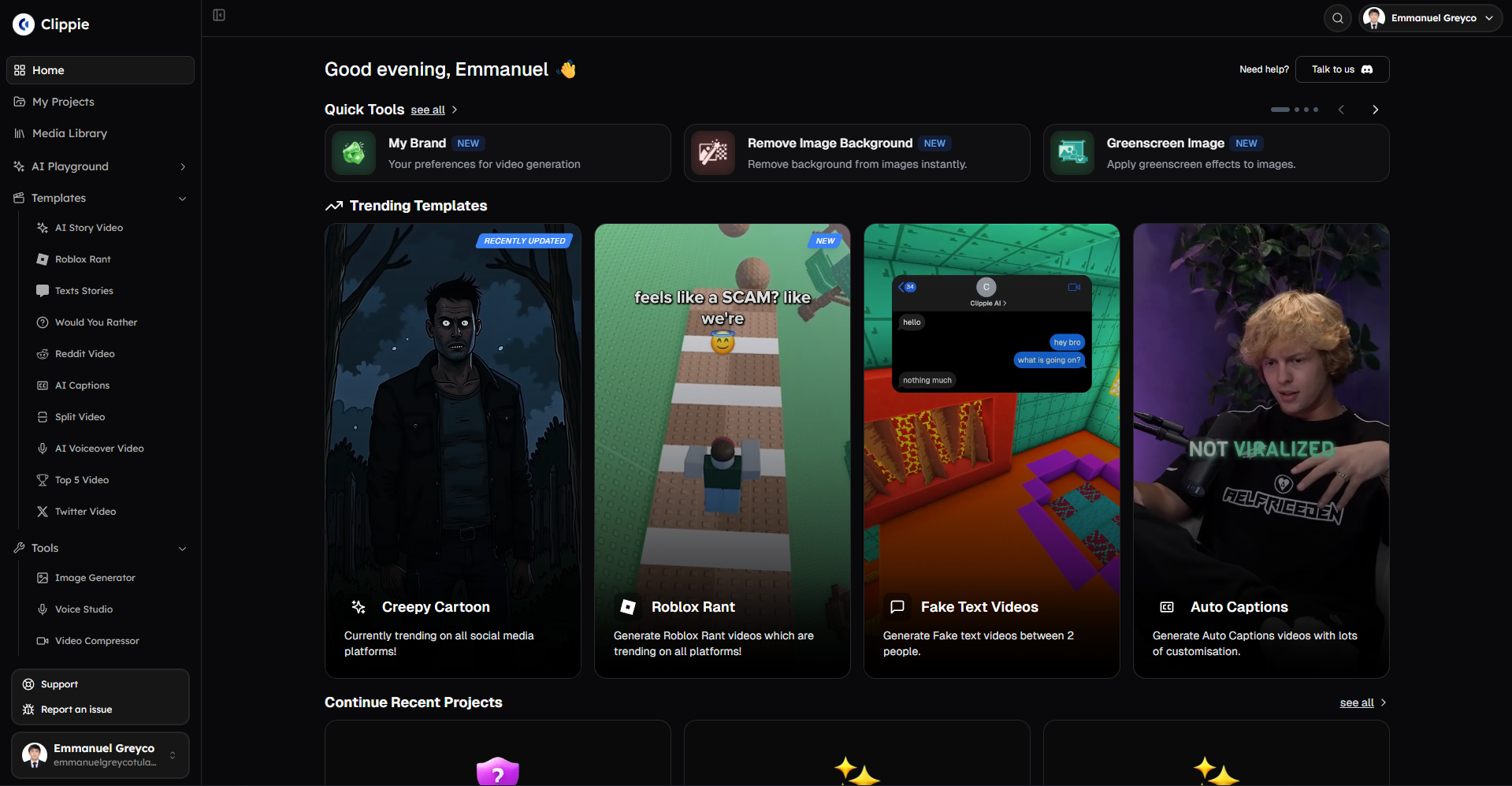
Clippie AI is designed to be the production core of a high-volume faceless video operation. It collapses the most time-intensive manual production stages into an integrated AI workflow, removing the per-video overhead that limits scaling.
How Clippie AI Performs at High Volume
Voiceover at volume:
Generate narration for multiple videos in a single session without setup overhead
Custom voice cloning (up to 30 voices on Pro) maintains separate voice identities across multiple channels simultaneously
No recording equipment, no acoustic treatment, no retakes, just paste and generate
Image generation at volume:
1,000 AI images per month on the Pro plan, sufficient for 15–25 videos with 40–60 images each
Generate all images for a batch in sequence, no platform switching
Consistent visual style across videos through consistent prompt language
Auto-captioning at volume:
Every video captioned automatically as part of the production workflow
102+ languages, international distribution requires only language selection, not re-production
Batch caption review takes minutes, not hours
Export at volume:
250 mins export capacity per month on Pro
Supports 15–25 videos per month depending on average video length
Export directly from the production session, no intermediate editing platform required
Clippie AI Plans: Matched to Production Scale
Lite: $19.99/month
30 mins video export (~3–5 videos/month)
30 mins AI voice generation
30 mins speech-to-subtitles
100 AI images
1 custom voice
Captions in 102+ languages
50+ AI voices
24/7 support
Best for: Solo creators building and validating their workflow before scaling
Creator: $34.99/month
120 mins video export (~10–15 videos/month)
120 mins AI voice generation
120 mins speech-to-subtitles
500 AI images
10 custom voices
Captions in 102+ languages
50+ AI voices
24/7 support
Best for: Solo creators operating at consistent mid-volume output across one or two channels
Pro: $69.99/month
250 mins video export (~15–25 videos/month)
250 mins AI voice generation
250 mins speech-to-subtitles
1,000 AI images
30 custom voices
Captions in 102+ languages
50+ AI voices
24/7 support
Best for: Multi-channel operators and small agencies managing parallel production workflows
No free tier is available on Clippie AI.
Scaling Beyond Clippie AI's Current Capacity
For operations targeting 50+ videos per month — content agencies, large multi-channel networks, production at that volume requires:
Multiple Clippie AI accounts or plans operating in parallel
Dedicated team roles (scriptwriter, producer, QA reviewer, publisher) to remove single-operator bottlenecks
A project management system (Notion, Asana, or Trello) to track every video from brief to published
Documented SOPs so production quality doesn't depend on any single team member
At this scale, Clippie AI functions as the production tool within a broader operational architecture, not a standalone solution. The system around the tool is what enables output at genuine agency scale.
💡 For the complete production workflow that underpins high-volume operations, read our guide on How Faceless Creators Use Short-Form Content to Generate $5K-$15K Monthly Service Revenue in 2026
💡 To build the business model that monetises high-volume output, read our blueprint for Best Social Media Monetisation Tools in 2026 (What Actually Pays)
Conclusion: Volume Is a Systems Problem, Not an Effort Problem
The creators and agencies producing the most video content in 2026 are not the ones working the longest hours.
They are the ones who built a pipeline where AI handles every repeatable production task, ideation monitoring, script generation, voiceover, image creation, captioning, and export, and humans make only the decisions that require judgment.
That pipeline starts with one working system. One production workflow that can be completed in under 60 minutes per video. One weekly batch session that generates a full week of content. One monthly review loop that continuously improves the output.
Build that system first. Scale the volume second. The capacity catches up, the system has to come first.
Start building your high-volume AI video production system with Clippie AI →
6. Frequently Asked Questions
Q1: How many videos can one person realistically produce per month using AI tools?
A solo creator using a fully optimised AI workflow, scripting with ChatGPT, production with Clippie AI, batch scheduling, can realistically produce 15–25 videos per month at consistent quality. This requires approximately 8–12 hours of total weekly effort across ideation, scripting, production batching, and publishing. Output above 30 videos per month for a single operator typically requires delegating the scripting stage to a second person or introducing additional automation for metadata and scheduling.
Q2: Does posting more videos always improve YouTube channel growth?
Volume improves growth only when paired with consistent quality. A channel posting 30 low-retention videos per month will grow slower than one posting 10 high-retention videos per month. The algorithmic sweet spot is the highest volume you can produce while maintaining your quality baseline, defined by consistent completion rates above 40% for short-form and 35% for long-form. Use your quality checklist to define the floor, then push volume as high as the floor allows.
Q3: What is the biggest operational bottleneck when scaling AI video production?
Scripting is almost always the first bottleneck. At low volume, manual or AI-assisted scripting is manageable. As output targets increase, script generation becomes the rate-limiting step. The solution is template-based scripting, creating master script templates for each of your primary content formats so AI can fill in topic-specific content without rebuilding structure from scratch each time. This reduces per-script time from 20–30 minutes to 5–10 minutes at the review stage.
Q4: How do I maintain visual consistency across a high volume of AI-generated videos?
Consistency comes from consistent prompt language, not from reviewing every image individually. Build a prompt template for each visual type your channel uses, scene images, title cards, section transition graphics, and use the same structural language in every generation request. The visual style that emerges from consistent prompting creates channel-level aesthetic cohesion without manual design work. Store your prompt templates alongside your script templates so they're immediately available in every production session.
Q5: Should I use multiple AI tools in my high-volume workflow or consolidate into fewer platforms?
Consolidate as much as possible. Every additional tool in the workflow adds a file transfer, a login, and a potential point of failure. The ideal high-volume workflow uses one scripting tool (ChatGPT or Claude), one production platform (Clippie AI for voiceover, images, captions, and export), and one scheduling tool (YouTube Studio's native scheduler for YouTube content). Adding tools beyond this is justified only when you hit a specific capability ceiling that the existing stack cannot address.
Q6: How does Clippie AI fit into a high-volume production operation versus standalone specialised tools?
Clippie AI's core value in a high-volume operation is integration, voiceover, image generation, captioning, and export in one platform eliminates the file transfer overhead that accumulates significantly at scale. For a creator producing 20 videos per month, each file transfer between tools costs 2–3 minutes, that's 40–60 minutes of lost production time per month from handoffs alone. Clippie AI's Pro plan at $69.99/month supports 15–25 videos monthly, making it the right production core for solo high-volume creators and small multi-channel operators. Larger agency operations running 50+ videos per month benefit from multiple parallel Clippie AI accounts within a documented team workflow.
Make an AI story video
Write a script or let AI write one. Clippie turns it into a narrated video with AI scenes, voiceover and captions.
Read more

How to Make Top 5 Ranking Videos in 2026 (Step-by-Step)
Build ranking Shorts that can still earn: pick a debatable topic, set clear criteria, source clips you may use, script the countdown, add your commentary.

How to Create Short-Form Videos Using AI: 8 Steps (2026)
A beginner workflow for AI videos on TikTok, Reels and Shorts: pick a format, script a hook, add visuals, voice and captions, export at 9:16, label AI.

7 Free CapCut Alternatives for Short-Form Video (2026)
Compare Edits, YouTube Create, VN, Clipchamp, Canva, DaVinci Resolve and Shotcut: what each gives free users, what it caps first and where it falls short.