
How to Create AI Video Ads for Your Business With Clippie AI in 2026 (No Camera or Agency Required)
Learn how to create AI video ads for your business with Clippie AI in 2026, 4 converting ad types, 15-minute AI scripting system, 30-minute production workflow, multi-platform distribution, and scaling guide.

Searching for how to create AI video ads for your business in 2026 without a camera or a production agency?
Video advertising is no longer optional for businesses that want to reach customers where they actually are, TikTok, Instagram Reels, YouTube, and Meta feeds. But the traditional production path, hiring a video production agency, booking a studio, managing revisions across weeks, costs $2,000–$10,000 per ad and takes far too long for the testing cadence that modern digital advertising requires.
In 2026, AI video production has changed this entirely. A business owner can produce a complete, professional-quality video ad in under 30 minutes, no camera, no crew, no agency contract, and distribute it across every major platform the same day.
This guide gives you the complete system.
Executive Summary
This guide is for small and medium business owners, marketing managers, and entrepreneurs who want to produce professional video ads using AI in 2026 without traditional production costs. It covers why AI video ads have become the standard for SMB advertising, the four ad types that convert and which AI production approach serves each, how to script a high-converting ad in under 15 minutes, the complete Clippie AI production workflow for a finished ad in under 30 minutes, how to distribute across TikTok, Instagram, YouTube, and Meta, and how to measure performance and scale winning creatives. By the end, you will have a complete AI video ad production and distribution system ready to activate.
Table of Contents
Why AI-Generated Video Ads Are Replacing Traditional Ad Production for Small and Medium Businesses in 2026
The 4 Types of Business Video Ads That Convert, And Which AI Production Format Serves Each
How to Script a High-Converting Business Ad in Under 15 Minutes With AI
How to Produce a Complete Business Video Ad With Clippie AI in Under 30 Minutes
How to Distribute Business Video Ads Across TikTok, Instagram, YouTube, and Meta
How to Measure Ad Performance and Scale What Works With More AI Production
Frequently Asked Questions

1. Why AI-Generated Video Ads Are Replacing Traditional Ad Production for Small and Medium Businesses in 2026
The economics of video advertising have been fundamentally restructured in 2026. The gap between what large brands spend on video production and what small businesses can now produce with AI has effectively closed, not because production quality has declined, but because AI generation has brought professional-grade output within reach of any business with a product and a 30-minute production window.
The Traditional Ad Production Economics Problem
Traditional video ad production for a small business looks like this:
Discovery and briefing with production agency: 1–2 weeks
Concept development and storyboarding: 1 week
Filming day with crew and equipment: $1,500–$3,000
Editing and post-production: $500–$2,000
Revision cycles: 1–3 weeks
Final delivery: 6–8 weeks from brief to published ad
Total investment: $2,000–$10,000 and 6–8 weeks per ad
For a business that wants to test multiple ad angles, a price-based hook versus a problem-solution hook versus a testimonial-style hook, the traditional model makes testing financially prohibitive. The business either commits to one untested creative or spends $6,000–$30,000 to test three.
The AI Video Ad Economics in 2026
With Clippie AI's integrated production workflow:
Script written with AI assistance: 10–15 minutes
Voiceover generated: 2–3 minutes
AI footage and images generated (Seedance 2.0 or VEO3.1): 10–15 minutes
Captions auto-synced: 2–3 minutes
Export in correct format for each platform: 2–3 minutes
Total investment: under 30 minutes and $35–$70/month for unlimited monthly ads within plan capacity
The testing capability this unlocks:
At 30 minutes per ad and a Creator plan ($34.99/month) supporting 8–12 videos per month, a business can test:
3 different hooks for the same product
2 different audience positioning angles
3 different offers or CTAs
Seasonal variations on a proven creative
This is the test-and-scale advertising approach that large brands use, now accessible to any business with a product and a Clippie AI subscription.
Why Video Specifically Outperforms Other Ad Formats
Video advertising is not just performing better than static image ads, it is increasingly the only format that drives meaningful results on the platforms where customers spend their time.
TikTok: TikTok is a video-only platform. There is no static image ad format. Every business that wants TikTok reach needs video.
Instagram Reels feed: Meta has shifted significant algorithmic distribution to Reels format, video content receives substantially more organic and paid reach than static posts in the Reels-dominant feed.
YouTube: Pre-roll and mid-roll video ads reach YouTube's enormous audience, static alternatives do not exist in the core ad formats.
Meta (Facebook/Instagram): Video ads on Meta consistently outperform image ads on the engagement metrics that determine ad efficiency, cost per click, click-through rate, and cost per conversion.
The Consistency Advantage of AI Production
Beyond the cost and speed advantage, AI production offers something traditional agency production cannot: consistent quality at consistent output volume without the relationship management, revision cycle management, or scheduling dependencies that make agency-produced ads slow to scale.
A business that produces one AI video ad per week maintains fresh creative rotation, preventing ad fatigue, testing new angles continuously, and responding to product launches or promotions within 24 hours rather than 6–8 weeks.

2. The 4 Types of Business Video Ads That Convert, And Which AI Production Format Serves Each
Not all video ads are equally suited to all business contexts or all platforms. Understanding which ad type serves which goal, and which Clippie AI production approach serves each ad type, is the foundation of an effective AI ad production system.
Ad Type 1: The Problem-Solution Ad (Highest Conversion Rate for New Audiences)
The problem-solution ad opens by precisely articulating a problem the target customer recognises as their own, then positions the product or service as the specific resolution.
Why it works:
When a customer sees their exact problem described accurately in the first 3 seconds, they stop scrolling. The pain point articulation communicates that the business understands their situation, which is the prerequisite for trust and conversion.
Structure:
Hook: Describe the specific pain point in the customer's language
Problem amplification: Acknowledge why existing solutions have failed
Solution introduction: Introduce the product/service as different
Mechanism: Briefly explain why it works differently
CTA: Direct instruction to purchase, book, or visit
Best for: Service businesses, specialised products, and businesses entering new audience segments where product awareness is low.
Clippie AI production approach: Seedance 2.0 in standard narrative mode, emotionally staged scenes depicting the problem and resolution, with an authoritative AI voice delivering the script. The visual approach should mirror the emotional journey: muted, tense visuals for the problem section transitioning to warmer, resolved imagery at the solution.
Ad Type 2: The Social Proof Ad (Highest Trust-Building for Warm Audiences)
Social proof ads present customer results, reviews, or outcomes, using verified customer experience as the primary conversion mechanism.
Why it works:
Prospective customers reduce their perceived risk by seeing that others have already purchased and benefited. Social proof ads convert at higher rates with warm audiences (people who have already encountered the brand) because they address the final hesitation barrier, "will this work for me?"
Structure:
Hook: State a specific customer result in compelling terms
Customer context: Who used the product and what their situation was before
The outcome: Specific, measurable or clearly observable result
Product connection: How the product enabled this outcome
CTA: Invitation to experience the same result
Best for: E-commerce brands, service businesses with documented client outcomes, and retargeting campaigns to people who have visited the website.
Clippie AI production approach: Seedance 2.0 with lifestyle and aspirational imagery depicting the outcome the customer achieved, paired with AI narration reading from a genuine customer review or testimonial. The image-to-video capability can animate real product photos for product-specific social proof content.
Ad Type 3: The Offer and Urgency Ad (Highest Immediate Response for Direct Sales)
The offer ad leads with a specific, time-limited promotion, a discount, a bundle, a free addition, designed to trigger immediate purchase action by removing the "I'll think about it" response.
Why it works:
Many prospective customers who are aware of a product and broadly interested in it do not convert because there is no reason to act now rather than later. A genuine, clearly communicated offer with an end date creates the urgency that converts interest into immediate action.
Structure:
Hook: Lead with the offer immediately ("50% off for the next 48 hours")
Product identification: What the offer applies to and why it is valuable
Offer details: Specific terms, duration, and any restrictions
Value articulation: Why this offer represents genuine value at this price
CTA: Specific instruction with the urgency element ("Shop before midnight Sunday")
Best for: E-commerce, restaurants and food businesses, local service businesses with appointment-based models, and seasonal promotions.
Clippie AI production approach: VEO3.1 for clean, professional product-appropriate imagery, the offer ad needs to communicate value and quality, not drama. Warm, aspirational lifestyle footage appropriate to the product category. The AI voice should deliver with energy and confidence, not pressured, but enthusiastic.
Ad Type 4: The Educational "How To" Ad (Highest Engagement and Brand Building)
Educational ads provide genuine value, teaching the viewer something useful, while positioning the business as the authority on the topic and the natural source for what the viewer now wants to do.
Why it works:
Educational content is shared more than promotional content, saved more than promotional content, and remembered more than promotional content. A business that consistently provides genuine educational value builds authority in the minds of potential customers, making them the default choice when the purchase decision arrives.
Structure:
Hook: State the specific outcome the viewer will learn in this video
Teaching content: 3 specific, actionable steps or insights
Business connection: Natural connection between the teaching and the business's expertise or product
CTA: Soft, "Follow for more" or "Visit [link] if you want us to handle this for you"
Best for: Service businesses (accountants, lawyers, consultants, coaches), health and wellness businesses, professional practices, and any business where expertise is the primary value proposition.
Clippie AI production approach: VEO3.1 for professional, clean environmental footage appropriate to the business's sector, a clean business environment for professional services, a relevant lifestyle environment for wellness businesses. The educational hook distinguishes this ad type visually from hard-sell formats, it should look informative, not promotional.

3. How to Script a High-Converting Business Ad in Under 15 Minutes With AI
The script is the highest-leverage element of any video ad. A compelling script in an average production outperforms a weak script in a beautiful production, every time. The following system produces publication-ready ad scripts in 15 minutes or less.

The Business Ad Script System
Step 1: Define the Single Most Important Input (3 Minutes)
Before opening ChatGPT, answer four questions in writing:
Who is the specific customer this ad targets? (Not "everyone", one specific person with a specific situation)
What is the single most painful problem this customer has that my business solves?
What is the single most compelling proof that my business solves it?
What is the one action I want the viewer to take?
Writing these four answers takes 3 minutes. They are the quality determinant of the script, vague inputs produce vague scripts.
Step 2: Generate the Script With AI (5 Minutes)
Paste the four answers into ChatGPT with this prompt:
"Write a 45-second video ad script for [business type] targeting [specific customer description]. Use this structure: (1) Open with this specific pain point in the customer's words: [pain point answer]. (2) Acknowledge that existing solutions have failed them. (3) Introduce [business/product name] as the solution in one sentence. (4) Explain why it works in two sentences maximum. (5) Include this proof point: [proof answer]. (6) Close with this CTA: [CTA answer]. Short sentences under 12 words, this will be delivered by AI voiceover. Conversational but confident tone. No filler words."
ChatGPT generates a complete first draft in under 30 seconds.
Step 3: Review and Refine (7 Minutes)
Review the draft against the high-converting ad checklist:
Does the opening hook articulate the problem in the customer's specific language, not generic marketing language?
Is the mechanism explanation clear in 1–2 sentences, does the customer understand why this works differently?
Is the CTA specific and action-oriented, does it tell the viewer exactly what to do and what will happen?
Does the total script read naturally when spoken aloud, does it sound like a person talking, not a brochure?
Is the total word count appropriate for the target length (45 seconds = approximately 110–130 words)?
Make targeted edits based on this checklist. The draft typically needs 2–4 sentence modifications rather than full rewrites.
Script Length Reference by Platform
TikTok short (15–30 seconds): 40–75 words
TikTok standard (45–60 seconds): 110–150 words
Instagram Reels (30–60 seconds): 75–150 words
YouTube pre-roll (15-second non-skippable): 40–50 words
YouTube pre-roll (30-second skippable): 75–90 words
Meta video (15–30 seconds): 40–75 words

4. How to Produce a Complete Business Video Ad With Clippie AI in Under 30 Minutes
With the script completed in 15 minutes, the production session inside Clippie AI follows a structured 30-minute workflow that produces a publication-ready ad file.
Minutes 0–5, Voiceover Generation
Voice selection for business ads:
Business advertising requires a voice that communicates credibility and authority, not the entertainment-optimised delivery of a TikTok creator, but a voice that sounds like a knowledgeable professional who genuinely believes in what they are saying.
From Clippie AI's 50+ voice library, for each business type:
Professional services (accounting, law, consulting): Mid-lower pitch, measured and authoritative delivery. The voice should sound like a senior professional sharing expertise.
Retail and e-commerce: Warm, enthusiastic, conversational. The voice should feel like a recommendation from a trusted friend who has found something worth sharing.
Health and wellness: Warm, empathetic, encouraging. The voice should convey genuine care for the listener's wellbeing.
Local service businesses (restaurants, home services, fitness): Friendly, energetic, community-oriented. The voice should feel local and personable.
Testing approach: Paste the opening hook sentence into the voice preview. The voice that delivers "Are you still dealing with [specific pain point]?" in a way that sounds genuinely empathetic rather than robotic is the right choice for this ad.
For businesses producing ongoing ad content, custom voice cloning creates a consistent brand voice identity, every ad from this business sounds like the same authoritative brand narrator.
Generate the full voiceover from the script. Listen to the first 10 seconds to confirm the hook delivery lands with appropriate energy.
Minutes 5–20, AI Visual Generation
Visuals for business ads serve a different purpose than visuals for faceless YouTube content. They need to:
Communicate the product or service category within the first visual frame
Reflect the brand's quality and positioning (premium, accessible, expert, community-oriented)
Support the emotional journey of the script (problem → solution → aspiration)
Visual Generation by Ad Type and Business Category
For professional service businesses (Problem-Solution or Educational ad):
VEO3.1 primary model, photorealistic professional environments communicate credibility.
"VEO3.1: Slow cinematic pan through a clean professional office environment, warm natural light through large windows, organised and authoritative, no people visible, documentary aesthetic, photorealistic 4K"
"Clean editorial illustration of professional business documents and tools, organised desk environment, warm professional tones, high quality"
For e-commerce and product businesses (Offer or Social Proof ad):
Seedance 2.0 UGC mode primary, organic-feeling product lifestyle content for TikTok and Reels.
"Seedance 2.0 UGC style: [product category] being used in a natural, everyday setting, authentic and handheld organic aesthetic, warm lifestyle tones, natural light, feels user-generated"
For product image animation: import the product's existing photography and use Seedance 2.0's image-to-video animation to create subtle motion from the static shot.
For local food and hospitality businesses (Offer ad):
Seedance 2.0 standard cinematic mode, warm, aspirational food and environment footage.
"Seedance 2.0: Cinematic close-up of [food item or environment], warm amber lighting, steam visible, inviting and appetite-stimulating, slow static shot, restaurant aesthetic, film grain, 4K"
For fitness and wellness businesses (Problem-Solution ad):
Mixed model: VEO3.1 for environmental establishing shots (clean gym environment, outdoor fitness setting), Seedance 2.0 for character-present scenes (figure completing a workout, person in a wellness context).
For home service businesses (Problem-Solution ad):
VEO3.1 for the before and after context, a problem environment and a resolved environment, with photorealistic quality communicating genuine transformation.
Generate 3–5 Visuals Per Ad
For a 45-second ad, generate:
1 opening visual that establishes the problem context or product category
1–2 mid-ad visuals supporting the solution and mechanism
1 closing visual accompanying the CTA, typically a clean, aspirational outcome image
Minutes 20–25, Auto-Captioning Review
Clippie AI auto-syncs captions to the voiceover. For business ads, review specifically:
Business name, must be transcribed correctly
Product or service name, no errors
Any pricing mentioned in an offer ad, must be accurate
CTA specifics, the URL, offer code, or action instruction must be perfectly transcribed
Any claims or guarantees, must match the script exactly
Caption accuracy in business ads is a credibility signal, a misspelled business name or incorrect CTA URL damages trust before the viewer has even acted on it.
Minutes 25–30, Export for Each Platform
Export in the correct specifications for each distribution channel:
TikTok and Instagram Reels:
9:16, 1080 × 1920, MP4, 30fps
Under 60 seconds for TikTok organic
Under 90 seconds for Instagram Reels
YouTube pre-roll (paid ads):
16:9, 1920 × 1080, MP4, 30fps
15 seconds (non-skippable) or 30+ seconds (skippable)
Meta (Facebook/Instagram) paid ads:
Both 9:16 and 1:1 square formats for Meta ad placements
MP4, 1080p minimum

5. How to Distribute Business Video Ads Across TikTok, Instagram, YouTube, and Meta
Distribution Channel 1, TikTok (Organic and Paid)
Organic TikTok distribution:
Post the ad as organic content alongside the business's regular TikTok posts, using the 80/20 rule (4 value content posts for every 1 promotional post). Organic TikTok ad posts should include:
TikTok Shop product tag if the business sells on TikTok Shop
A comment-inviting CTA: "Have you tried this? Drop your experience below"
4–6 relevant hashtags (product category, local hashtags if applicable, audience-specific tags)
Paid TikTok ads:
Upload to TikTok Ads Manager as a Video Creative. Set the campaign objective based on the ad type:
Offer ads: Conversion objective, target product page
Educational ads: Brand awareness or website traffic objective
Problem-solution ads: Conversion or lead generation objective
TikTok's Smart Creative option can automatically generate variants of the uploaded video, enable this to extend the reach of a single produced creative.
Distribution Channel 2, Instagram (Reels and Paid)
Organic Instagram Reels:
Post the 9:16 export as a Reel with:
Save-trigger caption opening: "Save this before [specific event/purchase decision]"
Product tag if the business has Instagram Shopping enabled
5–7 relevant hashtags including local tags for location-specific businesses
Paid Instagram/Meta ads:
Upload to Meta Ads Manager as a video creative. For local businesses, set audience targeting to a geographic radius around the business location. For e-commerce businesses, use Meta's Advantage+ audience targeting to let the algorithm identify the best audience for the creative.
The advantage of AI-produced ads for Meta's paid system: Advantage+ Shopping campaigns perform better when provided with multiple creative variants for the algorithm to test. Producing 3–5 variants of an ad (different hooks, different offers) within a 2-hour Clippie AI session gives Meta's system the creative variety to optimise effectively.
Distribution Channel 3, YouTube (Pre-Roll Ads)
YouTube pre-roll setup:
Upload to YouTube Studio as an unlisted video, then use it as the ad creative in Google Ads.
15-second non-skippable format: The entire script must be compelling, there is no skip option, but there is also no engagement choice. Use for high-intent audiences (remarketing, keyword targeting) where the business already has credibility with the viewer.
30-second skippable format: Hook quality is paramount, viewers can skip after 5 seconds. The hook must create a specific reason to keep watching before the skip option becomes available. The CTA should appear in the first 5 seconds as an on-screen text overlay to capture viewers who skip after seeing the CTA.
YouTube targeting for business ads:
Remarketing: Show ads to people who have visited the business website (requires Google Ads remarketing tag on the site)
Customer match: Upload existing customer email lists and target similar audiences
In-market audiences: Target viewers who Google's data identifies as actively researching the product/service category
Distribution Channel 4, Meta Paid Ads (Facebook and Instagram)
The Meta ad system advantage for small businesses:
Meta's Advantage+ system, particularly for e-commerce businesses, automates much of the targeting decision once strong creative is provided. The creative quality is the primary performance variable the business controls; Meta's system handles audience targeting optimisation.
Creative testing framework:
For any product or service, produce 3 ad variants in Clippie AI within a 90-minute production session:
Variant A: Problem-solution hook
Variant B: Social proof hook (leading with a customer result)
Variant C: Offer hook (leading with the promotion)
Upload all three to Meta Ads Manager as separate creatives within the same campaign. Meta's system identifies which variant performs best with which audience segments and shifts budget toward the winner automatically.
Budget recommendation for initial testing:
Start with $10–$20 per day per creative variant for 7–10 days. After 10 days, the performance data identifies which creative variant is generating the lowest cost per result. Scale the winning variant and pause the underperformers. Produce new variants based on what worked about the winner.

6. How to Measure Ad Performance and Scale What Works With More AI Production
The production speed that Clippie AI enables transforms the creative testing and scaling cycle from a weeks-long process into a continuous, responsive system.
The 5 Metrics That Determine Ad Performance
Metric 1: Hook Rate (First 3-Second View Rate)
The percentage of people who watch at least 3 seconds of the ad. This metric directly measures whether the hook stops the scroll.
Target benchmark: Above 25% on TikTok for business ads. Below 15% indicates a hook problem, the opening 3 seconds are not compelling enough to stop the scroll for the target audience.
How to improve: Produce 3 new hook variations on the same ad using Clippie AI, different opening sentences, different opening visuals. Each variant takes 10–15 minutes to produce and costs nothing beyond the existing Clippie AI subscription.
Metric 2: Video Completion Rate
The percentage of viewers who watch the full ad. For 45-second ads, a completion rate above 30% indicates the full content is compelling, not just the hook.
Below 30% with hook rate above 25%: The body content is losing viewers after the hook. The mechanism explanation, social proof, or CTA is not maintaining engagement. Revise the script from the 10-second mark onward.
Metric 3: Click-Through Rate (CTR)
The percentage of viewers who click the CTA link or visit the landing page. Strong CTR varies by platform and objective, but for business conversion ads:
TikTok: 1–3% is typical
Meta: 0.5–2% for broad audiences, 2–5% for remarketing audiences
YouTube: 0.3–1% for pre-roll
Below these benchmarks: The CTA is not compelling enough, the offer is not differentiated, or the audience targeting is misaligned.
Metric 4: Cost Per Result (CPR)
The cost to achieve the campaign objective, cost per lead, cost per purchase, cost per website visit. This is the primary efficiency metric for business advertising.
The CPR improvement cycle:
Identify the winning creative (lowest CPR)
Produce 3 variants of the winning creative, testing different hooks, different offers, or different audience positioning
Run the new variants against the existing winner
Retire the underperformers, keep the new winner
Repeat monthly
Metric 5: Return on Ad Spend (ROAS)
For e-commerce businesses with purchase tracking enabled, ROAS measures revenue generated per dollar spent on ads. A ROAS above 2.0 (generating $2 for every $1 spent) is typically the minimum threshold for sustainable advertising.
ROAS improvement comes from: stronger creative (lower CPR), higher-quality landing pages (better conversion from click to purchase), and better audience targeting (reaching higher-intent buyers).
The AI Production Scaling System
The combination of fast AI ad production and data-driven creative iteration creates a scaling system that compounds over time:
Month 1: Test 3 problem-solution ad variants. Identify winner. Identify underperforming elements (hook, mechanism, CTA).
Month 2: Produce 3 new variants improving the underperforming elements. Test winner from Month 1 against new variants.
Month 3: Produce seasonal or promotional variants on the Month 2 winner. Add a new ad type (social proof or offer format) to the rotation.
Month 6: The business has tested 12–18 creative variants and identified its top 3 performing hooks, its most effective offer structures, and its strongest audience positioning. Future ad production is informed by 6 months of performance data, dramatically reducing the cost of finding winning creative.
Clippie AI Plans: Matched to Business Ad Production Volume
Lite: $19.99/month
30 mins video export (~3–5 ads/month)
30 mins AI voice generation
30 mins speech-to-subtitles
100 AI images
1 custom voice
Captions in 102+ languages
50+ AI voices
24/7 support
Best for: Small businesses starting with video advertising, 3–5 ads per month covers initial testing across 1–2 platforms
Creator: $34.99/month
120 mins video export (~8–15 short-form ads/month)
120 mins AI voice generation
120 mins speech-to-subtitles
500 AI images
10 custom voices
Captions in 102+ languages
50+ AI voices
24/7 support
Best for: Growing businesses running active ad campaigns, sufficient capacity for weekly new creatives, seasonal promotions, and multi-platform distribution
Pro: $69.99/month
250 mins video export (~30–50 short-form ads/month)
250 mins AI voice generation
250 mins speech-to-subtitles
1,000 AI images
30 custom voices
Captions in 102+ languages
50+ AI voices
24/7 support
Best for: Businesses running aggressive multi-platform ad campaigns, marketing agencies producing AI video ads for multiple business clients, or businesses testing high volumes of creative variants simultaneously
No free tier is available on Clippie AI.
💡 For the complete guide to producing e-commerce-specific product videos and ad content with Clippie AI, read our guide on AI video tools for e-commerce in 2026
💡 For the TikTok Shop integration that extends business video ads into direct commerce, read our guide on how to make money on TikTok Shop as a faceless creator in 2026
💡 Start creating professional business video ads with Clippie AI today →
Conclusion: The Business That Produces More Creative Tests, Wins
The single most predictable predictor of advertising success is creative testing volume. Businesses that test more ad variants identify winning creative faster, optimise their cost per result more efficiently, and compound their advertising advantage over competitors who produce one ad and run it until it stops working.
Traditional production economics made creative testing inaccessible to small and medium businesses, testing 5 creative variants at $3,000 each requires a $15,000 production budget. With Clippie AI, testing 5 creative variants requires 5 hours of production time and $35/month.
The creative quality is professional. The production speed is 30 minutes. The cost is accessible to any business with a product worth advertising.
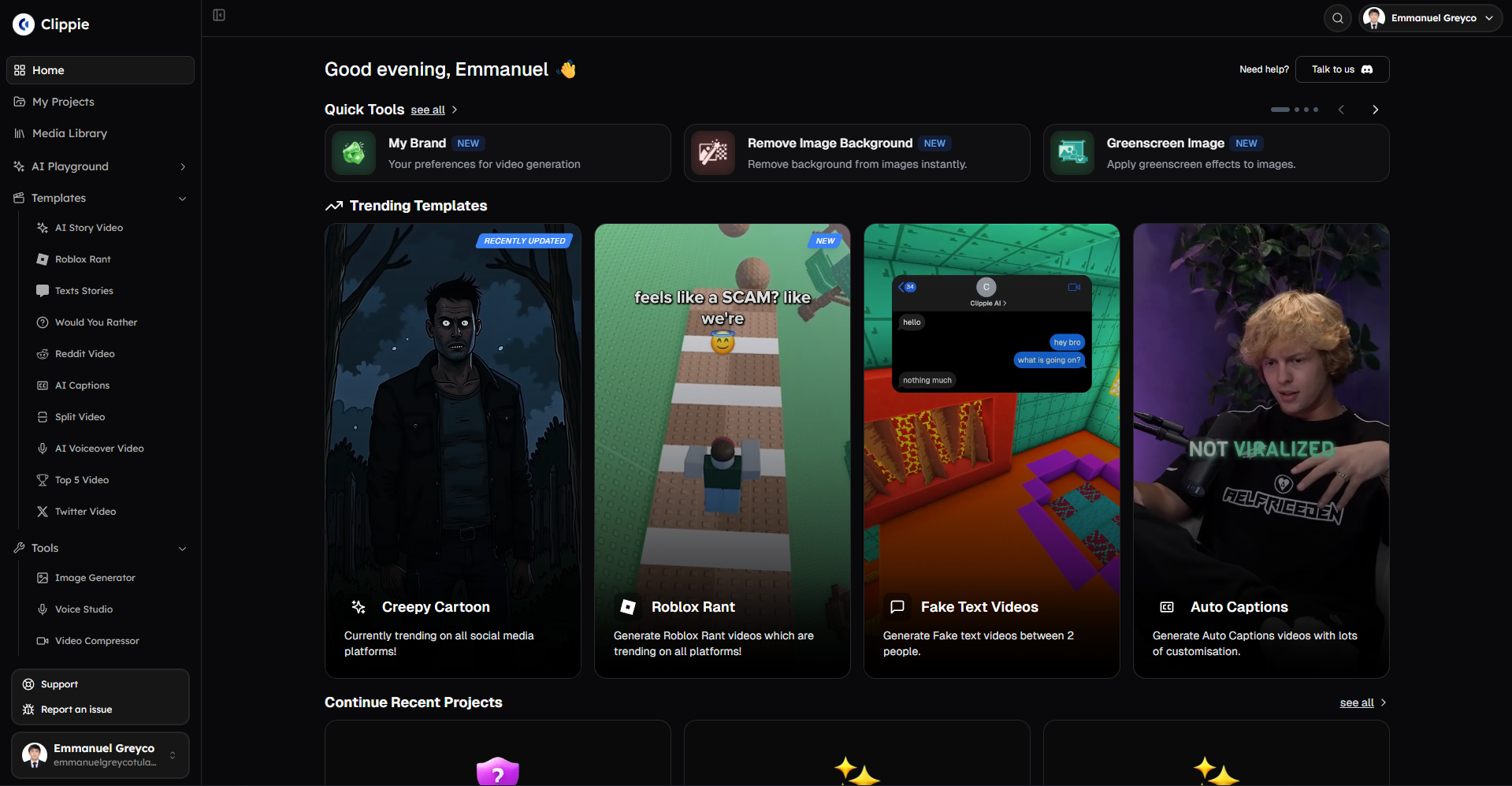
Start building your business video ad production system with Clippie AI today →
7. Frequently Asked Questions
Q1: Do I need any video production experience to create business ads with Clippie AI?
No. Clippie AI's production interface is designed for non-technical users, the workflow moves from script input to export-ready video through a sequential process that requires no video editing knowledge, no technical settings configuration, and no film production background. The script writing step (15 minutes using the AI-assisted system in this guide) and the visual prompt writing step (using the category-specific prompt templates above) are the primary skills required. Both are learnable within the first production session. Most business owners who have never produced video content complete their first complete ad within 45–60 minutes on their first session.
Q2: Can AI-generated video ads compete with professionally filmed ads for conversion rate?
Yes, and in many cases, AI-generated ads outperform traditionally produced ads for specific reasons. First, the UGC-style generation capability in Seedance 2.0 produces the organic, authentic aesthetic that consistently outperforms polished produced content on TikTok and Reels, because algorithmic and audience preferences on these platforms heavily favour content that feels native rather than advertised. Second, AI production's speed advantage enables more creative testing, and tested creative outperforms untested creative regardless of production budget. The businesses that consistently win on digital advertising are the ones that find winning creative through testing, not the ones that produce the most expensive creative.
Q3: How many different ad variants should a business test per month?
For businesses new to video advertising, testing 3 variants of the primary ad type (problem-solution) each month is the recommended starting point, covering 3 different hook angles on the same product or service. This testing volume is achievable within a single production session of 90 minutes using Clippie AI, and it provides enough performance data within 10 days to identify which hook resonates best with the target audience. Businesses with more active ad campaigns can test 6–8 variants monthly, covering multiple ad types and multiple offers simultaneously, which the Creator plan ($34.99/month) handles within its production capacity.
Q4: Which platform should a small business prioritise for AI video ads in 2026?
The priority depends on the business type and customer demographic. For businesses targeting 18–35 year olds: TikTok first, Instagram Reels second, the audience size and advertising cost on TikTok are both favourable for this demographic. For businesses targeting 35–55 year olds: Meta (Facebook/Instagram) first, the audience on Meta in this age group is larger and more mature than on TikTok. For professional services businesses targeting B2B buyers: LinkedIn video ads and YouTube pre-roll, the professional intent of these platforms matches the service context. For all businesses: start with the one platform most aligned with the customer demographic, establish a winning creative on that platform, then cross-post to other platforms once the creative is proven.
Q5: Can the same Clippie AI-produced video ad be used on TikTok, Instagram, YouTube, and Meta?
Yes, a single Clippie AI production session exports both 9:16 vertical (for TikTok, Instagram Reels, and YouTube Shorts) and 16:9 horizontal (for YouTube pre-roll and some Meta placements) from the same production. The same creative can run on multiple platforms simultaneously, with platform-specific caption copy and hashtag sets written separately for each distribution point. Some platforms perform better with creative that is native to that platform's conventions, the UGC-style mode in Seedance 2.0 is particularly suited to TikTok-native ad aesthetics, but most well-produced 9:16 video ads perform acceptably across all short-form platforms without modification.
Q6: Which Clippie AI plan is right for a small business running its first video ad campaign?
The Creator plan at $34.99/month is the right starting point for a small business committed to video advertising as an ongoing strategy. Its 120-minute export capacity supports 8–15 short-form ads per month, enough to test 3 variants across 3–4 campaigns simultaneously, plus seasonal or promotional variations. The 10 custom voice slots allow cloning a consistent brand narrator voice for all ads, creating the audio identity consistency that builds brand recognition across campaign touchpoints. The Lite plan at $19.99/month is appropriate for businesses producing 3–5 ads per month during an initial exploration phase before committing to higher-volume production.
Make an AI story video
Write a script or let AI write one. Clippie turns it into a narrated video with AI scenes, voiceover and captions.
Read more

How to Make Top 5 Ranking Videos in 2026 (Step-by-Step)
Build ranking Shorts that can still earn: pick a debatable topic, set clear criteria, source clips you may use, script the countdown, add your commentary.

How to Create Short-Form Videos Using AI: 8 Steps (2026)
A beginner workflow for AI videos on TikTok, Reels and Shorts: pick a format, script a hook, add visuals, voice and captions, export at 9:16, label AI.

7 Free CapCut Alternatives for Short-Form Video (2026)
Compare Edits, YouTube Create, VN, Clipchamp, Canva, DaVinci Resolve and Shotcut: what each gives free users, what it caps first and where it falls short.