
AI Video Tools for E-Commerce in 2026, How to Create Product Videos and Ad Creatives at Scale
Learn how to use AI video tools for e-commerce in 2026, the 5 product video types that drive sales, conversion scripting, Clippie AI production workflow, TikTok Shop distribution, and performance measurement.

Searching for how to use AI video tools for e-commerce in 2026?
Product video is no longer optional for e-commerce brands. Consumers watch product videos before purchasing, across TikTok, Instagram Reels, YouTube Shorts, and product listing pages. The brands generating the most sales from video are not the ones with the biggest production budgets. They are the ones producing the most consistent, high-quality video content across every stage of the buyer journey.
In 2026, AI video tools have made this possible for any e-commerce operator. No camera crew. No video production agency. No studio. Just a product, a script, and a production workflow that generates sales-ready video content at scale.
This guide is the complete blueprint.
Executive Summary
This guide is for e-commerce brand owners, marketing managers, and content operators who want to produce product videos and ad creatives at scale using AI tools in 2026. It covers why video is now the primary driver of e-commerce conversion, the five video types that generate the most sales across different stages of the buyer journey, how to script product videos that convert, the step-by-step production workflow inside Clippie AI, how to distribute across TikTok Shop, Reels, and YouTube Shorts, and how to measure performance and scale what works. Whether you are running a Shopify store, an Amazon brand, or a DTC brand, this is the operational framework for building an e-commerce video engine.
Table of Contents
Why AI-Generated Video Is the Fastest-Growing Tool for E-Commerce Brands in 2026
The 5 Types of E-Commerce Videos That Drive the Most Sales and Traffic
How to Script Product Videos That Convert Viewers Into Buyers
How to Produce E-Commerce Product Videos at Scale With Clippie AI
How to Distribute E-Commerce Videos Across TikTok Shop, Reels, and YouTube Shorts
How to Measure E-Commerce Video Performance and Scale What Works
Frequently Asked Questions

1. Why AI-Generated Video Is the Fastest-Growing Tool for E-Commerce Brands in 2026
The relationship between video content and e-commerce conversion has become definitive in 2026. Video is not a supplementary channel, it is the primary discovery and decision-making medium across every platform where consumers make purchasing choices.
The Conversion Reality
Product pages with video convert at significantly higher rates than product pages without. Shoppers who watch product videos are more likely to add to cart than those who only view images and text descriptions. On social commerce platforms, TikTok Shop, Instagram Shopping, video is the product listing format. There is no text-only option that reaches the same audience.
The platform-specific conversion data:
TikTok Shop: The vast majority of sales conversions on TikTok Shop are driven by short-form video, either organic creator content or brand-produced short-form ads. Static image posts generate minimal shop traffic by comparison.
Instagram Reels with product tags: Shoppable Reels convert viewers to buyers at significantly higher rates than standard image posts with shopping tags.
YouTube: Pre-purchase research videos ("Is [product] worth it?", "[Product] review 2026") influence buying decisions for considered purchases across virtually every product category.

The Production Economics That AI Has Changed
Traditional e-commerce video production economics made consistent high-volume video untenable for most brands:
Professional product video: $1,500–$5,000 per video
UGC creator partnerships: $200–$1,500 per piece of content
In-house production with equipment: $50,000+ setup cost, plus ongoing staff time
At these economics, a brand could afford 5–10 videos per year. In 2026, that is insufficient for meaningful video presence across TikTok, Reels, Shorts, and product pages simultaneously.
AI production economics:
Clippie AI Creator plan ($34.99/month): produces 8–12 complete product videos per month
Per-video production cost: approximately $3–$4.50
Production time: 20–35 minutes per complete product video
At these economics, a brand can produce 1–3 videos per week across every platform, matching the output of a dedicated video production team at a fraction of the cost.
Why E-Commerce Brands Specifically Benefit From Faceless AI Video
Traditional UGC (user-generated content) and influencer video requires:
Finding and briefing creators
Waiting for content to be produced
Reviewing and requesting revisions
Managing payments and contracts
Dealing with availability and scheduling constraints
AI-produced e-commerce video eliminates all of this:
Content is produced on the brand's schedule
Messaging is fully controlled, no off-brand statements
Visual style is consistent across all content
No creator relationship management
No revision cycles waiting on a third party
For e-commerce brands that want to own their video content pipeline, and produce at the volume that algorithm-driven discovery requires, AI production is not an experiment. It is the operational standard.

2. The 5 Types of E-Commerce Videos That Drive the Most Sales and Traffic
Not all e-commerce videos serve the same purpose in the buyer journey. Understanding which format addresses which stage of the purchase decision allows brands to build a complete video funnel rather than producing content that only reaches buyers at one stage.
Video Type 1: Product Showcase Videos (Top of Funnel, Discovery)
A product showcase video introduces the product to a viewer who has never encountered the brand, showing what it is, what it does, and what problem it solves in 30–60 seconds.
What it includes:
Clear product identification in the first 3 seconds
The primary benefit or transformation the product delivers
Lifestyle context, who this product is for and when they use it
A clear CTA directing viewers to the product page or shop
Why it works for discovery:
TikTok and Reels algorithms push product showcase videos to audiences who have shown interest in similar product categories. A well-produced 30-second showcase video for a skincare product reaches viewers who have engaged with skincare content, capturing high-intent audience without paid advertising spend.
Example script structure:
"[Product Name] is the [category] that [primary benefit], without [primary friction the product removes]. Here's how it works. [2–3 sentence product description]. Available now at [brand/link]. [CTA]"
Video Type 2: Problem-Solution Videos (Mid-Funnel, Consideration)
Problem-solution videos address a specific pain point the target customer experiences and position the product as the resolution.
What it includes:
The specific problem stated in terms the target audience recognises
The failed alternatives the audience has already tried
How this product solves the problem differently
Evidence that it works (before/after description, customer outcome, or statistic)
CTA to purchase
Why it works for consideration:
Buyers who are aware they have a problem and are actively evaluating solutions respond strongly to content that articulates their pain point accurately. Accurate pain point articulation signals that the brand understands the customer, which builds purchase trust.
Example script structure:
"If you've been struggling with [specific problem], you've probably already tried [common solution that didn't work]. Here's what's actually going on, [brief education on why the problem persists]. [Product Name] addresses this by [mechanism]. Here's what that means for you, [outcome]. [CTA]"
Video Type 3: Social Proof and Results Videos (Mid-to-Bottom Funnel, Decision)
Social proof videos present real customer outcomes, reviews, or transformation stories to reduce the final purchase hesitation.
What it includes:
Customer result or transformation presented as the hook
The specific product and how the customer used it
Before/after comparison where applicable
Customer quote or result description
CTA with urgency or offer
Why it works for decision:
The final barrier to purchase for most buyers is uncertainty, "Will this actually work for me?" Social proof videos that show real results from real customers reduce this uncertainty more effectively than any product description. For AI production, the social proof can be voiced narration of genuine customer reviews rather than requiring on-camera customer interviews.
Example script structure:
"[Customer name] had been dealing with [problem] for [timeframe]. After [X weeks/months] using [Product Name], [specific result]. Here's what they said: '[customer review excerpt]'. [Product details]. [CTA with offer or urgency]"

Video Type 4: Tutorial and How-To Videos (Retention and Repeat Purchase)
Tutorial videos show existing and potential customers how to get the best results from the product, demonstrating value beyond the initial purchase and driving both conversion for consideration-phase buyers and repeat purchase for existing customers.
What it includes:
Clear outcome stated in the title and hook
Step-by-step product use instructions
Pro tips or best-practice advice
Expected results timeline where applicable
CTA to purchase or reorder
Why it works across the funnel:
Tutorial content serves multiple purposes simultaneously. For consideration-phase buyers, it reduces the "but will I actually know how to use it?" objection. For existing customers, it provides post-purchase value that increases satisfaction and repeat purchase likelihood. Tutorial content also generates high save rates, viewers bookmark how-to content for later reference, which is a strong algorithmic signal.
Example script structure:
"Here's exactly how to get the best results from [Product Name] in [timeframe]. Step 1: [instruction]. Step 2: [instruction]. Step 3: [instruction]. Pro tip: [additional advice]. Most customers see [specific result] within [timeframe]. [CTA for new customers / CTA for reorder]"
Video Type 5: Comparison and "Why Us" Videos (Competitive Differentiation)
Comparison videos address the buyer's implicit question of "why this product over the alternatives?", directly comparing to competitors or the category default (DIY, generic alternatives, etc.).
What it includes:
The comparison framed clearly: "Us vs. [Competitor/Category]"
3–4 specific differentiators that favour the brand's product
Evidence for each differentiator where available
Honest acknowledgement of what the competitor does well, where appropriate (builds trust)
Strong CTA with the differentiator as the reason to act now
Why it works:
Buyers who are aware of multiple options and are evaluating them are high-intent buyers. A comparison video that meets them in this evaluation process, and presents the brand's differentiators clearly, intercepts the purchase decision at its most influenceable moment.

3. How to Script Product Videos That Convert Viewers Into Buyers
E-commerce video scripts have a different objective from entertainment or educational content. Every word must serve the conversion goal, and the conversion goal is always a specific action: visit the product page, add to cart, purchase now.

The E-Commerce Video Script Formula
Component 1: The Pattern Interrupt Hook (First 3 Seconds)
The hook must stop the scroll before any selling can happen. E-commerce hooks that perform best do one of three things:
The Pain Articulation Hook: "If your [product category] hasn't worked after [timeframe], here's what's actually happening."
The Result Hook: "I've been using [Product Name] for [timeframe] and here's what changed."
The Contrarian Hook: "You've been doing [common practice] wrong, and it's costing you [specific negative outcome]."
What makes a poor e-commerce hook:
Starting with the product name or brand. "Hi, I'm going to tell you about [Brand Name]'s new [product]...", this is a commercial announcement, not a content hook. The viewer's brain immediately categorises it as an ad and scrolls.
Component 2: The Problem Amplification (Seconds 3–12)
After the hook, briefly amplify the problem the product solves:
State the problem specifically
Acknowledge the failed solutions the customer has tried
Briefly explain why those solutions failed
This component builds empathy and positions the upcoming product presentation as a genuine solution rather than another failed attempt.
Component 3: The Solution Introduction (Seconds 12–25)
Introduce the product, but frame it as the solution to the stated problem, not as an object to be described.
"[Product Name] works differently because [mechanism]. Instead of [what competitors do], it [what this product does differently]."
The mechanism explanation is key, buyers who understand why a product works are more likely to convert than buyers who only know what it does. The mechanism creates purchase logic that the buyer can use to justify the decision to themselves.
Component 4: The Proof Point (Seconds 25–35)
Add a credibility element, evidence that the product does what it claims:
Customer result: "87% of customers reported [specific outcome] within [timeframe]"
Social proof: "[Number] people use this daily" or "rated 4.8 stars by [number] customers"
Specific result: "[Brand]'s [product] has [specific measurable outcome]"
Keep the proof point brief, one sentence maximum. The goal is credibility, not a data presentation.
Component 5: The CTA With Urgency or Offer (Final 5–10 Seconds)
Every e-commerce video must close with a specific, friction-reducing CTA:
Link specification: "Link in bio / Link in description / Link in comments"
Offer where applicable: "Use code [DISCOUNT] for [%] off"
Urgency where genuine: "Limited stock / Sale ends [date]"
Friction reduction: "Free shipping on all orders / 30-day returns"
What makes a weak e-commerce CTA:
Vague: "Check us out at our website." No direction, no offer, no urgency.
Strong: "Shop now at the link in bio, free shipping on your first order, and if you don't love it, returns are completely free." Specific, friction-reducing, action-oriented.
Script Length by Video Type and Platform
TikTok Shop product showcase (30 seconds): 80–100 words
Instagram Reels mid-funnel (45–60 seconds): 130–180 words
YouTube Shorts comparison (60 seconds): 160–200 words
YouTube long-form tutorial (5–8 minutes): 750–1,200 words
Product page video (60–90 seconds): 150–220 words

4. How to Produce E-Commerce Product Videos at Scale With Clippie AI
The e-commerce brand's production challenge is not creating one great product video, it is creating 30–50 product videos per month across multiple products, video types, and platforms consistently.
Clippie AI's integrated workflow, voiceover, image generation, captioning, and export, is what makes this scale achievable without a production team.
The E-Commerce Video Production Workflow in Clippie AI
Step 1: Script (5–8 Minutes Per Video)
Use the formula above and ChatGPT to generate first drafts:
E-commerce script prompt:
"Write a 45-second TikTok product video script for [product name], a [product category] that [primary benefit]. Target audience: [specific demographic]. Use this structure: (1) Pattern interrupt hook about [specific pain point], (2) Brief problem amplification, (3) Product as solution with mechanism, (4) One-sentence proof point, (5) CTA to [link in bio / TikTok Shop link]. Short sentences, natural for AI voiceover. Conversational but credible tone."
Review each draft for:
Accuracy of claims, do not overstate results
Specificity of the hook, vague hooks lose viewers
Clarity of the CTA, the action must be unambiguous
Step 2: Voiceover Selection and Generation (3–5 Minutes)
Voice selection for e-commerce content:
Different product categories benefit from different voice profiles:
Beauty and skincare: warm, conversational, slightly enthusiastic but not performative
Fitness and wellness: energetic, authoritative, motivational
Tech and gadgets: clear, informative, slightly technical but accessible
Home and lifestyle: warm, relatable, aspirational
Food and beverage: sensory, descriptive, inviting
Select from Clippie AI's 50+ voice library and test on the hook sentence before generating full narration. The voice that delivers the hook with natural conversational energy, rather than flat narration, is the right choice for e-commerce.
Custom voice cloning for brand consistency:
Brands building a long-term video presence benefit from cloning a consistent brand narrator voice, creating audio identity consistency across all product videos. The Creator plan's 10 custom voices supports a brand with multiple product lines maintaining separate voice identities.
Generate full narration from the script. Review for pacing, e-commerce narration should be slightly faster than documentary-style content, reflecting the medium's expected pace.
Step 3: Visual Generation (8–12 Minutes Per Video)
E-commerce visuals must accomplish two things: show the product in context, and convey the lifestyle or outcome the product enables. Generic stock imagery does neither reliably.
Visual approach for e-commerce with Clippie AI:
For each e-commerce video, generate:
Visual 1: Product In Context: "Clean editorial photography style illustration of [product name] being used by [target customer], [setting], natural light, aspirational and authentic, high quality product image aesthetic"
Visual 2: Lifestyle and Outcome: "Clean lifestyle illustration showing [the outcome the product delivers], [demographic], warm and aspirational tone, editorial aesthetic, high quality"
Visual 3: Product Close-Up (for product showcase and comparison videos): "Clean product photography style illustration of [product name], white or neutral background, professional product presentation, high quality"
Visual 4: Social Proof Element: "Clean editorial illustration of a 5-star review interface, professional and credible, neutral background, high quality"
Step 4: Auto-Captioning (2–3 Minutes)
For e-commerce content, captions are particularly important because:
A significant proportion of TikTok and Reels browsing occurs with sound off
Product names, benefits, and CTAs must be legible to sound-off viewers to drive any conversion
Caption accuracy on product names and claims is essential, errors undermine brand credibility
Clippie AI auto-syncs captions to the AI voiceover. Review specifically for:
Accurate rendering of brand name and product name
Accurate transcription of any statistics or claims
Correct rendering of the CTA, particularly any discount codes or URLs
Step 5: Export and Format (2–3 Minutes)
Export requirements for e-commerce video distribution:
TikTok Shop and TikTok Ads:
9:16, 1080 × 1920, MP4, 30fps
Length: 9–60 seconds for TikTok Shop optimal performance
Instagram Reels and Instagram Shopping:
9:16, 1080 × 1920 or 1:1 square, MP4, 30fps
Length: 15–90 seconds (45–60 seconds optimal)
YouTube Shorts:
9:16, 1080 × 1920, MP4, 30fps
Length: up to 60 seconds
Title required, unlike TikTok
Product page video (Shopify, Amazon, brand website):
16:9, 1920 × 1080, MP4, 30fps
Length: 30–90 seconds optimal
Clippie AI exports in the primary formats from the same production session, produce the 9:16 version for social first, then a 16:9 version for product page use if needed.
Total production time per e-commerce video: 20–30 minutes from script to exported file.
Batch Production for E-Commerce Scale
For e-commerce brands producing 20–50 product videos per month, batch production is the operational framework:
Weekly batch structure for an e-commerce brand producing 10 videos per week:
Monday: Write 10 scripts (60–90 minutes)
Tuesday: Produce all 10 videos in Clippie AI (3–4 hours at 20–25 minutes each)
Wednesday: Write captions, hashtag sets, and product links for all videos (90 minutes)
Thursday/Friday: Schedule and publish across TikTok Shop, Reels, and Shorts
Total weekly production time: 6–8 hours for 10 complete, platform-ready product videos

5. How to Distribute E-Commerce Videos Across TikTok Shop, Reels, and YouTube Shorts
Production without strategic distribution generates minimal sales impact. Each platform has distinct mechanics for converting video viewers into buyers.
TikTok Shop Distribution
TikTok Shop is the most significant short-form social commerce platform for product discovery and direct purchase in 2026. A video that performs on TikTok Shop's recommendation algorithm can drive hundreds of purchases within 24–48 hours of posting.
How TikTok Shop video distribution works:
Product videos are linked directly to the shop product listing
The algorithm recommends product videos to users who have engaged with similar products
Viewers can tap to purchase without leaving the app
Commission-free for brand-operated shops (unlike TikTok Shop affiliate sales where creators earn commission)
TikTok Shop optimisation for e-commerce videos:
Tag the product directly in the video, this is what enables in-app purchase
Add product tags to the caption before publishing
Use 3–5 hashtags including category-specific tags (#TikTokShop, #[product category], niche hashtags)
Post in the morning (8–10 AM) and evening (7–10 PM) for peak engagement windows
Add the product to TikTok's "Showcase" feature on the profile page for persistent product discovery
Instagram Reels and Instagram Shopping
Instagram Shopping integrates product tags into Reels, allowing viewers to tap on a product tag within the video to visit the product page.
Instagram Reels e-commerce distribution strategy:
Tag products directly in the Reel before publishing
Write a save-trigger caption: "Save this before your next [product use occasion]"
Add 5–7 hashtags including product category tags and niche hashtags
Use the Link in Bio tool (Linktree or Instagram's native link feature) for multi-product landing pages
For story distribution: share the Reel to Stories with a swipe-up or Link sticker
Instagram Shopping optimisation:
Enable the Instagram Shop tab on the business profile
Catalogue integration through Shopify or Facebook Business Manager
Price display in the video adds friction for some buyers, test with and without price visible in captions
YouTube Shorts
YouTube Shorts serves a different function in the e-commerce video funnel, primarily driving consideration-phase research traffic rather than direct-purchase conversion.
YouTube Shorts e-commerce strategy:
Titles are required and indexed by YouTube search, include the product name and primary benefit in the title
Description links drive traffic to product pages, include the direct product URL
Tutorial and comparison video formats perform best as Shorts because they serve the research-phase buyer
Shorts that perform well are automatically shown as recommendations alongside related product review videos, benefiting from adjacent search traffic
The YouTube to purchase funnel:
TikTok generates impulse purchase discovery → YouTube Shorts captures research-phase consideration → Product page converts. Brands that produce content for both stages own the full purchase journey.
Cross-Platform Publishing Strategy
The single-video, multi-platform approach:
Produce one video. Publish to TikTok Shop first (largest e-commerce impact). Cross-post to Reels same day (different audience, additional reach). Cross-post to Shorts 24–48 hours later (YouTube's algorithm does not penalise delayed cross-posts).
Caption adaptation by platform:
TikTok: Short hook caption (100–150 chars) + product hashtags + "Shop link in bio"
Instagram: Save-trigger opener + product detail + 5–7 hashtags + "Link in bio"
YouTube Shorts: Keyword-rich title + 100–200 word description + product URL + 3–5 hashtags

6. How to Measure E-Commerce Video Performance and Scale What Works
The 5 Metrics That Matter for E-Commerce Video
Metric 1: Video Completion Rate
The percentage of viewers who watch the full video. A completion rate below 40% on a 45-second product video indicates a hook problem, viewers are not getting to the product message. A completion rate above 60% on the same video indicates the content is holding attention through the full funnel.
Target benchmark: Above 50% for 45–60 second product videos.
Metric 2: Click-Through Rate (Link Taps)
The percentage of viewers who tap the product link in bio or the shopping tag within the video.
Target benchmark: 1–3% of total views clicking to the product page is typical for organic e-commerce video on TikTok and Reels. Above 3% indicates strong product-market fit between the video content and the platform's audience.
Metric 3: Add-to-Cart Rate
The percentage of product page visitors who add to cart after arriving from video traffic. This metric is specific to the product page experience, a high click-through rate with low add-to-cart indicates a product page issue, not a video issue.
Metric 4: Video-to-Purchase Conversion Rate
The percentage of video viewers who complete a purchase. This combines click-through rate and purchase conversion rate and is the primary KPI for e-commerce video ROI.
Target benchmark: 0.5–2% of total video views converting to purchases is achievable for well-matched products and audiences. Above 2% indicates a high-performing product-audience match worth scaling with increased video production.
Metric 5: Revenue Per Video
Total revenue attributable to each video through tracked links or promo codes. This is the simplest metric for assessing which videos to produce more of.
The Monthly Performance Review for E-Commerce Video
Once per month, assess the complete video portfolio:
Top 3 videos by revenue per video: What do they have in common? Video type, hook style, product category, platform? Produce more content matching these characteristics.
Bottom 3 videos by completion rate: What caused early drop-off? Hook quality? Product relevance to the audience that received it? Use these insights to improve hook writing.
CTR outliers: Which videos drove unexpectedly high click-through rates despite moderate view counts? These indicate strong product-audience matching at lower distribution, worth re-promoting or producing similar content.
Scaling What Works
Once a high-performing video type, product, or hook pattern is identified:
Produce 5–10 variations of the high-performing format
Test different hooks on the same product to identify the strongest entry point
Test different platforms with the same high-performing video to identify where the audience-product match is strongest
Increase production volume on the highest-performing video type
Clippie AI Plans: Matched to E-Commerce Production Volume
Lite: $19.99/month
30 mins video export (~3–5 videos/month)
30 mins AI voice generation
30 mins speech-to-subtitles
100 AI images
1 custom voice
Captions in 102+ languages
50+ AI voices
24/7 support
Best for: Small e-commerce brands testing video content with 2–4 product videos per month before committing to higher volume
Creator: $34.99/month
120 mins video export (~8–15 product videos/month)
120 mins AI voice generation
120 mins speech-to-subtitles
500 AI images
10 custom voices
Captions in 102+ languages
50+ AI voices
24/7 support
Best for: Growing e-commerce brands producing 2–3 product videos per week across TikTok Shop, Reels, and Shorts, sufficient for meaningful algorithmic presence across all platforms simultaneously
Pro: $69.99/month
250 mins video export (~20–40 product videos/month)
250 mins AI voice generation
250 mins speech-to-subtitles
1,000 AI images
30 custom voices
Captions in 102+ languages
50+ AI voices
24/7 support
Best for: E-commerce brands with multiple product lines needing high-volume video production, or agencies managing video content for multiple e-commerce clients
No free tier is available on Clippie AI.
💡 For the complete TikTok distribution strategy that maximises e-commerce video reach, read our guide on the most profitable TikTok niches that will explode in 2026
💡 For the complete short-form content system that powers consistent e-commerce video distribution, read our guide on why short-form content is dominating in 2026 and how to win
💡 Start producing e-commerce product videos at scale with Clippie AI today →
Conclusion: E-Commerce Video in 2026 Is Not Optional, But It Is Accessible
The brands building sustainable e-commerce revenue through video are not the ones with the largest production budgets. They are the ones with the most consistent, algorithm-optimised video presence across the platforms where their customers make purchasing decisions.
AI production tools have removed the cost and time barriers that previously made high-volume e-commerce video production accessible only to enterprise brands. Clippie AI's integrated workflow, voiceover, visuals, captioning, and multi-format export in 20–30 minutes per video, delivers the production volume that TikTok Shop, Instagram Reels, and YouTube Shorts algorithmic discovery requires.
The product opportunity exists. The production system exists. The platforms are actively driving social commerce volume.
The only variable is whether the brand builds the video production operation that captures it.
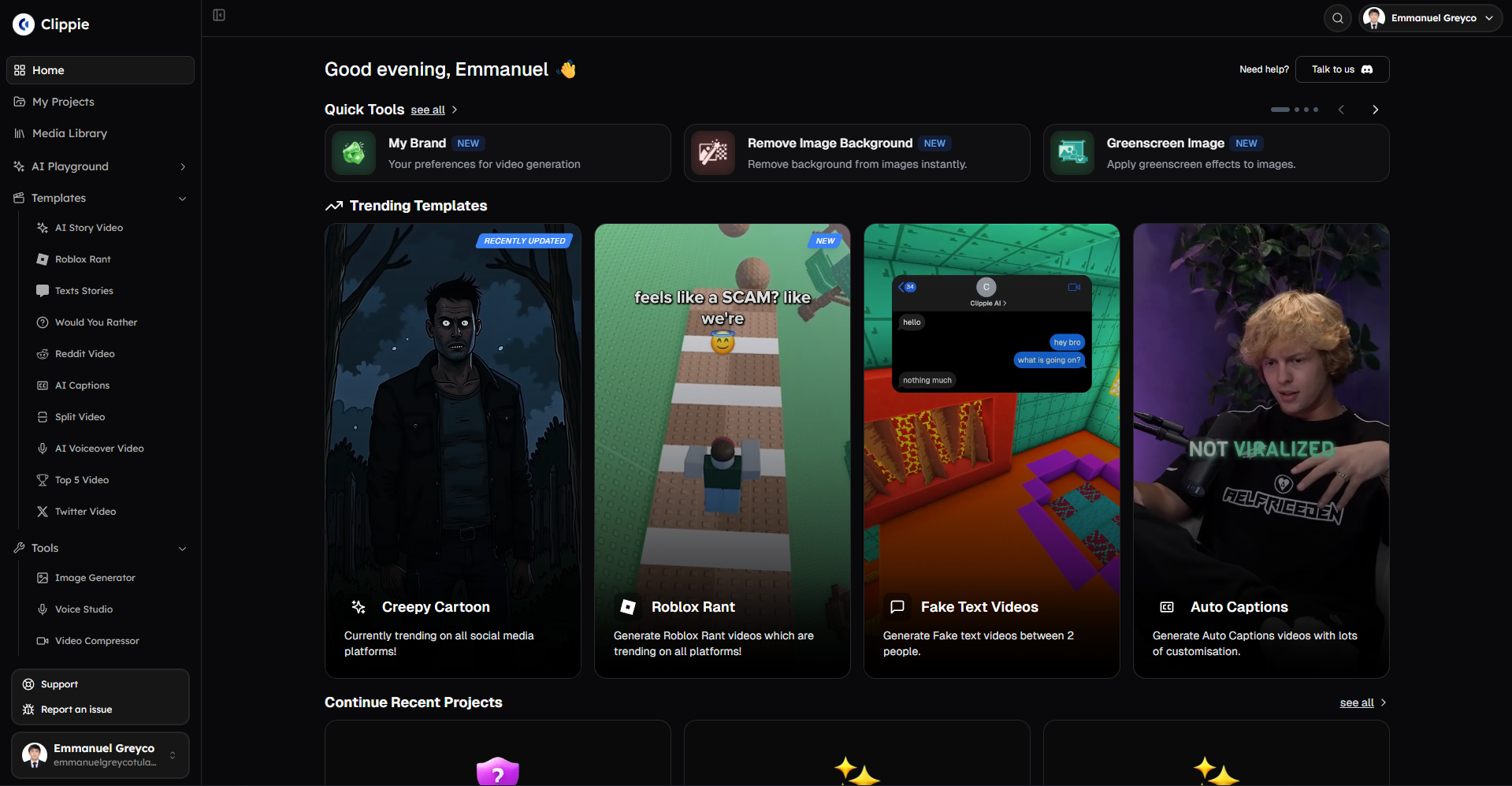
Start building your e-commerce video engine with Clippie AI today →
7. Frequently Asked Questions
Q1: Do I need to show the physical product in AI-generated e-commerce videos?
Not necessarily, though product context is important. AI-generated e-commerce videos that perform well focus on the outcome or transformation the product delivers, the problem it solves, and the lifestyle it enables, rather than close-up footage of the physical object. For products where physical appearance is the primary selling point (clothing, beauty products, home decor), supplementing AI-generated lifestyle visuals with actual product photography on the product page is the recommended approach. For functional products where the benefit is the primary purchase driver, AI-generated lifestyle and outcome visuals can be sufficient for the discovery and consideration video stages.
Q2: How many product videos should an e-commerce brand produce per month to see meaningful results?
A meaningful algorithmic presence on TikTok Shop, Instagram Reels, and YouTube Shorts simultaneously requires posting 8–15 product videos per month minimum, approximately 2–4 per week across all platforms. Brands producing below 4 videos per month see minimal algorithmic distribution because the platforms do not have enough content signals to build reliable audience models. Brands producing 12–20 videos per month in validated niches typically see measurable traffic and conversion increases within 60–90 days. Clippie AI's Creator plan ($34.99/month) supports 8–15 videos per month, the minimum effective volume for consistent algorithmic presence.
Q3: What is the most effective e-commerce video type for driving immediate purchases on TikTok Shop?
Problem-solution videos and social proof videos consistently drive the highest immediate purchase conversion rates on TikTok Shop, because they address the two primary barriers to purchase: uncertainty about whether the product solves the buyer's specific problem, and doubt about whether it actually works. Product showcase videos generate the most discovery traffic but convert at lower rates because they introduce the product before the buyer has confirmed relevance to their problem. For a brand optimising for TikTok Shop sales rather than just views, allocating 60–70% of video production to problem-solution and social proof formats generates better revenue-per-video than an even split across all five video types.
Q4: How do I track which specific videos are driving sales for my e-commerce brand?
The most reliable attribution method is unique UTM parameters or discount codes assigned to each video. For TikTok Shop, native analytics show which videos drove shop traffic and conversions directly. For traffic directed to a Shopify or external store, create a unique UTM link for each video (e.g., utm_source=tiktok&utm_content=video-title) and track in Google Analytics or Shopify's traffic source reports. For Instagram and YouTube, similar UTM tracking through the link-in-bio tool or YouTube description link tracks video-sourced traffic. Unique discount codes per video (VIDEO10, REEL15) allow attribution even when UTM data is incomplete due to iOS tracking limitations.
Q5: Can e-commerce brands run paid ads using Clippie AI-produced videos?
Yes. Clippie AI-produced videos export without watermarks in the technical formats required for paid advertising across TikTok Ads Manager, Meta Ads Manager (Facebook/Instagram), and YouTube Ads. The 9:16 format works for TikTok ads and Instagram Stories/Reels ads; 16:9 format works for YouTube pre-roll and YouTube Shorts ads. One important consideration: paid e-commerce ads on TikTok have specific content guidelines around claims and product representations, review TikTok's advertising policies for your product category before running paid campaigns with AI-generated product videos.
Q6: Which Clippie AI plan is right for an e-commerce brand just starting with video content?
The Creator plan at $34.99/month is the recommended starting point for e-commerce brands making a serious commitment to video. Its 120-minute export capacity supports 8–15 product videos per month, the minimum effective volume for algorithmic presence. The 500 AI image allocation covers 4–6 images per video across this monthly output. The 10 custom voice slots allow cloning a consistent brand narrator voice while maintaining flexibility for different product category tones. The Lite plan at $19.99/month is appropriate for brands producing 2–4 test videos per month during an initial format validation period before committing to full-volume production.
Make an AI story video
Write a script or let AI write one. Clippie turns it into a narrated video with AI scenes, voiceover and captions.
Read more

How to Make Top 5 Ranking Videos in 2026 (Step-by-Step)
Build ranking Shorts that can still earn: pick a debatable topic, set clear criteria, source clips you may use, script the countdown, add your commentary.

How to Create Short-Form Videos Using AI: 8 Steps (2026)
A beginner workflow for AI videos on TikTok, Reels and Shorts: pick a format, script a hook, add visuals, voice and captions, export at 9:16, label AI.

7 Free CapCut Alternatives for Short-Form Video (2026)
Compare Edits, YouTube Create, VN, Clipchamp, Canva, DaVinci Resolve and Shotcut: what each gives free users, what it caps first and where it falls short.