
Best Higgsfield AI Alternatives for Ultra-Realistic AI Video in 2026, Why Creators Are Switching to Clippie AI
Find the best Higgsfield AI alternatives for ultra-realistic AI video in 2026, why workflow integration matters more than footage alone, Clippie AI vs Higgsfield full comparison, and Seedance 2.0 quality guide.

Searching for the best Higgsfield AI alternatives for ultra-realistic AI video in 2026?
Higgsfield AI has built a strong reputation for one thing: cinematic, emotionally expressive AI footage with character presence that most competing models have struggled to match. If visual realism and character expressiveness are the primary benchmark, Higgsfield competes at the top of the AI video generation landscape.
But faceless content creators building YouTube channels and TikTok accounts have learned a consistent lesson: generating impressive footage is not the same as producing a complete video. Higgsfield generates clips. It does not generate voiceover, captions, or a complete assembled video, which means every Higgsfield user still needs two to three additional tools before anything is ready to publish.
In 2026, with Seedance 2.0 and VEO3.1 both integrated directly into Clippie AI's complete production workflow, the case for using Higgsfield as a standalone generation tool has narrowed significantly. This guide explains exactly why, and what you get when you switch.
Executive Summary
This guide is for faceless content creators evaluating Higgsfield AI alternatives in 2026. It covers what Higgsfield does and where its standalone generation model creates workflow friction, why ultra-realistic footage alone is not enough for publish-ready content, a full comparison between Clippie AI and Higgsfield across realism, integration, and pricing, how Seedance 2.0 and VEO3.1 within Clippie AI compare to Higgsfield's specific strengths, other alternatives worth evaluating, and the right Clippie AI plan for different production volumes. By the end, you will know whether Higgsfield's footage quality justifies its workflow complexity, or whether Clippie AI's integrated approach serves your production needs better.
Table of Contents
What Higgsfield AI Does and Where Ultra-Realistic Video Generation Hits Its Workflow Ceiling
Why Ultra-Realistic Footage Alone Does Not Make a Publish-Ready Faceless Video
Clippie AI vs Higgsfield, Realism, Workflow Integration, and Pricing Compared
How Seedance 2.0 and VEO3.1 Inside Clippie AI Compare to Higgsfield's Realism Output
Other Higgsfield Alternatives Worth Evaluating for Realistic AI Video in 2026
Which Clippie AI Plan Replaces Higgsfield for Faceless Channel Production
Frequently Asked Questions

1. What Higgsfield AI Does and Where Ultra-Realistic Video Generation Hits Its Workflow Ceiling
Higgsfield AI is a cinematic AI video generation platform built around the quality and emotional expressiveness of its generated footage. It is positioned specifically around character-expressive, emotionally staged, cinematic output, footage where human figures convey emotion and physical presence within the scene rather than simply occupying the frame.
What Higgsfield AI Does Well
Character expressiveness: Higgsfield's primary differentiator is the emotional expressiveness of its generated characters. Where many AI video models produce figures that look physically present but emotionally neutral, Higgsfield generates characters with facial expressions, body language, and physical staging that conveys emotional state, making it particularly useful for narrative, dramatic, and emotionally complex content.
Cinematic composition: Higgsfield's output consistently exhibits strong compositional intent, subjects are positioned within the frame with cinematic deliberateness rather than the more arbitrary placement that less sophisticated models sometimes produce. This compositional quality is visible immediately and communicates production value to viewers.
Motion coherence: Character motion in Higgsfield output is natural and stable across the clip duration, a quality that distinguishes it from models where figures morph or move unnaturally between frames. For content where character presence is the primary visual element, this stability is essential.
Where Higgsfield's Workflow Ceiling Appears
The ceiling is not in the footage. The ceiling is in everything else.
Higgsfield is a footage generation tool. It generates clips. It does not provide:
AI voiceover or voice cloning
Auto-captioning in any language
Video assembly, clips must be imported into an external editor
Audio-visual sync
Multi-format export for platform-specific specifications
AI image generation for static visual sections
A faceless creator using Higgsfield for footage generation is managing at minimum three additional tools for a complete production pipeline, a voiceover tool, a captioning tool, and a video assembly platform. Each tool adds subscription cost, file management overhead, and production time that does not contribute to content quality.
The Multi-Tool Overhead Problem at Scale
The true cost of Higgsfield's standalone model is not the subscription fee, it is the production time overhead at scale.
At 10 videos per month, the manual assembly steps required to integrate Higgsfield footage with separately generated voiceover and captions add approximately:
Audio import and manual sync: 10–15 minutes per video
Caption import and overlay application: 5–8 minutes per video
Platform-specific export configuration: 5–8 minutes per video
Total additional overhead per video: 20–31 minutes
Monthly overhead at 10 videos: 200–310 minutes (3–5 hours)
Three to five hours of monthly production time that produces no additional content quality, only workflow friction.

2. Why Ultra-Realistic Footage Alone Does Not Make a Publish-Ready Faceless Video
The most important reframing for creators evaluating Higgsfield is this: visual quality is one input into channel performance, not the output.
What Actually Determines Channel Growth
YouTube and TikTok algorithms distribute content based on engagement signals, completion rate, comment rate, share rate, save rate. These signals are downstream of:
Whether the hook stopped the scroll in the first 3 seconds
Whether the script maintained forward tension through the full video
Whether the narrator's voice built trust and kept attention
Whether captions were legible for sound-off viewers
Whether the video was distributed at the right time with the right metadata
Ultra-realistic footage contributes to the first of these, scroll-stop performance, but does not directly influence any of the other four. A channel with slightly less realistic but more efficiently produced content at twice the volume will typically outperform a channel with ultra-realistic footage produced at half the volume, because volume drives the algorithmic data that improves distribution.

The Volume Paradox
The creators who generate the most income from faceless channels are not those who produce the most visually spectacular individual videos. They are those who produce consistently high-quality content at sustainable volume, maintaining the publishing frequency that algorithmic compounding requires.
A production system where Higgsfield footage generation requires 3–5 additional hours of monthly assembly overhead will, over time, reduce sustainable production volume. The creator who spends that 3–5 hours producing additional content instead of managing workflow overhead publishes more videos, and more videos means more algorithmic data, more search surface area, and more cumulative watch time.
The Integration Value Proposition
Clippie AI's integrated workflow does not compete with Higgsfield on the single dimension of footage visual quality at the extreme ceiling. It competes on the dimension that actually determines channel success: the ratio of production quality to production time.
For the specific content types that faceless channels produce, motivational, true crime, history, Reddit stories, finance explainers, VEO3.1 and Seedance 2.0 within Clippie AI produce footage that meets and frequently exceeds the visual quality standard required for channel growth. And they do it within an integrated workflow that produces a complete, export-ready video in 45–65 minutes rather than a generation session followed by 3–4 additional tool stages.

3. Clippie AI vs Higgsfield, Realism, Workflow Integration, and Pricing Compared
AI Video Generation Quality
Higgsfield AI: Higgsfield's footage quality is its primary strength, particularly for emotionally expressive character content and dramatically staged scenes. The model's character expressiveness, compositional quality, and motion coherence are consistent strengths.
Specific documented public capabilities: character-forward dramatic footage, emotionally staged narrative scenes, cinematic composition, stable character motion across clip duration.
Clippie AI: Seedance 2.0: Seedance 2.0, now integrated into Clippie AI, produces filmic, character-forward footage with:
Higher visual fidelity than Seedance 1.0 with improved detail preservation
Better character consistency, figures maintain stable appearance and natural motion across the full clip
Advanced multi-modal controls including motion cloning from reference clips
Multi-shot generation capable of depicting narrative sequences with camera cuts in a single generation
Approximately 30% faster generation than Seedance 1.0
For narrative, emotionally staged, and character-forward content, Higgsfield's strongest territory, Seedance 2.0 is a direct and competitive alternative within an integrated production platform.
Clippie AI: VEO3.1: VEO3.1 produces photorealistic documentary-style footage with strong environmental realism, the correct model for natural environments, urban establishing shots, and footage where photorealism rather than cinematic expressiveness is the priority.
AI Voiceover and Voice Cloning
Higgsfield AI: No AI voiceover generation. A separate voiceover tool is required for every video.
Clippie AI:
50+ AI voices integrated within the production platform
Custom voice cloning: 1 (Lite), 10 (Creator), 30 (Pro) custom voices
Voiceover generated from script within the same session as footage generation
No separate subscription, no file export, no manual import
Auto-Captioning
Higgsfield AI: No auto-captioning. A separate captioning tool is required.
Clippie AI:
Speech-to-subtitles auto-synced to AI voiceover
102+ language support, the broadest multilingual captioning in any integrated creator platform
Captioning integrated within the production session

AI Image Generation
Higgsfield AI: No native AI image generation for static visual content.
Clippie AI:
Native AI image generation for title cards, section imagery, and concept illustration
100–1,000 images per month depending on plan
Generated alongside footage in the same production session
Video Assembly and Export
Higgsfield AI: Higgsfield generates and exports individual clips. Assembly with voiceover, captions, and other visual elements requires a separate video editor.
Clippie AI:
Complete video assembly, voiceover, footage, images, and captions assembled within the platform
9:16 vertical export for TikTok, Shorts, and Reels
16:9 horizontal export for YouTube long-form
Both formats from the same production session
MP4, 1080p minimum, no watermarks
Pricing
Higgsfield AI: Higgsfield uses credit-based pricing. Specific current plan details and per-generation credit costs should be verified directly on Higgsfield's website. Note that the effective monthly cost for a faceless creator includes Higgsfield plus the cost of additional tools (voiceover, captioning, video editor) required to complete the production pipeline.
Clippie AI:
Lite: $19.99/month
30 mins video export (~3–5 videos/month)
30 mins AI voice generation
30 mins speech-to-subtitles
100 AI images
1 custom voice
Captions in 102+ languages
50+ AI voices
24/7 support
Creator: $34.99/month
120 mins video export (~8–12 videos/month)
120 mins AI voice generation
120 mins speech-to-subtitles
500 AI images
10 custom voices
Captions in 102+ languages
50+ AI voices
24/7 support
Pro: $69.99/month
250 mins video export (~15–25 videos/month)
250 mins AI voice generation
250 mins speech-to-subtitles
1,000 AI images
30 custom voices
Captions in 102+ languages
50+ AI voices
24/7 support
No free tier is available on Clippie AI.
Total cost comparison for a faceless creator producing 10 videos per month:
Higgsfield (credit-based) + ElevenLabs ($11–$22/month) + captioning tool ($15–$35/month) + video editor ($0–$55/month) = $60–$130+ monthly combined
Clippie AI Creator plan = $34.99/month covering all production stages
4. How Seedance 2.0 and VEO3.1 Inside Clippie AI Compare to Higgsfield's Realism Output
This is the most important technical comparison for creators who have been using Higgsfield specifically for its footage quality.
The Realism Spectrum in 2026
AI video generation quality in 2026 spans a spectrum from photorealistic documentary footage to stylised filmic aesthetics. Different models occupy different positions on this spectrum, and the "most realistic" model is not always the correct choice for every content type.
Higgsfield: Cinematic and emotionally expressive, footage that looks like a directed film production. Strong character expressiveness. High compositional intent.
Seedance 2.0: Filmic and narrative-forward, footage with cinematic composition and character presence. Improved character consistency over 1.0. Multi-shot generation capability. UGC-style mode for product content. Approximately 30% faster generation than Seedance 1.0.
VEO3.1: Photorealistic and documentary, footage that looks captured rather than composed. Strongest model for natural environments and factual documentary aesthetics.
Seedance 2.0 vs Higgsfield, Direct Comparison by Scene Type
Character-Forward Emotional Scenes
Higgsfield strength: Emotionally expressive character staging with facial expression rendering that is among the strongest in the category.
Seedance 2.0 capability: Improved character consistency and natural motion across the clip with cinematic composition. Character staging is strong for narrative faceless content, figures convey emotional weight through body language and positioning within the scene.
Practical difference for faceless creators: For the emotional staging requirements of motivational, true crime, Reddit story, and narrative faceless content, Seedance 2.0 within Clippie AI produces footage that serves the content function without requiring Higgsfield's additional workflow overhead.
Dramatic Atmospheric Scenes
Higgsfield strength: Strong dramatic lighting rendering with intentional cinematographic composition.
Seedance 2.0 capability: Improved response to specific lighting descriptions, chiaroscuro, golden hour, cinematic neon, with high-quality compositional rendering. The six-element prompt framework produces dramatically lit scenes with consistent quality.
Action and Dynamic Motion Sequences
Higgsfield strength: Character motion stability across the clip duration.
Seedance 2.0 capability: Improved motion model handling complex multi-element scenes. Multi-character motion with independent, natural movement paths. Multi-shot generation for action sequences that include camera cuts in a single generation.
Practical advantage of Seedance 2.0: Multi-shot generation, producing narrative sequences with camera cuts in a single clip, is a capability Higgsfield does not offer. For true crime and action-oriented content, this reduces the number of separate generations required to depict a narrative sequence.
UGC-Style and Product Content
Higgsfield capability: Limited documented UGC-style output capability.
Seedance 2.0 capability: Dedicated UGC-style mode that replicates the handheld, organic aesthetic of creator-generated content, making it the only model in Clippie AI that produces authentic-looking UGC footage for product advertising.
Practical advantage: Creators who need both cinematic narrative content and UGC-style ad content can access both within a single Clippie AI account, VEO3.1 for documentary, Seedance 2.0 for narrative and UGC.
VEO3.1 vs Higgsfield, For Documentary and Environmental Content
For content that requires photorealistic documentary footage, natural environments, urban establishing shots, historical environmental context, VEO3.1 consistently produces stronger output than Higgsfield, whose cinematic aesthetic occasionally over-stylises footage that should look naturalistic.
A history channel covering ancient Rome benefits from VEO3.1's ability to generate Mediterranean landscape footage that looks genuinely captured, not from Higgsfield's compositional cinematic interpretation that makes the same scene look like a film production.

5. Other Higgsfield Alternatives Worth Evaluating for Realistic AI Video in 2026
Alternative 1: Clippie AI (Primary Recommendation)
As covered throughout this guide. Seedance 2.0 and VEO3.1 within Clippie AI's complete production platform is the strongest alternative for faceless creators who want cinematic footage quality within an integrated workflow that eliminates the multi-tool overhead of Higgsfield-based production.
Best for: All faceless channel creator types who need both high-quality footage and a complete production pipeline in one subscription.
Alternative 2: Runway ML
Runway ML offers one of the most sophisticated AI video generation environments, multi-motion brush controls, camera direction tools, and generation quality that competes directly with Higgsfield at the technical ceiling.
Best for: Creative filmmakers and visual artists who want maximum generation control and have existing production workflows for voiceover and assembly.
Limitation: Same multi-tool overhead as Higgsfield, voiceover, captioning, and assembly all require separate tools. Higher technical complexity than most faceless channel workflows require.
Alternative 3: Sora (OpenAI)
OpenAI's Sora produces exceptional temporal consistency and visual quality, in many benchmarks it matches or exceeds Higgsfield's realism. Access is available to ChatGPT Pro subscribers with usage limits.
Best for: Creators who want the highest visual quality ceiling and are comfortable with access limitations and manual integration.
Limitation: Generation tool only, full multi-tool overhead applies. Access limitations make consistent high-volume production difficult.
Alternative 4: Kling AI
Kling AI (developed by Kuaishou Technology) produces high-quality cinematic footage with strong motion coherence, positioning it as a direct competitor to Higgsfield in the character-expressive category.
Best for: Creators who want Higgsfield-competitive footage quality at potentially lower credit costs.
Limitation: Generation tool only, the same multi-tool production overhead applies.
Alternative 5: Pika Labs
Pika Labs is a more accessible AI video generation tool with improving quality and an approachable interface. It does not match Higgsfield's footage quality ceiling but provides strong output for less demanding content types.
Best for: Creators whose content type does not require the highest quality footage generation and who prioritise accessibility over visual ceiling.
Limitation: Quality ceiling below Higgsfield and Seedance 2.0 for complex character and narrative scenes. Same single-function limitation as other generation-only tools.
6. Which Clippie AI Plan Replaces Higgsfield for Faceless Channel Production
Lite Plan ($19.99/month)
Right for: Creators who have been using Higgsfield for occasional footage in a light production schedule and are transitioning to an integrated platform at 3–5 videos per month.
Specifications:
30 mins video export (~3–5 videos/month)
30 mins AI voice generation
30 mins speech-to-subtitles
100 AI images
1 custom voice
Captions in 102+ languages
50+ AI voices
24/7 support
Creator Plan ($34.99/month), Primary Recommendation for Higgsfield Switchers
Right for: Creators who have been using Higgsfield alongside ElevenLabs, a captioning tool, and a video editor, and are ready to consolidate all four functions into one platform at a lower combined monthly cost. This is the most commonly recommended plan for Higgsfield switchers producing 8–12 videos per month.
Specifications:
120 mins video export (~8–12 videos/month)
120 mins AI voice generation
120 mins speech-to-subtitles
500 AI images
10 custom voices
Captions in 102+ languages
50+ AI voices
24/7 support
Why this is the right switch: The Creator plan provides Seedance 2.0 and VEO3.1 footage generation, integrated voiceover with 10 custom voice clones, 102+ language captioning, AI image generation, and 120-minute export capacity within one subscription at $34.99/month, replacing a 4-tool stack that typically costs $60–$130+ monthly for the same combined functionality.
Pro Plan ($69.99/month)
Right for: High-volume creators producing 15–25 videos per month, agencies using Higgsfield for multiple client channels, or creators running both faceless channel production and AI UGC ad production simultaneously.
Specifications:
250 mins video export (~15–25 videos/month)
250 mins AI voice generation
250 mins speech-to-subtitles
1,000 AI images
30 custom voices
Captions in 102+ languages
50+ AI voices
24/7 support
No free tier is available on Clippie AI.
💡 For the complete VEO3.1 and Seedance prompt framework that produces Higgsfield-competitive footage within Clippie AI, read our guide on how to use VEO3 and VEO3.1 to create cinematic AI videos in 2026
💡 Start producing cinematic AI footage within a complete production workflow with Clippie AI today →
Conclusion: Higgsfield's Footage Quality Is Real, But It Is Not Enough on Its Own
Higgsfield AI produces genuinely impressive footage. The character expressiveness, compositional quality, and motion coherence that make it distinctive in the AI video generation landscape are real and measurable.
The problem is not the footage. The problem is that the footage is all Higgsfield provides, and faceless channel production requires a complete pipeline that Higgsfield cannot complete without three additional tools, three additional subscriptions, and 3–5 hours of monthly production overhead that produces no additional content value.
Clippie AI's Seedance 2.0 and VEO3.1 integration produces footage that competes directly with Higgsfield for the content types that faceless channels produce, and delivers it within an integrated workflow that includes voiceover generation, voice cloning, 102+ language captioning, AI image generation, and multi-format export in one platform at one price.
The footage quality that reaches viewers is not the footage quality in the generator's preview window. It is the footage quality that a creator can produce consistently, at sustainable volume, within a workflow that does not require hours of manual overhead per video.
For faceless creators who want cinematic footage quality without the multi-tool overhead, Clippie AI is the right platform in 2026.
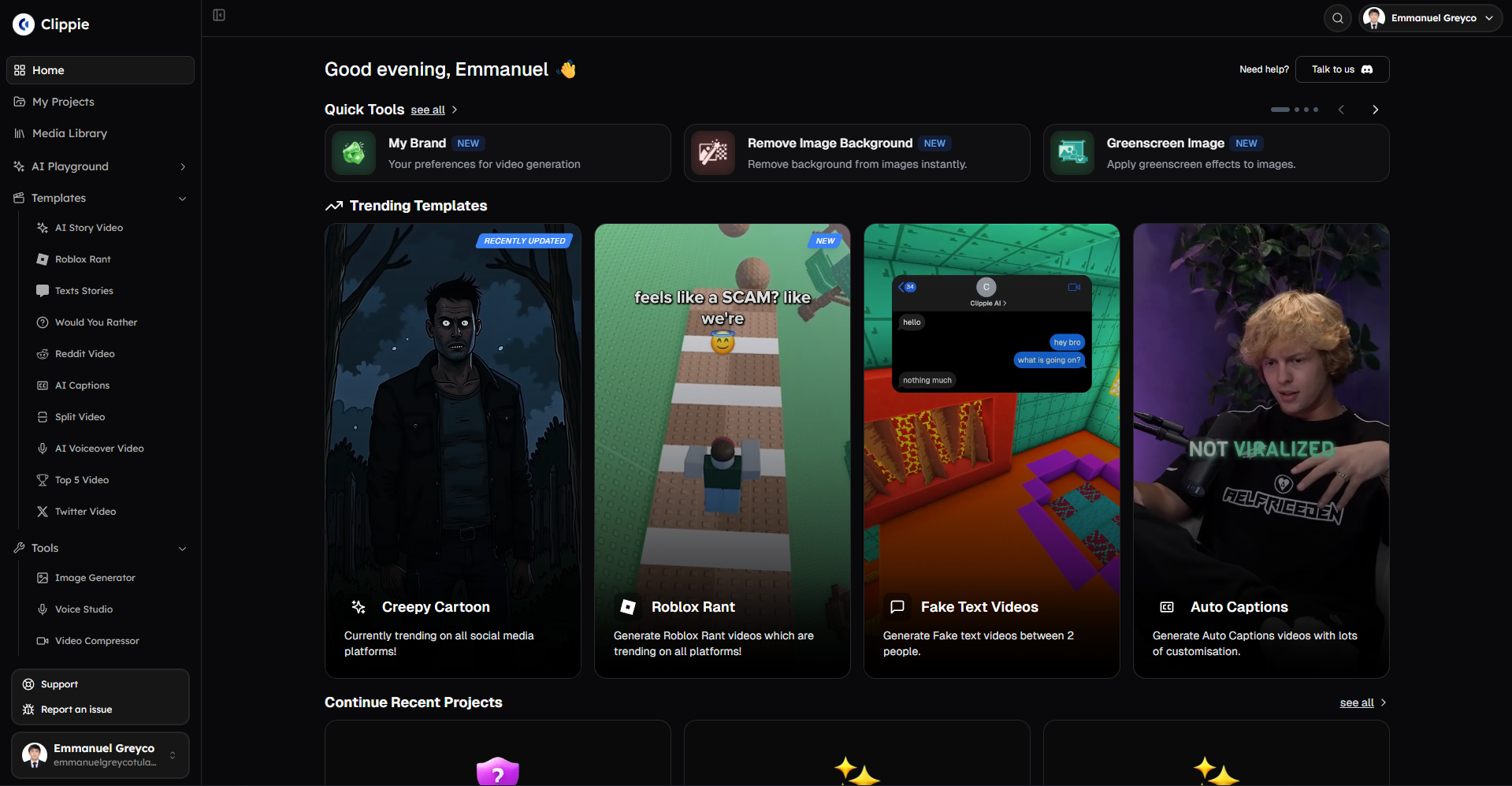
Switch to Clippie AI and build your cinematic faceless channel today →
7. Frequently Asked Questions
Q1: What is Higgsfield AI and why are faceless creators looking for alternatives in 2026?
Higgsfield AI is a cinematic AI video generation platform known for character-expressive, emotionally staged footage with strong compositional quality and stable motion. Faceless creators look for alternatives primarily because Higgsfield is a standalone generation tool, it does not provide voiceover, captioning, video assembly, or integrated export. Building a complete faceless video production workflow around Higgsfield requires 3–4 additional tools and subscriptions, adding $60–$130+ in combined monthly costs and 3–5 hours of manual production overhead per month beyond the footage generation itself.
Q2: Does Clippie AI's Seedance 2.0 match Higgsfield's footage quality for faceless channel content?
For the specific content types that faceless channels produce, emotionally staged narrative scenes, character-forward dramatic footage, atmospheric true crime and motivational content, Seedance 2.0 within Clippie AI produces footage that is directly competitive with Higgsfield. Seedance 2.0's improved character consistency, multi-shot generation capability (depicting narrative sequences with camera cuts in a single generation), and multi-modal controls including motion cloning address the specific strengths that make Higgsfield attractive. Higgsfield's facial expression rendering is among the strongest in the category, Seedance 2.0 conveys emotional weight primarily through body language and staging rather than facial detail, which is sufficient for most faceless channel narrative content.
Q3: What is the total monthly cost difference between a Higgsfield-based and Clippie AI-based production workflow?
A Higgsfield-based complete production workflow typically costs $60–$130+ monthly across Higgsfield plus ElevenLabs (voiceover, $11–$22), a captioning tool ($15–$35), and a video editor ($0–$55). Clippie AI's Creator plan at $34.99/month covers all production stages, Seedance 2.0 and VEO3.1 footage, voiceover with custom cloning, AI image generation, 102+ language captioning, and multi-format export, within one subscription. The typical saving when switching from a Higgsfield-based multi-tool stack to Clippie AI is $25–$95+ per month, with the additional benefit of 3–5 hours of recovered monthly production time from eliminating manual assembly overhead.
Q4: Can I use both Higgsfield and Clippie AI in the same production workflow?
Yes, though it is an unusual workflow that most creators will not need. A creator who wants Higgsfield's specific facial expression capability for particular clips could generate those clips in Higgsfield and import them into a broader production session in Clippie AI alongside Seedance 2.0 and VEO3.1 clips. The integrated voiceover, captioning, and export in Clippie AI would still handle the complete assembly. However, for the vast majority of faceless channel content types, Seedance 2.0 within Clippie AI produces footage that serves the creative function without requiring the additional Higgsfield subscription and file management step.
Q5: Which Clippie AI model, Seedance 2.0 or VEO3.1, is closer to Higgsfield's aesthetic?
Seedance 2.0 is the closer aesthetic match to Higgsfield, both produce filmic, cinematically composed footage with character presence and dramatic staging. VEO3.1 produces a different aesthetic: photorealistic and documentary in style, looking captured rather than composed. For creators switching from Higgsfield who want to maintain a cinematic narrative aesthetic, Seedance 2.0 is the primary replacement model. VEO3.1 then serves a complementary function, handling establishing shots and environmental footage where photorealism is more appropriate than Higgsfield or Seedance's cinematic interpretation.
Q6: Which Clippie AI plan is right for a creator currently producing 10 videos per month with Higgsfield?
The Creator plan at $34.99/month is the right replacement for a creator producing 10 videos per month. Its 120-minute export capacity covers 10 videos at 12 minutes average length, its Seedance 2.0 and VEO3.1 integration provides the cinematic footage quality, its 10 custom voice clones allow immediate channel audio identity development, and its 102+ language captioning covers international distribution requirements. This replaces a Higgsfield-based stack that typically costs $60–$130+ monthly at the same production volume, at lower cost with significantly less workflow overhead.
Generate it in AI Studio
Create videos with Seedance and Veo, or copy any dance onto your own character with Motion Control.
Read more

How to Make Top 5 Ranking Videos in 2026 (Step-by-Step)
Build ranking Shorts that can still earn: pick a debatable topic, set clear criteria, source clips you may use, script the countdown, add your commentary.

How to Create Short-Form Videos Using AI: 8 Steps (2026)
A beginner workflow for AI videos on TikTok, Reels and Shorts: pick a format, script a hook, add visuals, voice and captions, export at 9:16, label AI.

7 Free CapCut Alternatives for Short-Form Video (2026)
Compare Edits, YouTube Create, VN, Clipchamp, Canva, DaVinci Resolve and Shotcut: what each gives free users, what it caps first and where it falls short.