Where to Find Clips for YouTube Shorts in 2026 (No Strikes)
Eight legitimate footage sources for ranking and faceless Shorts, from stock libraries to public domain archives, plus the reuse and Content ID rules.
 Emmanuel Greyco Tulabut
On this page
If you searched for where to find clips for YouTube Shorts, you probably want a steady supply of footage for ranking videos, compilations or faceless explainers that won't get claimed, blocked or demonetized.
That question got sharper in October 2026, when YouTube said Shorts recommendations would reduce the reach of content re-uploaded from other creators, and its revenue rules already exclude compilations with nothing original added. This guide lists eight legitimate places to get clips, explains the rights rules attached to each, and shows how to research clip-worthy moments and add enough of your own work that every Short is genuinely yours.
Executive summary: This guide covers the rights basics (copyright, Content ID, reused content, fair use), eight legitimate clip sources and their license terms, a research workflow for clip-worthy moments, a clip library system and the edits that make a compilation original. It is for faceless and ranking channel creators who want footage they can monetize.
Table of Contents
Can You Use Other People's Clips in YouTube Shorts?
8 Legitimate Places to Find Clips for YouTube Shorts
How to Find Clip-Worthy Moments Before You Source Footage
How to Organize a Clip Library for Ranking Shorts
How to Add Transformation So Shorts Are Not Reused Content
Mistakes That Get Shorts Claimed or Demonetized
FAQs
What to Do Next
Can You Use Other People's Clips in YouTube Shorts?
Usually not without permission. A clip belongs to whoever filmed it, wherever it was posted. Finding it on Reddit, TikTok or Instagram gives you no right to reuse it, and crediting the uploader doesn't either. Monetization adds a second test: even licensed clips need meaningful original work on top.
Copyright and Content ID
Content ID is YouTube's automated matching system for rights holders who registered their footage. According to YouTube's help page on how Content ID claims work:
A match triggers a claim that can block the video, run ads on it, or track its views.
Claims are not strikes. Strikes come from formal removal requests.
Shorts between one and three minutes long with an active claim are blocked, whatever the claimant's policy.
Reused Content and Monetization
Separately, YouTube's channel monetization policies on reused content cover repurposed material without significant original commentary or substantive changes.
Not allowed: show clips strung together with little narrative, or downloaded footage re-posted without substantive changes.
Allowed: critical reviews, sports replays that explain a player's moves, and footage edited with an added storyline.
Permission doesn't exempt you. The page says the policy applies even if the original creator agreed.
Shorts revenue rules also exclude reuploads and compilations with nothing original added. For the full picture, see our guide to YouTube's 2026 monetization changes for creators.
Fair Use Is Decided Case by Case
YouTube's fair use explainer says courts decide fair use case by case, and Content ID can't. Short clips aren't a safe harbor, and "no infringement intended" carries no weight.
Treat fair use as a defense, not a sourcing strategy. Rules differ outside the US, and this isn't legal advice.
What About Downloading From Reddit, TikTok or Instagram?
Some tutorials suggest saving viral clips with third-party downloaders. That fails on three counts:
Someone else owns the clip: the uploader, or the original filmer if it is a repost.
Platform terms restrict it. YouTube's Terms of Service bar downloading unless the service allows it or rights holders give written permission.
It is the exact pattern the reused content policy and the October 2026 update target.
8 Legitimate Places to Find Clips for YouTube Shorts
The safest clip sources are footage you create, stock libraries whose licenses allow YouTube use, Creative Commons and public domain archives, official media kits, clips licensed in writing and AI-generated visuals. Each has limits, so read the license on every download rather than trusting the site's label.
Source #1: Your Own Recordings and Gameplay
Phone footage, screen recordings, gameplay you captured and segments of your own long videos (via YouTube Studio's Clips and Shorts tool) are the strongest base for any Short.
Gameplay still involves the publisher's rights. Nintendo's guidelines allow YouTube Partner Program monetization but ban plain copies without your creative input or commentary.
Microsoft's Game Content Usage Rules allow YouTube ad revenue, with conditions. Minecraft has its own guidelines.
Check each publisher's policy, and watch for licensed game soundtracks.
Where it falls short: it takes time, and you can't film most viral moments yourself.
Source #2: Free Stock Libraries (Pexels, Pixabay, Mixkit)
These sites offer stock footage for Shorts at no cost, with no attribution required. Their licenses are permissive, with conditions:
Pexels allows its videos on YouTube inside your own video, not uploaded unchanged.
Pixabay bans distributing unaltered content and warns some files carry trademark or privacy rights.
Mixkit (by Envato) has a Free License covering YouTube and a Restricted License for personal projects only.
Where it falls short: the same clips appear everywhere, and generic B-roll rarely fits a ranking topic.
Source #3: Paid Stock Footage (Storyblocks, Artgrid)
Paid libraries offer more cinematic, niche footage and clearer commercial licenses.
Storyblocks sells download subscriptions, roughly $20 to $30 a month billed annually depending on the plan and the page you land on.
Artgrid shares a parent company with Artlist; third-party reviews place its annual plans at about $20 to $50 a month. Check current pricing and licenses first.
Where it falls short: it's a monthly cost, and stock rarely has the "fails" ranking channels feature.
Source #4: Creative Commons and Remix on YouTube
YouTube search has a Creative Commons filter that surfaces videos under CC BY, which allows reuse with attribution. Its Shorts Remix tools (Cut, Green Screen) also sample eligible videos inside YouTube, credited with a link to the source; creators can opt out.
Credit properly: YouTube asks for the work's title, author, source URL and license, on screen, in voiceover or in the description.
Confirm commercial rights before monetizing, and check that the uploader actually owns what they licensed.
Where it falls short: the CC pool is small, and a remix still needs your own commentary.
Source #5: Public Domain Archives (Internet Archive, Prelinger, NASA)
Public domain footage has no copyright owner to claim it, which makes it excellent for history, science and "then vs now" rankings.
Internet Archive hosts the Prelinger Archives, thousands of ephemeral films available for unrestricted reuse. Rights vary across the wider site, so check each item.
NASA says its images, audio and video generally aren't copyrighted in the US. Credit NASA, avoid implying endorsement and watch for third-party material marked with another owner.
Where it falls short: older footage looks dated, and restored copies may still be Content ID-registered, so keep your source link.
Source #6: Official Press and Media Kits
Studios, car makers, sports bodies and distributors publish media kits with trailers and B-roll.
Read the kit's terms. Many limit use to editorial coverage, which suits review Shorts.
Don't imply sponsorship or use logos as your branding.
Where it falls short: terms can forbid monetized use, and trailers are often Content ID-registered anyway.
Source #7: Licensed Clips With Written Permission
For a specific viral clip, ask the original filmer, or license it through an agency that represents viral clip owners.
Get it in writing, covering Shorts, monetization and regions.
Keep the agreement for disputes.
Where it falls short: it's slow, often paid, and a license doesn't replace your own added value.
Source #8: AI-Generated Footage
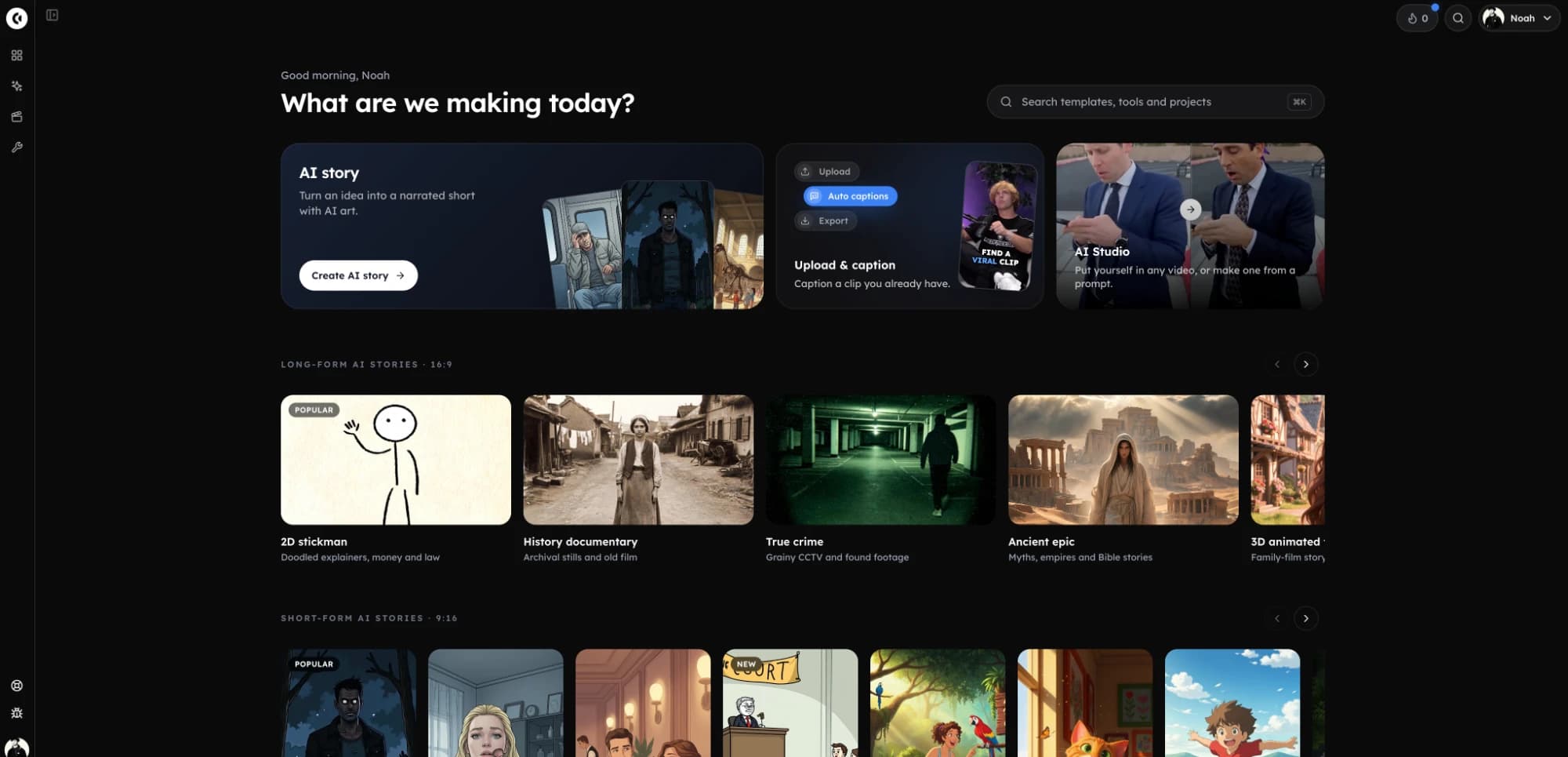
Generating your own visuals removes third-party footage rights from the equation. In Clippie's AI Studio you can generate clips with models such as Seedance 2.5 and Veo 3.1. A 10-second 720p Seedance 2.5 clip costs 348 credits, and the price is shown before you generate.
Originality still applies. YouTube's inauthentic content rules target mass-produced, template-built AI videos.
Disclose realistic AI with YouTube's AI use setting at upload.
Where it falls short: AI can't reproduce real events, and the Lite plan's 800 monthly AI credits cover only two such clips. Plans start at $19.99 a month, with discounts on longer billing; check the pricing page.
How to Find Clip-Worthy Moments Before You Source Footage
Research the moments first, then source footage you're allowed to use. Study what top channels in your niche feature, note the structure that keeps viewers watching, and build a shortlist of moments. Then match each moment to a legitimate source from the list above.
This is the useful half of how we research clip-worthy moments for ranking Shorts. That video also suggests downloading clips from social apps; use its research method, not that step.
Step 1: Watch Five or Six Shorts Back to Back
One Short shows a video; five or six from one channel show a pattern. Note:
The first two seconds: title card, voiceover or sound effect?
Clip length: fixed per slot or varied?
Title style: a consistent color and layout.
Clip type: one theme per video, such as only demolitions.
Step 2: Use Outliers as Topic Signals
A Short far above a channel's usual views marks a topic the audience wants. Borrow the topic, not the footage. "Most satisfying demolitions" is an idea; someone else's demolition clip is their property.
Step 3: Research on Reddit and Reverse Image Search
Reddit's Top sort (week, month or year) shows which moments people engaged with most. A reverse image search on a screenshot often finds the original filmer. Use that to request permission or find licensed alternatives, never as a shortcut to downloading.
Step 4: Map Each Moment to a Legal Source
For every shortlisted moment, ask: can I film it, license it, find it in stock or public domain, or generate it? If none applies, drop it.
How to Organize a Clip Library for Ranking Shorts
A clip library is a folder system that stores every clip with its source and license. It lets you batch Part 1, Part 2 and Part 3 of a winning topic in one session, and it gives you proof of rights the moment a claim appears.
How to set it up:
One folder per topic, with subfolders per part.
Consistent file names, e.g.
demolition_p1_03_pexels.mp4.A rights log: source URL, license, download date and attribution text per clip.
Saved license pages, since terms change.
Example: 15 legitimate "parking fails" clips become three five-clip Shorts.
To decide which formats deserve a library at all, compare them in our ranking of the best short-form video formats for monetization in 2026.
How to Add Transformation So Shorts Are Not Reused Content
Transformation is the original work that turns a set of clips into your video: stated ranking criteria, commentary explaining each pick, research the viewer didn't have, and real editing. YouTube's policy treats commentary, storylines and substantive edits as the line between reused and original.
What counts:
Ranking criteria said out loud, such as "ranked by height of the drop."
Commentary per clip that argues why it beats the one before.
Facts the clips don't show, like dates, costs or records.
Editing choices, including trims to the key beat, captions and on-screen numbers.
What doesn't: a voiceover that only describes the screen, or one template reused with new clips.
How to build it in Clippie: open the Top 5 video generator, choose 2 to 9 items, upload clips you have rights to (MP4, MOV, AVI, MKV or WebM), then arrange, add text and preview. Clippie's walkthrough also shows trimming each clip and adding a generated voiceover between clips.
Where it falls short: Clippie doesn't supply clips or make them original, and it isn't a timeline editor.
For the four fixes that keep ranking channels monetized, watch how to create monetizable ranking Shorts under the 2026 rules.

Mistakes That Get Shorts Claimed or Demonetized
Most claimed or demonetized Shorts fail for predictable reasons: clips downloaded from other platforms, misplaced trust in credit or disclaimers, unchecked audio and one template repeated endlessly. Each is avoidable once you source and edit with rights in mind from the first clip.
Mistake #1: Treating "Found Online" as "Free to Use"
A viral clip belongs to its filmer. Visibility is not a license.
Mistake #2: Relying on Credit or Disclaimers
YouTube says credit doesn't grant rights, and no disclaimer protects you. Credit is required for CC BY, but only alongside a valid license.
Mistake #3: Forgetting the Audio
Clips often carry copyrighted music. Mute audio you can't verify and use licensed music, such as YouTube's Audio Library.
Mistake #4: Publishing Identical Templates
Same intro, pacing and captions with new clips is the repetitive pattern YouTube's inauthentic content rules describe. Vary structure and criteria.
FAQs
Where can I find clips for YouTube Shorts without copyright problems?
Use footage you record, gameplay from publishers that allow it, stock libraries such as Pexels, Pixabay, Mixkit or Storyblocks, Creative Commons videos, public domain archives like the Internet Archive and NASA, clips licensed in writing, or AI-generated visuals. Check every file's license.
Can I use clips from TikTok or Instagram if I give credit?
No. YouTube's copyright guidance says credit doesn't grant permission. You need a license or written permission from the owner. Even then, a Short built only from re-posted clips can fail the reused content policy, so add your own commentary, criteria and editing.
Are copyright free clips for Shorts safe to monetize?
Often, but "copyright free" usually means royalty-free under a license with conditions. Pexels expects you to incorporate clips into your own video, and Mixkit's Restricted License excludes monetized use. Read each license, keep a record, and add original work so the Short also passes YouTube's monetization review.
How long can a clip be under fair use?
There is no safe length. YouTube's fair use guidance says courts weigh purpose, the nature of the work, the amount used and market effect case by case. A few seconds can still be infringing, especially if it is the heart of the work. This isn't legal advice; consult a lawyer.
Where can I get clips for ranking videos specifically?
Stock and public domain footage suits science, history and "most expensive" lists, while gameplay suits game rankings. For viral moments, license clips from their owners or agencies. Research which moments perform first, then map each one to a legitimate source before you build the countdown.
Do AI-generated clips count as original content?
AI visuals you generate avoid third-party footage rights, but YouTube judges originality across the whole video and channel. Mass-produced, template-built AI Shorts can still be demonetized under its inauthentic content rules. Add your own script, criteria and editing, and use the AI use setting for realistic scenes.
What to Do Next
Pick one topic and shortlist five to ten moments using Steps 1 to 4.
Source each moment from the eight sources above, and log the license.
Write your criteria and commentary before you edit.
Build and preview the countdown, then publish and watch for claims in YouTube Studio.
Start with footage you can prove you're allowed to use, and every Short becomes an asset rather than a risk.
Try it in Clippie
Make faceless videos with Clippie
Type an idea or paste a script. Clippie writes, voices, illustrates and captions a video you never have to appear in.
See the faceless video formats