
Best InVideo AI Alternatives in 2026, AI Video Tools That Go Beyond Templates
Find the best InVideo AI alternatives in 2026 for faceless creators, why template production limits channel growth, full Clippie AI vs InVideo comparison, transition guide, and plan recommendations by volume.

Searching for the best InVideo AI alternatives in 2026?
InVideo AI is one of the most widely used AI video creation tools, and for good reason. It is fast, accessible, and covers the basics of text-to-video production efficiently. But for faceless content creators who are building serious YouTube channels and TikTok accounts, the template model that makes InVideo fast is also what limits it.
When thousands of creators are using the same template library, the same stock footage pool, and the same visual frameworks, every channel starts to look like every other channel. In a content landscape where visual distinctiveness is a measurable growth advantage, looking like a template is a meaningful disadvantage.
This guide covers what InVideo AI does well, where its ceiling becomes a growth problem, how Clippie AI compares across every feature that matters, and what other alternatives are worth considering in 2026.
Executive Summary
This guide is for faceless content creators who are currently using InVideo AI or evaluating it as a production platform. It covers what InVideo AI is built for and where template-based production hits its ceiling, why visual homogeneity is a measurable growth problem for faceless channels in 2026, a full feature and pricing comparison between Clippie AI and InVideo AI, other alternatives worth evaluating, a practical transition plan from InVideo to a custom AI production workflow, and the right Clippie AI plan for different production volumes. By the end, you will know whether switching is the right decision and exactly how to execute it.
Table of Contents
What InVideo AI Does and Where Template-Based Production Hits Its Ceiling
Why Visual Homogeneity Is Killing Template-Built Faceless Channels in 2026
Clippie AI vs InVideo AI, Feature, Pricing, and Workflow Comparison
Other InVideo AI Alternatives Worth Evaluating in 2026
How to Transition From InVideo AI to a Custom AI Production Workflow
Which Clippie AI Plan Is Right for Creators Switching From InVideo
Frequently Asked Questions

1. What InVideo AI Does and Where Template-Based Production Hits Its Ceiling
InVideo AI is a text-to-video platform built around an extensive template library. The creator selects a template, inputs a script or topic, and the platform produces a video by assembling stock footage clips, text overlays, and AI voiceover within the template's visual framework.
What InVideo AI Is Designed For
InVideo's core use cases are:
Fast social media video creation using pre-built templates
Text-to-video conversion for marketing and promotional content
YouTube video production for creators who prioritise speed over visual customisation
Business and brand video content for organisations that need consistent templated output
The platform's template library is extensive, covering virtually every common social media and marketing video format. For creators who need to produce content quickly within an established visual framework, InVideo AI delivers on its core promise.

Where the Template Model Hits Its Ceiling
Templates are efficiency tools. They produce consistent output quickly by constraining creative decisions within pre-built frameworks. This constraint is the feature, and the limitation simultaneously.
Ceiling 1: Template Recognition by Audiences
InVideo's templates are used by tens of thousands of creators globally. A viewer who consumes significant video content across YouTube, TikTok, and Instagram develops unconscious pattern recognition for template-based production, the same text overlay positions, the same visual transitions, the same stock footage aesthetic. This recognition registers as generic even when the viewer cannot articulate why.
Ceiling 2: Stock Footage Homogeneity
InVideo's visual content draws from stock media libraries. The same footage, professional office environments, person-at-laptop shots, city skyline b-roll, appears across videos from different creators, brands, and industries who use the same platform. At small production scale this is manageable. At the scale where channel growth requires differentiation, stock footage homogeneity is a genuine competitive disadvantage.
Ceiling 3: Limited Custom Voice Identity
Building a recognisable channel audio identity, a narrator voice that audiences associate specifically with the creator's channel, requires custom voice cloning. InVideo AI's voice cloning capability is more limited than platforms specifically designed for faceless channel building at scale. A channel that sounds like a generic AI voice is harder to build audience loyalty around than a channel with a proprietary, consistent narrator identity.
Ceiling 4: No AI Video Generation Integration
InVideo does not integrate AI video generation models, VEO3.1, Seedance, or equivalent. All visual content is stock-based. For creators in niches requiring cinematic, atmospheric, or period-specific footage (history, true crime, motivational, dark cartoon), stock footage cannot provide what the format demands regardless of how good the template is.
Ceiling 5: Template-First Design Does Not Serve All Faceless Formats
Faceless content formats that perform best in 2026, Reddit story videos, dark cartoon AI storytelling, cinematic motivational content, documentary-style history, are not well served by template frameworks. These formats require custom visual approaches that reflect the specific story, emotion, and aesthetic of each individual video. A template constrains precisely the visual customisation these formats depend on.

2. Why Visual Homogeneity Is Killing Template-Built Faceless Channels in 2026
Visual homogeneity is not just an aesthetic problem, it is a measurable algorithmic and growth problem. Understanding how it affects channel performance clarifies why the template ceiling matters beyond preference.
How Visual Homogeneity Affects Scroll-Stop Performance
The For You Page on TikTok and the YouTube Shorts feed are competitive environments where the viewer's scroll decision happens in under 2 seconds. In that window, the visual content, before the audio has had any effect, determines whether the viewer pauses.
A video that looks identical to dozens of other videos the viewer has seen from different channels produces no scroll-stopping response. It reads as more of the same. A video with visually distinctive, custom-generated footage creates a moment of unfamiliarity that triggers the pause, "I haven't seen this before."
This distinction is not marginal. It is the difference between getting the click that generates completion data and being scrolled past before the algorithm ever gets to evaluate the content's quality.
How Algorithmic Distribution Reflects Visual Quality
TikTok and YouTube's algorithms use engagement signals, completion rate, re-watch rate, share rate, save rate, to determine distribution. These signals are all downstream of whether the viewer stopped scrolling in the first place.
A channel consistently producing visually distinctive content earns better first-impression engagement, which produces better completion data, which drives broader algorithmic distribution. A channel consistently producing template-identical content earns weaker first-impression engagement, which produces weaker completion data, which constrains algorithmic distribution.
Over a 100-video content catalogue, this difference in algorithmic treatment compounds. The visually distinctive channel builds a distribution advantage that widens with every video produced.

The Competitor Differentiation Problem
In established niches, finance, self-improvement, true crime, the creators who have already built significant channels are producing visually polished content. A new channel entering these niches using the same template library as thousands of other creators is competing visually from a position of disadvantage against channels that have had years to develop distinctive visual identities.
AI-generated custom footage changes this calculation. A new faceless history channel producing cinematic period-appropriate footage through Clippie AI's VEO3.1 integration does not look like every other history channel, it looks like a channel with a production team behind it, even if it is run by one person with a $34.99/month subscription.
The Long-Term Brand Identity Problem
Template-built channels are difficult to brand. If the visual identity of the channel is defined by a third-party template framework, the channel's visual brand is shared with every other creator using the same template.
Custom AI-generated visual content, developed around a consistent prompt style, a consistent colour palette, a consistent atmospheric aesthetic, creates a visual brand that belongs to the channel. Returning viewers recognise the aesthetic before the first second of audio. That recognition is brand equity, and it is impossible to build on a shared template.

3. Clippie AI vs InVideo AI, Feature, Pricing, and Workflow Comparison
AI Video and Image Generation
InVideo AI: InVideo's visual content is drawn from stock media libraries, the platform matches script sections to relevant stock footage clips within the selected template's visual framework. No native AI video generation (VEO3.1, Seedance) integration is available. Visual customisation is constrained to the template framework and stock footage selection.
Clippie AI:
VEO3, VEO3.1, and Seedance 1.0 integration within the production platform
VEO3.1 for photorealistic natural environments and documentary-style footage
Seedance 1.0 for filmic, narrative, character-forward cinematic footage
Native AI image generation for static visual content, title cards, section imagery, concept illustration
No stock library dependency, all visual content custom-generated per video
No template framework, complete creative control over visual aesthetic
AI Voiceover and Voice Cloning
InVideo AI: InVideo provides AI voiceover as part of its video creation workflow, with a range of pre-built voices available. The platform offers voice cloning functionality, specific details about clone count limits and output naturalness should be verified directly on InVideo's platform, as these evolve.
Clippie AI:
50+ AI voices across multiple accents, genders, tonal styles, and delivery registers
Custom voice cloning: 1 voice (Lite), 10 voices (Creator), 30 voices (Pro)
Voice generation capacity: 30–250 minutes per month by plan
All voiceover generation within the production platform, no separate subscription
Auto-Captioning and Language Support
InVideo AI: InVideo includes auto-captioning within its video creation workflow. Language support varies, verify current multilingual captioning coverage directly on InVideo's platform for international distribution requirements.
Clippie AI:
Speech-to-subtitles auto-synced to AI voiceover within the production session
102+ language support, the broadest multilingual captioning in any integrated creator platform
No manual timing required, captions sync automatically
Caption capacity included across all plan tiers
Template System vs Custom Workflow
InVideo AI: Template-first production, the creator selects from InVideo's library of templates and the platform generates video within that framework. Fast and consistent but constrained to the template aesthetic.
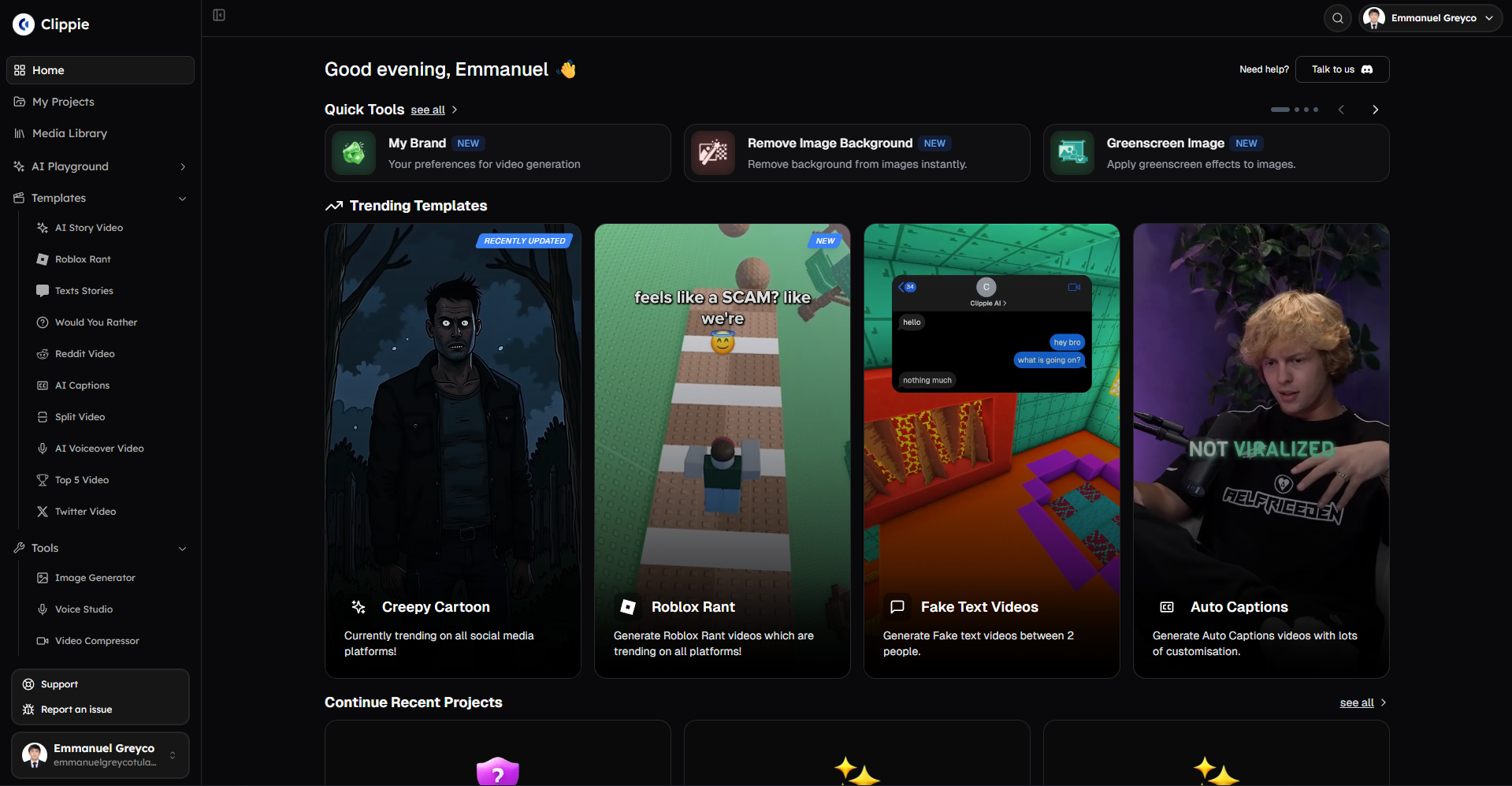
Clippie AI: No template system, complete creative control. The creator defines the visual aesthetic through image and footage prompts, building a custom visual identity for the channel rather than working within a shared template framework. This requires more intentional visual decision-making but produces output that is visually unique to the channel.

Production Workflow Integration
InVideo AI: InVideo handles template selection, stock footage matching, voiceover, and export within a single platform. The workflow is streamlined for template-based production.
Clippie AI: Voiceover, AI image generation, VEO3.1/Seedance footage generation, auto-captioning, and multi-format export within one platform. No external tools required for any production stage. No template framework constraining the output.
Export Format and Platform Support
InVideo AI: InVideo exports in standard video formats for social media distribution. Specific aspect ratio options and format details should be verified directly on the platform.
Clippie AI:
9:16 vertical for TikTok, Shorts, and Reels
16:9 horizontal for YouTube long-form
Both formats from the same production session
MP4, 1080p minimum, no watermarks
Pricing
InVideo AI: InVideo operates on a freemium model with paid plan tiers. Specific current pricing should be verified directly on InVideo's website. InVideo's free tier produces videos with watermarks and limited features — meaningful production requires a paid plan.
Clippie AI:
Lite: $19.99/month
30 mins video export (~3–5 videos/month)
30 mins AI voice generation
30 mins speech-to-subtitles
100 AI images
1 custom voice
Captions in 102+ languages
50+ AI voices
24/7 support
Creator: $34.99/month
120 mins video export (~8–12 videos/month)
120 mins AI voice generation
120 mins speech-to-subtitles
500 AI images
10 custom voices
Captions in 102+ languages
50+ AI voices
24/7 support
Pro: $69.99/month
250 mins video export (~15–25 videos/month)
250 mins AI voice generation
250 mins speech-to-subtitles
1,000 AI images
30 custom voices
Captions in 102+ languages
50+ AI voices
24/7 support
No free tier is available on Clippie AI.
The value comparison:
Clippie AI's plans include AI video generation (VEO3.1, Seedance), AI image generation, custom voice cloning, and 102+ language captioning within the subscription price. If InVideo requires additional tool subscriptions for AI footage generation or custom voice cloning, the effective per-video cost comparison shifts in Clippie AI's favour at equivalent production volumes.

4. Other InVideo AI Alternatives Worth Evaluating in 2026
Alternative 1: Clippie AI (Primary Recommendation)
The strongest recommendation for faceless YouTube and TikTok creators who want to move beyond template-based production. Custom AI footage generation, integrated voiceover with custom cloning, 102+ language captioning, and complete workflow integration at $19.99–$69.99/month.
Best for: Faceless channel creators, multi-channel operators, content agencies.
Alternative 2: Pictory AI
Pictory AI is a text-to-video repurposing tool, strong for converting existing written content into video using stock footage and AI voiceover. Like InVideo, it is stock-dependent and template-influenced, but its repurposing workflow is specifically designed for creators with significant written content archives.
Best for: Creators with existing blog, article, or podcast content who want to convert it into video efficiently.
Limitation: Stock footage dependency creates the same visual homogeneity problem as InVideo for long-term channel building.
Alternative 3: Synthesia
Synthesia is an enterprise AI avatar platform producing presenter-format videos with realistic digital human avatars. It is designed for corporate training and internal communications rather than faceless narration-over-visuals channel production.
Best for: Enterprise teams producing corporate training, onboarding, and internal communications content.
Limitation: Synthesia's avatar-presenter format, enterprise pricing, and low monthly video capacity make it unsuitable for faceless YouTube channel production at creator price points.
Alternative 4: Lumen5
Lumen5 is a social media video creation tool that converts blog posts and text content into short video clips using stock footage. It shares InVideo's text-to-video repurposing positioning but with a stronger social media marketing focus.
Best for: Social media marketers repurposing written content into short-form social media posts.
Limitation: Lumen5's stock dependency and social media marketing orientation make it less suitable for faceless YouTube channel production at scale. No AI video generation integration.
Alternative 5: Canva Video
Canva's video creation tools provide template-based video production integrated within Canva's broader design platform. For creators already using Canva for thumbnails and graphics, adding Canva video to the workflow is a natural extension.
Best for: Creators already in the Canva ecosystem who want basic video creation without adopting a separate platform.
Limitation: Canva video is a design-first tool, it does not provide AI voiceover, AI video generation, or the integrated production workflow that faceless channel production requires. It is a supplementary tool rather than a primary production platform.

5. How to Transition From InVideo AI to a Custom AI Production Workflow
Moving from InVideo's template-based workflow to Clippie AI's custom production workflow is a mindset shift as much as a tool change. The efficiency of templates is traded for the creative control and visual distinctiveness of custom generation. Here is how to make that transition without disrupting the publishing schedule.
Phase 1: Understanding the Workflow Difference (Before Starting)
The most important preparation is understanding what changes:
InVideo workflow: Select template → input script → platform assembles footage → review → export
Clippie AI workflow: Input script → generate voiceover → write image/footage prompts → generate visuals → review captions → export
The Clippie AI workflow requires one additional intentional step, writing visual prompts rather than relying on automatic template matching. This step takes 5–8 minutes per video once a prompt library is established, and it is what produces the custom visual output that differentiates the channel.
Phase 2: Account Setup and Voice Selection (Day 1)
Create your Clippie AI account:
Start on the Creator plan ($34.99/month) if you are currently producing 8+ videos per month on InVideo. This provides the capacity to maintain production volume through the transition without restrictions.
Voice selection:
Browse Clippie AI's 50+ voice library
Test 3–4 candidates on the opening hook paragraph of a recent script
Select the voice that best matches your channel's tone, authoritative, conversational, energetic, or warm
If custom voice cloning is important to the channel's audio identity, record 2–3 minutes of clean audio and upload through the cloning feature
Phase 3: Visual Prompt Library Development (Days 2–3)
Developing a visual prompt library is the most important preparation step for creators transitioning from template-based production. It converts the prompt-writing step from a time-intensive creative task to a 3-minute template selection and customisation.
For each recurring visual category in the channel, write a template prompt:
Finance and business content:
"Clean professional editorial illustration of a financial environment, dark navy and charcoal tones, minimal design, no text in image, high quality"
"Aspirational lifestyle illustration showing financial freedom concept, warm tones, editorial aesthetic, high quality"
"VEO3.1: Slow cinematic pan through a professional business district, golden hour light, photorealistic 4K, documentary aesthetic"
Motivational content:
"Slow cinematic aerial shot over mountain landscape at sunrise, aspirational and dramatic, photorealistic 4K, VEO3.1"
"Dark editorial illustration of a lone figure walking toward distant light, symbolic and atmospheric, cinematic quality"
True crime and mystery:
"Dark atmospheric illustration of an empty investigation room at night, single lamp, muted colour palette, documentary aesthetic, high quality"
"Seedance: Cinematic dramatic shot of an empty corridor at night, slow push-in, cool blue tones, unsettling atmosphere, feature film aesthetic"
Build 10–15 prompts covering the main visual categories for the channel. This library is the production efficiency foundation that makes Clippie AI as fast as InVideo for experienced users.
Phase 4: Parallel Production Period (Days 4–10)
During the transition, run both platforms briefly in parallel:
Continue publishing using InVideo for the first week to maintain posting schedule
Produce 2–3 test videos in Clippie AI using existing scripts
Compare output quality, production time, and visual distinctiveness between the two platforms
Refine the visual prompt library based on test production learnings
Phase 5: Full Transition (Day 10 Onward)
Once the test phase confirms Clippie AI meets quality requirements:
Move all production to Clippie AI
Cancel InVideo at the next billing cycle
Maintain the weekly production routine with the Clippie AI workflow
Content archive: All InVideo-produced videos remain live on YouTube, TikTok, and other platforms, switching tools does not affect existing published content.

6. Which Clippie AI Plan Is Right for Creators Switching From InVideo
Lite Plan ($19.99/month), Right For:
Creators currently producing 3–5 videos per month on InVideo
Channels posting once per week at moderate video lengths
Creators who want to evaluate the custom workflow before committing to higher capacity
Specifications:
30 mins video export (~3–5 videos/month)
30 mins AI voice generation
30 mins speech-to-subtitles
100 AI images
1 custom voice
Captions in 102+ languages
50+ AI voices
24/7 support
Creator Plan ($34.99/month), Right For:
Creators currently producing 8–12 videos per month
Channels posting 2–3 times per week across YouTube and short-form platforms
Creators who want 10 custom voice clones for multiple channels or voice variation testing
Specifications:
120 mins video export (~8–12 videos/month)
120 mins AI voice generation
120 mins speech-to-subtitles
500 AI images
10 custom voices
Captions in 102+ languages
50+ AI voices
24/7 support
This is the most commonly recommended plan for InVideo switchers, it provides the capacity for consistent weekly production on both YouTube and short-form platforms, with 10 custom voices for channel identity development.
Pro Plan ($69.99/month), Right For:
High-volume creators producing 15–25 videos per month
Multi-channel operators managing 3–5 channels from one account
Content agencies managing AI video production for multiple clients
Specifications:
250 mins video export (~15–25 videos/month)
250 mins AI voice generation
250 mins speech-to-subtitles
1,000 AI images
30 custom voices
Captions in 102+ languages
50+ AI voices
24/7 support
No free tier is available on Clippie AI.
💡 For the complete AI tool landscape that positions Clippie AI within the broader faceless video market, read our guide on the best AI video tools for faceless content creators in 2026
💡 For the complete production workflow that replaces InVideo's template system with a custom Clippie AI operation, read our guide on the ultimate faceless content workflow from idea to viral video
💡 Start building visually distinctive faceless content with Clippie AI today →
Conclusion: Templates Got You Started, Custom AI Production Is What Grows You
InVideo AI is a legitimate tool for getting started with video production quickly. Templates reduce the decisions that slow new creators down. Stock footage provides visual content without requiring generation skills.
But templates are a starting point, not a growth strategy. The channels that build significant audiences in 2026 look different from each other. They have visual identities that are recognisably their own. They use footage that no stock library contains. They have narrator voices that audiences associate specifically with that channel and no other.
Clippie AI's custom production workflow, AI-generated footage from VEO3.1 and Seedance, custom voice cloning, and 102+ language captioning, is the infrastructure for building that distinctive channel identity. The visual prompt library replaces the template, but the output belongs to the channel in a way that a shared template never can.
7. Frequently Asked Questions
Q1: What is InVideo AI primarily used for and why are faceless creators looking for alternatives?
InVideo AI is a template-based text-to-video platform primarily used for fast social media content creation, marketing video production, and YouTube content using pre-built visual frameworks and stock footage. Faceless creators look for alternatives when they find that template-based production creates visual homogeneity with other channels using the same platform, when stock footage limits the visual distinctiveness the channel needs to grow, when they require AI video generation (VEO3.1, Seedance) for custom cinematic footage not available in stock libraries, or when they need deeper custom voice cloning for channel audio identity.
Q2: Is Clippie AI harder to use than InVideo AI for a creator who is not technically experienced?
Clippie AI requires one additional skill that InVideo does not, writing visual prompts for image and footage generation. This is the trade-off for custom visual output rather than automatic template matching. The prompt-writing skill develops quickly, most creators feel confident with the process within 3–5 production sessions. The visual prompt library approach described in the transition section further reduces this friction by converting prompt writing into template selection and customisation rather than starting from scratch each time. Outside of visual prompting, Clippie AI's production interface is self-service and accessible to non-technical creators.
Q3: How does Clippie AI's visual output quality compare to InVideo's stock footage?
Clippie AI's visual output, AI-generated images and VEO3.1/Seedance footage, is custom-generated for each video and does not appear in any stock library. InVideo's visual content is drawn from stock libraries shared by thousands of other creators. For visual distinctiveness and channel differentiation, custom AI-generated footage is a measurable advantage over stock media, particularly in established niches where stock footage aesthetics are familiar to the audience. For pure production speed on simple content types, InVideo's automatic template matching is faster in the initial sessions before the Clippie AI prompt library is established.
Q4: Can I use both InVideo AI and Clippie AI simultaneously during the transition period?
Yes, the parallel production period in the transition plan specifically recommends this. Continuing to publish InVideo-produced content during the first 7–10 days while producing test videos in Clippie AI preserves publishing schedule consistency during the learning phase. Once the Clippie AI workflow is producing output at the required quality, cancel the InVideo subscription at its next billing cycle. Running both subscriptions briefly during transition is a small additional cost relative to the risk of a publishing gap during the transition.
Q5: Does switching from InVideo to Clippie AI affect my existing published videos?
No. All previously published videos produced through InVideo remain live on YouTube, TikTok, and other distribution platforms. Switching production tools only affects future videos. Existing content continues generating views, watch hours, and affiliate revenue regardless of which tool produced it. The transition is purely a production workflow change for future content.
Q6: Which Clippie AI plan is the best replacement for InVideo for a creator posting twice per week?
The Creator plan at $34.99/month is the right replacement for a creator posting twice per week (approximately 8 videos per month). Its 120-minute export capacity supports 8–12 videos monthly at average lengths of 10–15 minutes, the 500 AI images cover visual production at this volume, and the 10 custom voice slots allow custom voice cloning for channel identity alongside voice variation testing. Creators posting more frequently, 3+ videos per week, should evaluate the Pro plan at $69.99/month for its 250-minute capacity and 30 custom voice slots.
Read more

Best AI Video Tools for Faceless Content in 2026
The right tool depends on what you make: story shorts, prompt-to-video, repurposing, captions or avatars. Honest picks for each, plus where each one fails.

The Psychology Behind Viral Short-Form Videos, Minus the Myths
Viewers decide fast, but not for the reasons most guides repeat. Seven patterns behind videos people finish, plus how to read your own retention curve.

Are AI Story Videos Still Worth Making in 2026?
Two AI story videos can use the same tool and get opposite results. What changed in 2026, which formats hold attention, and what YouTube won't monetize.