
Best Opus Clip Alternatives in 2026, AI Tools That Do More Than Just Clip Your Videos
Find the best Opus Clip alternatives in 2026 for faceless creators, why clipping tools fall short for original AI production, full Clippie AI vs Opus Clip comparison, migration guide, and plan recommendations.
Searching for the best Opus Clip alternatives in 2026?
Opus Clip solves one specific problem very well: taking existing long-form video footage and identifying the most engaging moments to clip into short-form content automatically. If that is the entire scope of what you need, Opus Clip delivers on its promise.
But for faceless content creators who need to produce original AI-generated content from scripts, not repurpose existing camera footage, Opus Clip is not the right tool. It requires source footage that faceless creators do not have. And it does not handle voiceover, captioning at scale, AI visual generation, or the complete production workflow that a serious faceless channel requires.
This guide covers what Opus Clip does well, where its single-function model limits faceless creators, how Clippie AI compares across every relevant feature, and what alternatives exist for different creator needs.
Executive Summary
This guide is for faceless content creators evaluating Opus Clip alternatives in 2026. It covers what Opus Clip is designed for and where its clipping-only model falls short for creators who need to originate content, why a complete AI production platform is fundamentally different from a clipping tool, a full comparison between Clippie AI and Opus Clip, other alternatives worth evaluating, how to build a complete faceless production workflow in Clippie AI, and the right plan for creators at different production volumes. By the end, you will know whether Opus Clip serves your needs or whether a different platform better fits your production model.
Table of Contents
What Opus Clip Does and Where Its Single-Function Model Limits Faceless Creators
Why Clipping Existing Footage Is Not Enough, What a Complete AI Production Platform Provides
Clippie AI vs Opus Clip, Full Feature and Workflow Comparison for Faceless Creators
Other Opus Clip Alternatives Worth Evaluating in 2026
How to Replace Opus Clip With a Full Faceless Production Workflow in Clippie AI
Which Clippie AI Plan Is Right for Creators Switching From Opus Clip
Frequently Asked Questions

1. What Opus Clip Does and Where Its Single-Function Model Limits Faceless Creators
Opus Clip is an AI-powered video clipping tool that analyses existing long-form video content, recorded interviews, podcasts with video, webinars, recorded presentations, and automatically identifies the most engaging moments to extract as short-form clips. It then applies captions, reformats the clip to vertical 9:16, and exports it ready for TikTok, YouTube Shorts, and Instagram Reels.
What Opus Clip Is Designed For
Opus Clip's primary use cases:
Podcasters who record video podcasts and want clips for social media distribution
Face-on-camera creators who produce long-form YouTube videos and want automated short-form repurposing
Interview-format content creators who have hours of recorded footage to mine for highlights
Business and thought leadership creators who record webinars and presentations and want clips distributed on social channels
What Opus Clip does well:
Accurately identifies high-engagement moments in recorded footage using AI analysis
Applies captions to the clips automatically
Reformats horizontal footage to vertical for short-form platforms
Saves significant manual editing time for creators who have existing recorded footage

Where Opus Clip's Model Falls Short for Faceless Creators
The foundational limitation of Opus Clip for faceless creators is structural: Opus Clip requires existing footage to clip from. Faceless creators do not have existing footage. They produce content from scripts using AI tools, and they need a platform that takes a script and produces a complete video, not a platform that extracts clips from a recording they never made.
Limitation 1: Requires Human-Recorded Source Footage
Opus Clip's entire workflow depends on importing existing video recordings, typically a creator talking to camera, a podcast recording, or a webinar. Faceless creators who produce content through AI voiceover over AI-generated visuals do not have this source footage.
A faceless creator cannot use Opus Clip to produce content from a script because Opus Clip does not generate voiceover, does not generate visuals, and does not produce complete original videos. It only extracts from what already exists.
Limitation 2: No AI Voiceover or Voice Cloning
Opus Clip does not generate voiceover. It transcribes and captions existing audio, it cannot generate a narrated AI voiceover from a script. Faceless creators whose entire content production depends on AI voiceover generation have no use for this capability within Opus Clip.
Limitation 3: No AI Visual Generation
Opus Clip does not generate images or video footage. It works with the visual content that already exists in the source recording, reformatting and cropping it. There is no VEO3.1 integration, no Seedance integration, and no AI image generation within the platform.
Limitation 4: No Long-Form Production Capability
Opus Clip produces clips, it does not produce complete videos. A faceless YouTube creator needs to produce 10–20 minute complete videos with scripted narration, visual content, and captions. Opus Clip cannot produce this output regardless of what footage is provided to it.
Limitation 5: Limited Value Without a Pre-Existing Content Library
Opus Clip's value proposition assumes the creator already has a substantial library of recorded long-form content to mine. A new creator with no recording history gets minimal value from a clipping tool, they need to produce original content before anything can be clipped.
Who Opus Clip Is Actually Right For
Opus Clip is the right tool for:
Video podcast creators who record 60-90 minute video podcast episodes and want AI to identify the best 5–10 short-form clips automatically
Face-on-camera YouTube creators with an existing library of long-form recordings they have not yet repurposed
Business creators who have a library of recorded webinars, presentations, or talks they want to distribute as short-form content
It is not the right tool for faceless content creators who originate content from scripts using AI production tools.

2. Why Clipping Existing Footage Is Not Enough, What a Complete AI Production Platform Provides
Understanding why the clipping function alone is insufficient for faceless creator needs clarifies what a complete AI production platform must provide.
The Complete Faceless Video Production Pipeline
Producing a publish-ready faceless video requires seven distinct production stages:
Stage 1: Script: A written script that provides the narration content for the video. For faceless creators, this is the primary content input, there is no recording.
Stage 2: AI Voiceover: Generating natural-sounding narration from the script text, using a consistent voice that matches the channel's audio identity.
Stage 3: Visual Generation: Creating the visual content that accompanies the narration, either AI-generated images (static) or AI-generated footage (motion) from VEO3.1 or Seedance.
Stage 4: Assembly: Combining the voiceover audio with the visual content in a synchronised production.
Stage 5: Auto-Captioning: Generating and syncing captions to the voiceover for sound-off viewers and multi-language distribution.
Stage 6: Export: Outputting the complete video in the correct format and aspect ratio for each distribution platform.
Stage 7: Quality Review: Checking audio sync, caption accuracy, visual quality, and export specifications before publishing.
A clipping tool covers approximately Stage 5 (captioning) and Stage 6 (format export), only when applied to footage that has already completed Stages 1–4 through some other means. It does not replace or accelerate Stages 1–4 for faceless creators.
A complete AI production platform like Clippie AI handles all seven stages within a single integrated workflow.

The Workflow Efficiency Difference
Creator using Opus Clip:
Must first produce long-form content through some other means (recording on camera, hiring a presenter, managing a video production process), then import that footage to Opus Clip for clipping.
For a faceless creator trying to use Opus Clip, this means:
Building a separate production system for original content (all seven stages above without Opus Clip)
Then paying for Opus Clip to clip that content
Creator using Clippie AI:
Handles all seven stages within one platform, from script to exported video in one integrated session. Repurposing into short-form clips is an additional export step in the same session, not a separate tool requirement.
The Cost Comparison
A faceless creator who attempts to use Opus Clip needs to separately acquire:
An AI voiceover tool (ElevenLabs or equivalent): $11–$22/month
An AI image generation tool: varies
A video editor or assembly platform: varies
Opus Clip for clipping: varies by plan
Combined monthly cost for this multi-tool approach: $60–$120+ depending on tier selections.
Clippie AI: $19.99–$69.99/month, covering all production stages including clipping capability through its multi-format export system.
3. Clippie AI vs Opus Clip, Full Feature and Workflow Comparison for Faceless Creators
AI Voiceover Generation
Opus Clip: No AI voiceover generation. Opus Clip transcribes existing audio, it does not generate narration from text scripts.
Clippie AI:
50+ AI voices for narration generation
Custom voice cloning: 1, 10, or 30 voices by plan
Voiceover generated from pasted script in 2–5 minutes
Integrated within the production workflow, no separate tool required
AI Visual and Video Generation
Opus Clip: No AI visual or video generation. Opus Clip processes and reformats existing video footage, it does not generate images or footage from text prompts.
Clippie AI:
VEO3, VEO3.1, and Seedance 1.0 integration for cinematic AI footage
Native AI image generation for static visual content
Custom visual generation per video, no stock footage dependency
Auto-Captioning
Opus Clip: Auto-captioning from existing audio, a core feature. Opus Clip generates captions from imported video audio and applies them to the clip. Language support should be verified directly on the platform.
Clippie AI:
Speech-to-subtitles auto-synced to AI voiceover
102+ language support
No manual timing required
Caption generation integrated within the production workflow
Comparison note: Both platforms provide auto-captioning. Opus Clip's captioning applies to imported footage; Clippie AI's captioning applies to AI-generated voiceover. For faceless creators, Clippie AI's captioning is the relevant capability, Opus Clip's captioning cannot be applied to content that was generated rather than recorded.
Long-Form to Short-Form Repurposing
Opus Clip: This is Opus Clip's primary differentiating capability, AI analysis of long-form recordings to identify and extract the most engaging moments as short-form clips. For face-on-camera creators with a substantial video library, this is genuinely valuable.
Clippie AI: Short-form repurposing of Clippie AI-produced content requires the creator to identify clip moments from the transcript (using the AI transcript analysis method covered in the repurposing guide) and export the clip section in 9:16 format. This is a manual identification step rather than an automated AI analysis step, which is Opus Clip's specific advantage for face-on-camera creators with large footage libraries.
Comparison note: For faceless creators who originate content through Clippie AI's workflow, repurposing into short-form clips takes 15–20 minutes using the transcript-based identification method. For face-on-camera creators with hours of existing footage, Opus Clip's automated moment identification saves significant manual clip-finding time.

Original Content Production
Opus Clip: No original content production capability. Opus Clip cannot produce a complete video from a script, it only processes existing footage.
Clippie AI: Complete original content production, from script input to export-ready video, in one integrated session. This is Clippie AI's primary use case and the primary requirement for faceless content creators.
Export Formats
Opus Clip: 9:16 vertical export for short-form platforms, this is the primary output format.
Clippie AI:
9:16 vertical for TikTok, Shorts, and Reels
16:9 horizontal for YouTube long-form
Both formats from the same production session
Pricing
Opus Clip: Opus Clip uses a credit-based or subscription pricing model. Specific current plan pricing should be verified directly on Opus Clip's website, as this evolves. The platform is primarily priced around the number of hours of source footage that can be processed per month.
Clippie AI:
Lite: $19.99/month
30 mins video export (~3–5 videos/month)
30 mins AI voice generation
30 mins speech-to-subtitles
100 AI images
1 custom voice
Captions in 102+ languages
50+ AI voices
24/7 support
Creator: $34.99/month
120 mins video export (~8–12 videos/month)
120 mins AI voice generation
120 mins speech-to-subtitles
500 AI images
10 custom voices
Captions in 102+ languages
50+ AI voices
24/7 support
Pro: $69.99/month
250 mins video export (~15–25 videos/month)
250 mins AI voice generation
250 mins speech-to-subtitles
1,000 AI images
30 custom voices
Captions in 102+ languages
50+ AI voices
24/7 support
No free tier is available on Clippie AI.

4. Other Opus Clip Alternatives Worth Evaluating in 2026
Alternative 1: Clippie AI (Primary Recommendation for Faceless Creators)
As covered throughout this guide. The correct replacement for faceless creators who need original content production rather than footage clipping. Complete production platform: AI voiceover, visual generation, captioning, and export.
Best for: Faceless YouTube and TikTok channel creators, multi-channel operators, content agencies.
Alternative 2: Descript
Descript is a video and podcast editing platform with AI features including transcription, filler-word removal, and automated clip identification. It is a more complete production tool than Opus Clip, covering editing, captioning, and some automation, but still requires recorded human footage as input.
Best for: Podcast creators and face-on-camera YouTubers who want more editing control than Opus Clip offers alongside automated clipping.
Limitation for faceless creators: Like Opus Clip, Descript requires existing recorded footage. It does not generate voiceover, AI images, or footage from scripts.
Alternative 3: Submagic
Submagic is a caption-focused tool specifically designed for short-form content, it produces animated, styled captions for existing video content with a TikTok-native aesthetic.
Best for: Creators who have recorded footage and want premium animated caption styling that standard auto-captioning tools do not provide.
Limitation for faceless creators: Submagic is a captioning add-on, not a complete production platform. It requires existing footage and does not handle any other production stage.
Alternative 4: Vidyo.ai
Vidyo.ai is an AI-powered video repurposing platform similar in concept to Opus Clip, it analyses long-form video content and automatically generates short-form clips. It includes additional features around scheduling and multi-platform distribution.
Best for: Face-on-camera and podcast creators who want automated clip generation with built-in distribution scheduling.
Limitation for faceless creators: Vidyo.ai requires existing recorded footage as input and does not handle original AI content production.
Alternative 5: Pictory AI
Pictory AI converts existing text content (blog posts, articles) and existing video recordings into short-form clips using stock footage and AI voiceover. It bridges the gap between pure clipping tools and production platforms, but relies on stock footage rather than custom AI-generated footage.
Best for: Creators who want to convert existing written content into video format efficiently and are comfortable with stock footage visuals.
Limitation for faceless creators: Stock footage dependency limits visual distinctiveness. No VEO3.1 or Seedance integration for custom cinematic footage.
5. How to Replace Opus Clip With a Full Faceless Production Workflow in Clippie AI
For creators who have been using Opus Clip for repurposing alongside another tool for original production, transitioning to Clippie AI consolidates both functions into a single platform and significantly improves the original content production stage.
Phase 1: Understanding the Transition (Before Starting)
The key understanding: transitioning from Opus Clip to Clippie AI is not a like-for-like tool swap. It is a workflow consolidation, replacing a multi-tool setup (original production tool + Opus Clip for clipping) with a single integrated platform that handles both.
What changes:
Original production (voiceover, visuals, assembly) moves entirely into Clippie AI
Short-form clip repurposing uses Clippie AI's transcript-based clip identification and 9:16 export rather than Opus Clip's AI clip analysis
What improves:
Visual quality, VEO3.1 and Seedance replace stock footage or existing camera footage
Production efficiency, all production stages in one session without file transfers
Custom voice identity, Clippie AI's voice cloning creates proprietary channel audio
Multi-language distribution, 102+ language captioning without additional tools
Phase 2: Account Setup and Voice Selection (Day 1)
Create Clippie AI account:
Start on the Creator plan for established creators, its 120-minute capacity handles 8–12 videos per month at the standard automation channel pace.
Voice selection and cloning:
Browse the 50+ voice library and test candidates on a script hook
If the channel has previously used a specific narrator style, match it in the voice selection
Set up custom voice cloning if proprietary channel audio identity is a priority
Phase 3: First Production Sessions (Days 2–5)
Complete 3 full production sessions using existing or upcoming scripts:
Session 1: Short-form video (60 seconds): Script → voiceover → 3 images → captions → 9:16 export. Assess the complete workflow.
Session 2: Long-form video (10 minutes): Script → voiceover → 5 VEO3.1/Seedance clips + 4 images → captions → 16:9 export. Assess the visual quality and production time.
Session 3: Repurposing clip from Session 2: Use the transcript-based clip identification method to extract the best 60-second moment from Session 2's video. Export as 9:16. Compare the process to Opus Clip's automated approach.
Phase 4: Full Workflow Transition (Day 7 Onward)
Once the Clippie AI workflow is producing output at the required quality:
Move all original content production to Clippie AI
Use Clippie AI's transcript and 9:16 export for short-form repurposing
Cancel Opus Clip subscription at the next billing cycle if the repurposing functionality is no longer required
Note on retaining Opus Clip:
If the channel has a significant library of face-on-camera recorded content that benefits from Opus Clip's automated moment identification, and the channel is transitioning from face-on-camera to faceless production rather than starting fresh, consider retaining Opus Clip briefly to process the existing footage library while building the new faceless production system in Clippie AI. Both tools serve different functions and are not directly in conflict for this transitional use case.
The Faceless Short-Form Repurposing Method Without Opus Clip
The specific Opus Clip function that some creators will miss is automated moment identification, Opus Clip's AI analyzes hours of footage and surfaces the best clips without manual review.
The Clippie AI equivalent is the transcript-based identification method:
Step 1: Export the transcript from the completed Clippie AI long-form video.
Step 2: Paste into ChatGPT with the prompt: "Read this video transcript and identify the 5 best moments for a 60-second TikTok clip. For each, note the approximate word position, the hook line, and why it works as standalone content."
Step 3: Review the 5 suggestions and select the 2–3 strongest.
Step 4: Re-export the selected section as a 9:16 clip from Clippie AI.
Total time: 15–20 minutes for 3 clips. This compares to Opus Clip's automated identification (faster for long raw footage), but for Clippie AI-produced content of 10–15 minutes, the time difference is modest.

6. Which Clippie AI Plan Is Right for Creators Switching From Opus Clip
Lite Plan ($19.99/month)
Right for: Creators who were using Opus Clip for modest repurposing volumes (3–5 clips per month) and are transitioning to building a faceless channel from scratch with a light publishing schedule.
Specifications:
30 mins video export (~3–5 videos/month)
30 mins AI voice generation
30 mins speech-to-subtitles
100 AI images
1 custom voice
Captions in 102+ languages
50+ AI voices
24/7 support
Creator Plan ($34.99/month), Most Common Starting Point
Right for: Creators who were using Opus Clip alongside another production tool and are consolidating into a single platform for both original production and short-form repurposing at a consistent weekly volume.
Specifications:
120 mins video export (~8–12 videos/month)
120 mins AI voice generation
120 mins speech-to-subtitles
500 AI images
10 custom voices
Captions in 102+ languages
50+ AI voices
24/7 support
Pro Plan ($69.99/month)
Right for: High-volume creators or agencies who need both high-volume original production and extensive short-form repurposing across multiple channels.
Specifications:
250 mins video export (~15–25 videos/month)
250 mins AI voice generation
250 mins speech-to-subtitles
1,000 AI images
30 custom voices
Captions in 102+ languages
50+ AI voices
24/7 support
No free tier is available on Clippie AI.
💡 For the complete repurposing workflow that replaces Opus Clip's clip identification function for Clippie AI-produced content, read our guide on How to Start a Faceless YouTube Automation Channel in 2026
💡 For the full AI video tool landscape that positions Clippie AI alongside all major platforms in this category, read our guide on the best AI video tools for faceless content creators in 2026
💡 Start building your complete faceless production workflow with Clippie AI today →
Conclusion: A Clipping Tool and a Production Platform Are Not the Same Thing
Opus Clip is a well-designed tool that does exactly what it claims, it identifies and extracts the best moments from existing long-form video recordings and formats them for short-form distribution. For face-on-camera creators and podcasters with substantial footage libraries, it delivers genuine time savings.
For faceless content creators, it is the wrong category of tool entirely. Faceless creators do not need a tool that extracts clips from recordings they never made. They need a platform that produces complete original videos from scripts, with AI voiceover, AI-generated visuals, integrated captioning, and multi-format export, and enables short-form repurposing of that produced content within the same workflow.
Clippie AI is that platform. The distinction is not a feature comparison, it is a fundamental difference in what problem each tool is designed to solve.
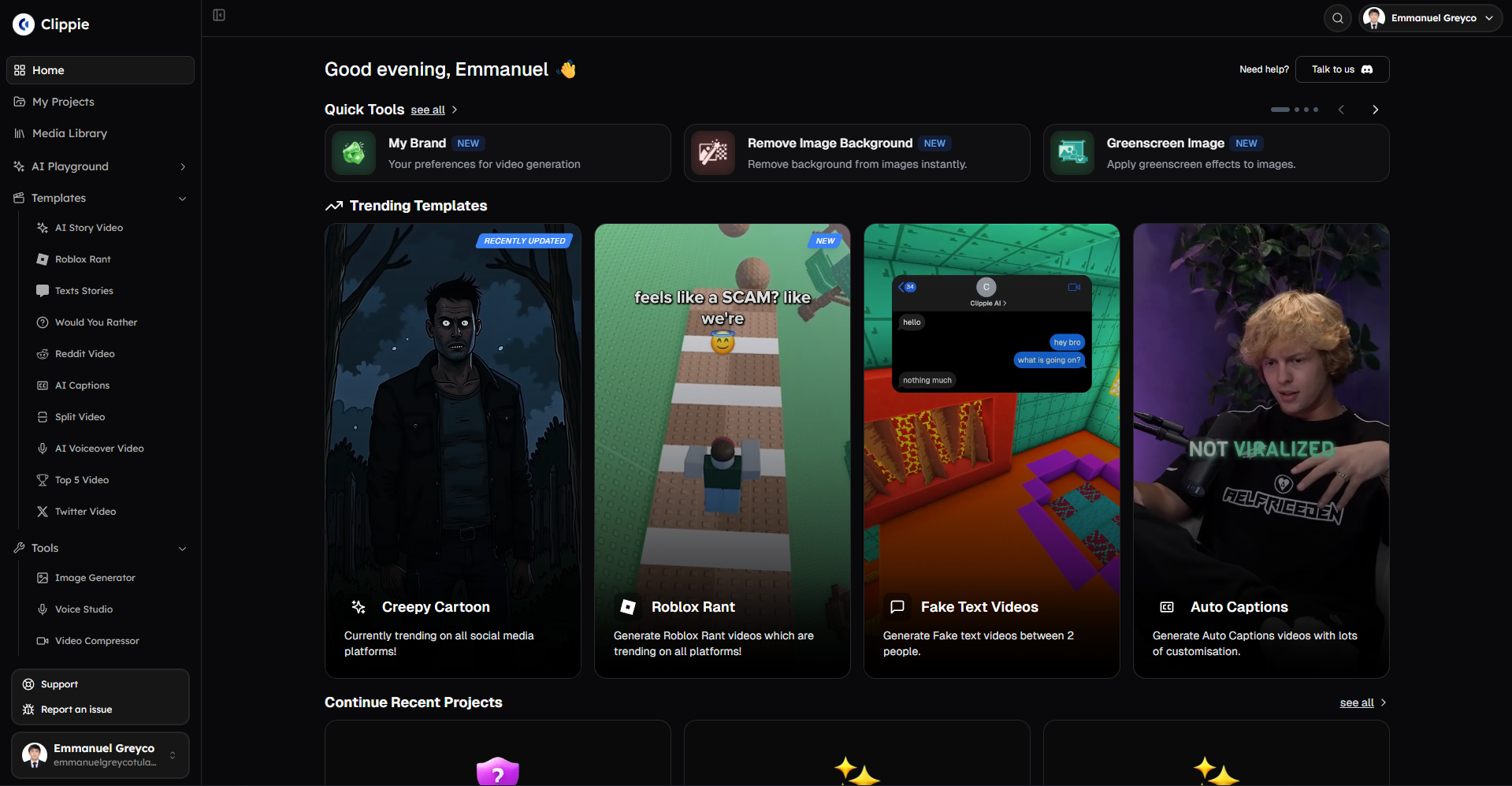
Start building your complete faceless production workflow with Clippie AI today →
7. Frequently Asked Questions
Q1: What is Opus Clip and why are faceless creators looking for alternatives?
Opus Clip is an AI-powered video clipping tool that analyses existing long-form video recordings and automatically identifies and extracts the most engaging moments as short-form clips. Faceless creators look for alternatives because Opus Clip requires existing recorded footage as input, and faceless creators originate content from scripts using AI tools rather than recording footage on camera. Opus Clip cannot generate voiceover, AI visuals, or complete original videos from scripts, making it structurally unsuitable for the faceless content creation workflow regardless of its clipping quality.
Q2: Can Clippie AI replace Opus Clip's automated clip identification feature?
Clippie AI does not replicate Opus Clip's automated AI analysis of raw footage hours to surface the best clips. The equivalent function in Clippie AI is the transcript-based clip identification method, using the generated transcript and ChatGPT to identify the 3–5 best repurposing moments from a completed video. This takes 10–15 minutes per video rather than automated seconds. For faceless creators whose content is 10–15 minutes of produced video (not hours of raw footage), the time difference is modest and the transcript method is a workable replacement. For creators with hours of raw footage to process, Opus Clip's automated identification is genuinely more efficient.
Q3: Do I need both Clippie AI and Opus Clip in my production workflow?
Not if you are a faceless creator who originates all content through AI production. In this case, Clippie AI's production workflow and transcript-based clip extraction method covers everything Opus Clip would provide, plus all the upstream production stages Opus Clip cannot handle. However, a creator who is transitioning from face-on-camera content to faceless content may benefit from running both temporarily, Opus Clip to process existing camera footage while Clippie AI handles new faceless content production. Once the existing footage library is processed, Opus Clip is no longer needed.
Q4: Is Clippie AI more expensive than Opus Clip for equivalent functionality?
This comparison is difficult to make precisely because the tools serve different functions. A faceless creator using Opus Clip alongside other tools for original production typically spends $60–$120+ per month across multiple subscriptions. Clippie AI's Creator plan at $34.99/month covers all production stages, voiceover, visuals, captioning, export, and short-form repurposing, within one subscription. For faceless creators, Clippie AI is almost certainly less expensive than the Opus Clip plus other tools combination, while providing substantially more production capability.
Q5: What types of creators should continue using Opus Clip rather than switching to Clippie AI?
Creators who should continue with Opus Clip: video podcast hosts with substantial recorded episode libraries who want automated clip extraction; face-on-camera YouTube creators with hours of weekly recordings who want AI to surface the best short-form moments; business content creators who record webinars, presentations, and talks that need automated short-form clip generation. These use cases all involve large volumes of existing recorded footage, the specific context where Opus Clip's automated analysis provides genuine time savings that manual or transcript-based clip identification cannot match.
Q6: Which Clippie AI plan is the right starting point for a creator switching from Opus Clip?
The Creator plan at $34.99/month is the right starting point for most creators switching from Opus Clip. It provides the complete production pipeline, voiceover with 10 custom voice clones, AI image generation (500 images), VEO3.1 and Seedance footage generation, 102+ language captioning, and 120-minute export capacity, sufficient for 8–12 videos per month including both long-form YouTube and short-form clip repurposing. Creators who were using Opus Clip for very light repurposing volumes (3–5 clips per month total) can start with the Lite plan at $19.99/month during the evaluation period.
Make an AI story video
Write a script or let AI write one. Clippie turns it into a narrated video with AI scenes, voiceover and captions.
Read more

How to Make Top 5 Ranking Videos in 2026 (Step-by-Step)
Build ranking Shorts that can still earn: pick a debatable topic, set clear criteria, source clips you may use, script the countdown, add your commentary.

How to Create Short-Form Videos Using AI: 8 Steps (2026)
A beginner workflow for AI videos on TikTok, Reels and Shorts: pick a format, script a hook, add visuals, voice and captions, export at 9:16, label AI.

7 Free CapCut Alternatives for Short-Form Video (2026)
Compare Edits, YouTube Create, VN, Clipchamp, Canva, DaVinci Resolve and Shotcut: what each gives free users, what it caps first and where it falls short.