
How to Start a Faceless YouTube Automation Channel in 2026 (Zero Experience Required)
Learn how to start a faceless YouTube automation channel in 2026 with zero experience, niche selection, AI tool stack, step-by-step first workflow, monetisation roadmap, and Clippie AI production system.

Searching for how to start a faceless YouTube automation channel in 2026 with no prior experience?
The barrier to entry has never been lower. In 2026, you do not need a camera. You do not need a microphone. You do not need video editing skills, a studio, or a production team. You need a niche, a workflow, and the right AI tools, and you can publish your first video within a week of reading this guide.
This is the complete, step-by-step blueprint. From understanding what a faceless automation channel actually is in 2026, to picking a niche that grows fast, to building your first production workflow, to hitting monetisation without burning out.
Executive Summary
This guide is for complete beginners who want to build a faceless YouTube automation channel in 2026. It covers exactly what automation means in the context of YouTube content creation, the five niches with the fastest growth potential right now, the minimum AI tool stack required to start, a step-by-step first workflow, a practical roadmap to 1,000 subscribers and monetisation eligibility, and how Clippie AI powers the full production system from day one. No prior video experience, editing skills, or content creation background required.
Table of Contents
What a Faceless YouTube Automation Channel Actually Is in 2026
The 5 Faceless Automation Niches With the Highest Growth Potential Right Now
The Exact AI Tool Stack You Need to Start (And What You Can Skip)
How to Build Your First Faceless YouTube Automation Workflow Step-by-Step
How to Hit 1,000 Subscribers and Qualify for Monetisation Faster
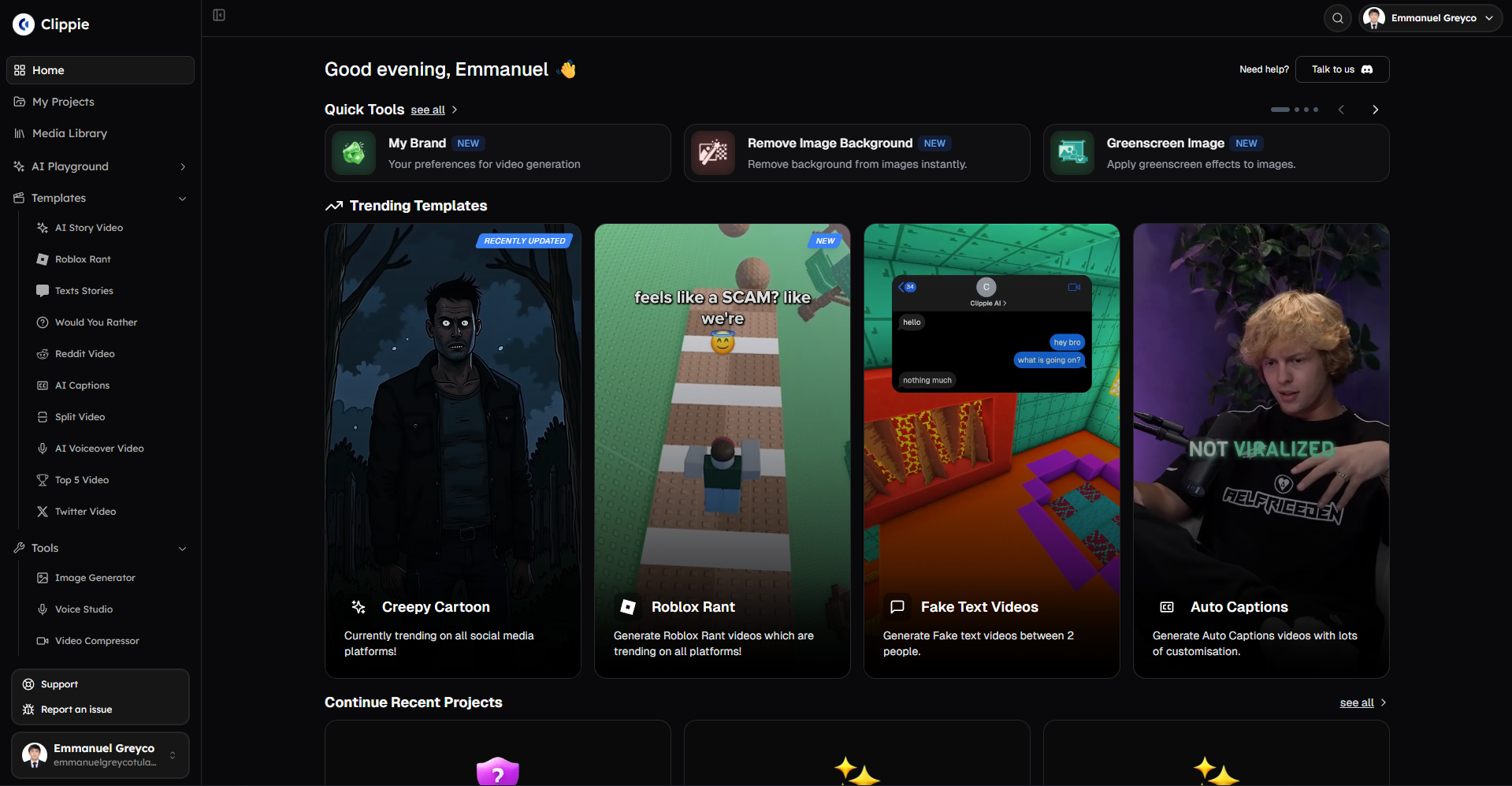
How to Run Your Full Automation Channel With Clippie AI
Frequently Asked Questions

1. What a Faceless YouTube Automation Channel Actually Is in 2026
The term "YouTube automation" gets used loosely. Before building a channel around it, understand precisely what it means, and what it does not mean.
The Accurate Definition
A faceless YouTube automation channel is a content operation where:
The creator never appears on camera
AI tools handle the majority of production tasks, scripting, voiceover, visuals, captions, and export
The creator's primary input is strategic: topic selection, quality review, and publishing decisions
The channel produces content consistently enough for the algorithm to build an audience model and distribute the content to new viewers
What "automation" means in practice:
Automation does not mean the channel runs entirely without human input, it means the human input is concentrated at strategic decision points rather than distributed across every manual production task. A creator running an automated faceless channel in 2026 might spend 6–10 hours per week on their channel and produce 10–15 videos. A creator doing the same manually would spend 40–60 hours to produce the same volume.
What Makes Faceless Automation Viable in 2026
Three developments converged in 2025–2026 to make faceless automation genuinely viable at the quality level YouTube rewards:
AI voiceover quality crossed the retention threshold: Early AI voices were robotic enough that viewers noticed and dropped off. Current AI voices, including those built into Clippie AI, are natural enough that completion rates are indistinguishable from human-narrated content when scripts are written well.
AI video generation became production-ready: Models like VEO3.1 and Seedance 1.0 now produce cinematic footage that surpasses generic stock libraries in both quality and relevance. A faceless channel using AI-generated footage looks more original than a channel using standard stock video.
Platform policy normalised AI content: YouTube explicitly permits AI-generated content provided it meets quality and originality standards. The platform's algorithm rewards content that holds viewer attention, it does not penalise content for being AI-assisted. Faceless channels with strong retention metrics receive the same algorithmic amplification as any other high-performing content.
The Difference Between a Faceless Channel and a Faceless Automation Channel
A faceless channel: Creator produces content without showing their face. Production may still be largely manual, recording voiceover, editing footage, creating captions by hand.
A faceless automation channel: Creator uses AI tools to handle production tasks at every stage. The workflow is systemised, repeatable, and scalable. The creator is the director, not the production crew.
The distinction matters because building an automation channel requires upfront workflow design that a standard faceless channel does not. The first few weeks are spent building the system, after that, the system runs the channel.
Who a Faceless Automation Channel Is Right For
This model works best for:
Creators who want to build a passive income channel without daily active involvement
Professionals or entrepreneurs who have limited daily time but want consistent output
People who are camera-shy or value privacy and cannot build a personal brand channel
Anyone who wants to run multiple channels simultaneously, the automation model is the only way to manage parallel channels without a production team

2. The 5 Faceless Automation Niches With the Highest Growth Potential Right Now
Niche selection is the single most consequential decision in building a faceless automation channel. A weak niche with good production beats a strong niche poorly executed, but a strong niche with good production is the combination that produces sustainable growth.
Niche 1: Personal Finance and Investing (Highest CPM)
Why it grows fast: Finance audiences actively search for specific answers to financial questions, they are not passive entertainment consumers. Every video that answers a specific financial query captures evergreen search traffic that compounds over months and years.
Why automation fits perfectly: Finance content is entirely narration-driven. Explainers, list videos, comparisons, and news commentary require voiceover over visuals, exactly what AI production handles best. No on-camera presence required at any stage.
Growth indicators:
YouTube CPM: $8–$25 per thousand views
Affiliate commissions: $50–$200 per referral for investment and financial products
Audience size: hundreds of millions of active searchers globally
Content types that work:
"How to" finance tutorials (evergreen, high search volume)
Financial product comparisons (high affiliate conversion)
Economic news commentary (high short-term impressions)
Beginner investing explainers (high watch time, high save rate)
Niche 2: AI Tools and Technology Explainers (Fastest Growing)
Why it grows fast: AI tool adoption is accelerating across every professional category. Audiences searching for "how to use [AI tool]" or "best AI tools for [task]" represent one of YouTube's fastest-growing search query segments in 2026.
Why automation fits perfectly: Screen recording tutorials combined with AI voiceover narration are the dominant format in this niche. The creator never needs to appear on screen, the tool being demonstrated IS the visual content.
Growth indicators:
Extremely high search velocity, new AI tools launch weekly, generating fresh search queries continuously
Affiliate commissions: 20–40% recurring monthly on SaaS tool referrals
B2B audience: higher CPM than consumer niches (advertisers value business-audience attention)
Content types that work:
"How to use [AI tool] for [specific task]"
"Best AI tools for [profession or use case] in 2026"
"[Tool A] vs [Tool B], which is better?"
"I automated [workflow] with AI, here's how"

Niche 3: True Crime and Mystery Storytelling (Highest Engagement Rate)
Why it grows fast: True crime is one of YouTube's most consistently high-performing content categories. The audience is passionate, loyal, and highly engaged, comment rates and save rates in this niche are among the highest on the platform.
Why automation fits perfectly: True crime is a pure narration-over-visuals format. The creator's voice (or cloned AI voice) tells the story; atmospheric footage, crime scene maps, and documentary-style images provide the visual backdrop. No on-camera presence at any point.
Growth indicators:
Audience loyalty: true crime viewers subscribe and return more consistently than entertainment audiences
Cross-platform strength: true crime content performs on TikTok, Shorts, Reels, and long-form YouTube simultaneously
Sponsorship potential: true crime channels attract sponsors from VPN services, home security, legal services, and entertainment platforms
Content types that work:
Single-case deep dives (10–20 minutes, high watch time)
Short-form case summaries (30–60 seconds for Shorts and TikTok)
Cold case investigations
Unsolved mystery and unexplained events content
Niche 4: History and Documentary (Highest Watch Time)
Why it grows fast: History content generates some of YouTube's highest average view durations because the audience is genuinely curious and invested in the narrative. Videos about historical events, civilisations, and figures consistently outperform average completion rates.
Why automation fits perfectly: History content requires atmospheric footage of landscapes, architecture, and environments that match historical periods, footage that stock libraries are notoriously poor at providing. VEO3.1's ability to generate period-appropriate cinematic footage is a direct advantage in this niche.
Growth indicators:
Watch time: history videos regularly achieve 50–70% completion rates
Evergreen traffic: history content does not expire, a video about ancient Rome published in 2026 generates traffic in 2028
Educational CPM: history audiences attract educational advertisers with higher CPMs than entertainment niches
Content types that work:
"The Rise and Fall of [Empire/Civilisation]", long-form documentary style
"10 Things You Didn't Know About [Historical Period]", high-CTR list format
"The Untold Story of [Historical Figure or Event]", narrative storytelling
Short-form historical fact clips for Shorts and TikTok
Niche 5: Self-Improvement and Productivity (Highest Digital Product Conversion)
Why it grows fast: Self-improvement is a perennial YouTube niche with consistent demand. The audience actively seeks actionable advice and tools, and they convert to digital product purchases at higher rates than most other niches.
Why automation fits perfectly: Self-improvement content is primarily text-and-narration driven. Motivational scripts, productivity frameworks, and habit-building guides are delivered through voiceover with atmospheric or aspirational visual backdrops, no camera presence required.
Growth indicators:
Digital product conversion: self-improvement audiences buy courses, templates, and guides at high rates
Affiliate opportunities: productivity apps, online learning platforms, book affiliates
Cross-demographic appeal: self-improvement content performs across age groups and geographies
Content types that work:
Habit and routine videos ("The Morning Routine That Changed Everything")
Productivity system explainers ("How to Build a Second Brain With AI")
Book summaries and key lessons
Mindset and motivation content for Shorts

3. The Exact AI Tool Stack You Need to Start (And What You Can Skip)
One of the most common mistakes beginners make is over-tooling before they have produced a single video. Here is the minimum viable stack to launch, and what to skip until the channel is established.
The Minimum Stack to Launch (Total: Under $35/Month)
Tool 1: ChatGPT Free Tier (Scriptwriting)
ChatGPT handles script generation from topic briefs. The free tier is sufficient for producing 10–15 scripts per month.
What to use it for:
Generating first-draft scripts from a brief
Creating video titles and descriptions
Generating FAQ sections and content outlines
Prompt template for automation channel scripts: "Write a faceless YouTube script about [topic]. Audience: [specific demographic]. Length: [word count for target video duration]. Open with a hook that immediately creates curiosity. Use short sentences under 15 words for AI voiceover delivery. Include [number] clearly numbered sections. Close with a CTA asking viewers to [specific action]."
Tool 2: Clippie AI Lite ($19.99/month): Production Platform
Clippie AI handles everything from script-to-export in one platform:
AI voiceover - select from 50+ voices or upload a custom cloned voice
AI image generation - custom scene visuals, title cards, section images
Speech-to-subtitles - auto-synced captions in 102+ languages
Video export - production-ready output for YouTube, TikTok, and Reels
The Lite plan at $19.99/month supports 30 minutes of video export per month, sufficient for 3–5 videos while learning the workflow. Upgrade to Creator ($34.99/month) once the channel is posting consistently.
Tool 3: Canva Free Tier (Thumbnails)
YouTube thumbnails require a separate design step that Clippie AI does not handle. Canva's free tier provides:
Thumbnail templates sized correctly for YouTube (1280 x 720px)
Text overlays and basic image editing
Brand kit storage for consistent thumbnail design
This is the only tool outside Clippie AI that is genuinely necessary from day one.
Tool 4: YouTube Studio (Free): Publishing and Analytics
YouTube Studio is the native publishing and analytics platform. It includes:
Native video scheduler - schedule posts in advance without a third-party tool
Performance analytics - views, watch time, completion rate, CTR
Comment management - engage with audience comments from one dashboard
Total monthly cost to start: $19.99 (Clippie AI Lite)
Everything else in this stack is free.
What to Skip at the Start
These tools add value at scale, they create unnecessary cost and complexity before the channel is established:
Standalone voiceover tools (ElevenLabs, Murf): Clippie AI's built-in voiceover handles this. No additional subscription needed.
Video compression tools (HandBrake): Only needed for very large file sizes. Not relevant at 3–5 videos per month.
Third-party scheduling tools (Buffer, Later): YouTube Studio's native scheduler handles this for free.
Keyword research tools (TubeBuddy, VidIQ): Useful at scale. Unnecessary before the channel has 50+ videos and established search history.
AI video generation (VEO3.1 separately): Clippie AI includes VEO3 and VEO3.1 integration, no separate access required.
Add these tools only when you hit the specific production problem they solve. Not before.
4. How to Build Your First Faceless YouTube Automation Workflow Step-by-Step
The first workflow you build is the most important one. It does not need to be perfect, it needs to be completeable. Once you have completed the workflow once, every subsequent run is faster and more refined.
Week 1: Channel Foundation (One-Time Setup)
Day 1: Channel Creation and Niche Confirmation
Create the YouTube channel:
Set up a dedicated Google account for the channel, keep it separate from your personal account
Create the channel in YouTube Studio
Upload a channel banner and profile image
Write a channel description that includes your primary niche keyword
Confirm the niche: Before producing any content, run the niche through this four-question test:
Can you generate 50 video topics in this niche right now?
Does the niche have affiliate products paying 15%+ commission?
Are there existing channels in this niche under 200k subscribers getting consistent views? (Validates demand without oversaturation)
Can the content be produced entirely without showing your face?
If yes to all four: proceed. If no to any one: adjust the niche before producing anything.
Day 2: Clippie AI Account Setup and Voice Selection
Create your Clippie AI account
Explore the voice library and identify 3–5 candidate voices for your channel
Test each on a 100-word excerpt from a sample script
Select the voice that sounds most natural and authoritative for your niche
If you plan to clone your own voice, record your 2–3 minute sample today and upload it
Voice selection principles:
Finance and history: lower pitch, measured pace, authoritative tone
Self-improvement: warm, conversational, encouraging
True crime: measured, serious, slightly dramatic
AI tools: clear, energetic, tech-forward
Day 3: Topic Research and First Video Brief
Topic research process:
Type your niche keyword into YouTube search and note every autocomplete suggestion
Check Google Trends for the top 3–5 topics to confirm search demand
Browse the top 10 comment sections in your niche for audience questions
Select your first video topic from this research, choose the topic with the clearest search intent and the most specific answer
Write the first video brief:
Topic:
Target audience:
Primary keyword:
Video format (explainer / list / tutorial / story):
Target length:
Hook idea:
4–5 main points:
CTA:
Day 4: First Script
Use the ChatGPT prompt template to generate a first draft, then review and edit for:
Factual accuracy - verify every statistic or claim
Natural sentence length - ensure sentences stay under 15 words for AI voiceover delivery
Hook quality - the opening sentence must create immediate forward tension
Section clarity - each numbered section should have one clear takeaway
For a beginner, target 900–1,200 words, this produces approximately 6–9 minutes of narration, long enough to generate multiple ad placements but short enough to produce efficiently.
Day 5: First Production Session in Clippie AI
This session will take longer than future sessions because it also includes platform familiarisation.
Step 1: Voiceover (15–20 minutes)
Paste the completed script into Clippie AI
Select your chosen voice
Generate full narration
Listen to the output and note any sentences that sound unnatural
Regenerate individual sections if needed
Step 2: Image generation (20–25 minutes)
Generate a title card for the video opening
Generate 4–6 scene images, one per main section of the script
Generate a closing image for the CTA section
Step 3: Caption review (5–8 minutes)
Review auto-generated captions for accuracy
Correct any mistranscribed words, pay attention to proper nouns and niche-specific terms
Step 4: Export (5 minutes)
Export in 16:9 MP4 format at 1080p for YouTube
Day 6: Thumbnail and Upload
Thumbnail (20 minutes in Canva):
Use a frame from the video or a generated image as the background
Add bold text (3–5 words maximum) that matches the core promise of the video
Ensure high contrast between text and background, the thumbnail must be readable at small size in YouTube search results
Upload in YouTube Studio:
Title: include the primary keyword in the first 60 characters
Description: 150–250 words with natural keyword inclusion
Tags: 5–8 tags matching your niche and video topic
Category: select the most relevant YouTube category
Thumbnail: upload the custom thumbnail
End screen: add a subscribe prompt
Schedule or publish immediately
Day 7: Review and Plan Week 2
48-hour analytics check: After 48 hours, review in YouTube Studio:
Initial view count, is it in line with other new channels in this niche?
Click-through rate, below 2% suggests a title or thumbnail issue
Average view duration, below 35% suggests a hook or pacing issue
Comments, what are viewers asking? Each question is a next video idea
Plan Week 2: Generate 3 new video briefs based on the comment section questions and related autocomplete topics from your niche research.

5. How to Hit 1,000 Subscribers and Qualify for Monetisation Faster
1,000 subscribers and 4,000 watch hours (or 10 million Shorts views in 90 days) are the YouTube Partner Programme thresholds. For a faceless automation channel, here is the fastest proven path to both.
The Fastest Path to 1,000 Subscribers
Strategy 1: Post Consistently at Minimum Effective Frequency
The algorithm needs data to build an audience model for your channel. Below 2 videos per week, data accumulates too slowly for meaningful distribution to begin.
Minimum effective posting frequency:
2 long-form videos per week (Monday and Thursday is a reliable posting schedule)
2–3 Shorts per week (repurposed from the most compelling 45–60 second segment of each long-form video)
At this frequency, a channel accumulates enough data for algorithmic distribution to begin within 6–8 weeks of consistent posting.

Strategy 2: Optimise for Subscribe Triggers, Not Just Views
A view becomes a subscriber only when the viewer believes the channel will consistently deliver more of what they just watched. Two interventions drive subscriber conversion:
Verbal CTA at the right moment: Include a subscribe request immediately after delivering the most valuable information in the video, not at the end when viewers are already leaving. Example: "If that helped you understand [concept], subscribe, I publish [niche-specific content] every [day of week]."
Channel consistency signal: The channel page should show at least 5–10 videos in the same niche before a viewer decides to subscribe. A channel with 2 videos and a third pending does not inspire subscription confidence. Batch-produce the first 5 videos before publishing any of them, launch with 3 on day one and publish the remaining 2 in the following week.
Strategy 3: Target Low-Competition, High-Intent Keywords First
New channels cannot rank for high-competition queries against established channels with hundreds of videos and thousands of subscribers. Target the edges of the niche first.
Finding low-competition keywords:
Search your primary keyword on YouTube
Filter results by "This month", see what new content is performing
Look for search queries where the top results have under 100k views and fewer than 50k subscribers on the channel
These gaps are where a new channel can rank within weeks rather than months
Titles that attract search traffic from new channels:
"Why [Common Assumption in Your Niche] Is Wrong"
"[Specific Question From Comment Section], Answered"
"[Niche Topic] Explained in 5 Minutes (For Complete Beginners)"
"The [Niche Topic] Guide Nobody Is Talking About in 2026"
Strategy 4: Cross-Post Shorts to TikTok and Instagram Reels
Every long-form video should produce at least one Short. That Short cross-posted to TikTok and Instagram Reels gives the video three additional distribution chances at no additional production cost.
A single Short that performs on TikTok can drive hundreds or thousands of new YouTube channel visits, and converts to subscribers at a significantly higher rate than cold YouTube search traffic.
Hitting 4,000 Watch Hours
4,000 watch hours requires sustained watch time across the channel's entire catalogue. Two tactics have the greatest impact:
Produce longer videos in watch-time-friendly formats: Explainer and documentary formats consistently generate higher average view duration than entertainment formats. A 12-minute explainer with 55% completion generates 6.6 minutes of watch time per view, more than a 6-minute entertainment video with 80% completion generates.
Create series content: A multi-part series, "The Complete Beginner's Guide to Investing, Part 1–5", encourages viewers to watch multiple videos in sequence. Each series video links to the next in end screens and descriptions, creating a watch-time compounding loop.
6. How to Run Your Full Automation Channel With Clippie AI
Once the first workflow is complete and the channel has its first 3–5 videos live, the operation shifts from learning mode to system mode. This is the weekly operational structure.
The Weekly Automation Channel Schedule
Monday: Ideation and Research (30–45 minutes)
Review the comment sections from last week's videos, capture every question as a potential video brief
Run YouTube autocomplete for 3–4 keyword variations in your niche
Check Google Trends for any trending topics relevant to your niche this week
Select 2–3 topics for this week's production and write one-line briefs for each
Tuesday: Scripting (1.5–2 hours)
Generate first-draft scripts for all 2–3 videos using ChatGPT
Review each script for accuracy, hook quality, and sentence length
Add any required disclaimers (finance, health, or legal content)
Finalise all scripts before opening Clippie AI, scripting and production should be separate sessions
Wednesday: Production Batch in Clippie AI (2–3 hours)
For each video:
Voiceover generation: 3–5 minutes
Paste script into Clippie AI
Select custom cloned voice or pre-built voice
Generate narration
Image generation: 5–8 minutes
Generate title card
Generate 4–6 section images
Caption review: 2–3 minutes
Confirm auto-caption accuracy
Export: 3–5 minutes
Export 16:9 for YouTube long-form
Export 9:16 for Shorts cross-post
Total per video inside Clippie AI: 15–20 minutes
Total batch session for 3 videos: approximately 55–65 minutes
Thursday: Publishing Preparation (1–1.5 hours)
Create thumbnails for all 3 videos in Canva (15 minutes each)
Write YouTube titles, descriptions, and tags (10 minutes per video)
Write platform-specific captions and hashtags for Shorts, TikTok, and Reels cross-posts
Schedule all uploads in YouTube Studio for Monday, Wednesday, and Friday of the following week
Friday: Analytics Review (20–30 minutes)
Check 48-hour and 7-day performance for videos published earlier in the week
Note which titles had the highest CTR, which videos had the best completion rate, which generated the most comments
Feed findings directly into Monday's ideation, more content about what performed, different angle on what underperformed
Total weekly active time: 6–7.5 hours for 3 complete, scheduled videos
Clippie AI Plans: Matched to Automation Channel Scale
Lite: $19.99/month
30 mins video export (~3–5 videos/month)
30 mins AI voice generation
30 mins speech-to-subtitles
100 AI images
1 custom voice
Captions in 102+ languages
50+ AI voices
24/7 support
Best for: The first 4–6 weeks while building and refining the workflow, 3–5 videos per month is the right volume while learning
Creator: $34.99/month
120 mins video export (~8–12 videos/month)
120 mins AI voice generation
120 mins speech-to-subtitles
500 AI images
10 custom voices
Captions in 102+ languages
50+ AI voices
24/7 support
Best for: A channel posting 2–3 times per week, the volume required to build algorithmic momentum and reach monetisation in 4–6 months
Pro: $69.99/month
250 mins video export (~15–20 videos/month)
250 mins AI voice generation
250 mins speech-to-subtitles
1,000 AI images
30 custom voices
Captions in 102+ languages
50+ AI voices
24/7 support
Best for: Scaling to multiple automation channels simultaneously, 30 custom voices supports a separate voice identity per channel
No free tier is available on Clippie AI.
💡 For the complete monetisation strategy that activates once the channel qualifies for the Partner Programme, read our guide on the complete faceless content monetisation blueprint for 2026
💡 For the full operational system that scales this channel into a multi-channel automated business, read our guide on how to build a fully automated AI video business in 2026
💡 Start building your faceless automation channel with Clippie AI today →
Conclusion: The Best Time to Start Is Before the Workflow Feels Perfect
Every week spent planning instead of producing is a week of algorithmic momentum lost.
The faceless automation channel model works in 2026. The tools are mature. The platforms reward it. The audiences are there. The monetisation infrastructure exists from day one.
What separates the creators who build successful automation channels from those who research indefinitely is simple: they started before they felt ready, completed the workflow imperfectly, improved with every video, and let the compounding do the rest.
Clippie AI removes the production barrier that used to make faceless automation dependent on technical skill or large budgets. Voiceover, visuals, captions, and export in one platform. A workflow completeable in under 60 minutes per video. A business model that grows while you sleep.
Start this week. Publish the first video. Build from there.
Launch your faceless automation channel with Clippie AI today →
7. Frequently Asked Questions
Q1: Do I need any video editing experience to start a faceless YouTube automation channel?
No. Clippie AI handles the production stages that traditionally require editing skills, voiceover generation, visual creation, caption syncing, and video export. The only manually created element is the thumbnail, which can be produced in Canva using free templates without any prior design experience. A creator with zero video production background can complete their first full video in a single session using this guide's workflow.
Q2: How much does it cost to start a faceless YouTube automation channel in 2026?
The minimum monthly cost is $19.99 for Clippie AI's Lite plan. Combined with free tools, ChatGPT's free tier for scripting, Canva's free tier for thumbnails, and YouTube Studio for publishing and analytics, the total startup cost is under $20 per month. This covers everything needed to produce and publish 3–5 videos monthly while validating the niche and refining the workflow.
Q3: How long does it realistically take to reach 1,000 subscribers on a faceless automation channel?
For a creator posting 2–3 videos per week in a validated niche with good production quality, 1,000 subscribers typically takes 3–6 months. Channels that cross this threshold fastest share three characteristics: they post at consistent minimum frequency without gaps, they target low-competition keywords in the early weeks rather than competing against established channels, and they cross-post Shorts to TikTok and Instagram Reels to accelerate audience acquisition beyond YouTube's organic reach.
Q4: Can I run a faceless automation channel alongside a full-time job?
Yes, and many of the most successful automation channel operators do exactly this. The weekly production schedule in this guide requires 6–7.5 hours per week for 3 videos, which fits into evenings and weekends. The batch production model, scripting all videos in one session, producing all videos in one Clippie AI session, and scheduling all publishing in one session, means the weekly commitment is concentrated into 2–3 focused blocks rather than spread across daily tasks.
Q5: What is the most common reason faceless automation channels fail to grow?
The most common reason is inconsistency. Creators produce 5–10 videos, see modest initial results, and reduce posting frequency or stop entirely before the algorithmic momentum that drives growth has a chance to build. The algorithm needs 8–12 weeks of consistent posting to build a reliable audience model for a new channel. Channels that post consistently for 90 days, even with imperfect production, almost universally show measurable growth by the end of that period. Channels that post sporadically never give the algorithm enough data to distribute the content effectively.
Q6: Which Clippie AI plan is right for a brand-new faceless automation channel?
Start with the Lite plan at $19.99/month for the first 4–6 weeks. Its 30-minute export capacity supports 3–5 videos monthly, the right volume while building the workflow and validating the niche. Once the workflow is established and posting frequency increases to 2–3 videos per week, upgrade to the Creator plan at $34.99/month. The Creator plan's 120-minute export capacity supports 8–12 videos monthly, sufficient for the consistent posting frequency that drives algorithmic growth and monetisation eligibility.
Make an AI story video
Write a script or let AI write one. Clippie turns it into a narrated video with AI scenes, voiceover and captions.
Read more

How Faceless YouTube Channels Make Money in 2026: 6 Streams
Faceless YouTube channels make money from far more than ads: Shorts, affiliates, sponsors and products. February 2027 Shorts rules shift the whole mix.

How to Monetize AI Videos in 2026 Without Getting Demonetized
Monetizing AI videos now depends on YouTube's July 2026 originality rules. Payout routes on YouTube and TikTok, eligibility bars and formats that fail.
How to Create AI Story Videos Step by Step (2026 Guide)
AI story videos follow one pipeline: script, scenes, characters, voice, captions, export. Each stage explained, plus where YouTube draws the template line.