What If Stickman Videos: 20 Ideas and How to Make Them (2026)
Second-person survival, science and history scenarios with hooks, beat outlines and template picks, plus a six-beat script and YouTube originality rules.
 Emmanuel Greyco Tulabut
On this page
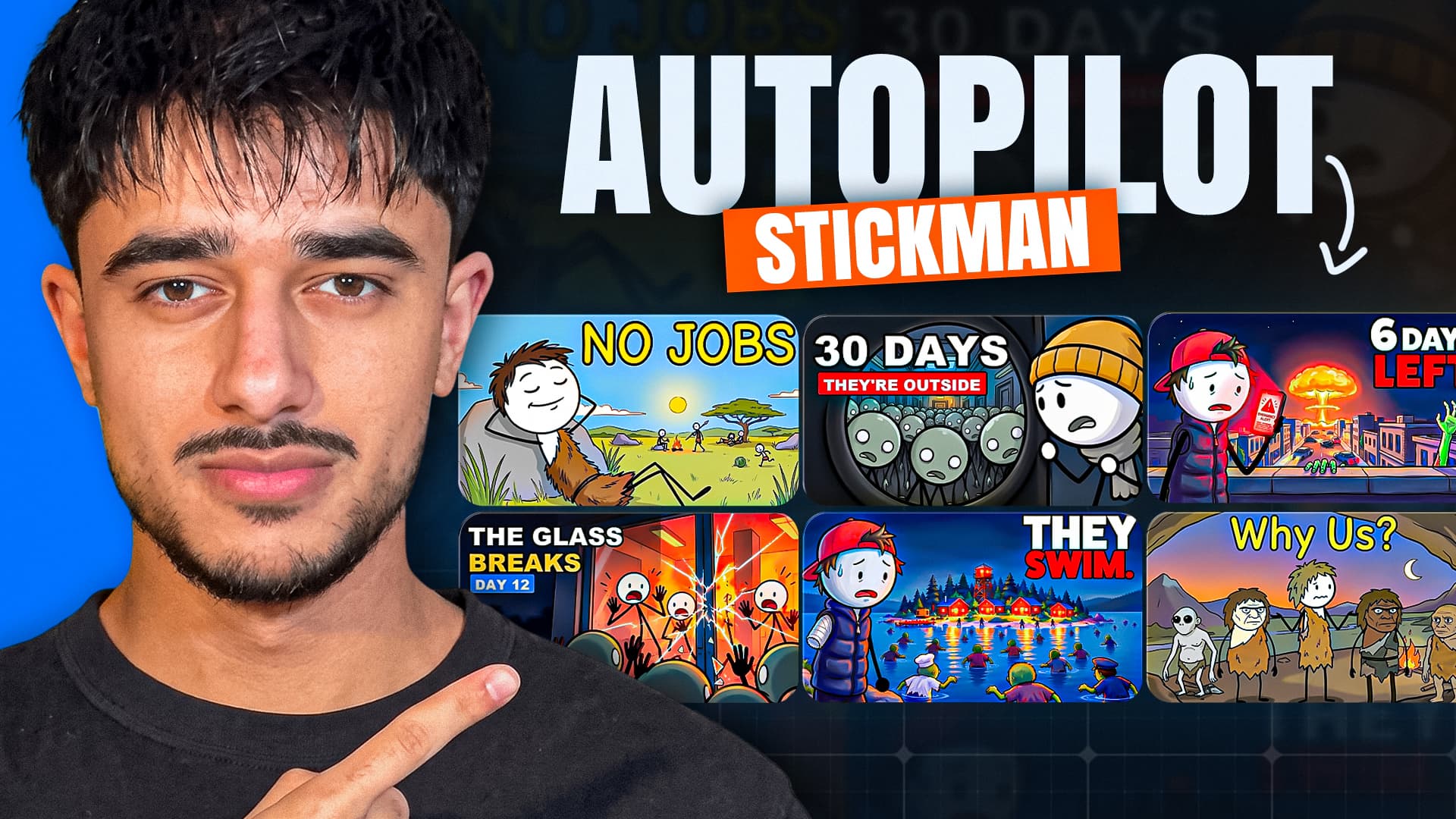
If you searched for what if stickman videos, you have probably seen the format everywhere this autumn: a plain stick figure, a narrator saying "What if you…", and a scenario that gets worse every 20 seconds.
The demand is real. vidIQ's YouTube search estimates show "what if stickman" and "what if animation" each pulling over 240,000 searches a month in early November 2026, both up several hundred percent. This post gives you 20 ready-to-script ideas, the beat structure behind the format, accuracy rules and the monetization checks that matter before you upload.
Executive summary: This guide is for faceless creators starting a what if animation or stickman survival channel. It covers the format, a six-beat script, fact-checking survival and science claims, and 20 ideas in four labeled groups, each with a hook, beats and stickman style. It ends with a short workflow, Shorts versus long-form advice and YouTube's originality rules.
Table of Contents
What Are What If Stickman Videos?
Why What If Animation Is Trending in Late 2026
How to Script a What If Video in 6 Beats
Accuracy Rules for Survival and Science Claims
Survival Ideas: #1 to #5
Science What-Ifs: #6 to #10
History What-Ifs: #11 to #15
Everyday Scenario Ideas: #16 to #20
How to Make a What If Stickman Video in Clippie
Shorts vs Long-Form What If Videos
Monetization and Originality Rules
FAQs
What to Do Next
What Are What If Stickman Videos?
What if stickman videos are narrated, second-person scenario stories. The narrator puts "you" in a situation, sets the rules of that world, escalates beat by beat and asks you to make choices. Simple stick figures keep attention on the decisions rather than the art.
The four traits of the format:
Second person. "You wake up on a raft" beats "a man wakes up".
Escalation. Thirst, then a storm, then a fin.
One decision per beat. The viewer silently answers "what would you do?"
Stakes and a payoff. An outcome, twist or verdict.
Why What If Animation Is Trending in Late 2026
What if animation is trending because it combines curiosity, survival tension and comment-friendly choices in a style that is cheap to produce. vidIQ's YouTube data shows sharp search growth this autumn, and new channels built around the format keep appearing.
Related demand (vidIQ YouTube estimates, Nov 5, 2026):
"what would you do": about 113,000 searches a month, up 57%.
"how to survive a zombie apocalypse": about 67,000, up 52%.
Channels that show the format (YouTube search, Nov 5, 2026):
Ifverse: multi-part what-ifs with science notes in descriptions.
Nobody Gets In: day-by-day outbreak stories listing the real facts used.
Stickman Extinction: outbreak Shorts that ask what you would do first.
What If: a long-running science what-if channel.
Compare this lane with others in our faceless video niches ranked by monetization potential.

How to Script a What If Video in 6 Beats
A strong what if script has six beats: a "What if you…" hook, the rules of the world, escalation, choice points, an outcome and a comment prompt. Every beat should change the situation. If a beat only describes, cut it or merge it into the next.
Step 1: Hook. One line, no intro: "What if you woke up alone on a raft?"
Step 2: Rules. What you have, what you lack, how long you must last.
Step 3: Escalation. Three to six beats, each harder: need, then threat, then twist.
Step 4: Choice points. Two options out loud, then a short pause.
Step 5: Outcome. A verdict, tied to a real fact.
Step 6: Comment prompt. "Which choice would you change?"
Accuracy Rules for Survival and Science Claims
Survival and science what-ifs mix fiction with real facts, so every factual claim needs a source you could defend. Check numbers against official or academic sources, list them in the description and never present dramatic story choices as real-world safety advice.
Fact-check every number against sources such as NASA, NOAA or Ready.gov.
Cite in the description with a short "Facts in this video" list.
Separate story from advice: "This is a fictional story, not safety advice."
Skip dangerous how-tos: no weapons, foraging, medical procedures or stunts.
Respect real tragedies: historical disasters involved real people.
Survival Ideas: #1 to #5
Survival ideas are the core of stickman survival videos: one person, one hostile setting and a clock. Most suit the Bare stickman template, built for viral survival stories. Each idea lists a hook line, a beat outline and one fact to verify first.
Idea #1: Stranded on a Desert Island (Bare stickman)
Hook: "What if your boat sank and you washed up with nothing?"
Beats: shade, water, storm, a ship on the horizon. Verify: NOAA on why seawater dehydrates you.
Idea #2: 30 Days in a Zombie Outbreak (Bare stickman)
Hook: "Day one. The radio says stay inside. Your water is already low."
Beats: day chapters in 16:9: supplies, noise, a stranger, rescue. Verify: Ready.gov's gallon of water per person per day.
Idea #3: Lost in a Forest at Night (Painted stickman)
Hook: "What if your phone died two miles from the trail at sunset?"
Beats: panic, walk or stay put, cold, a sound, morning. Verify: park-service advice on staying in one place.
Idea #4: Stuck in an Elevator (Classic stickman)
Hook: "What if the elevator stopped and the lights went out?"
Beats: alarm button, the urge to pry doors, rescue. Verify: Otis's 1854 safety-brake demonstration.
Idea #5: Waking Up on Everest's Summit (Bare stickman)
Hook: "What if you opened your eyes at 8,849 meters with no oxygen?"
Beats: thin air, confusion, the descent choice, a storm. Verify: the 2020 China–Nepal survey height.
Science What-Ifs: #6 to #10
Science what-ifs take one impossible premise and follow real physics or biology to the end. They suit the Doodle explainer and Classic stickman templates, because diagrams and labels carry the explanation. Accuracy matters most here, since science fans correct mistakes fast.
Idea #6: Falling Into a Black Hole (Doodle explainer)
Hook: "What if you drifted past the point light can't escape?"
Beats: approach, time slowing, stretching, the unknown. Verify: NASA on event horizons.
Idea #7: Never Sleeping Again (Classic stickman)
Hook: "What if you never slept again, starting tonight?"
Beats: fine, irritable, hallucinating, the record, the crash. Verify: Randy Gardner's 1964 record of about 264 hours.
Idea #8: The Moon Disappears (Doodle explainer)
Hook: "What if you looked up tonight and the Moon was gone?"
Beats: darker nights, smaller tides, coastal ecosystems. Verify: NOAA on solar versus lunar tides.
Idea #9: Shrinking to Ant Size (Classic stickman)
Hook: "What if you shrank to six millimeters tall in your kitchen?"
Beats: a raindrop like a boulder, falling safely, a spider, getting home. Verify: surface tension at tiny scales.
Idea #10: Earth Stops Spinning (Doodle explainer)
Hook: "What if Earth stopped turning while you stood on the equator?"
Beats: momentum, a year-long day, shifting oceans, survivors. Verify: NASA's roughly 1,000 mph equator speed.
History What-Ifs: #11 to #15
History what-ifs drop the viewer into a real era and ask how they would cope. The Caveman stickman template is built for ancient humans and first inventions; Painted stickman suits later periods. Keep dates hedged, cite sources and treat real victims with respect.
Idea #11: A Week in the Stone Age (Caveman stickman)
Hook: "What if you woke up 50,000 years ago with no tools?"
Beats: water, fire, a predator, joining a group. Verify: museum sources on early fire and stone tools.
Idea #12: Inventing the Wheel (Caveman stickman)
Hook: "What if you were the first person to think of a wheel?"
Beats: the idea, failure, a potter's wheel, the first cart. Verify: Mesopotamian wheels, around 3500 BC.
Idea #13: Building the Great Pyramid (Painted stickman)
Hook: "What if you joined the crew building Egypt's greatest tomb?"
Beats: arrival, hauling stone, rations, an accident, completion. Verify: findings from the Giza workers' settlement.
Idea #14: Aboard the Titanic (Painted stickman)
Hook: "It's 11:40 p.m., April 14, 1912. You feel a strange shudder."
Beats: denial, too few lifeboats, wait or go, the outcome. Verify: 20 lifeboats for about 1,178 people (British inquiry).
Idea #15: Living Through the Black Death (Doodle explainer)
Hook: "What if you lived in a town in 1348 as plague arrived?"
Beats: rumors, first cases, flee or stay, aftermath. Verify: estimates of a third to half of Europe dying.
Everyday Scenario Ideas: #16 to #20
Everyday scenario ideas apply the what would you do animation formula to normal life: money, habits and social situations. They are the most relatable stickman story ideas and the safest to fact-check. Doodle explainer fits money and law topics; Classic stickman fits humor.
Idea #16: Winning the Lottery Tomorrow (Doodle explainer)
Hook: "What if your numbers came up tonight?"
Beats: lump sum or annuity, taxes, friends calling. Verify: Powerball's 1 in 292.2 million odds; add "not financial advice".
Idea #17: 30 Days Without Your Phone (Classic stickman)
Hook: "What if you locked your phone in a drawer for a month?"
Beats: the itch, boredom, new habits, the choice to go back. Don't invent study results.
Idea #18: Saving $5 a Day for 10 Years (Doodle explainer)
Hook: "What if you skipped one coffee a day for ten years?"
Beats: Year 1, Year 5, the interest twist, Year 10. Verify: $18,250 before interest; show the math.
Idea #19: Invisible for a Day (Classic stickman)
Hook: "What if you woke up and your reflection was gone?"
Beats: fun at first, nobody hears you, a moral choice, the way back.
Idea #20: Saying Yes to Everything for a Week (Classic stickman)
Hook: "What if you had to say yes to everything for seven days?"
Beats: small favors, a risky invite, a money request, the lesson.
How to Make a What If Stickman Video in Clippie
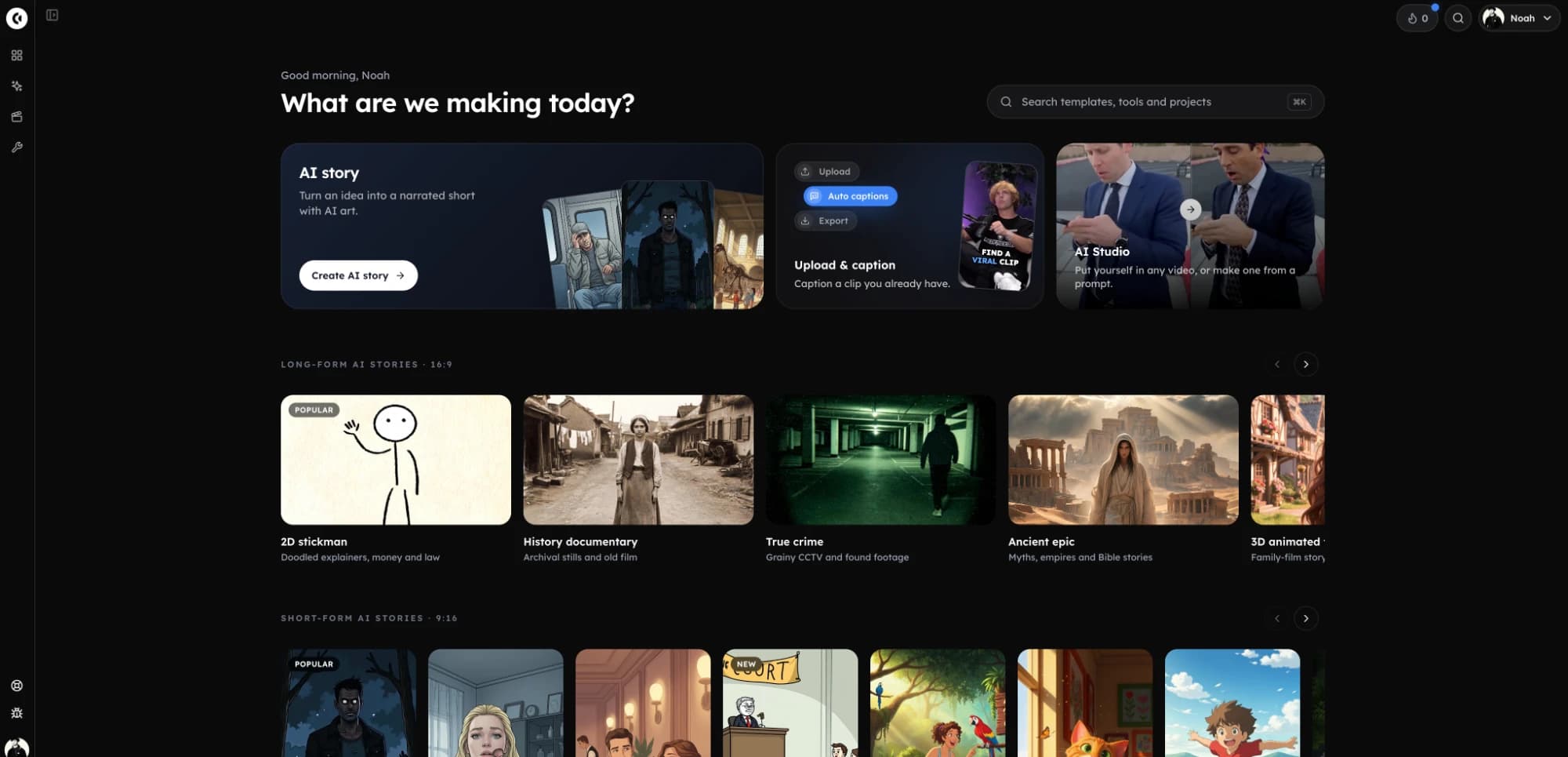
You can make a what if stickman video in Clippie's AI Story tool by choosing a stickman template, adding your script, picking a voice and exporting in 9:16 or 16:9. The full tutorial is a separate post; this is the short version.
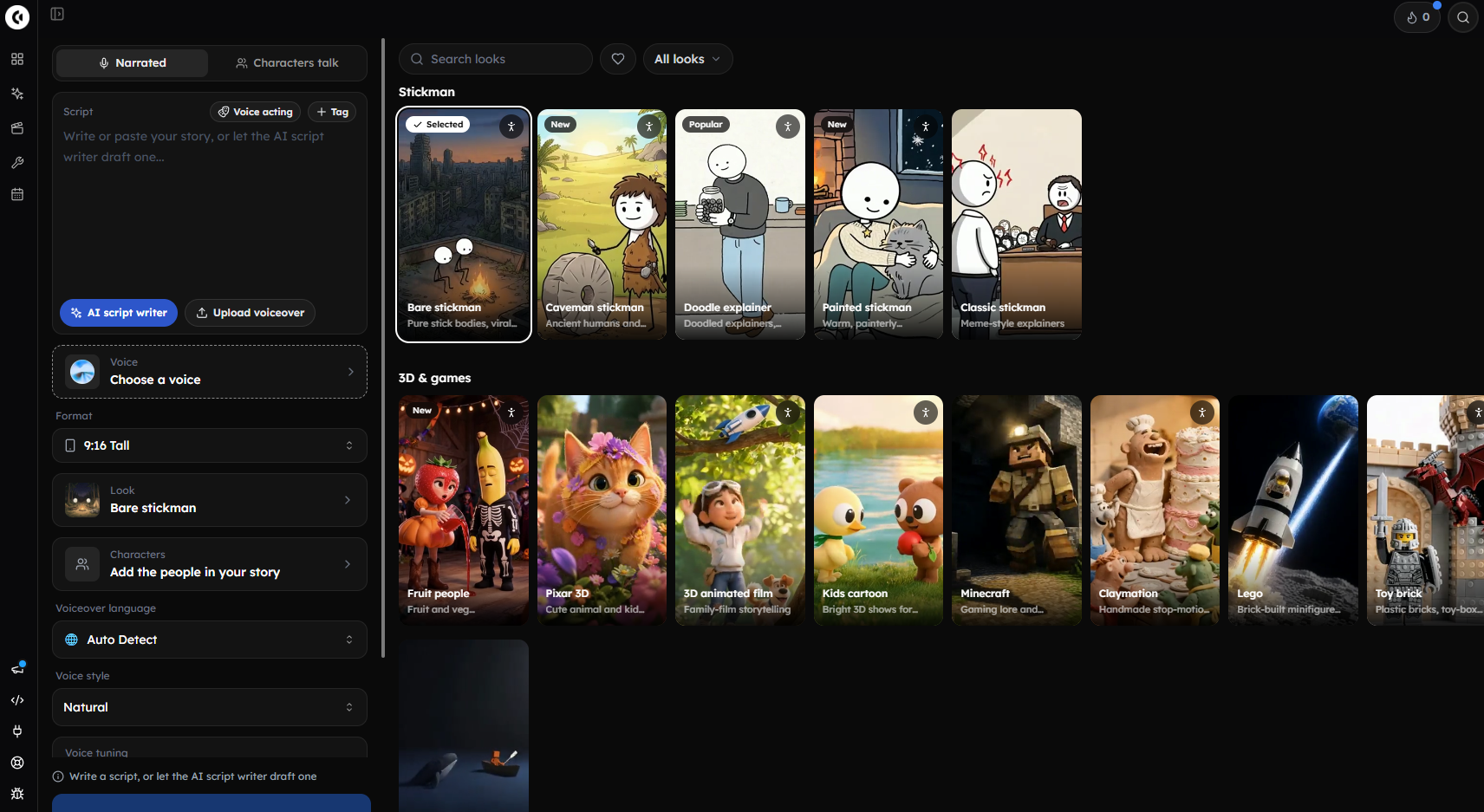
Open the AI Story video generator and choose 9:16 or 16:9.
Pick a look: Bare stickman, Doodle explainer, Caveman stickman, Painted stickman or Classic stickman.
Paste your six-beat script, or let the AI script writer draft one to a target length.
Add a stickman from the Characters library and mention it with @ for consistency.
Choose a voice and style such as Dramatic or Eerie; tags like [whispers] are performed.
Add scene instructions, such as "locked camera, red backpack in every scene".
Optionally animate key scenes; the cost shows before you confirm.
If visuals miss, "Redo pictures" regenerates them but keeps words, voiceover and timing.
Plans start at $19.99 a month, with discounts on longer billing; check the pricing page.
Where it falls short: Clippie isn't a timeline editor, so frame-by-frame stick fight choreography needs a dedicated animation app.
Shorts vs Long-Form What If Videos
Shorts suit one scenario with three or four fast beats and a choice at the end. Long-form 16:9 videos suit day-by-day survival stories and multi-part science series. Shorts drive discovery, while long-form builds watch time, and one script can feed both.
Shorts (9:16):
One premise, three or four beats, under YouTube's three-minute Shorts limit.
The "What if you…" line on screen in the first second.
End on a choice question.
Long-form (16:9):
Roughly 6–12 minutes, as the channels above tend to run.
Day chapters ("Day 1: Water") in the description.
A Part 2 that raises the stakes.
Example: our stickman animation walkthrough using Claude and Clippie builds a 16:9 survival story through to upload settings.
Monetization and Originality Rules
What if stickman channels can earn through the YouTube Partner Program, but originality matters more than volume. YouTube's inauthentic content policy targets templated, interchangeable videos, so each upload needs its own premise, research and storyline, even when your style and intro repeat.
YPP thresholds (YouTube's own pages):
Now: 1,000 subscribers plus 4,000 public watch hours in 12 months, or 10 million public Shorts views in 90 days.
From February 1, 2027: new applicants need 8,000 qualified watch hours in 365 days, or 20 million qualified Shorts views in 90 days.
Originality checks:
Inauthentic content: templated storylines and generic AI templates aren't allowed; a recurring format is fine if each storyline differs.
No identical scripts: swapping "zombie" for "flood" isn't a new video.
AI disclosure: YouTube exempts clearly unrealistic content, such as animation.
Made for kids: answer honestly; YouTube counts animated characters as one factor among several.
Our 30-day monetization course for 2026 covers the YPP changes and review timeline.
FAQs
What are what if stickman videos?
They are animated, second-person scenario stories narrated as "What if you…". A stick figure stands in for the viewer, who faces escalating challenges and choices, such as surviving an outbreak or waking up on Everest. Each ends with an outcome and a question for the comments.
How long should a what if stickman video be?
Shorts work best as one scenario with three or four beats, well under YouTube's three-minute limit. Long-form 16:9 versions often run about 6 to 12 minutes with day or stage chapters. Test premises as Shorts, then expand the most-debated ones.
Can I make stickman survival videos with AI?
Yes. AI tools can write the script, generate consistent stickman scenes and narrate with an AI voice. You still choose the premise, fact-check every survival or science claim and shape the choices. That human work keeps a channel original enough for monetization review.
Do what if animation videos get monetized?
They can, if the channel meets YouTube Partner Program thresholds and passes review. The inauthentic content policy excludes templated, interchangeable videos, so each episode needs a distinct premise, storyline and facts. Thresholds for new applicants double on February 1, 2027.
Do I need to label stickman videos as AI-generated?
Usually not on YouTube. Its altered or synthetic content rules require disclosure for realistic content, such as a real person appearing to say something they didn't. Clearly unrealistic content like animation is exempt. Adding realistic footage or a real likeness changes that.
How do I make survival videos without giving dangerous advice?
Keep the story fictional and say so in the description. Use real facts only from official sources such as Ready.gov or NOAA, and list them. Avoid step-by-step instructions viewers could copy in danger, such as weapons, foraging or medical procedures.
What to Do Next
Pick one idea group and script three videos before producing any. Writing first shows which premises escalate well.
Step 1: Choose Survival, Science, History or Everyday as your lane.
Step 2: Write three six-beat scripts, each with a fact list.
Step 3: Produce a Short and a long-form version of the best one.
Step 4: Turn the most-debated choice in your comments into Part 2.
For formats to run alongside this one, browse our list of faceless YouTube automation ideas.
Build the story step by step
How to storyboard a Stickman survival video
Build a Stickman survival story around one difficult choice, with an original six-scene script, visual instructions and a practical production checklist.
How to plan ancient-human Stickman stories
Plan an ancient-human Stickman video with a clear story, a consistent setting and an explicit distinction between researched history and fictional scenes.
Stickman animation prompts and video ideas you can build on
Original stickman prompts for survival stories, what-if videos, explainers and horror, with separate script, scene and animation instructions for Clippie.
Try it in Clippie
Make a stickman video
Turn a script into Stickman scenes, narration and captions in 16:9 or 9:16. Add AI animation to the moments that need motion.
Make a stickman video