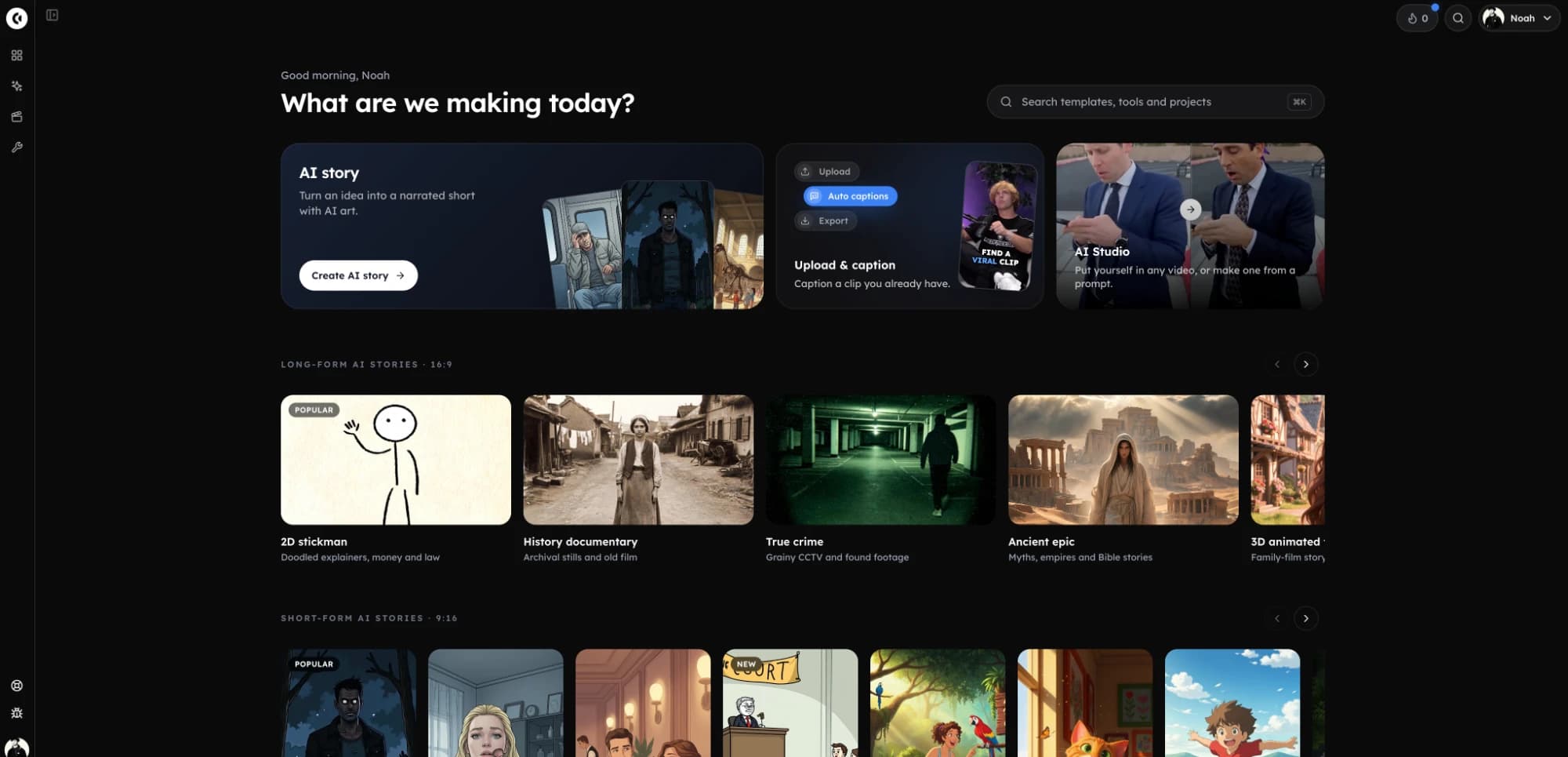
A stickman video script template, with a real script to copy the shape of.
A stickman script is short lines that each give the picture one thing to show. Here are fill-in outlines for four kinds of video, a word budget for each length, and the complete script of a finished Clippie story.
Short answer
A stickman video script is narration written one picture at a time: a first line that holds the problem, short sentences with one action each, and a last line that pays off the first. Write about 150 words for a one-minute video. Use the outlines below for a twist story, a survival scene, an explainer or a history story, then paste the script into a Clippie stickman template, which splits it into scenes and draws a picture for each.
The word counts assume about 2.5 words a second, the pace Clippie assumes when it splits a script into scenes. Voices differ, so check the real length after generating.
A finished 37-second stickman story, made in Clippie. Tap it to hear the narration. Its full script is below.
How to write a stickman script. Four steps.
- 1
Write the last line first
Know where it ends: the twist, the answer or the rescue. Every earlier line exists to set that up.
- 2
Open on the problem
The first sentence should already hold the odd thing, the danger or the question. No greeting, and no “in this video”.
- 3
One action per sentence
Each sentence becomes part of a picture. “He knocked.” can be drawn. “He had always felt uneasy about it” cannot.
- 4
Read it aloud, then paste it in
Cut what you stumble on. Paste the script into a stickman template, and Clippie splits it into scenes, draws them and narrates it.
How many words for each length. At about 2.5 words a second.
| Length | Words | Sentences of about 10 words | Use it for |
|---|---|---|---|
| 30 sec | About 75 | About 8 | One joke or one fact |
| 45 sec | About 115 | About 12 | A twist story |
| 1 min | About 150 | About 15 | A survival scene or a one-question explainer |
| 1.5 min | About 225 | About 23 | A story with a middle |
| 2 min | About 300 | About 30 | An explainer with two examples |
| 3 min | About 450 | About 45 | The longest a YouTube Short can be |
| 5 min | About 750 | About 75 | A short YouTube explainer |
| 10 min | About 1,500 | About 150 | A full YouTube story or history video |
These are the eight lengths the AI script writer offers. The writer sizes a draft to the voice you picked, so your own count is a guide and not a target. YouTube’s help page on Shorts, read on 20 November 2026, says a Short can be up to three minutes long.
A worked example and four templates. Replace anything in brackets.
First a finished script, so you can see the shape. Then four outlines to fill in, and what Clippie does with the result.
A worked example: the door in the field
The sample at the top of this page is a finished Clippie video of about 37 seconds and about 100 words. This is its narration as its captions show it, with the picture on screen for each part. The story is fiction.
- “There was a door in the middle of the field. No walls, no house, just a door.”: A wooden door in its frame stands alone on a dirt path through a wheat field at sunset.
- “Every evening on his walk home he passed it, and every evening he told himself not to touch it.”: A stick figure walks along the path, past the door.
- “On the hundredth evening he knocked. Nothing.”: He stands at the door, knocking.
- “He turned the handle. On the other side was the same field, the same sky, the same path.”: His hand rests on the door, with the same field behind it.
- “He laughed, stepped through and closed the door behind him. He walked home.”: He steps through the open door, smiling, and walks on.
- “His dog barked at him like a stranger. His key didn’t fit the lock,”: Seen from inside a kitchen: a figure sits at the table, and through the window he stands outside while a dog barks at him.
- “and through the kitchen window he watched himself sit down to dinner.”: Outside, he tries the handle as the dog keeps barking.
The shape is plain: an odd thing, a rule he keeps, the day he breaks it, a moment where nothing seems wrong, and a last line that changes what the first one meant. The twist is never explained.
Template 1: the twist story (30 to 45 seconds)
The shape of the door story, in six lines.
- The odd thing: “There was a [ordinary object] in [a place it should not be].”
- The rule: “Every [day or night] [he or she] [passed it or heard it], and every time told [himself or herself] not to [touch it, answer it, look].”
- The break: “On the [number]th [day or night], [he or she] did.”
- The false relief: “Nothing. It was only [the ordinary explanation].”
- The small wrong detail: “[Something familiar] did not [know them, fit, answer].”
- The last line: “And [through a window, in a mirror, on the phone], [he or she] saw [the thing that explains it].”
Stop there. Do not explain the twist.
Template 2: the survival scene (1 minute)
Second person, present tense, with one thing running out.
- The hook: “You have [amount] of [air, water, battery, daylight] left.”
- Where and who: “You are [place]. With you: [one person or animal] and [one object].”
- Problem one and its fix: “[What fails]. You [fix it with the object], which costs you [something].”
- Problem two, worse: “Then [the fix causes the next problem].”
- The choice: “You can [option one, and its cost] or [option two, and its cost].”
- The end: “[What you choose, in one short sentence].” Or stop on the question.
Change the number at least twice, so the viewer can follow it falling.
Template 3: the one-question explainer (1 minute)
For money, psychology and science. The question is the first line and the answer is the last.
- The question: “Why does [everyday thing] [do the surprising thing]?”
- Why it is odd: “You would expect [the obvious guess].”
- One person, one example: “[Name] [does something ordinary with a prop].”
- The idea in plain words: “That happens because [one cause].”
- Where it stops being true: “It does not mean [the common overstatement].”
- The answer: “So [everyday thing] [does the thing] because [the cause, in a few words].”
Every sentence after the second needs a source. Write the source next to the line in your notes, and delete the line if you cannot find one.
Template 4: the history story (3 to 5 minutes)
One person inside one event, told in order.
- A moment, not a date: “[Person] is [doing a small thing] on the morning of [event].”
- What they do not know yet: “[He or she] does not know that [what is coming].”
- How it got here: three sentences, one cause in each.
- The event, through that person: what they see, hear and do, in the order it happened.
- What changed: “By [time], [the result].”
- The link to now: “[What still exists because of it].”
Check every name, date and number against a reputable source before you generate, and say “around” where historians disagree.
What happens when you paste it in
At Normal pacing Clippie splits a pasted script into scenes of roughly 13 to 20 words and draws a picture for each. Scene headings such as “Scene 1” and timestamps from a script written in another tool start a new scene and are not read aloud. A line that begins “Visual:” is used as a note for that part’s picture and is not read aloud either.
You do not have to describe the pictures. Clippie plans one for each scene from the words. To set a picture yourself, put it in square brackets on the line after its narration, such as [Image: a wooden door standing alone in a wheat field at sunset], and it is drawn as written for that line.
To start from a draft, the AI script writer has formats that match these templates: You are in it for second-person survival, Explain why for one-question explainers, and History for events told in order. It also has Storytime, Warning, List, True story and Cliffhanger. Leave it on Auto and it picks a format from your idea.
Directions in square brackets, such as [pause] or [whispers], are performed by the voice and not read out. Rules for every picture, such as “every scene is at dusk”, go in Scene instructions and not in the script.
From script to video. What the editor does with your words.
Paste or draft
Paste your own script, or let the AI writer draft one from 30 seconds to 10 minutes.
A format for each shape
Second-person stories, explainers, histories, lists, warnings and cliffhangers, or Auto.
Sized to the voice
The writer aims a draft at the time your chosen voice takes to read it.
A picture per scene
Drawn in one of seven stickman looks, and redrawn one at a time if you need to.
Acted delivery
Square-bracket directions such as [pause] and [whispers] change how a line is read.
Edit after generating
Change a line or redraw a scene without starting over.
Frequently asked questions.
How do you write a script for a stickman video?
Write the last line first, open on the problem, and give every sentence one action that can be drawn. Aim for about 150 words a minute, read it aloud, and cut anything that explains what the picture already shows.
How long should a stickman script be?
About 75 words for 30 seconds, 150 for a minute and 750 for five minutes, at about 2.5 words a second. Clippie’s AI writer offers lengths from 30 seconds to 10 minutes.
Is there a stickman script template I can copy?
Yes. This page has four fill-in outlines: a twist story, a survival scene, a one-question explainer and a history story. They were written for this page and are yours to use.
Did Clippie make the door video on this page?
Yes. It is a finished video of about 37 seconds made in Clippie, with an AI narrator and word-by-word captions. The script printed above is its narration as its captions show it. The story is fiction.
Do I need to write scene descriptions?
No. Paste the narration and Clippie plans a picture for each scene from the words. To set one picture yourself, add it in square brackets on the line after its narration, as [Image: …]. To steer all of them, use Scene instructions.
Can the AI write the script for me?
Yes. Type an idea, pick a length and a format, and the AI script writer drafts it. Treat it as a first draft: rewrite the first and last lines, and check any facts.
How much does a stickman video cost to make in Clippie?
Stickman videos are included in every Clippie plan, from $19.99 a month. Scene pictures are included in all seven stickman looks. Narration uses voice minutes and the export uses export minutes, one of each per minute of video. Monthly allowances are Lite: 3 hours of export and 1 hour of AI voice; Creator: 10 hours of export and 4 hours of AI voice; Pro: 16 hours of export and 8 hours 20 minutes of AI voice. Animating scenes is optional and uses AI credits, about 7 credits for a 5-second clip at the default settings.