
Best AI Voiceover Tools for Faceless YouTube Channels in 2026 (Honest Comparison)
Compare the best AI voiceover tools for faceless YouTube channels in 2026, ElevenLabs vs Murf vs Play.ht vs Clippie AI, with honest feature breakdowns and a clear recommendation by channel size.
Searching for the best AI voiceover tool for your faceless YouTube channel in 2026?
The market has expanded dramatically. There are now dozens of AI voiceover platforms competing for creator attention, each with different voice libraries, pricing models, integration capabilities, and output quality. Choosing the wrong one means paying for a tool that slows your workflow, sounds robotic, or requires expensive add-ons to do what a single integrated platform handles automatically.
This guide cuts through the noise. It covers exactly what to compare before choosing a tool, how the leading platforms stack up against each other, and why the distinction between standalone voiceover tools and built-in voiceover inside a production platform matters more than most creators realise.
Executive Summary
This guide is for faceless YouTube creators evaluating AI voiceover tools in 2026. It covers why voiceover quality is the most important production factor for channel retention, the six criteria that actually matter in a comparison, an honest head-to-head breakdown of ElevenLabs, Murf, Play.ht, and Clippie AI, why integrated voiceover outperforms standalone tools for high-volume faceless creators, how Clippie AI's voice library and custom cloning compare to the competition, and a clear recommendation framework by channel size and budget. By the end, you will know exactly which tool fits your channel, and why.
Table of Contents
Why Voiceover Quality Is the Single Biggest Factor in Faceless Channel Retention
The 6 Most Important Things to Compare Before Choosing an AI Voiceover Tool
ElevenLabs vs Murf vs Play.ht vs Clippie AI, Head-to-Head Breakdown
Why Built-In Voiceover Inside Your Video Platform Beats Standalone Tools
How Clippie AI's 50+ Voices and Custom Voice Cloning Stack Up Against the Competition
Which AI Voiceover Tool Is Right for Your Channel Size and Budget
Frequently Asked Questions
1. Why Voiceover Quality Is the Single Biggest Factor in Faceless Channel Retention
On a faceless YouTube channel, viewers cannot see the creator. There is no body language, no facial expression, no visual personality to create engagement and trust. The voiceover carries the entire weight of audience connection, and that means voiceover quality directly determines whether viewers stay or scroll.

The Retention Mechanism
YouTube's primary algorithmic signal is average view duration, specifically, what percentage of each video the average viewer watches before leaving.
High completion rates signal to YouTube that the content is valuable. The algorithm responds by distributing the video to more viewers, increasing impressions, and growing the channel. Low completion rates signal the opposite, distribution slows, and the channel stagnates regardless of how frequently it posts.
Where viewers drop off on faceless videos:
The most dangerous drop-off point on any faceless video is the first 30 seconds. This is when viewers make the subconscious decision about whether the channel is worth their time. In the absence of a face to create immediate connection, the voiceover is the primary engagement signal during this window.
A natural, authoritative, well-paced voice holds viewers through the opening and into the content body. A robotic, flat, or inconsistently paced voice triggers the scroll, often within the first 10 seconds.
What "Good Voiceover" Actually Means in 2026
The threshold has moved significantly. Early AI voices, even from leading platforms, had tells: robotic pauses between words, flat emotional delivery, unnatural stress patterns on certain syllables. Experienced viewers noticed and left.
In 2026, the best AI voiceover tools produce narration that is genuinely indistinguishable from human delivery for most listeners. The quality benchmark has shifted from "acceptable despite being AI" to "sounds like a professional human narrator."
The characteristics of voiceover that holds retention:
Natural pacing - sentences flow at conversational speed, not uniform mechanical speed
Appropriate emphasis - the voice stresses the right words in each sentence
Tonal variation - the delivery shifts slightly between informational passages and emphatic moments
Pronunciation accuracy - niche-specific terms, proper nouns, and numbers are delivered correctly
Consistency - the same quality from the first sentence to the last, with no audible degradation
What robotic voiceover costs a channel:
Every percentage point of completion rate lost to poor voiceover is a percentage point of algorithmic reach lost. Over a catalogue of 50 videos, consistently poor voiceover compounds into dramatically lower total impressions, lower subscriber acquisition, and lower AdSense revenue, even if every other element of the production is strong.
The Platform-Specific Context
YouTube long-form: Voiceover quality impact is highest in the first 30 seconds and at natural "exit points", section transitions where a robotic voice triggers a pause in engagement that converts to a drop-off.
TikTok and YouTube Shorts: The impact is concentrated in the first 3 seconds. If the voice does not create forward tension in the opening statement, viewers swipe before the content has a chance to deliver value.
Instagram Reels: A significant proportion of Reels viewers watch with sound off initially. Captions replace the voiceover in the first phase, but when sound is turned on, voice quality must justify continued watching.

2. The 6 Most Important Things to Compare Before Choosing an AI Voiceover Tool
Most creators compare AI voiceover tools on the wrong criteria, voice count, character limits, and price per minute. These are secondary. Here are the six factors that actually determine which tool is right for a faceless YouTube channel.
Comparison Factor 1: Naturalness of Delivery
This is the primary factor. Everything else is secondary.
How to evaluate it:
Do not rely on demo clips provided by the platform, these are curated to show each voice at its best. Test each tool with your own script: paste 300 words from a real video you plan to produce and generate the narration.
Listen specifically for:
Does it sound like a human chose where to pause, or like a machine calculating sentence boundaries?
Does emphasis fall on the right words in each sentence?
Does it handle questions differently from statements?
Does it maintain consistent quality across the full 300-word passage or degrade toward the end?
Any tool that does not pass this test on real-world content should not be selected regardless of price or feature list.
Comparison Factor 2: Custom Voice Cloning Capability
For faceless creators building a long-term channel, custom voice cloning is the most valuable feature available. A cloned voice creates proprietary audio identity that no competitor can replicate.
What to look for:
How much source audio is required for a high-quality clone? (2–5 minutes is the practical range for production-quality output)
How many custom cloned voices does the plan support?
Is the cloned voice indistinguishable from the source recording in output?
Can the cloned voice be regenerated and updated as the platform's model improves?
Comparison Factor 3: Integration With the Video Production Workflow
A standalone voiceover tool generates audio files that must be exported, imported into an editing platform, synced to visuals, and exported again. For a creator producing 10+ videos per month, this file management overhead adds hours of friction to the monthly workflow.
The integration question to ask:
Does this tool generate voiceover inside the same platform where I also create visuals, captions, and export my video, or does it require me to move files between platforms?
A tool that integrates with the full production workflow eliminates this friction entirely.
Comparison Factor 4: Captioning and Subtitle Synchronisation
Captions are not optional for faceless YouTube content, they are a retention tool. Platform data consistently shows that auto-captions improve average view duration by keeping sound-off viewers engaged long enough to activate audio.
What to look for:
Does the tool automatically sync captions to the generated voiceover?
How many languages does the captioning support?
How accurate is the transcription on niche-specific terminology?
A voiceover tool that also handles auto-captioning reduces two production tasks to one.

Comparison Factor 5: Pricing Model and Scalability
AI voiceover pricing models vary significantly and their cost implications at scale differ dramatically.
The three pricing model types:
Character-based: Pay per character of script text generated. Predictable but can become expensive at high volume.
Minute-based: Pay per minute of audio generated. Straightforward but requires accurate volume estimation.
Flat monthly subscription: Fixed cost for a defined capacity. Most predictable for creators with consistent output volume.
For faceless creators with a consistent posting schedule, flat monthly subscriptions are almost always more cost-efficient than usage-based pricing, provided the plan's capacity matches the actual production volume.
Comparison Factor 6: Voice Library Breadth and Niche Fit
A large voice library is only valuable if it contains voices that are appropriate for your specific niche. 200 voices that are all entertainment-focused does not serve a finance or history channel as well as 50 voices with strong representation across authoritative and documentary styles.
What to evaluate:
Does the library include voices appropriate for your niche's tone requirements?
Are there multiple accent options for targeting different geographic markets?
Is there gender diversity across the authoritative and educational voice styles?
3. ElevenLabs vs Murf vs Play.ht vs Clippie AI: Head-to-Head Breakdown
ElevenLabs
ElevenLabs is widely regarded as the industry leader for raw voice quality. Its neural voice synthesis produces some of the most naturally human-sounding AI narration available in 2026.
Strengths:
Voice naturalness is the highest in the standalone tool category, emotional range, emphasis, and pacing are consistently impressive
Voice cloning from short audio samples produces high-quality results
Large voice library with strong diversity across accents, genders, and tonal styles
API access for creators building custom workflow integrations
Multilingual voice generation across 32+ languages
Limitations:
Standalone tool, generates audio files that must be integrated into a separate editing and production workflow
No built-in video editing, captioning, or export, requires additional tools for complete video production
Pricing at higher tiers can become expensive for creators producing 15+ videos per month
Character-based pricing on lower tiers creates cost unpredictability at variable output volumes
Best for:
Creators who prioritise raw voice quality above all other considerations and are comfortable managing a multi-tool workflow, importing ElevenLabs audio into a separate video editing platform, manually syncing captions, and handling export separately.
Murf AI
Murf AI is a strong mid-tier option with a clean interface and a broad voice library designed for professional use cases including marketing, e-learning, and content creation.
Strengths:
Clean, intuitive interface, lower learning curve than ElevenLabs for beginners
Strong voice quality at mid-tier pricing, competitive with ElevenLabs for most use cases
Built-in slide and media synchronisation. limited video editing functionality within the platform
Good pronunciation control, creators can specify emphasis and pauses at a granular level
120+ voices across 20+ languages
Limitations:
Voice quality ceiling is slightly below ElevenLabs for the most nuanced delivery
Video integration is limited, not a full production environment
Custom voice cloning available but requires more source audio than ElevenLabs for equivalent quality
Pricing for higher-volume plans increases steeply relative to the feature set provided
Best for:
Creators who want a more user-friendly interface than ElevenLabs and are producing at moderate volume (5–8 videos per month) in a workflow where voiceover is the primary production challenge.
Play.ht
Play.ht focuses primarily on text-to-speech with extensive language support, 142 languages, making it the strongest option for creators targeting international or multilingual audiences.
Strengths:
Most extensive language support of any platform in this comparison, 142 languages
Voice cloning capability with consistent quality
API access for workflow integration
Competitive pricing on mid-tier plans
Realistic, natural delivery on most major languages
Limitations:
Voice quality in English narration is strong but generally below ElevenLabs at the same price point
No video editing, captioning, or export, purely a voiceover generation tool
Interface is less polished than ElevenLabs or Murf, requires more technical familiarity
Limited voice library breadth in some niche tonal styles
Best for:
Creators building multilingual content strategies who need voiceover generation across many languages at competitive pricing, particularly useful for channels targeting non-English-speaking audiences or creators using Clippie AI's 102+ language caption support alongside Play.ht narration.
Clippie AI
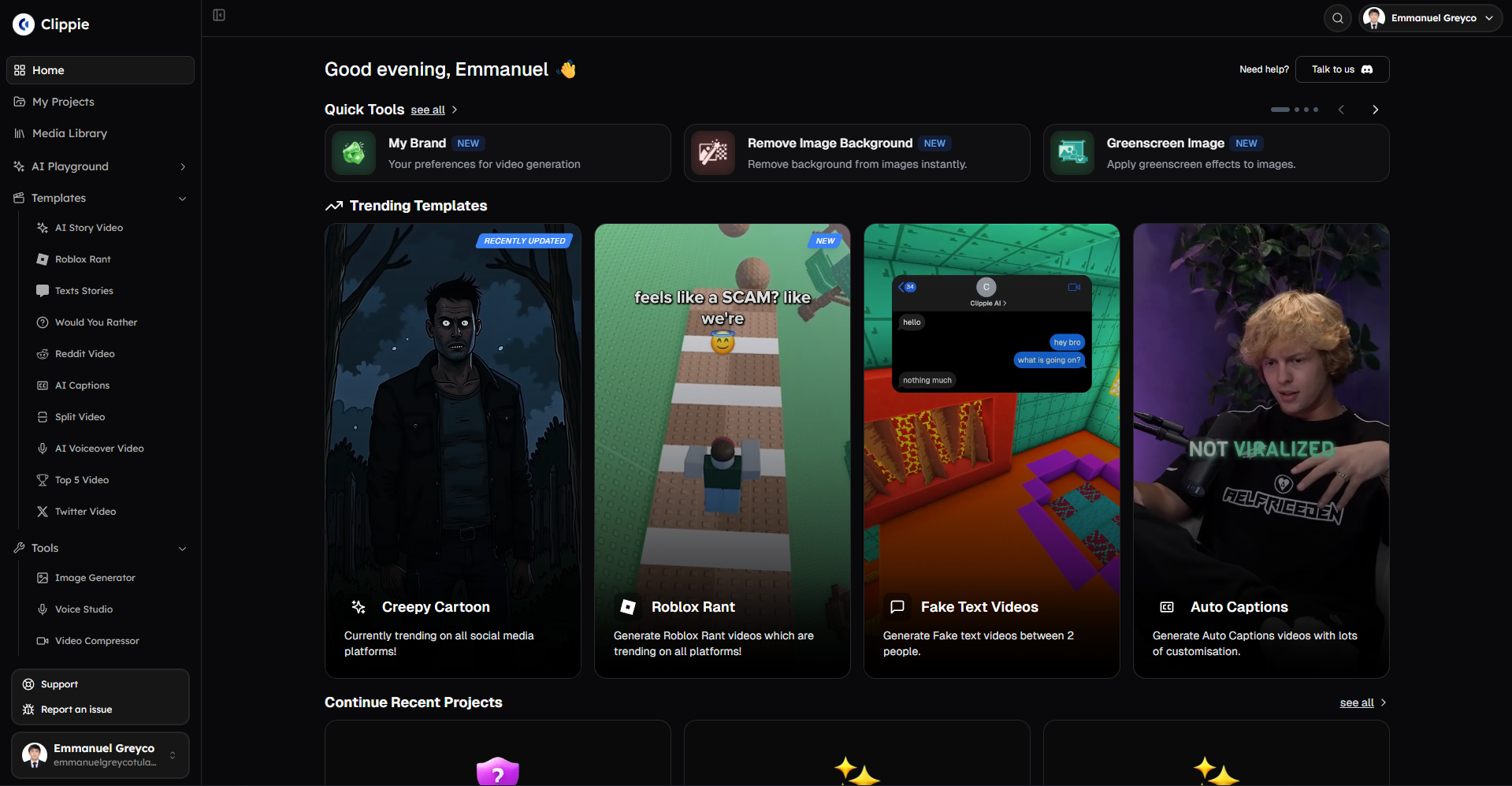
Clippie AI approaches the voiceover problem differently from the three standalone tools above. Rather than providing the best possible isolated voiceover generation, it provides voiceover as part of a complete, integrated video production platform, where voiceover, image generation, captioning, and export all happen in the same workflow.
Strengths:
50+ AI voices built directly into the production workflow, no file export or import between platforms
Custom voice cloning integrated into the same account, up to 1, 10, or 30 custom voices depending on plan
Auto-captioning synced automatically to generated voiceover, no separate captioning step or tool
102+ language caption support, the broadest multilingual reach of any production platform in this comparison
AI image generation, VEO3.1 video footage, and video export all in the same platform, the entire production workflow in one place
Fixed flat monthly pricing, cost is fully predictable at any production volume within the plan capacity
24/7 support
Limitations:
Voice quality, while strong and production-ready, operates within a different model than ElevenLabs, creators prioritising the absolute ceiling of voice naturalness above all other considerations may prefer ElevenLabs
No standalone API access for external workflow integration
No free tier, the entry plan starts at $19.99/month
Best for:
Faceless creators who want to produce complete, export-ready videos, not just audio files, in the minimum time with the minimum number of tools. The platform eliminates the multi-tool workflow that standalone voiceover tools require and replaces it with a single integrated production environment.

4. Why Built-In Voiceover Inside Your Video Platform Beats Standalone Tools
This is the comparison dimension most creators overlook, and it is the one that most significantly affects sustainable production at scale.
The Hidden Cost of Standalone Voiceover Tools
When a creator uses a standalone voiceover tool alongside a separate video editor, the production workflow looks like this:
Generate voiceover in ElevenLabs → download audio file
Open video editor → import audio file
Manually sync audio to visuals → adjust timing
Generate captions in a separate captioning tool → import caption file
Apply captions to the video → adjust caption timing
Export the final video
Each of these handoff points, file downloads, imports, manual syncing, costs 5–15 minutes per video. At 10 videos per month, these handoffs consume 50–150 minutes of production time that contributes nothing to the quality of the final video.
At 20 videos per month: 100–300 minutes of pure administrative overhead.
At 50 videos per month (agency scale): 250–750 minutes, more than 12 hours of time spent moving files between tools rather than producing content.
The Integrated Workflow Advantage
When voiceover is built into the production platform, as it is in Clippie AI, the workflow becomes:
Paste script into Clippie AI → select voice → generate voiceover
Generate scene images in the same platform
Auto-captions sync to the voiceover automatically
Export the complete video from the same platform
No file downloads. No imports. No manual syncing. No switching between four open browser tabs.
The time saved per video is modest in isolation, 8–15 minutes. At scale, that time saving is the difference between a sustainable 10-video-per-month workflow and a burnout-inducing 20-video-per-month grind.
The Quality Consistency Advantage
Manual audio-video syncing in a separate editor introduces human error. A voiceover that is 0.3 seconds out of sync with the visual it accompanies creates a subtle but perceptible disconnect that degrades viewer experience without being obviously identifiable as the problem.
Auto-sync within an integrated platform eliminates this category of error entirely. Captions are always accurately timed. Voiceover and visuals are always properly synchronised. Quality consistency is structural rather than dependent on the creator's manual attention.
The Cost Structure Advantage
Using a standalone voiceover tool requires:
Voiceover tool subscription ($5–$33/month depending on tier)
Video editor subscription ($10–$30/month)
Captioning tool subscription ($10–$20/month, if not using a free tool with limited accuracy)
Total minimum multi-tool stack cost: $25–$83/month
Clippie AI's Creator plan at $34.99/month covers voiceover, image generation, captioning, and export, replacing three separate subscriptions at equal or lower total cost.
5. How Clippie AI's 50+ Voices and Custom Voice Cloning Stack Up Against the Competition
The Voice Library
Clippie AI's 50+ voice library is curated specifically for faceless content creator use cases, not for corporate e-learning or marketing presentations. The voices are selected and tuned for the content formats that faceless YouTube channels produce most frequently.
Voice library coverage:
Male and female voices across multiple age ranges
Multiple accent options, US, UK, Australian, and neutral international
Tonal variety, authoritative (finance, history, documentary), conversational (self-improvement, lifestyle, AI tools), dramatic (true crime, storytelling, mystery)
Consistent quality across the full library, no large variation between the best and worst voices in the set
How it compares:
ElevenLabs has a larger raw library, but a larger library also means more low-quality voices to filter through. Clippie AI's curated approach means a creator can identify a production-ready voice in one or two tests rather than spending an hour auditioning dozens of options.
Custom Voice Cloning
Clippie AI's custom voice cloning allows creators to build a proprietary voice identity for their channel, narration that sounds like them, generated automatically from any script, without recording sessions.
Clipping capacity by plan:
Lite: $19.99/month: 1 custom voice
Creator: $34.99/month: 10 custom voices
Pro: $69.99/month: 30 custom voices
The competitive advantage of Clippie AI's cloning capacity:
ElevenLabs allows custom voice cloning at higher price points but as a standalone tool. Clippie AI integrates custom voice cloning directly into the production platform, the cloned voice generates narration in the same session where images and captions are also created.
The Pro plan's 30 custom voices is the most significant competitive differentiation for multi-channel operators and agencies. A content agency managing 15 client channels can maintain a distinct cloned voice identity for each channel within a single Clippie AI Pro account, something that would require 15 separate ElevenLabs accounts to replicate at significantly higher cost.
Caption Integration
This is where Clippie AI's comparison advantage is clearest. ElevenLabs, Murf, and Play.ht all generate audio files. They do not auto-generate captions. They do not sync captions to the voiceover. They do not support 102 languages of captioning within the same platform.
Clippie AI's speech-to-subtitles feature:
Auto-generates captions from the AI voiceover in the same production session
Syncs captions to the voiceover timing automatically, no manual adjustment required
Supports 102+ languages, international creators can caption their videos in their audience's native language without a separate translation or captioning tool
For faceless creators targeting non-English-speaking markets, a significant growth opportunity in 2026, this multilingual captioning capability represents months of audience expansion that standalone voiceover tools simply cannot facilitate within the same workflow.

6. Which AI Voiceover Tool Is Right for Your Channel Size and Budget
For Creators Just Starting Out (0–50 videos total)
Recommended: Clippie AI Lite ($19.99/month)
The priority at this stage is completing the production workflow efficiently enough to post consistently. The integrated platform, voiceover, images, captions, and export in one place, removes the multi-tool complexity that causes most beginner channels to stall before reaching 20 videos.
The 50+ pre-built voices are sufficient to find a strong niche-appropriate voice in the first production session. The 1 custom voice slot on the Lite plan can be used immediately for a cloned voice if the creator wants to build channel identity from the start.
For Creators Scaling to 10+ Videos Per Month
Recommended: Clippie AI Creator ($34.99/month)
At this production volume, workflow efficiency becomes the primary bottleneck. The Creator plan's 120-minute export capacity supports 8–12 videos monthly, the right volume for a channel building algorithmic momentum toward monetisation. Ten custom voices allow separate voice identities for multiple channels or multiple content series within the same channel.
Alternative consideration: ElevenLabs at a mid-tier plan for creators who prioritise maximum voice naturalness and are comfortable managing a multi-tool workflow with separate video editing and captioning tools.
For Multi-Channel Operators and Agencies
Recommended: Clippie AI Pro ($69.99/month)
The Pro plan's 30 custom voices, 250 minutes of export capacity, and 1,000 AI images per month provide the infrastructure for operating 3–5 channels simultaneously from a single account. The integrated platform removes the per-channel tool subscription complexity that multi-channel operations built on standalone voiceover tools accumulate rapidly.
For an agency managing 10+ client channels, multiple Pro accounts provide better economics and operational simplicity than equivalent standalone tool stacks.
No free tier is available on Clippie AI.
💡 For the complete AI tool stack that goes alongside voiceover in a faceless YouTube workflow, read our guide on the top 10 AI tools for faceless YouTube channels in 2026
💡 For how voice cloning specifically contributes to channel identity and long-term growth, read our guide on The Ultimate Faceless Content Workflow in 2026: From Idea to Viral Video (Step-by-Step)
💡 Start with Clippie AI's 50+ voices and built-in production workflow today →
Conclusion: The Best AI Voiceover Tool Is the One That Fits Your Full Workflow, Not Just Your Microphone Test
The most natural-sounding voice in isolation is not the best voiceover tool for a faceless YouTube channel. The best voiceover tool is the one that delivers production-ready narration, integrates with the full video creation workflow, handles captioning automatically, scales affordably as output volume increases, and supports the channel identity differentiation that voice cloning provides.
Evaluated on those criteria, the criteria that actually determine sustainable channel growth, Clippie AI's integrated approach outperforms standalone voiceover tools for the vast majority of faceless creators in 2026. Not because it wins every individual feature comparison, but because it eliminates the workflow friction that standalone tools accumulate at scale.
For the rare creator who demands the absolute ceiling of voice naturalness above all other considerations, ElevenLabs remains the standalone benchmark. For every other faceless creator building a real YouTube channel at real production volume, Clippie AI is the more practical, more cost-efficient, and more scalable choice.
Start producing with Clippie AI's built-in voiceover and production platform today →
7. Frequently Asked Questions
Q1: Is ElevenLabs or Clippie AI better for faceless YouTube channels in 2026?
It depends on what you are optimising for. ElevenLabs produces slightly more nuanced voice naturalness at the ceiling level and is the right choice for creators who prioritise that above all other factors and are comfortable managing voiceover as a separate step in a multi-tool workflow. Clippie AI is the better choice for creators who want voiceover, image generation, captioning, and video export in one integrated platform, which describes the majority of faceless creators managing consistent production volume. The workflow efficiency advantage of Clippie AI outweighs the marginal voice quality ceiling difference for most practical use cases.
Q2: How many AI voices does Clippie AI offer?
Clippie AI offers 50+ AI voices across its platform, covering multiple genders, accents, age ranges, and tonal styles. This library is available on all plans, Lite ($19.99/month), Creator ($34.99/month), and Pro ($69.99/month). Custom voice cloning adds to this with 1, 10, or 30 custom cloned voices respectively per plan.
Q3: Do I need a separate captioning tool if I use Clippie AI for voiceover?
No. Clippie AI's speech-to-subtitles feature automatically generates and syncs captions to the AI voiceover within the same production session. This eliminates the need for a separate captioning subscription. The captioning supports 102+ languages, making it suitable for creators targeting international audiences without additional tools or manual translation workflows.
Q4: Can I use a cloned voice from ElevenLabs inside Clippie AI?
No, voice clones are proprietary to the platform where they are created and cannot be transferred between tools. If you want custom voice cloning integrated into your Clippie AI production workflow, use Clippie AI's built-in voice cloning feature. The Lite plan supports 1 custom voice, the Creator plan supports 10, and the Pro plan supports 30. This keeps the cloned voice and the full production workflow in the same platform.
Q5: Which AI voiceover tool is best for a channel targeting non-English-speaking audiences?
For multilingual voice generation across many languages, Play.ht offers the broadest raw language support at 142 languages. However, if caption support across those languages within the production workflow matters, which it does for most faceless creators targeting international audiences, Clippie AI's 102+ language caption support within the integrated platform provides a more practical solution. The caption support covers the primary international audience markets for most content categories without requiring a separate translation or captioning tool.
Q6: Is there a free tier available for Clippie AI?
No. Clippie AI does not offer a free tier. The entry plan is the Lite plan at $19.99/month, which includes 30 minutes of video export capacity, 30 minutes of AI voice generation, 30 minutes of speech-to-subtitles, 100 AI images, 1 custom voice, captions in 102+ languages, access to 50+ AI voices, and 24/7 support. This plan is sufficient for 3–5 videos per month while a creator is learning the workflow and validating a niche before committing to higher-volume production.
Read more

The Future of Faceless Content in 2026 (What to Expect)
The future of faceless content in 2026: where AI video, the rules, and monetization are heading, and what to do now.

The Best TikTok Niches for High CPM in 2026
The best high-CPM TikTok niches in 2026: which are worth the most, what CPM really means, and how to earn from them.

How to Make Money With Whop Clipping in 2026
How to make money with Whop clipping in 2026: how pay-per-view campaigns work, realistic earnings, and how to start.