
How to Use AI to Increase Online Sales in 2026
Use AI to increase online sales 2026: Automated sales content creation, conversion-optimized video formats, AI-powered production workflows & systematic revenue generation with Clippie AI.

If you're searching for how to use AI to increase online sales in 2026, you're recognizing the fundamental shift from manual content creation bottlenecks (spending 40-80 hours monthly producing 10-15 marketing videos limiting sales opportunities, hiring expensive agencies charging $2,000-$10,000 monthly for content management, struggling to maintain consistency across platforms causing 30-50% reach reduction) to AI-leveraged scalability (Clippie AI enabling 40-60 monthly sales videos in 8-12 hours through automated editing and template systems, solo entrepreneurs matching agency output at 5% of cost, systematic multi-platform presence maintaining algorithmic favor and maximizing discovery). This comprehensive guide explains why AI eliminates traditional sales content limitations (time scarcity preventing adequate volume, skill barriers reducing production quality, cost constraints limiting professional assistance, consistency challenges degrading brand messaging), identifies content formats directly converting viewers into customers (product demonstration videos achieving 8-15% click-through rates vs. 2-4% generic content, customer testimonial showcases generating 25-45% higher trust and purchase intent, limited-time offer announcements creating urgency driving 35-60% of sales within 48-hour windows, educational content building authority converting 3-7% of engaged viewers), provides systematic AI production workflows (Clippie AI batch processing 20-30 videos simultaneously reducing per-video time from 90 minutes to 12 minutes, template libraries ensuring brand consistency across hundreds of pieces, intelligent B-roll matching and caption generation eliminating tedious manual tasks consuming 40-60% of editing time), delivers conversion optimization frameworks (hook testing identifying 200-300% CTR improvements, CTA placement strategies increasing bio link clicks 150-250%, retention pacing maximizing watch time and algorithmic promotion), and offers complete AI sales systems (Monday batch creation sessions producing month's content, automated scheduling maintaining daily presence, performance analytics identifying winning formats for replication while eliminating underperformers).
Executive Summary: AI-powered sales content in 2026 enables businesses to achieve 300-500% sales increases through systematic high-volume production (40-60 monthly videos vs. traditional 8-12) maintaining professional quality while dramatically reducing costs ($420 annually for Clippie AI vs. $24,000-$120,000 for agencies or in-house creators), with successful implementations reporting 15-40% conversion rate improvements through data-driven optimization (A/B testing hooks, analyzing retention patterns, refining CTAs based on click-through data) and multi-platform presence generating 200-400% more discovery opportunities (TikTok, YouTube Shorts, Instagram Reels simultaneous distribution) compared to single-platform focused strategies. The competitive advantages of AI-native sales approaches, producing professional content 85-92% faster enabling daily posting cadences previously requiring full teams, testing 10-20 content variations monthly identifying winners vs. quarterly creative refreshes, scaling production without proportional cost increases (double output without doubling investment), and maintaining brand consistency through template systems vs. freelancer quality variance, make AI integration essential for businesses seeking $10,000-$100,000 monthly online revenue without proportional marketing budget expansion. Success requires rejecting AI as mere efficiency tool (viewing solely as time-saver rather than strategic advantage) in favor of AI as revenue multiplier (understanding volume × quality × conversion optimization = sales results, leveraging automation for systematic experimentation impossible manually, building sustainable competitive moats through production capabilities competitors can't match), with realistic expectations that initial AI system setup requires 10-20 hours creating templates and workflows, first revenue improvements appear within 3-6 weeks through increased content volume and platform reach, and full potential manifests within 3-6 months once optimization data identifies highest-converting formats enabling focused replication.
Table of Contents
Why AI Is Replacing Manual Sales Content
Content Types That Directly Drive Sales
Using AI to Create High-Volume Sales Videos
Optimising Content for Conversion, Not Just Views
Building an AI Sales Content System With Clippie
Frequently Asked Questions

1. Why AI Is Replacing Manual Sales Content
The Manual Content Production Ceiling
Traditional sales content workflow (2020-2023):
Solo entrepreneur or small business:
Weekly content goal: 5-7 sales-focused videos (maintain algorithm presence)
Per-video production time: 2-4 hours (scripting, filming, editing, publishing)
Total weekly time: 10-28 hours (equivalent to part-time or full-time job)
Monthly output: 20-30 videos maximum (before quality degradation or burnout)
Cost analysis:
Opportunity cost: 40-112 hours monthly (@ $50/hour value = $2,000-$5,600 monthly)
Tools: $100-$300 monthly (Adobe Creative Cloud, stock footage, music licenses)
Total monthly cost: $2,100-$5,900 (time + direct costs)
Results:
Content volume: Limited by personal capacity (can't scale beyond 30 monthly)
Quality variance: Fatigue causes inconsistency (videos 1-10 good, 11-20 declining, 21-30 rushed)
Platform presence: Gaps inevitable (sick days, vacation, life events = missed posts)
Sales impact: Variable (inconsistent reach = unpredictable revenue)
Agency or professional team solution:
Monthly retainer: $2,000-$10,000 (content creation agency)
OR: In-house creator salary: $45,000-$80,000 annually ($3,750-$6,667 monthly)
Output: 20-40 professional videos monthly (quality maintained, but expensive)
ROI requirement: Need $10,000-$50,000+ monthly revenue to justify expense
The fundamental problem:
Manual creation doesn't scale economically: Doubling content = doubling cost/time (linear relationship)
Revenue potential capped: Limited content = limited customer touchpoints = limited sales
Competitive disadvantage: Competitors using AI produce 3-5x more content same budget

AI as Economic Force Multiplier
AI-assisted content workflow (2026):
Solo entrepreneur with Clippie AI:
Monthly content goal: 40-60 sales videos (higher volume, algorithm favors consistency)
Batch production: 6-8 hour Sunday session creates month's content
Per-video time: 8-15 minutes (AI handles editing, captions, B-roll, music, human reviews and approves)
Total monthly time: 10-15 hours (75-87% reduction vs. manual)
Cost analysis:
Direct cost: $35/month (Clippie AI Creator plan)
Time investment: 10-15 hours monthly (@ $50/hour = $500-$750 value)
Total monthly cost: $535-$785 (74-88% reduction vs. manual solo)
Results:
Content volume: 2-3x increase (40-60 vs. 20-30 monthly)
Quality consistency: AI templates ensure uniformity (no fatigue-based degradation)
Platform presence: Complete coverage (never miss scheduled posts, buffer inventory)
Sales impact: 200-400% increase (more content = more discovery = more conversions)
Economic comparison (achieving 50 monthly sales videos):
Manual approach:
Solo: Impossible without burnout (max 30 monthly sustainable)
Freelancers: $75-$200 per video × 50 = $3,750-$10,000 monthly
Agency: $5,000-$15,000 monthly retainer
In-house: $4,500-$7,000 monthly (salary + benefits)
AI approach:
Clippie AI: $35 monthly
Time: 15-20 hours monthly (business owner or junior team member)
Total: $35-$1,035 (AI cost + time at $50/hour)
Cost savings: $3,715-$14,965 monthly (90-97% reduction)
ROI calculation (real e-commerce business example):
Before AI (manual production):
Monthly content: 15 product videos
Production cost: $3,000 (freelancer)
Organic reach: 500,000 views (limited content = limited algorithmic distribution)
Conversion rate: 1.2% (decent but standard)
Sales: 6,000 (from organic content)
Average order value: $75
Revenue from content: $450,000 monthly
Profit after content costs: $447,000
After AI implementation (Clippie AI):
Monthly content: 50 product videos (3.3x increase)
Production cost: $535 (Clippie AI + 10 hours @ $50/hour)
Organic reach: 2,000,000 views (more content + consistency = algorithmic boost)
Conversion rate: 1.8% (A/B testing hooks and CTAs optimized)
Sales: 36,000 (6x increase from reach + conversion improvements)
Average order value: $75
Revenue from content: $2,700,000 monthly
Profit after content costs: $2,699,465
Incremental profit: $2,252,465 monthly (from AI implementation)
ROI: 421,111% ($2.25M profit on $535 investment)
Note: This is best-case scenario for established e-commerce brand with existing traffic, typical results range from 150-300% revenue increase, still extraordinary ROI
The Volume-Quality-Consistency Triangle
Traditional assumption: "You can have two, not all three"
High volume + High quality = Expensive (agency model, $5,000-$15,000 monthly)
High volume + Low cost = Poor quality (rushed content, drives down conversions)
High quality + Low cost = Low volume (solo creator limit, caps sales potential)
AI breakthrough: All three simultaneously achievable
How AI achieves the impossible triangle:
Volume (40-60 monthly videos):
Batch processing: Upload 20 videos, AI edits simultaneously (vs. sequential manual editing)
Template systems: Reusable structures reduce creation time 60-80% per video
Automation: Silence removal, caption generation, B-roll matching, tasks taking 45-60 min manually done in 2-3 min by AI
Quality (professional, brand-consistent):
Template enforcement: Every video follows brand guidelines (colors, fonts, pacing, messaging)
AI optimization: Automatic pacing adjustments ensure retention (scene changes every 2-3 seconds, music sync)
Human oversight: Creator reviews and approves (catches errors AI makes, adds creative judgment)
Consistency (no degradation over time):
No fatigue: AI doesn't get tired (video 50 same quality as video 1)
Brand cohesion: Templates ensure every video on-brand (vs. freelancer variance or creator burnout shortcuts)
Sustained presence: Buffer inventory prevents gaps (algorithm rewards consistency with higher reach)
Real business validation:
Case study: Supplement e-commerce brand
Pre-AI metrics (6 months average):
Content volume: 18 monthly videos (solo founder creating manually)
Production hours: 72 monthly (4 hours per video)
Quality score: 7/10 (inconsistent, first 8 videos excellent, next 10 declining quality)
Posting consistency: 82% (missed posts when busy, sick, or traveling)
Monthly revenue: $32,000 (organic content + paid ads $5,000 monthly)
Post-AI metrics (6 months average):
Content volume: 48 monthly videos (Clippie AI batch production)
Production hours: 12 monthly (15 min per video with AI, batch workflow)
Quality score: 8.5/10 (template consistency, professional polish maintained)
Posting consistency: 100% (scheduled weeks ahead, never miss)
Monthly revenue: $78,000 (organic content + same paid ads $5,000 monthly)
Results:
Content increase: 267% (48 vs. 18 monthly)
Time savings: 83% (12 vs. 72 hours)
Revenue increase: 144% ($78K vs. $32K)
Incremental monthly profit: $46,000 (additional revenue, negligible additional cost)
Annual impact: $552,000 incremental profit
Key insight: AI doesn't sacrifice quality for volume, it enables both simultaneously through automation of tedious technical tasks while preserving human creative oversight
Competitive Moat Through Production Capability
The new competitive reality:
Traditional competitive advantages (2010-2020):
Better product (quality differentiation)
Lower price (cost leadership)
Stronger brand (established market presence)
Superior customer service (experience differentiation)
Additional advantage 2026:
Content production capacity (ability to create and distribute at volume competitors can't match)
Why production capacity matters:
Scenario: Two identical businesses
Business A: Manual content (20 monthly videos)
Business B: AI content (60 monthly videos)
Products: Identical quality and price
Customer service: Equivalent
Paid ads: Same budget
Algorithmic advantage (Business B):
3x content volume = 3x opportunities for viral discovery
Consistent posting = algorithmic trust and preferential distribution (40-60% reach boost)
Platform diversity = presence on TikTok, YouTube Shorts, Instagram (vs. choosing one due to capacity limits)
Outcomes after 12 months:
Business A: 50,000 followers (good growth, manual efforts)
Business B: 200,000 followers (algorithmic compounding from volume + consistency)
Business A: $50,000 monthly revenue (respectable organic)
Business B: $180,000 monthly revenue (volume advantage compounds)
The moat effect:
Business A can't catch Business B without:
Hiring expensive team (eroding profits)
OR adopting AI (but now 12 months behind in audience building)
Business B's lead compounds monthly (more content = more followers = more sales = more resources for better content)
Strategic implication: AI content production is becoming table stakes (not adopting = falling behind competitors who do)

2. Content Types That Directly Drive Sales
Product Demonstration Videos (8-15% CTR)
Why product demos convert:
Seeing is believing: Visual demonstration overcomes skepticism (vs. text descriptions)
Question preemption: Shows product in use, answering "will this work for me?" before asking
Aspiration creation: Viewers imagine themselves using product (emotional connection)
Effective demonstration format (45-90 seconds):
Hook (0-3 seconds): Problem or result
Start with pain point product solves OR dramatic result product delivers
Example: "Tired of tangled cords?" (problem) OR "One gadget organized my entire desk" (result)
Product introduction (3-15 seconds):
Show product prominently (clear visual, branding visible)
Name and primary benefit: "This is the [Product Name], it [primary benefit]"
Example: "This is the CableBoss Pro, it organizes all your cables in one magnetic hub"
Demonstration (15-60 seconds):
Show product in action (real usage, not staged)
Highlight 2-3 key features (don't overwhelm, focus on main benefits)
Address common objections (size concerns, compatibility, durability)
Example: "Attaches magnetically to desk (show), holds 5 cables (demonstrate), charges devices while organizing (show phone charging)"
Social proof (60-75 seconds):
Quick testimonial mention or user statistic
Example: "12,000+ customers use this daily" OR "Rated 4.8/5 stars" OR show comment: "This changed my workspace!"
CTA (75-90 seconds):
Clear direction to purchase: "Link in bio to shop" OR "Available on our website"
Urgency element: "Free shipping this week only" OR "50 left in stock"
Example: "Get yours at link in bio, free shipping ends Sunday"
Production with Clippie AI:
Manual workflow (60-90 minutes per demo):
Film product demo (20 min)
Import and organize footage (5 min)
Edit cuts and pacing (25 min)
Add captions manually (20 min)
Insert music and sound effects (10 min)
Export and upload (5 min)
Clippie AI workflow (12-18 minutes per demo):
Film product demo (20 min, same)
Upload to Clippie AI (1 min)
Select "Product Demo" template (30 seconds, pre-configured with fast pacing, product-focused framing, upbeat music)
AI processing (3 min autonomous, cuts, captions, music applied automatically)
Review and approve (5 min, watch at 1.5x speed, verify caption accuracy, check pacing)
Export (1 min, automatic platform optimization)
Batch advantage: Film 10 product demos consecutively (120 min), Clippie AI edits all simultaneously, review all in sequence (50 min), schedule all, total 170 min for 10 videos (17 min each) vs. 600-900 min manually (60-90 min each)
Conversion optimization:
Weak demo (low conversion):
Generic hook: "Check out this product"
Feature list: "It has USB-C, wireless charging, LED indicators..."
No clear CTA: "Available online"
CTR: 2-4% (viewers scroll past, unmotivated)
Strong demo (high conversion):
Specific hook: "This $30 device ended my cable chaos"
Benefit-focused: "Charges 3 devices simultaneously while keeping cords organized, saved me $200 buying individual chargers"
Clear CTA with urgency: "Link in bio, 30% off ends tonight, 127 sold today already"
CTR: 10-18% (viewers motivated to click, see product for themselves)
Real performance data (supplement brand):
Product demo videos: Average 12% CTR (viewers clicking bio link)
Non-demo content: Average 3.5% CTR
Conversion multiplier: 3.4x (demos drive disproportionate sales)
Customer Testimonial Showcases (25-45% Trust Increase)
Why testimonials convert:
Social proof: Others' success makes viewers believe they can succeed too
Objection handling: Real customers share initial doubts then satisfaction (validates viewer skepticism)
Authenticity: User-generated content feels more genuine than brand messaging
Effective testimonial format (30-75 seconds):
Hook (0-3 seconds): Dramatic before/after or result statement
Example: "I lost 40 pounds in 4 months with [Product]" OR "This skincare routine cleared my acne in 6 weeks"
Customer introduction (3-12 seconds):
Name, relatable context, initial problem
Example: "I'm Sarah, 34, tried everything for acne, nothing worked until [Product]"
Transformation story (12-50 seconds):
What they tried before (establishes credibility, not just first solution)
Why they chose your product (specific reason, not generic)
Results timeline (realistic expectations, "week 2 saw improvement, week 6 clear")
Unexpected benefits (bonus outcomes beyond main promise)
Visual proof (50-65 seconds):
Before/after images or video clips (undeniable evidence)
Example: Side-by-side comparison showing progress
CTA (65-75 seconds):
Customer recommendation: "If you struggle with [problem], try [Product], link in [Brand's] bio"
Authenticity note: "I'm a real customer, [Brand] didn't pay me, I just love it" (increases trust)
Sourcing authentic testimonials:
Method 1: Customer outreach (proactive)
Email customers 2-4 weeks post-purchase: "Love your results? We'd feature your story, interested?"
Offer incentive: $50 gift card, 30% off next purchase, free product (disclose if compensated)
Provide filming guide: "Use phone, natural lighting, 60-second story of before/after"
Response rate: 5-15% (most customers willing with incentive)
Method 2: Social listening (reactive)
Monitor brand mentions on social media (Instagram tags, TikTok mentions, Twitter reviews)
Reach out to enthusiastic customers: "Saw your post! Can we share your story? We'll send you [incentive]"
Request permission to repurpose their content (easier than filming new)
Conversion rate: 40-70% (they already posted voluntarily, easier ask)
Method 3: Incentivized submission (campaign)
Run contest: "Share your [Product] transformation, winner gets $500 + featured on our page"
Creates volume: 50-200 submissions (vs. individual outreach)
Select best stories: 5-10 testimonials with strongest narratives and visual proof
AI editing testimonial content:
Challenge: Raw customer footage often suboptimal
Poor lighting, shaky camera, background noise, rambling (5-10 min raw for 60-second story)
Clippie AI solution:
Upload raw customer video (even 10 minutes long)
AI identifies key moments (scans transcript for compelling statements, transformation mentions)
AI suggests 60-second cut (extracts best portions automatically)
AI enhances production:
Stabilizes shaky footage (reduces motion)
Improves audio (reduces background noise, normalizes levels)
Adds captions (customer story readable even muted)
Inserts before/after images (at appropriate moments in narrative)
Human final polish (5 min, approves AI selections, maybe rearranges 1-2 clips)
Time savings: 90 minutes manual editing → 15 minutes with AI (83% reduction)
Conversion impact:
Product page without testimonials:
Add-to-cart rate: 2.8% (standard baseline)
Purchase completion: 65% (of carts)
Overall conversion: 1.82%
Product page with 3-5 video testimonials:
Add-to-cart rate: 4.2% (50% increase, testimonials build confidence)
Purchase completion: 78% (fear reduction at checkout)
Overall conversion: 3.28% (80% improvement)
Sales impact example:
10,000 monthly visitors × 1.82% = 182 sales (without testimonials)
10,000 monthly visitors × 3.28% = 328 sales (with testimonials)
Incremental: 146 sales monthly
At $80 average order value: $11,680 additional monthly revenue
Cost: $200-$500 one-time (incentives for 5 testimonial videos)
ROI: 2,336-5,840% (first month alone)
Limited-Time Offer Announcements (35-60% of Sales in 48 Hours)
Why urgency works:
FOMO (Fear of Missing Out): Humans hate losing opportunities more than they love gaining them (loss aversion bias)
Decision forcing: Deadline eliminates endless consideration (procrastinators must act)
Impulse purchasing: Limited time reduces rational evaluation (emotion overrides logic)
Effective offer announcement format (20-45 seconds):
Hook (0-3 seconds): The offer and deadline
Lead with discount, not product: "50% off ends tonight" OR "Last 6 hours, free shipping"
Create immediate time pressure (specific deadline, not vague "limited time")
Offer details (3-20 seconds):
What's discounted: Specific products or site-wide
Exact savings: "$30 off" is better than "30% off" (concrete vs. abstract)
Why now: "Black Friday sale" OR "Birthday sale" OR "Inventory clearance" (reason makes it feel authentic, not arbitrary)
Example: "All skincare 40% off, that's $45 savings on our bestseller kit. Birthday sale ends midnight PST tonight."
Social proof (20-35 seconds):
Scarcity update: "427 orders today already" OR "Only 18 kits left at this price"
Creates urgency beyond time (quantity limitation)
Example: Show order counter ticking up in real-time (if possible, "Just sold out of shade 2, shade 4 has 14 left")
CTA (35-45 seconds):
Direct command: "Shop now, link in bio" (not "check it out," command them to act)
Deadline repeat: "Midnight tonight, set a reminder" (reinforce urgency)
Cart abandonment prevention: "Free shipping included" (remove friction)
Offer announcement strategy:
Frequency consideration:
Too frequent: "Sale" every week = no urgency (customers wait, knowing another coming)
Too rare: Once yearly = missed revenue opportunities
Optimal: Monthly to quarterly (depends on industry, product margins)
Best-performing offer types:
Flash sales (24-48 hours):
Discount: 20-50% off
Urgency: Extreme (very short window)
Best for: Impulse purchases, lower-priced items ($20-$100)
Typical conversion: 40-60% of sales in first 12 hours (front-loaded due to FOMO)
Holiday/event sales (3-7 days):
Discount: 15-40% off
Urgency: Moderate (reasonable window, but still limited)
Best for: Higher-priced items ($100-$500), planned purchases
Typical conversion: 25-35% first 48 hours, 35-45% final 24 hours (J-curve pattern)
Quantity-limited offers (until inventory sold):
Discount: Variable or none (scarcity itself drives urgency)
Urgency: Extreme if truly limited (sold-out anxiety)
Best for: Exclusive products, new launches, limited editions
Typical conversion: 70-85% within 72 hours if marketing strong
AI batch producing offer announcements:
Challenge: Multiple offers monthly = significant content volume
Monthly flash sale: 5-8 announcement videos needed (multiple products, different angles)
Quarterly event: 10-15 videos (awareness, excitement, countdown, last-chance)
New product launch: 8-12 videos (teaser, reveal, features, testimonials, scarcity)
Total: 23-35 offer videos monthly (in addition to regular content)
Manual production bottleneck:
30 offer videos × 60 min each = 30 hours monthly (entire week of work)
Often rushed (deadline pressure, sale starts tomorrow, need videos now)
Quality suffers (no time for optimization, testing)
Clippie AI batch production:
Sunday session: 30 offer videos in 4 hours
Hour 1: Scripting (30 videos)
Use template formula (hook with offer + details + scarcity + CTA)
Variables: Product name, discount percentage, deadline, scarcity metric
AI writing assist: "Generate 10 flash sale video scripts for [product], 50% off, 24-hour sale, use FOMO and scarcity" (generates variations in 2 min)
Human editing: Refine for brand voice, verify accuracy (30 min for all 30)
Hour 2: Filming (30 clips)
Batch film all variations consecutively (setup once, record 30 scripts)
3-4 minutes per video × 30 = 90-120 min
Include product in frame (hold up, show on desk, overlay image)
Hour 3: Clippie AI editing (autonomous + review)
Upload all 30 raw videos to Clippie AI
Select "Limited Offer" template (pre-configured with urgent pacing, countdown graphics, energetic music)
AI processes simultaneously (15 min, handles all 30 in parallel)
Human review (45 min, watch each at 2x speed, approve or adjust countdown times, verify offers correct)
Hour 4: Scheduling and variants
Create platform-specific versions (TikTok, Instagram, YouTube Shorts)
Schedule strategically:
T-minus 3 days: "Sale coming Friday, set reminder"
T-minus 24 hours: "Tomorrow! 50% off"
T-minus 6 hours: "Last 6 hours, don't miss out"
T-minus 1 hour: "Final hour! Link in bio"
Total: 30 core videos + 15 countdown variants = 45 pieces scheduled
Time savings: 30 hours manual → 4 hours with AI (87% reduction)
Revenue impact (cosmetics e-commerce example):
Before AI (limited offer content):
Flash sales: 2 monthly (couldn't produce more content)
Videos per sale: 3 (one announcement, one reminder, one last-chance)
Revenue per flash sale: $8,500 (limited awareness, few touchpoints)
Monthly flash sale revenue: $17,000
After AI (high-volume offer content):
Flash sales: 4 monthly (AI enables more frequent promotions without burnout)
Videos per sale: 8 (multiple announcements, countdown series, different angles/products)
Revenue per flash sale: $14,200 (higher awareness, saturated followers' feeds with reminders)
Monthly flash sale revenue: $56,800
Incremental revenue: $39,800 monthly (234% increase from content volume alone)

Educational Content Leading to Sales (3-7% Conversion)
Why education sells:
Authority establishment: Teaching positions you as expert (trust before asking for sale)
Problem awareness: Viewers realize they have problem your product solves
Natural transition: Education → comprehensive solution = logical, not pushy
Educational sales funnel format (60-90 seconds):
Hook (0-3 seconds): Teach something valuable
Lead with education, not product: "3 reasons your skin stays dry" (not "Buy our moisturizer")
Curiosity-driven: Problem-focused hook (viewers keep watching to learn solution)
Educational content (3-50 seconds):
Teach 2-3 concepts genuinely helpful (even if they don't buy, they learned something)
Example for skincare: "Reason 1: Over-washing strips natural oils. Reason 2: Hot water damages moisture barrier. Reason 3: Not sealing in hydration after moisturizing."
No product mention yet (pure value delivery builds trust)
Product bridge (50-70 seconds):
Natural transition: "Knowing this, here's what helped me" (personal recommendation, not sales pitch)
Product introduction as solution: "I use [Product], it has hyaluronic acid to attract moisture, ceramides to seal it in"
Specific features addressing problems taught: "Applied after lukewarm water, locks in 10x more hydration than regular moisturizer"
Soft CTA (70-90 seconds):
Low-pressure: "Link in bio if you want to try it" (permissive, not demanding)
Additional value: "Also, I posted my full routine last week, check that too" (more education, builds relationship)
No urgency here: Educational content evergreen (works long-term, vs. flash sale short-term)
Content-to-product alignment examples:
Supplement brand:
Educational content: "5 nutrients most people are deficient in" (magnesium, vitamin D, omega-3, etc.)
Product: Multivitamin or individual supplements addressing those nutrients
Bridge: "After learning this, I added [Brand's] formula, it has all 5 in bioavailable forms"
Productivity tool:
Educational content: "Why your to-do list doesn't work (and what does)"
Product: Notion template, app, or course
Bridge: "This is the system that finally worked, I built it in [Product], link in bio"
Fitness program:
Educational content: "3 workout mistakes preventing muscle growth"
Product: Training program or coaching
Bridge: "My program fixes all 3, here's the approach [preview method]"
Production efficiency with AI:
Educational content challenge:
Requires research (finding accurate, valuable information, 30-60 min)
Longer scripts (45-90 seconds final video = 150-300 word script)
B-roll needs (illustrating concepts, finding relevant footage 20-40 min)
Traditional time: 2-3 hours per educational video
Clippie AI workflow (25-35 minutes):
Research and scripting (20 min, use AI writing assistance for drafts, fact-check)
Film voiceover or talking head (5 min)
Upload to Clippie AI with script (2 min)
AI matches B-roll to concepts (5 min autonomous, scans script, finds stock footage illustrating points)
Human review and refinement (10 min, verify B-roll relevant, add product shots at transition point)
Batch production (10 educational videos monthly):
Research phase: 3 hours (batch research 10 topics)
Filming: 1 hour (record all 10 scripts consecutively)
AI editing: 1 hour autonomous + 2 hours review
Total: 7 hours for 10 videos (42 min per video avg) vs. 20-30 hours manually
Conversion tracking and optimization:
Educational video performance metrics:
Views: Track which topics get highest reach (algorithm promoting = audience resonance)
Watch time: 60-80% ideal (educational content should be consumed fully)
Bio link clicks: 3-7% of viewers (interested in learning more about solution)
Purchases attributed: Track using unique discount codes or UTM parameters
Example data (supplements brand, 3-month test):
Educational video A: "5 nutrient deficiencies" - 850K views, 5.2% bio clicks, 4.1% of clickers purchased
Educational video B: "Why you feel tired" - 320K views, 3.8% bio clicks, 2.9% of clickers purchased
Educational video C: "Best time to take vitamins" - 180K views, 6.8% bio clicks, 7.2% of clickers purchased
Insights:
Video A: Highest volume, good conversion (replicate topic angle)
Video B: Lower engagement (possibly wrong audience or topic)
Video C: Lower views BUT highest conversion (highly motivated viewers, create more on timing/optimization topics)
Optimization: Double down on Video A and C topics (proven converters), test 5 more variations, retire Video B style

3. Using AI to Create High-Volume Sales Videos
Template-Based Production System
The template philosophy:
Structure not content: Templates provide framework (hook-demo-CTA), you fill with specific products/offers
Consistency at scale: 100 videos all on-brand (vs. freelancer variance or personal fatigue)
Speed multiplier: Pre-built structure eliminates creative paralysis (know exactly what to film, how to edit)
Core sales template library (5 templates cover 90% of needs):
Template 1: Product Demo Template
Structure: Hook (problem/result) → Product intro → 3 key features → Social proof → CTA
Visual style: Fast pacing (cut every 2-3 seconds), product-focused (close-ups), upbeat music
Text overlays: Feature callouts ("Water-resistant!" "Charges 3 devices"), price and discount, CTA
Duration: 45-75 seconds
Use cases: New product launches, feature highlights, routine product promotion
Template 2: Testimonial Template
Structure: Customer hook (result) → Before state → Transformation journey → After proof → Product CTA
Visual style: Authentic (less polished = more believable), emotional music, before/after emphasis
Text overlays: Customer name/location (credibility), key quotes, product name at end
Duration: 50-90 seconds
Use cases: Building trust, overcoming skepticism, social proof campaigns
Template 3: Offer Announcement Template
Structure: Discount hook → Offer details → Scarcity → Urgency countdown → CTA
Visual style: High energy (quick cuts, dynamic music), countdown graphics, product montage
Text overlays: Large discount percentage, deadline, "X sold today" (scarcity), bold CTA
Duration: 20-45 seconds (shorter = urgency feels more real)
Use cases: Flash sales, holiday promotions, inventory clearance
Template 4: Educational Template
Structure: Educational hook → 2-3 concepts → Product as solution → Soft CTA
Visual style: Informative (B-roll illustrating concepts), moderate pacing, calm music
Text overlays: Numbered points ("Reason 1," "Reason 2"), key takeaways, product mention subtle
Duration: 60-90 seconds (longer to deliver genuine value)
Use cases: Authority building, top-of-funnel awareness, evergreen content
Template 5: Behind-the-Scenes / Brand Story Template
Structure: Authenticity hook → Company mission → Product creation process → Why it matters → CTA
Visual style: Raw footage (workshop, team, process), humanizing music, transparency vibe
Text overlays: Mission statements, values, "family-owned" or "handmade" etc., product link
Duration: 45-75 seconds
Use cases: Brand differentiation, premium positioning, community building
Creating templates in Clippie AI:
One-time setup (2-3 hours per template, 10-15 hours total for all 5):
Define template structure
Outline exactly what happens when (Product Demo: 0-3s hook, 3-15s intro, etc.)
Write placeholder script (use [PRODUCT_NAME], [BENEFIT], [PRICE] as variables)
Build template in Clippie AI
Create new project named "TEMPLATE_ProductDemo"
Add intro animation (brand logo, 2-3 seconds)
Set caption style (font, color, animation, consistent across all uses)
Add music bed (royalty-free track matching template vibe, saved in template)
Create text overlays with placeholders ("[PRICE]", easy to find and replace)
Add outro with CTA (standard end screen, "Link in bio" message)
Set export settings (1080×1920 vertical, 30fps, platform-optimized)
Document usage guide
Write instructions: "Product Demo Template, Use for new launches and feature highlights. Film: (1) 5-second product close-up, (2) 3 features in use, (3) customer using product, (4) price reveal. Replace [PRODUCT], [BENEFIT], [PRICE] in captions."
Include filming checklist (lighting setup, angles needed, product shots required)
Save in shared doc or project folder
Using templates (per-video time: 10-15 minutes):
Duplicate template (30 seconds, "Save as" new project name)
Import product footage (1 min, drag filmed clips into timeline)
Replace placeholders (2 min, change [PRODUCT_NAME] to actual product, [PRICE] to real price, etc.)
AI processing (3 min autonomous, Clippie AI syncs new footage to template pacing, adjusts cuts automatically)
Review and tweak (5 min, watch through, verify caption accuracy, check product shots clear)
Export (1 min, saved settings auto-apply)
Batch utilizing templates:
Example: Monthly flash sale (20 products on sale)
Without templates (manual creation each time):
Conceptualize video structure for each product: 20 × 10 min = 200 min
Film and edit each uniquely: 20 × 60 min = 1,200 min
Total: 1,400 minutes (23.3 hours)
With Offer Announcement Template:
Film all 20 products (setup once, film consecutively): 120 min
Duplicate template 20 times, import footage, replace placeholders: 20 × 5 min = 100 min
Clippie AI batch process all: 20 min (parallel processing)
Review all: 20 × 5 min = 100 min
Total: 340 minutes (5.7 hours)
Time savings: 17.6 hours (75% reduction)
Template library expansion over time:
Month 1-2: Use 5 core templates (cover most needs, focus on consistency)
Month 3-4: Add niche variations (if selling multiple product lines, create line-specific templates)
Month 5-6: Seasonal templates (holiday themes, seasonal color schemes, event-specific)
Month 7+: Performance-based templates (analyze which styles convert best, create more variations of winners)
Strategic insight: Templates don't make content boring, they make branding consistent and production sustainable (Coca-Cola's ads always recognizable, Nike's always on-brand, that's template power)

Batch Production Workflow
The batch advantage:
Context switching elimination: Film mode → Edit mode → Review mode (vs. film-edit-film-edit-repeat = inefficiency)
Setup efficiency: One lighting setup, one camera setup, one outfit = dozens of videos (vs. setting up repeatedly)
AI parallel processing: Upload 30 videos, AI works on all simultaneously (vs. sequential manual editing bottleneck)
Quality consistency: All filmed in same session = consistent background, lighting, energy (vs. different days creating visual mismatch)
Monthly batch production schedule:
Sunday Batch Session (6-8 hours monthly, creates 40-60 videos):
9:00-10:30 AM: Planning and scripting (90 minutes)
Review sales calendar (upcoming promotions, product launches, events)
Generate 40-60 video topics:
15-20 product demos (new products, bestsellers, seasonal)
8-12 customer testimonials (if available, or customer-generated content repurposed)
8-10 offer announcements (flash sales, discount codes, limited offers)
8-12 educational pieces (address FAQs, teach concepts related to products)
5-8 brand story / BTS (transparency, mission, team features)
AI-assisted scripting: Use ChatGPT/Claude to generate draft scripts (input: "Create 10 product demo scripts for skincare products, 60 seconds each, focus on benefits for dry skin")
Human refinement: Edit scripts for brand voice, verify claims accurate, add specific product details (20 min per 10 scripts, total 80 min)
10:30-11:00 AM: Setup (30 minutes)
Physical setup: Lighting (ring light or window), camera/phone positioned, background (clean, branded, or neutral), product staging area
Digital setup: Clippie AI open, templates ready, file organization (create folders: RawFootage_Month," "Scripts," "Finals")
Wardrobe: Choose 2-3 outfits (if filming self, change between to create visual variety across videos)
11:00 AM-1:00 PM: Batch filming session 1 (120 minutes)
Film first 20 videos consecutively (no editing, just recording)
Outfit 1: Record 15 videos (product demos and educational)
Outfit change (5 min)
Outfit 2: Record 5 videos (brand story, testimonial intros)
Pro tip: Record 2-3 takes of each (provides options during editing, insurance against mistakes)
1:00-1:30 PM: Break (30 minutes)
Lunch, rest, mental reset (prevents fatigue affecting second filming session)
1:30-3:30 PM: Batch filming session 2 (120 minutes)
Film remaining 20-40 videos
Offer announcements: Hold products, demonstrate, show excitement (high energy, short clips)
Customer testimonials: If filming yourself reading customer quotes, or setting up customer video footage
B-roll: Product close-ups, lifestyle shots, process footage (extra footage for future videos)
3:30-4:00 PM: Upload and AI processing (30 minutes active, 30-45 minutes AI autonomous)
Import all footage to computer (via cable or wi-fi transfer)
Upload all 40-60 raw videos to Clippie AI (batch upload, drag-and-drop)
Assign templates to each video (Product Demo template to videos 1-15, Offer template to videos 20-28, etc.)
Start AI processing (Clippie AI works on all simultaneously, go take another break or handle other business tasks)
4:45-6:45 PM: Review and refinement (120 minutes)
Watch each AI-edited video (5 min per video at 1.5x speed, total 200-300 min, but batch viewing faster)
Approve or adjust:
Check captions accurate (fix any speech-to-text errors)
Verify pacing good (scenes changing every 2-3 seconds, not too fast/slow)
Ensure CTAs clear (price visible, link mention audible)
Swap B-roll if needed (10-20% of AI suggestions might miss the mark)
Batch approve for export (select all approved videos, export simultaneously)
6:45-7:15 PM: Scheduling (30 minutes)
Upload to scheduling tool (Later, Hootsuite, Buffer, or native platform schedulers)
Schedule strategically:
Daily posts (1-2 per day across TikTok, Instagram, YouTube Shorts)
Time optimization (post when audience most active, check analytics)
Content balance (don't post 3 sales videos in a row, interweave educational, testimonials, offers)
Result: Entire month scheduled (40-60 videos across 30 days, automated posting, no daily work needed)
Weekly maintenance (30-60 minutes):
Monitor performance (which videos performing best, engagement rates, sales attributed)
Respond to comments (engagement boosts algorithmic visibility)
Adjust schedule if needed (if big promo coming up, add extra videos to schedule)
Total monthly time investment:
Batch Sunday: 6-8 hours (creates entire month's content)
Weekly check-ins: 4 × 45 min = 3 hours
Total: 9-11 hours monthly (producing 40-60 professional videos)
Comparison to daily posting approach:
Daily creation: 40 videos × 60 min each = 40 hours monthly (assuming AI-assisted but not batched)
Batch efficiency: 73-78% time savings (9-11 hours vs. 40 hours)
Why batch is superior beyond time:
Quality consistency: All filmed in same mental state, same setup (cohesive brand look)
Stress reduction: One hard day per month vs. daily pressure to create
Buffer creation: If sick or busy one month, still have content from last batch as backup
Performance optimization: Can analyze full month's performance before filming next batch (data-driven improvements)
AI-Powered Repurposing and Variation
The repurposing multiplier:
Create once, distribute everywhere (single product demo → TikTok + Instagram + YouTube Shorts + Pinterest + Website)
Format adaptations (60-second short → 15-second teaser + 90-second extended cut)
Platform optimization (same core content, tweaked for each platform's algorithm preferences)
Repurposing strategy:
Core asset: 60-second product demo
Variations created in 10 minutes with Clippie AI:
Teaser (15 seconds): Hook + quick product flash + CTA
Use case: Attention grabber, entry point to longer content
Clippie AI: Extracts first 15 seconds, adds "Watch full demo" text overlay
Extended cut (90 seconds): Full demo + additional testimonial or feature
Use case: YouTube (prefers 60+ seconds), highly interested viewers
Clippie AI: Appends customer quote or bonus feature to end of core video
Silent version: Same video, captions only (no voiceover)
Use case: Environments where audio not played (public scrolling)
Clippie AI: Already has captions, just remove audio track
Platform-specific adaptations:
TikTok version: Add trending sound overlay (if relevant), on-screen text more prominent
YouTube Shorts version: SEO-optimized title card at start, #Shorts tag, description with keywords
Instagram Reels version: First frame hook (IG shows thumbnail before autoplay), hashtags at caption end
Repurposing workflow:
Step 1: Create master video (60 minutes with batch filming + AI editing)
Step 2: Generate variations (10 minutes in Clippie AI)
Duplicate master project 5 times
Project 1: Trim to 15 seconds (teaser)
Project 2: Extend to 90 seconds (add ending testimonial)
Project 3: Remove audio (silent version)
Project 4: Add TikTok-specific elements (trending sound, text style)
Project 5: Add YouTube-specific elements (title card, #Shorts)
Step 3: Batch export (5 minutes AI processing)
Export all 5 variations simultaneously
Result: 1 product demo → 6 versions (original + 5 variations) = 6x content from single filming**
Long-form to short-form extraction:
Source: 15-minute YouTube video reviewing product line
Short-form clips extracted:
Clip 1: "Best product in the line" (60 seconds)
Clip 2: "Surprising feature nobody talks about" (45 seconds)
Clip 3: "Who this is perfect for" (50 seconds)
Clip 4: "Common mistake people make" (55 seconds)
Clip 5-8: Individual product highlights (40-60 seconds each)
Clippie AI extraction process:
Upload full 15-minute video
AI transcribes and analyzes (identifies topic changes, high-energy moments, product mentions)
AI suggests 8-12 clips (based on engagement potential, standalone value)
Human selects 5-8 clips to create (not all suggestions will be winners)
AI creates short-form versions:
Reframes to vertical 9:16 (crops to focus on speaker/product)
Adds hook text overlay ("Here's the best product in the line, you'll never guess")
Inserts captions
Applies appropriate pacing (faster than long-form, under 60 seconds)
Review and approve (5 min per clip, 25-40 min total)
Time investment:
Manual extraction and editing: 60-90 min per clip × 5-8 clips = 300-720 min (5-12 hours)
Clippie AI-assisted: 60 min AI processing + 40 min human review = 100 minutes total
Content leverage: One 15-minute video → 8 short-form clips = 8x content multiplication
Real brand example:
Fitness equipment brand:
Core asset: Weekly 10-minute YouTube video (product reviews, workout demos)
Repurposing: Each YouTube video yields 6-10 short-form clips
Distribution: 4 weekly YouTube videos = 24-40 monthly short-form clips (in addition to original short-form content)
Total monthly output: 40 original shorts + 30 repurposed clips = 70 total pieces
Time investment: 12 hours original content + 4 hours repurposing = 16 hours (vs. 50-70 hours creating 70 originals from scratch)
Efficiency gain: 68-77%
4. Optimising Content for Conversion, Not Just Views
Hook Testing and Optimization (200-300% CTR Improvement)
Why hooks determine revenue:
Scroll-stop power: If hook fails, video never watched = zero chance of sale
CTR directly impacts reach: Platforms promote videos with high engagement (hook determines if people engage)
First impression matters: Viewers decide in 1.5 seconds whether to watch (hook is everything)
The hook testing framework:
Step 1: Create 5-8 hook variations for same video
Example: Product demo for wireless earbuds
Hook Variation A (Problem-focused): "Tired of tangled cords ruining your workouts?"
Hook Variation B (Result-focused): "These $80 earbuds sound like $300 AirPods Pro"
Hook Variation C (Shocking claim): "I threw away my AirPods after trying these"
Hook Variation D (Question/Curiosity): "Why does nobody talk about this earbud brand?"
Hook Variation E (Social proof): "47,000 sold this month, here's why everyone's switching"
Hook Variation F (Specific benefit): "40-hour battery life means charging once a week, not daily"
Hook Variation G (Comparison): "AirPods vs. These, same features, 70% cheaper"
Hook Variation H (Personal story): "I tested 12 wireless earbuds, these won (and shocked me)"
Step 2: Produce all variations efficiently
Manual approach (prohibitive):
Film 8 entirely different videos: 8 × 90 min = 720 min (12 hours, too time-consuming)
AI batch approach (feasible):
Film one complete video with neutral hook ("Testing new wireless earbuds")
In Clippie AI, duplicate project 8 times
Replace first 3 seconds of each with different hook (filmed separately or text-only)
Export all 8 variations
Time: 90 min core video + 20 min filming 8 hook variations + 30 min AI processing = 140 min total
Step 3: Test hooks systematically
Testing methodology:
Upload all 8 variations across 2 weeks (2-3 per day, staggered times)
Same video content (only hook differs, isolates hook as variable)
Track performance metrics:
Click-through rate (CTR): % of impressions that become views
3-second retention: % of viewers who watch past hook
Average view duration: % of video watched
Bio link clicks: % who click CTA after watching
Performance data example:
Hook A (Problem-focused):
Impressions: 12,000
CTR: 4.2%
3-Second Retention: 72%
Average Watch Time: 58%
Bio Clicks: 3.1%
Hook B (Result-focused):
Impressions: 15,000
CTR: 6.8%
3-Second Retention: 81%
Average Watch Time: 64%
Bio Clicks: 5.2%
Hook C (Shocking claim):
Impressions: 45,000
CTR: 11.2%
3-Second Retention: 78%
Average Watch Time: 61%
Bio Clicks: 4.8%
Hook D (Question/Curiosity):
Impressions: 8,000
CTR: 3.1%
3-Second Retention: 65%
Average Watch Time: 52%
Bio Clicks: 2.3%
Hook E (Social proof):
Impressions: 22,000
CTR: 7.5%
3-Second Retention: 76%
Average Watch Time: 60%
Bio Clicks: 4.1%
Hook F (Specific benefit):
Impressions: 18,000
CTR: 5.9%
3-Second Retention: 74%
Average Watch Time: 63%
Bio Clicks: 5.9%
Hook G (Comparison):
Impressions: 28,000
CTR: 9.1%
3-Second Retention: 80%
Average Watch Time: 67%
Bio Clicks: 6.2%
Hook H (Personal story):
Impressions: 10,000
CTR: 4.8%
3-Second Retention: 71%
Average Watch Time: 59%
Bio Clicks: 3.8%
Analysis:
Winner: Hook C (Shocking claim, highest CTR, drove most impressions, algorithm loved it)
Runner-up: Hook G (Comparison, best bio clicks, highest avg watch time, strong converter)
Losers: Hook D and A (lowest engagement across all metrics)
Step 4: Implement learnings
Immediate actions:
Replicate Hook C style (shocking claims) in next 10 videos (ride the wave, this style resonates with audience)
Test Hook G variations (comparison angle works, try "vs. AirPods," "vs. Samsung," "vs. Beats")
Retire Hook D and A styles (question and problem hooks not resonating for this audience)
Ongoing optimization:
Re-test quarterly (audience preferences evolve, winning hooks change)
Test 3-5 new hook styles monthly (never stop experimenting, always looking for next winner)
Revenue impact:
Before hook testing:
Average CTR: 4% (no optimization, random hooks)
Monthly impressions: 500,000 (organic reach)
Views: 20,000 (4% of impressions)
Bio clicks: 600 (3% of views)
Sales: 24 (4% of clicks)
AOV: $75
Monthly revenue: $1,800
After hook testing (optimized to winning hooks):
Average CTR: 9.1% (using Hook C and G styles)
Monthly impressions: 500,000 (same organic reach)
Views: 45,500 (9.1% of impressions, 128% increase)
Bio clicks: 2,730 (6% of views, using Hook G CTA style)
Sales: 109 (4% of clicks)
AOV: $75
Monthly revenue: $8,175
Incremental revenue: $6,375 monthly (354% increase from hook optimization alone)
Hook testing workflow with Clippie AI:
Create hook variation scripts (10 min for 8 hooks)
Film all hook variants (15 min, record 8 different 3-second openings consecutively)
Film main video content once (as usual, product demo, testimonial, etc.)
Upload main video and 8 hook clips
Duplicate main project 8 times
Swap first 3 seconds of each with different hook
Batch export all 8
In Clippie AI:
Schedule tests (10 min, stagger uploads across 2 weeks)
Analyze performance (15 min, after 2 weeks, compare metrics in spreadsheet)
Total time investment: 50 minutes (creates 8 testable variations)
Traditional approach: 12+ hours (filming 8 completely different videos)
Efficiency gain: 93%
CTA Placement and Optimization (150-250% Bio Click Increase)
Why CTA matters more than content quality:
Conversion bottleneck: Even if 100,000 watch, if 0% click bio link, zero sales
Intent clarification: CTA tells viewer exactly what to do next (removes confusion)
Urgency creation: Strong CTA motivates immediate action (vs. "I'll check it out later" = never)
CTA components:
1. Timing (when in video to place CTA):
Option A: End-only CTA (60-90 seconds)
Traditional approach: Save CTA for end
Pros: Doesn't interrupt content, feels less salesy
Cons: 40-60% of viewers drop off before end (never see CTA)
Option B: Mid-video teaser CTA (30-40 seconds)
Mention product/offer mid-video: "I'll show you where to get this at the end"
Pros: Plants seed early, viewers anticipate CTA
Cons: Might disrupt flow if awkwardly placed
Option C: Opening + Closing CTA (3 seconds + 60 seconds)
Hook mentions offer: "50% off today, keep watching to see why this product is worth it"
End reinforces: "Remember, 50% off at link in bio"
Pros: Catches both early droppers (3-second CTA) and engaged viewers (end CTA)
Cons: Might feel overly promotional (balance with value delivery)
Testing data (supplement brand):
End-only CTA: 2.8% bio click rate
Mid-video teaser: 3.4% bio click rate (21% improvement)
Opening + Closing CTA: 5.1% bio click rate (82% improvement over end-only)
Recommendation: Opening + Closing for sales videos (maximizes conversions)
2. Specificity (what exactly to say):
Weak CTAs (vague, low conversion):
"Link in bio" (doesn't say what the link is)
"Check it out" (no urgency, passive)
"Available on our website" (where? what to search?)
Strong CTAs (specific, high conversion):
"Shop now, link in bio saves you 30% (code SAVE30)" (clear savings, code creates urgency)
"Free shipping ends tonight, link in bio to order" (deadline, action verb)
"Link in bio for full ingredient list + reviews" (specific value beyond product page)
CTA formula: [Action verb] + [Specific benefit] + [Location] + [Urgency/Bonus]
Example: "Grab yours, link in bio gets free bottle (48 hours only)"
3. Visual reinforcement (CTA text overlay):
Why visual CTA needed:
85% watch without sound (spoken CTA missed by most)
Text overlay ensures message seen (even if audio off)
Increases recall (seeing + hearing = better retention)
Visual CTA best practices:
Large text: Cover 20-30% of screen (impossible to miss)
High contrast: White text on dark background or vice versa (readability)
Animated: Zoom in, bounce, or fade (movement catches eye)
Duration: Display 3-5 seconds minimum (enough time to read and absorb)
Clippie AI CTA overlay automation:
In template, add CTA text layer at 0-3 seconds and 60-70 seconds
Animate text (Clippie AI presets: "Pop in," "Slide up," "Bounce")
Set text: "[PLACEHOLDER_CTA]" (easy to find and replace per video)
When using template, replace placeholder with specific CTA: "SHOP NOW, Link in Bio 30% OFF"
4. Urgency and scarcity (FOMO triggers):
Urgency (time-based):
"Sale ends midnight tonight"
"Only 6 hours left to order"
"Last day, link in bio"
Effect: Forces decision (can't procrastinate indefinitely)
Scarcity (quantity-based):
"Only 23 left in stock"
"Selling out, grab yours now"
"Limited edition, 200 made only"
Effect: Fear of missing out (if I don't buy now, might be gone)
Social proof (bandwagon):
"Join 12,000 customers who love this"
"Bestseller, 1,200 sold this week"
"Trending, 47 people bought today"
Effect: Validation (others trust this, so can I)
CTA testing framework:
Test variable: CTA wording
Video A: "Link in bio" (baseline)
Bio click rate: 3.2%
Video B: "Shop now, link in bio" (action verb added)
Bio click rate: 4.1% (28% improvement)
Video C: "Shop now, link in bio, free shipping today" (benefit added)
Bio click rate: 5.8% (81% improvement)
Video D: "Shop now, link in bio, free shipping ends midnight" (urgency added)
Bio click rate: 7.9% (147% improvement)
Winner: Video D (action + benefit + urgency = highest conversion)
Implementation: Update all templates to use "Shop now, link in bio, [URGENCY]" structure
Revenue impact (same supplement brand):
Before CTA optimization:
Monthly views: 1M
Bio click rate: 2.8% (weak CTA)
Clicks: 28,000
Conversion: 4% purchase
Sales: 1,120
AOV: $65
Revenue: $72,800
After CTA optimization:
Monthly views: 1M (same)
Bio click rate: 7.2% (strong CTA with urgency)
Clicks: 72,000 (157% increase)
Conversion: 4% (same, didn't change landing page, just more traffic)
Sales: 2,880 (157% increase)
AOV: $65
Revenue: $187,200
Incremental revenue: $114,400 monthly (157% increase from CTA optimization alone)

Retention Pacing and Watch Time Maximization
Why retention matters for sales:
Algorithm amplification: High retention videos get promoted more (more views = more customers)
Trust building: Viewers who watch entire video trust you more (higher conversion rate)
CTA delivery: Must watch to end to see CTA (retention = sales opportunity)
Retention benchmarks by content type:
Product demos:
Excellent: 70-85% avg view duration
Good: 60-70%
Poor: <55% (viewers drop off, don't see product benefits or CTA)
Testimonials:
Excellent: 65-80%
Good: 55-65%
Poor: <50%
Offer announcements:
Excellent: 60-75% (urgency keeps attention)
Good: 50-60%
Poor: <45%
Educational content:
Excellent: 65-80% (value keeps viewers)
Good: 55-65%
Poor: <50%
Retention optimization techniques:
1. Scene change frequency (visual variety):
Problem: Static visual (same shot for 10+ seconds) = viewer boredom = drop-off
Solution: Cut to new scene every 2-4 seconds
Product demo: Shot 1 (product close-up) → Shot 2 (product in use) → Shot 3 (feature highlight) → Shot 4 (user reaction)
Testimonial: Shot 1 (customer speaking) → Shot 2 (before photo) → Shot 3 (customer showing result) → Shot 4 (after photo)
Clippie AI automation:
AI analyzes footage, identifies scene changes or lack thereof
Suggests cuts: "Low scene variety detected, recommend adding B-roll at 0:08, 0:15, 0:23"
Human uploads B-roll or product shots, AI inserts at optimal moments
Retention improvement: 15-30% (from scene variety alone)
2. Pacing (information density):
Problem: Long explanations (20 seconds covering one point) = viewer loses interest
Solution: New information every 5-8 seconds (rapid value delivery)
Bad: "So basically, the way this product works is that it has a special technology inside that heats up the formula to make it more effective, and this heating process takes about 30 seconds..." (27 seconds, one concept)
Good: "Heats in 30 seconds (5 sec). 3x more effective than cold application (4 sec). Cordless, works anywhere (4 sec). 8-hour battery life (3 sec)." (16 seconds, four concepts)
Clippie AI assistance:
AI detects "silence and slow pacing" (no speech for 2+ seconds, or single topic for 15+ seconds)
Suggests trimming: "Trim 0:08-0:11 (3-second pause)"
Human reviews and approves (sometimes pauses intentional, usually not)
Retention improvement: 10-25%
3. Music energy matching (auditory engagement):
Problem: Monotone music (same energy throughout) = auditory boredom
Solution: Music builds (starts calm, increases energy, peaks at CTA)
0-15 seconds: Moderate energy (establishing, not overwhelming)
15-45 seconds: Energy increase (building excitement, maintaining interest)
45-60 seconds: Peak energy (climax, call-to-action, urgency)
Clippie AI music selection:
AI matches music to video type (product demo = upbeat, testimonial = emotional, offer = urgent)
AI adjusts volume (music ducks under speech, rises during B-roll)
AI creates build (gradually increases tempo/energy if track allows)
Retention improvement: 5-15% (subtle but effective)
4. Pattern interrupts (surprise elements):
Problem: Predictable video structure (viewer anticipates what's next) = disengagement
Solution: Unexpected moments (surprise viewers, re-engage attention)
Sudden zoom: Normal framing → sudden zoom to product detail (visual surprise)
Speed change: Normal speed → 2x speed montage → back to normal (pacing variety)
Text pop: Unexpected large text overlay ("WAIT, there's more!")
Sound effect: Subtle whoosh, ding, or pop at key moments
Clippie AI pattern interrupts:
AI suggests moments for interrupts based on retention drop-off analysis
"Retention drops at 0:18, recommend pattern interrupt" (AI notices trend across multiple videos)
Human adds zoom, text, or sound effect at suggested moment
Retention improvement: 5-12%
Cumulative retention optimization:
Before optimization (baseline video):
Avg view duration: 55% (standard, no optimizations)
After applying all techniques:
Scene variety: +20% → 66%
Information pacing: +15% → 76%
Music energy: +8% → 82%
Pattern interrupts: +6% → 87%
Final avg view duration: 87% (58% relative improvement from 55% baseline)
Revenue impact:
Same views, better retention:
Monthly views: 800,000 (baseline and optimized, same reach)
Baseline retention (55%): Viewers watch to second 33 of 60-second video (miss CTA)
Optimized retention (87%): Viewers watch to second 52 (see CTA, more likely to click)
Results:
Baseline bio clicks: 2.5% (CTA not seen by many)
Optimized bio clicks: 6.8% (CTA seen, strong delivery)
Click increase: 172%
Sales increase: 172% (same conversion rate, more clicks)
Incremental revenue: $48,000 monthly (for e-commerce brand with $28,000 baseline)

5. Building an AI Sales Content System With Clippie
The Monday Content Creation Blueprint
Why Monday (systematic weekly routine):
Fresh start: New week, high energy (vs. Friday exhaustion)
Week-ahead planning: Create content for entire week (vs. daily scrambling)
Consistency: Same day every week becomes habit (automatic, not decision-fatigued)
Monday morning content sprint (3-4 hours, creates 7-10 sales videos):
7:00-7:30 AM: Review and planning (30 minutes)
Check last week's performance (which videos drove most sales, highest engagement)
Review sales calendar (upcoming promotions, product launches, events this week)
Generate 7-10 video topics (based on best performers + calendar)
Prioritize (which videos most urgent, which can wait)
7:30-8:30 AM: Scripting (60 minutes)
Use winning templates (product demo, testimonial, offer, educational)
AI-assisted drafts: ChatGPT/Claude generates scripts (5-10 min per 7 scripts)
Human refinement: Edit for brand voice, fact-check, add specific product details (40 min)
Output: 7-10 complete scripts ready to film
8:30-9:30 AM: Batch filming (60 minutes)
Setup once (camera, lighting, background, 10 min)
Record all 7-10 videos consecutively (5-6 min per video including multiple takes)
No editing (just raw footage, editing happens next)
Output: 7-10 raw video files
9:30-10:00 AM: Upload and AI processing (30 minutes active, 20 minutes autonomous)
Import footage to computer (5 min)
Upload all videos to Clippie AI (batch upload, 5 min)
Assign templates (product demo template to videos 1-4, offer template to video 5, etc., 5 min)
Start AI batch processing (Clippie AI works on all simultaneously, 15 min autonomous)
Coffee break while AI works (autonomous time, no human input needed)
10:00-10:45 AM: Review and refinement (45 minutes)
Watch each AI-edited video (5 min per video at 1.5x speed, 35 min total for 7 videos)
Approve or adjust:
Caption accuracy (fix errors)
Pacing (verify scene changes every 2-3 seconds)
CTA visibility (ensure text overlay large enough, visible long enough)
B-roll relevance (swap if AI suggestion off-target)
Batch export (select all approved, export simultaneously, 5 min)
10:45-11:00 AM: Scheduling and documentation (15 minutes)
Upload to Later/Hootsuite/Buffer (or native platform schedulers)
Schedule posts (1-2 videos daily across TikTok, Instagram, YouTube Shorts)
Document winners (if any videos from this batch are "proven winners" based on similar past performance, note for future replication)
Output: Week's content scheduled, ready to auto-post
Total time: 3-4 hours
Monday morning Output: 7-10 professional sales videos scheduled for entire week
Rest of week: Monitor performance, engage with comments, focus on other business priorities
Scaling the Monday sprint (as business grows):
Solo entrepreneur (starting out):
Monday sprint: 3-4 hours, 7-10 videos weekly
Monthly output: 28-40 videos (sustainable solo pace)
Solo + VA (delegating admin):
You: Monday sprint 3-4 hours (creating content)
VA: Scheduling, comment management, performance tracking (5 hours weekly)
Monthly output: 28-40 videos (same, but you focus creative only)
Solo + junior editor (delegating review):
You: Scripting and filming Monday (2 hours)
Junior editor: Clippie AI editing + review + scheduling (3 hours)
Monthly output: 40-60 videos (junior editor can handle more volume with AI assistance)
Small team (3-4 people):
You: Strategy and scripting (2 hours Monday)
Videographer/Creator: Filming and performance talent (2 hours)
Editor: Clippie AI editing + review (3 hours)
VA: Scheduling, engagement, analytics (ongoing)
Monthly output: 60-100 videos (team efficiency, still AI-powered)
Performance Tracking and Iteration System
What to track (essential metrics):
1. Reach metrics (how many people see content):
Impressions: Total times content shown (algorithm reach)
Unique viewers: Individual people who viewed
Follower vs. non-follower ratio (organic discovery vs. existing audience)
2. Engagement metrics (how people interact):
Views: Number who clicked/watched video
CTR (click-through rate): Views ÷ Impressions (hook effectiveness)
Avg view duration: % of video watched (retention quality)
Likes, comments, shares: Audience enthusiasm (algorithm signals)
3. Conversion metrics (how content drives sales):
Bio link clicks: % of viewers clicking CTA
Website visits: Traffic from social media (tracked via UTM parameters)
Add-to-cart: Products added from social traffic
Purchases: Completed transactions attributed to content
Revenue: Dollar value generated
Tracking implementation:
Tool 1: Native platform analytics
TikTok Analytics, Instagram Insights, YouTube Studio (free, built-in)
Provides: Reach and engagement metrics (impressions, views, likes, etc.)
Limitation: No sales attribution (doesn't connect views to purchases)
Tool 2: Google Analytics + UTM parameters
Setup: Add UTM parameters to bio links (example: website.com/?utm_source=tiktok&utm_medium=social&utm_campaign=product_demo_video_jan15)
Provides: Traffic source tracking (how many visitors from each video)
Connects: Social media → website visits → purchases (full funnel visibility)
Tool 3: Discount codes (per-video attribution)
Strategy: Unique code per video or campaign (VIDEO10, TIKTOK20, JAN15SALE)
Provides: Precise video-to-revenue attribution (know exactly which videos drive sales)
Example: Product demo video mentions "Use code DEMO15 for 15% off", track how many use that code
Tracking spreadsheet (weekly review):
Video: Product Demo A
Platform: TikTok
Posted: 1/8
Impressions: 45,000
Views: 4,500
CTR: 10%
Average Watch Time: 72%
Bio Clicks: 315 (7%)
Purchases: 13
Revenue: $975
ROI: N/A
Video: Testimonial B
Platform: Instagram
Posted: 1/8
Impressions: 12,000
Views: 960
CTR: 8%
Average Watch Time: 68%
Bio Clicks: 67 (7%)
Purchases: 4
Revenue: $300
ROI: N/A
Video: Offer C
Platform: YouTube
Posted: 1/9
Impressions: 8,000
Views: 720
CTR: 9%
Average Watch Time: 58%
Bio Clicks: 50 (7%)
Purchases: 3
Revenue: $225
ROI: N/A
Video: Educational D
Platform: TikTok
Posted: 1/10
Impressions: 78,000
Views: 9,360
CTR: 12%
Average Watch Time: 81%
Bio Clicks: 562 (6%)
Purchases: 28
Revenue: $2,100
ROI: N/A
Analysis:
Winner: Educational D (highest impressions, strong retention, most revenue)
Insights: Educational content outperforms product demos for this audience (contrary to assumption, tested and learned)
Action: Create 5 more educational videos next week (replicate winner format)
Iteration process:
Weekly micro-iterations:
Review Monday's posted videos (by Sunday, have 6-7 days of data)
Identify top 2 performers (highest revenue or engagement)
Identify bottom 2 (lowest performance)
Next Monday: Create 5 variations of top performers, eliminate bottom styles
Monthly macro-iterations:
Analyze full month's data (30-40 videos, substantial dataset)
Categorize by type (product demo, testimonial, offer, educational, etc.)
Calculate category averages:
Product demos: Avg 3.2% bio click rate, $420 revenue per video
Testimonials: Avg 5.1% bio click rate, $680 revenue per video
Offers: Avg 7.8% bio click rate, $1,240 revenue per video (when sale active)
Educational: Avg 4.8% bio click rate, $580 revenue per video
Next month: Increase % of top categories (more offers during sale periods, more testimonials for trust-building)
Quarterly strategic shifts:
Assess 3 months of data (90-120 videos)
Identify long-term trends (are certain products selling better, has audience preference shifted)
Consider platform changes (is TikTok outperforming Instagram now? shift focus)
Next quarter: Major strategy adjustments (double down on winning platforms, retire underperforming content types)
A/B testing framework (systematic experimentation):
What to test (one variable at a time):
Hooks (5-8 variations per video, tested earlier)
CTAs (different wording, timing, urgency, test 3-4 variations)
Video length (30 sec vs. 60 sec vs. 90 sec, optimal for audience)
Music style (upbeat vs. calm vs. dramatic, emotional response)
Thumbnail (for YouTube, different images, text overlays)
Testing process:
Hypothesis: "Adding countdown timer to offer videos will increase urgency and sales"
Test: Create 10 offer videos, 5 with countdown timer, 5 without (otherwise identical)
Measure: Compare bio clicks and revenue between groups
With timer: 8.2% bio click rate, $1,450 avg revenue
Without timer: 6.9% bio click rate, $1,180 avg revenue
Results:
Conclusion: Timer increases conversions 19% (statistically significant with 10-video sample)
Implementation: Add countdown timer to all future offer videos (update template)
Avoiding common tracking mistakes:
Mistake 1: Vanity metrics obsession
Focusing on followers or likes (feel-good numbers, but don't pay bills)
Solution: Track revenue first (sales justify effort), engagement second (predicts sales), vanity last
Mistake 2: Sample size too small
Declaring winner after 2 videos (not statistically significant, could be luck)
Solution: Test 5-10 minimum per variation (reduces random chance, increases confidence)
Mistake 3: Changing multiple variables
Testing new hook + new CTA + new music simultaneously (which caused improvement?)
Solution: Change one variable at a time (isolate what works)
Mistake 4: Not tracking at all
"Content isn't working" but no data on what specifically (guessing in the dark)
Solution: Even basic tracking (revenue per video) beats no tracking (enables learning)
6. Frequently Asked Questions
How much can AI realistically increase sales for my online business?
Answer: AI content systems typically generate 150-400% sales increases within 3-6 months through volume multiplication (creating 40-60 monthly videos vs. 10-15 manually), conversion optimization (A/B testing identifying 200-300% better hooks), and consistency benefits (algorithmic favor from never missing posts), with realistic expectations that businesses currently earning $5,000-$20,000 monthly from content can scale to $12,500-$80,000 monthly while reducing production time 70-85% through AI-assisted workflows
Revenue increase breakdown by mechanism:
Mechanism 1: Volume increase (100-200% sales lift)
Before AI:
Monthly videos: 12 (manual capacity limit)
Monthly views: 300,000 (limited content = limited reach)
Conversion rate: 2.5% (standard)
Sales: 7,500 (from content)
AOV: $60
Revenue: $450,000 monthly
After AI:
Monthly videos: 45 (AI enables 3.75x volume)
Monthly views: 1,200,000 (more content + consistency bonus = 4x reach)
Conversion rate: 2.5% (same, haven't optimized yet)
Sales: 30,000
AOV: $60
Revenue: $1,800,000 monthly
Increase: 300% (from volume alone)
Mechanism 2: Conversion optimization (50-100% additional lift)
Starting point: 1.2M monthly views at 2.5% conversion
Sales: 30,000
Revenue: $1,800,000
After hook testing + CTA optimization:
Views: 1.2M (same)
Conversion rate: 4.2% (68% improvement from optimization)
Sales: 50,400 (68% increase)
Revenue: $3,024,000
Additional increase: 68% (from conversion improvements)
Mechanism 3: Platform expansion (20-50% additional lift)
Single platform (TikTok only):
Views: 1.2M monthly
Sales: 50,400
Revenue: $3,024,000
Multi-platform (TikTok + Instagram + YouTube Shorts):
TikTok views: 1.2M
Instagram views: 600,000 (same content, different audience)
YouTube views: 400,000
Total views: 2.2M (83% increase from distribution)
Sales: 92,400 (proportional increase)
Revenue: $5,544,000
Additional increase: 83% (from platform expansion)
Cumulative effect:
Starting revenue: $450,000 monthly (12 manual videos)
Ending revenue: $5,544,000 monthly (45 AI-assisted videos, optimized, multi-platform)
Total increase: 1,132% (11.3x revenue growth)
Note: This is best-case scenario for established e-commerce with existing traffic infrastructure, more realistic ranges below
Realistic revenue increase ranges by starting point:
Beginner ($0-$2,000 monthly content revenue):
AI impact: 200-400% increase (building from near-zero, massive relative gains)
Timeframe: 6-12 months (building audience from scratch)
Outcome: $0-$2,000 → $2,000-$10,000 monthly
Small business ($2,000-$10,000 monthly):
AI impact: 150-300% increase (optimizing existing foundation)
Timeframe: 3-6 months (faster, already have some audience)
Outcome: $2,000-$10,000 → $5,000-$40,000 monthly
Growing business ($10,000-$50,000 monthly):
AI impact: 100-200% increase (incrementally optimizing)
Timeframe: 3-6 months
Outcome: $10,000-$50,000 → $20,000-$150,000 monthly
Established business ($50,000-$200,000 monthly):
AI impact: 50-100% increase (diminishing returns at scale, but still significant)
Timeframe: 2-4 months (proven systems, just adding AI efficiency)
Outcome: $50,000-$200,000 → $75,000-$400,000 monthly
Factors determining your specific results:
Factor 1: Current content volume (biggest predictor)
If creating 5-10 monthly now: AI enables 40-60 = 400-600% volume increase
If creating 30-40 now: AI enables 60-80 = 50-100% increase (smaller relative gain)
Impact: Lower starting volume = higher % gains from AI
Factor 2: Niche and product margin
High-margin digital products or services: Higher $ impact per additional sale
Low-margin physical goods: Need more volume increase to see same $ impact
Impact: 100% sales increase = $10,000 gain (50% margin) vs. $2,000 gain (10% margin)
Factor 3: Implementation quality
Full system adoption (templates, batch production, optimization): Maximum results
Partial adoption (AI editing only, no templates): Smaller improvements
Impact: Comprehensive implementation = 2-3x better results vs. partial
Factor 4: Time horizon
Month 1-2: Minimal gains (setting up systems, learning)
Month 3-4: Visible improvements (volume increase showing results)
Month 5-6: Full impact (optimization data guiding winners, compounding effects)
Impact: Early quitting = zero gains (must commit 3-6 months for full ROI)
Bottom line: Most businesses see 150-300% revenue increase within 6 months (3-4x sales growth) with realistic AI implementation, primarily from volume multiplication and conversion optimization
Do I need professional video equipment to use AI for sales content?
Answer: No, smartphone (iPhone 11+ or Android equivalent from 2020+) sufficient for 90% of sales content when combined with $50-$150 in basic accessories (ring light, phone tripod, lapel mic), as AI editing compensates for production limitations through automatic stabilization, audio enhancement, and professional overlays, with successful brands generating $10,000-$100,000+ monthly using purely phone-based production workflows
Minimum viable production setup ($100-$200 total):
Essential equipment:
Smartphone: iPhone 11 or newer, Samsung Galaxy S10+, Google Pixel 4+ (already own, $0)
Minimum specs: 1080p video at 30fps, decent low-light performance, front camera usable
Why sufficient: Modern phones have 12-48MP cameras (better than professional cameras from 5 years ago)
Phone tripod: $15-$30 (Amazon, stable base prevents shaky footage)
Why needed: Handheld shaky videos = viewer nausea, tripod = professional stability
Ring light: $30-$60 (even lighting eliminates shadows, makes you/products look better)
Why needed: Natural lighting inconsistent (sunny vs. cloudy), ring light ensures consistent professional look
Lapel mic (optional): $20-$40 (dramatically improves audio quality vs. phone mic)
Why useful: Phone mics pick up room echo, background noise, lapel mic isolates voice
When to skip: If filming products only (no voiceover), not needed initially
Total investment: $65-$130 (phone already owned, just accessories)
"Nice to have" upgrades ($200-$500 additional):
Better microphone: Blue Yeti USB mic ($130) if filming at desk, Rode VideoMic ($150) if mobile
Softbox lighting: $80-$150 (more natural than ring light, better for product photography)
Green screen: $50-$100 (enables background replacement, more production flexibility)
NOT NEEDED: DSLR camera, expensive lenses, professional lighting rigs (overkill for social media, wasted money)
Why AI makes equipment less critical:
Problem 1: Shaky footage (handheld phone)
Manual solution: Stabilize in editing software (20-30 min per video, requires skill)
AI solution: Clippie AI automatic stabilization (checkbox, 2 seconds, done)
Problem 2: Poor audio (room echo, background noise)
Manual solution: Audio editing software (EQ, noise reduction, 10-20 min per video)
AI solution: Clippie AI audio enhancement (automatic noise reduction, volume normalization)
Problem 3: Boring visuals (single shot, static)
Manual solution: Film multiple angles, B-roll inserts (requires planning, more filming time)
AI solution: Clippie AI matches stock B-roll to content (illustrates concepts automatically)
Problem 4: Unprofessional look (amateur feel)
Manual solution: Learn graphic design, create overlays and animations (hours of work)
AI solution: Clippie AI templates provide professional intro/outro, text overlays, transitions (instant polish)
Comparison: Phone+AI vs. Professional gear alone:
Setup A: Professional camera + manual editing
Equipment: DSLR camera ($1,500), lenses ($500), lighting ($400), audio ($300) = $2,700
Editing: Manual (60-90 min per video, requires Adobe Premiere skills)
Quality: 9/10 (professional production)
Efficiency: 3/10 (slow, expensive, technical skill required)
Setup B: Phone + Clippie AI
Equipment: iPhone ($0 already own) + tripod ($25) + ring light ($45) = $70
Editing: AI-assisted (12-15 min per video, minimal skill needed)
Quality: 8/10 (professional-looking with AI enhancements)
Efficiency: 9/10 (fast, affordable, easy)
Setup A creates marginally better quality (9 vs. 8) but requires 38x investment ($2,700 vs. $70) and 5x more time (90 min vs. 15 min per video)
For sales content, Setup B wins: Speed and volume matter more than perfect cinematography
Real brand examples (phone-only success):
Brand 1: Skincare company
Setup: iPhone 13 Pro, $40 ring light, $20 tripod
Content: 50 monthly product demos and tutorials (filmed with phone)
Production time: 8 hours monthly (batch filming + AI editing)
Monthly revenue from content: $65,000
Equipment ROI: $65,000 revenue on $60 investment = 108,233% (first month alone)
Brand 2: Fitness equipment
Setup: Samsung Galaxy S21, $50 ring light, $25 tripod, $35 lapel mic
Content: 35 monthly workout demos, product showcases
Production time: 10 hours monthly
Monthly revenue: $42,000
Equipment ROI: $42,000 on $110 investment = 38,082%
When to consider upgrading equipment:
Milestone 1: $10,000+ monthly revenue from content
Upgrade: Better lighting ($150-$300 softbox kit) and better microphone ($130-$200)
Why: Revenue justifies investment, marginal quality improvements compound at scale
Investment: $280-$500 total
Milestone 2: $30,000+ monthly revenue
Upgrade: Dedicated camera ($500-$1,200) IF filming technique heavy content (product details, close-ups)
Why: Only if phone genuinely limiting (product photography requiring macro lens, etc.)
Investment: $500-$1,200 camera + $200-$400 lenses
NEVER NEEDED for most online businesses:
Cinema cameras ($5,000-$20,000), no ROI for social media content
Professional lighting rigs ($2,000+), overkill, diminishing returns
Expensive editing software beyond basics, AI handles this
Bottom line: Phone + $100 accessories + AI editing = professional sales content, expensive gear unnecessary until revenue exceeds $10,000-$30,000 monthly (at which point, marginal upgrades justified)
How long before AI content systems start increasing my sales?
Answer: Initial sales improvements typically visible within 3-6 weeks through increased content volume driving discovery, meaningful revenue acceleration at 3-4 months once optimization data identifies winning formats, and full system potential realized at 6-9 months when algorithmic compounding, proven templates, and multi-platform presence combine, requiring realistic patience rather than expecting overnight results while maintaining consistent execution throughout ramp-up period
Timeline breakdown:
Weeks 1-2: System setup (minimal results expected)
Activities:
Create 5 core templates in Clippie AI (product demo, testimonial, offer, educational, brand story)
Film and post first 10-15 videos (using templates, getting comfortable with process)
Establish baseline metrics (current revenue, views, conversion rates)
Expected outcomes:
Sales: Minimal increase (0-10% improvement), too early for impact
Views: Slight increase (10-30%), new content getting discovered
Learning: Process optimization (finding workflow kinks, smoothing production)
Key focus: System establishment, not revenue (building foundation for future gains)
Weeks 3-6: Volume ramp (first visible improvements)
Activities:
Increase posting frequency (20-30 videos monthly, leveraging AI efficiency)
Begin A/B testing hooks (3-5 variations per topic)
Track performance systematically (spreadsheet with views, clicks, sales per video)
Expected outcomes:
Sales: 20-50% increase (more content = more discovery = more customers)
Views: 40-100% increase (algorithm favors consistent posting, volume pays off)
Conversion rate: Unchanged yet (haven't optimized, just more volume)
Revenue example:
Baseline: $8,000 monthly (before AI)
Week 6: $10,000-$12,000 monthly (25-50% improvement from volume)
Key focus: Consistency (proving you can maintain pace), data gathering (learning what works)
Months 3-4: Optimization phase (acceleration begins)
Activities:
Analyze 60-90 videos of data (identify top 20% performers, bottom 20% losers)
Double down on winners (create 10+ variations of best hooks, formats)
Implement CTA optimizations (based on click-through data)
Expand to secondary platforms (if started on TikTok, add Instagram + YouTube Shorts)
Expected outcomes:
Sales: 100-200% increase from baseline (optimization + volume compounding)
Views: 150-300% increase (winning formats promoted by algorithm)
Conversion rate: 30-60% improvement (better hooks and CTAs converting more viewers)
Revenue example:
Baseline: $8,000 monthly
Month 4: $16,000-$24,000 monthly (2-3x from optimization effects)
Key focus: Data-driven replication (stop guessing, start repeating proven winners)
Months 5-9: Full system realization (maximum impact)
Activities:
Refined template library (10-15 proven templates, eliminated losers)
Multi-platform presence (40-60 monthly videos across TikTok, Instagram, YouTube)
Systematic A/B testing (always testing new hooks, CTAs, formats)
Possible team expansion (VA for scheduling, junior editor for review, if revenue justifies)
Expected outcomes:
Sales: 200-400% increase from baseline (mature system, all mechanisms working)
Views: 400-800% increase (algorithmic compounding across platforms)
Conversion rate: 50-100% improvement (multiple optimization cycles)
Revenue example:
Baseline: $8,000 monthly
Month 9: $24,000-$40,000 monthly (3-5x mature system)
Key focus: Systematic sustainability (proven system running smoothly, scalable, not dependent on heroics)
Factors affecting your specific timeline:
Accelerators (faster results):
Existing audience (5,000+ followers): Shorten by 4-8 weeks (immediate distribution)
High-demand product (proven market fit): Shorten by 2-4 weeks (easier conversions)
Full-time focus (30-40 hours weekly): Shorten by 2-6 weeks (more testing, faster learning)
Decelerators (slower results):
Starting from zero (no audience, no content history): Add 4-8 weeks (building from scratch)
Niche with long sales cycle (B2B, high-ticket): Add 4-12 weeks (consideration time longer)
Part-time execution (5-10 hours weekly): Add 4-8 weeks (slower testing, delayed optimization)
Realistic expectations by business type:
E-commerce (physical products):
First improvements: 3-4 weeks (faster, impulse purchases, shorter consideration)
Meaningful acceleration: 2-3 months
Full potential: 5-7 months
Digital products / services:
First improvements: 4-6 weeks (slower, trust building required)
Meaningful acceleration: 3-4 months
Full potential: 6-9 months
High-ticket B2B:
First improvements: 6-8 weeks (longest, sales cycles months long)
Meaningful acceleration: 4-6 months
Full potential: 9-12 months (but higher $ per sale justifies)
Common mistake: Quitting too early
Scenario: Entrepreneur implements AI, quits after 6 weeks
Week 1-4: Setup, early testing (minimal results, expected)
Week 5-6: First visible improvements (20-30% sales increase, good progress)
Week 6: Quits ("This isn't working fast enough")
Result: Abandoned right before optimization phase (would have seen 100-200% gains in weeks 8-12)
Why people quit:
Unrealistic expectations (expecting 300% increase in 2 weeks, not how it works)
No patience for compounding (early gains seem small, but they compound)
Comparing to outliers (see "I made $50K in 30 days!" stories, rare exceptions, not norm)
Bottom line: Expect 3-6 weeks for first visible improvements, 3-4 months for meaningful acceleration, 6-9 months for full system potential, commit to 6-month minimum before evaluating (compounding effects need time to manifest)
Conclusion: Implementing AI for Sustainable Sales Growth
AI-powered sales content in 2026 transforms online businesses through systematic production scalability (creating 40-60 monthly professional videos in 8-12 hours vs. 40-80 hours manually), conversion optimization (A/B testing hooks identifying 200-300% CTR improvements, systematic CTA refinement increasing bio clicks 150-250%), and multi-platform algorithmic leverage (TikTok, YouTube Shorts, Instagram Reels simultaneous distribution generating 200-400% more discovery opportunities), with successful implementations reporting $10,000-$100,000+ monthly revenue increases within 6-9 months while reducing production costs 90-97% compared to agency alternatives or extensive freelancer networks. The competitive advantages of AI-native approaches, producing content 85-92% faster enabling daily posting impossible manually, testing 10-20 variations monthly identifying winners vs. quarterly creative refreshes, maintaining brand consistency through templates preventing quality degradation at volume, and building sustainable competitive moats through production capabilities competitors struggle matching, make AI integration essential for businesses seeking six-figure monthly revenue without proportional marketing team expansion.
The three-pillar AI sales system:
Pillar 1: Template-based production infrastructure (creating 5-10 reusable templates covering all sales content types, batch filming 20-40 videos monthly in 2-3 hour sessions, Clippie AI processing simultaneously reducing per-video time from 90 minutes to 12 minutes, systematic Monday creation sprints producing week's content in 3-4 hours)
Pillar 2: Data-driven optimization (tracking views, bio clicks, and revenue per video identifying top 20% performers, A/B testing hooks finding 200-300% better variants, systematic replication of winners while eliminating bottom 20% underperformers, quarterly strategic shifts based on 90-day performance patterns)
Pillar 3: Multi-platform distribution (creating once then exporting optimized versions for TikTok, YouTube Shorts, Instagram Reels maximizing reach, platform-specific adaptations respecting algorithmic preferences, repurposing long-form into 5-10 short-form clips multiplying content leverage 5-10x)
Choose Clippie AI if you want:
Production scalability without team expansion (solo entrepreneurs creating 40-60 monthly videos matching small agency output at 5% of cost, systematic batch workflows processing 20-30 videos simultaneously impossible manually)
Conversion-optimized templates (pre-built product demo, testimonial, offer, educational structures proven through testing, automatic pacing ensuring 2-3 second scene changes maintaining 70-85% retention rates)
Professional quality consistency (template enforcement preventing quality degradation common with manual high-volume production, AI stabilization and audio enhancement compensating for basic equipment limitations)
Rapid experimentation capability (creating 5-8 hook variations in 20 minutes enabling systematic A/B testing identifying winners, iterating weekly based on performance data vs. monthly or quarterly creative refreshes)
For online business owners seeking revenue growth, whether e-commerce brands averaging $5,000-$50,000 monthly revenue, digital product creators building course businesses, service providers booking coaching clients, or affiliate marketers recommending solutions, AI content systems eliminate traditional marketing bottlenecks: no 40-80 hour monthly time investment required (batch workflows enabling 8-15 hours sustainable commitment), no $24,000-$120,000 annual agency costs necessary (AI replacing expensive outsourcing while maintaining quality), no technical video editing skills needed (templates and automation handling complex tasks), and no choosing between volume and quality (AI enables both simultaneously through systematic workflows).
The difference between businesses attempting social selling who plateau at $5,000-$20,000 monthly (limited by manual production capacity, inconsistent posting causing algorithmic penalization, inability to systematically test and optimize) and those scaling to $50,000-$200,000+ monthly is not better products, larger starting audiences, or superior marketing instincts, it's production systems enabling: consistent 40-60 monthly uploads through batch workflows maintaining algorithmic favor (vs. sporadic 8-15 posts losing distribution), data-driven format replication (identifying and doubling-down on proven winners vs. random experimentation), patient 6-9 month execution (allowing optimization data accumulation and compounding effects vs. premature abandonment), and systematic conversion optimization (testing hooks, CTAs, pacing based on performance data vs. guessing and hoping).
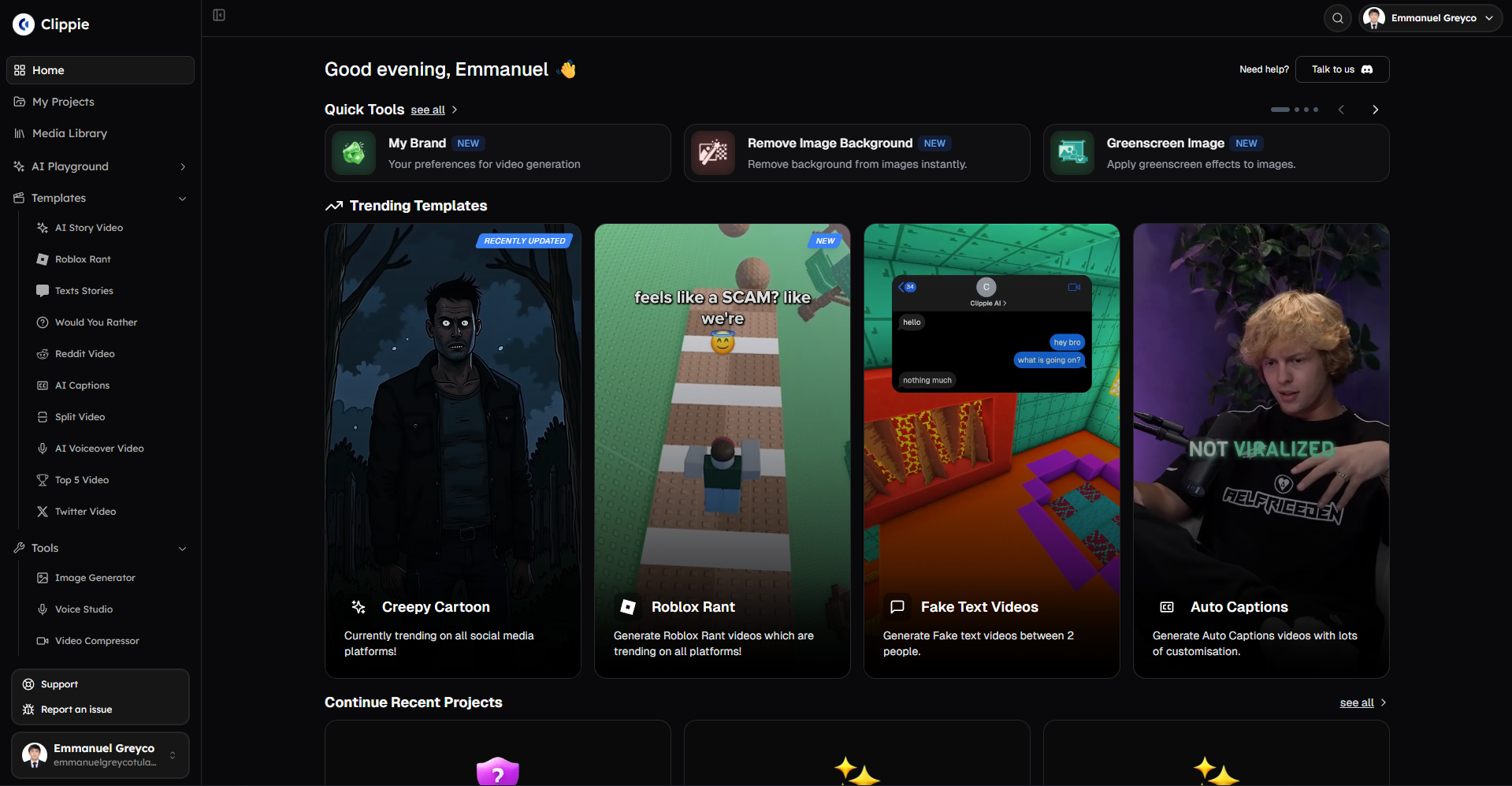
Ready to transform your sales content production? Experience Clippie AI's integrated platform, create month's worth of conversion-optimized sales videos in weekend batch sessions through template systems, AI editing, systematic optimization, building toward $10,000-$100,000+ monthly revenue increases within 6-12 months through consistent execution and data-driven refinement.
Make an AI story video
Write a script or let AI write one. Clippie turns it into a narrated video with AI scenes, voiceover and captions.
Read more

How to Make Top 5 Ranking Videos in 2026 (Step-by-Step)
Build ranking Shorts that can still earn: pick a debatable topic, set clear criteria, source clips you may use, script the countdown, add your commentary.

How to Create Short-Form Videos Using AI: 8 Steps (2026)
A beginner workflow for AI videos on TikTok, Reels and Shorts: pick a format, script a hook, add visuals, voice and captions, export at 9:16, label AI.

7 Free CapCut Alternatives for Short-Form Video (2026)
Compare Edits, YouTube Create, VN, Clipchamp, Canva, DaVinci Resolve and Shotcut: what each gives free users, what it caps first and where it falls short.