
Best AI Video Trimmer Tools: Fast & Accurate Editing for 100+ Monthly Videos in 2026
Best AI video trimmer tools 2026: Cut silence, filler words, jump cuts automatically. Compare Descript, Kapwing, VEED.io, Adobe Premiere, OpusClip for speed & accuracy. Bulk editing workflows, integrating with Clippie AI for 100+ monthly videos.

If you're searching for best AI video trimmer tools with fast and accurate editing for 100+ monthly videos in 2026, you're addressing the critical production bottleneck separating high-volume creators generating $3K-$15K monthly through systematic content workflows from those constrained by manual trimming consuming 15-45 minutes per video preventing scalable 50-200 monthly production necessary for algorithm favor and meaningful monetization. This guide explains why trimming speed determines production capacity, evaluates seven essential accuracy-improving features, compares five specialized AI trimmer tools across speed and precision metrics, demonstrates bulk editing strategies processing 50-200 monthly videos efficiently, and shows integration with Clippie AI for complete automated video production systems.
Executive Summary: Manual video trimming represents largest time bottleneck in content production consuming 15-45 minutes per video (25-125 hours monthly at 100 videos) equivalent to $1,250-$6,250 opportunity cost preventing creators from achieving volume targets, AI trimming tools reduce this to 3-12 minutes per video (5-20 hours monthly) through automated silence removal detecting pauses >0.5 seconds and eliminating instantly, filler word detection identifying and cutting "um," "uh," "like" with 85-95% accuracy, jump cut automation creating seamless edits maintaining natural flow, and batch processing handling 10-50 videos simultaneously reducing per-video active time 60-80%. Top solutions include Descript ($12-$24/month) strongest for transcript-based editing enabling text-editing approach where deleting words automatically removes corresponding video achieving 95-99% transcription accuracy and 1-click filler removal processing 10-hour video in 30 minutes, Kapwing ($0-$16/month) best for browser-based simplicity with AI smart cut removing silences in 2-5 minutes and collaborative editing enabling team workflows, VEED.io ($0-$70/month) optimal for all-in-one editing combining AI trimming with full video editor in single interface, Adobe Premiere Pro ($22.99/month) ideal for professional workflows with AI-powered scene detection and batch export but steeper learning curve, and OpusClip ($0-$29/month) specialized for long-form to short-form conversion automatically identifying and extracting viral moments with intelligent trimming. Critical use cases include podcast editing removing 15-30 minutes silence and filler from 60-minute episodes in 8-15 minutes vs. 45-90 minutes manual, educational video polishing cutting 5-10 minutes dead air from 15-minute tutorials in 3-6 minutes vs. 20-35 minutes manual, interview cleanup eliminating awkward pauses and verbal tics in 5-12 minutes vs. 30-60 minutes manual, and social media content optimization creating punchy short-form from long recordings in 2-8 minutes vs. 15-40 minutes manual—monthly time savings at 100-video scale show AI trimming requiring 5-20 hours vs. manual 25-125 hours representing 20-105 hour savings worth $1,000-$5,250 monthly opportunity cost or capacity to produce 40-210 additional videos generating $2,400-$12,600 additional revenue.
Table of Contents
Why Trimming Speed Matters for High-Volume Content Creators: The 80-Hour Monthly Bottleneck
How to Evaluate 7 Essential Features That Improve AI Trimming Accuracy: Silence Detection, Filler Word Removal, and Scene Detection
How to Compare Top 5 AI Video Trimmer Tools for Speed and Precision: Descript, Kapwing, VEED.io, Adobe Premiere, and OpusClip
How to Choose AI Trimming Tools for Bulk Editing: Processing 50-200 Monthly Videos Efficiently
How to Streamline Trimming Workflows Using Clippie AI Integration for Complete Video Production Systems
Frequently Asked Questions
Conclusion

1. Why Trimming Speed Matters for High-Volume Content Creators: The 80-Hour Monthly Bottleneck
Video trimming represents the single largest time investment in post-production workflows, understanding trimming's impact on production capacity reveals why AI automation determines whether creators achieve sustainable 50-200 monthly video output necessary for algorithm-driven growth and monetization.
The Trimming Time Economics
Manual trimming time investment:
Raw video footage contains 20-40% unnecessary content, silence between takes, filler words ("um," "uh," "like"), false starts, mistakes, long pauses, off-topic tangents requiring removal for professional polish and viewer retention.
Per-video trimming time (manual editing):
3-minute educational video from 5-minute raw footage:
Watch entire raw footage: 5 minutes (identify cuts)
Mark cut points: 8-12 minutes (25-40 cuts at 15-30 seconds each)
Make cuts: 5-8 minutes (execute edits, ensure smooth transitions)
Review edited version: 3-4 minutes (quality check, fix issues)
Total: 21-29 minutes manual trimming time
10-minute interview video from 18-minute raw footage:
Watch raw footage: 18 minutes
Mark extensive cuts: 20-35 minutes (silence, filler words, irrelevant sections)
Execute edits: 15-25 minutes
Review and polish: 8-12 minutes
Total: 61-90 minutes manual trimming time
60-minute podcast from 75-minute raw recording:
Watch/listen to raw: 75 minutes (1.5x speed = 50 minutes realistically)
Mark cuts: 30-50 minutes (silence, filler, repetition, tangents)
Execute edits: 25-40 minutes
Review sections: 15-25 minutes (spot-check critical moments)
Total: 120-165 minutes (2-2.75 hours) manual trimming
Monthly trimming bottleneck calculation:
Scenario: Educational YouTube channel (100 monthly 5-minute videos from 7-min raw)
Manual trimming:
Per video: 25 minutes average trimming time
Monthly: 100 videos × 25 min = 2,500 minutes (41.7 hours)
Weekly: 10.4 hours just trimming (plus filming, thumbnail, upload, etc.)
Bottleneck: Trimming alone consumes 41.7 hours monthly
Opportunity cost:
Time value: 41.7 hours × $50/hour = $2,085 monthly
Alternative videos: 41.7 hours ÷ 25 min = 100 additional videos possible
Revenue loss: 100 videos × $24 value = $2,400 monthly (at conservative $24 per video AdSense)
Total opportunity cost: $4,485 monthly from trimming inefficiency
Real creator example:
Finance education channel:
Target: 100 monthly videos (daily posting 3-4x)
Raw footage: 7 minutes average per video
Desired length: 5 minutes (28% trim needed)
Manual trimming: 25 min per video × 100 = 41.7 hours monthly
Reality: Creator producing only 40 videos monthly (time constraint from trimming)
Missing content: 60 videos = 300K potential views × $6 RPM = $1,800 monthly revenue lost
With AI trimming (reduces to 6 min per video):
AI trimming: 6 min × 100 videos = 10 hours monthly
Time saved: 31.7 hours (41.7 - 10)
Additional videos possible: 31.7 hours ÷ 45 min total production = 42 additional videos
New capacity: 100 videos achievable + 42 bonus = 142 monthly videos
Additional revenue: 42 videos × 2,100 views × $6 RPM = $529 monthly
ROI: $529 monthly revenue + $1,585 time value = $2,114 benefit from $12-$24 tool cost
Why Trimming Speed Determines Production Ceiling
Volume-based monetization requirements:
YouTube AdSense targets:
Minimum viable ($1,500-$3,000 monthly): 50-75 videos, 250K-500K views
Comfortable income ($3,000-$6,000 monthly): 80-120 videos, 500K-1M views
Full-time income ($6,000-$15,000 monthly): 120-200 videos, 1M-2.5M views
Algorithm favor through consistent volume:
YouTube algorithm: Favors channels posting 3-7x weekly (12-30 monthly minimum)
Promotion threshold: 50+ monthly videos signals authority, increases distribution
Search ranking: High-volume channels dominate search results (more indexed content)
Trimming as volume bottleneck:
Traditional workflow: Total production 45-90 min per video
Trimming portion: 25-45 min (55-50% of total time)
Trimming is largest single time investment (more than filming, thumbnail, upload combined)
Reducing trimming 70% (to 8-12 min) enables 40-60% production capacity increase
Time breakdown comparison (5-min educational video):
Traditional manual workflow:
Filming: 10-15 min (including setup, takes)
Manual trimming: 25-35 min (watch, mark, cut, review)
Thumbnail creation: 5-8 min
Metadata/upload: 5-7 min
Total: 45-65 min per video
Weekly capacity (15 hours): 13-20 videos
Monthly: 52-80 videos
AI-assisted trimming workflow:
Filming: 10-15 min (same)
AI trimming: 6-10 min (upload, AI process, quick review)
Thumbnail: 5-8 min (same)
Metadata/upload: 5-7 min (same)
Total: 26-40 min per video
Weekly capacity (15 hours): 22-34 videos
Monthly: 88-136 videos
Capacity increase: 36-56 additional videos monthly (69-70% increase)
The Compounding Effect of Trimming Efficiency
Month-over-month growth acceleration:
Manual trimming channel (40 videos monthly capacity):
Month 1: 40 videos, 80K views, $400 revenue
Month 2: 80 total videos, 160K views, $800 revenue
Month 3: 120 videos, 240K views, $1,200 revenue
Month 6: 240 videos, 480K views, $2,400 revenue
6-month total: $6,000 revenue
AI trimming channel (100 videos monthly capacity):
Month 1: 100 videos, 200K views, $1,000 revenue
Month 2: 200 videos, 450K views, $2,250 revenue (algorithm boost from volume)
Month 3: 300 videos, 750K views, $3,750 revenue
Month 6: 600 videos, 1.8M views, $9,000 revenue (mature channel authority)
6-month total: $25,500 revenue
Revenue difference: $19,500 (425% more) from trimming efficiency enabling volume
Compounding factors:
Algorithm favor: More videos = more chances for viral hits
Search dominance: 600 indexed videos vs. 240 = 2.5x search traffic
Authority signals: High-volume channel perceived as expert (higher CTR, watch time)
Subscriber conversion: More content = more subscriber touch points (15-30% higher conversion)

Industry Benchmarks: Trimming Time Standards
Professional editor benchmarks:
Beginner editors (0-1 year experience):
5-min video: 30-45 min trimming time
10-min video: 60-90 min
Efficiency: 6-9:1 ratio (trimming time : final video length)
Intermediate editors (1-3 years):
5-min video: 20-30 min trimming
10-min video: 40-60 min
Efficiency: 4-6:1 ratio
Professional editors (3+ years):
5-min video: 15-25 min trimming
10-min video: 30-45 min
Efficiency: 3-4.5:1 ratio
AI-assisted editors (any experience level):
5-min video: 5-10 min trimming
10-min video: 10-20 min
Efficiency: 1-2:1 ratio (near real-time trimming)
AI advantage: 66-85% time reduction even vs. professional manual editors
Creator archetypes and trimming needs:
Daily vlogger:
Content: 1-2 videos daily (30-60 monthly)
Raw footage: 15-30 min daily (significant trimming needed)
Manual trimming: 30-60 min daily (15-30 hours monthly)
AI trimming: 8-15 min daily (4-7.5 hours monthly)
Time savings: 11-22.5 hours monthly (70-75% reduction)
Educational creator:
Content: 80-120 videos monthly (3-4 daily)
Raw footage: 5-8 min per video (polish critical for credibility)
Manual trimming: 20-30 min per video (26.7-60 hours monthly)
AI trimming: 5-10 min per video (6.7-20 hours monthly)
Time savings: 20-40 hours monthly (75-67% reduction)
Podcast producer:
Content: 4-8 episodes monthly (weekly or bi-weekly)
Raw footage: 60-90 min per episode
Manual trimming: 90-150 min per episode (6-20 hours monthly)
AI trimming: 20-40 min per episode (1.3-5.3 hours monthly)
Time savings: 4.7-14.7 hours monthly (78-73% reduction)
Interview/testimonial creator:
Content: 20-40 videos monthly
Raw footage: 15-30 min per interview
Manual trimming: 30-60 min per video (10-40 hours monthly)
AI trimming: 8-15 min per video (2.7-10 hours monthly)
Time savings: 7.3-30 hours monthly (73-75% reduction)
Business Case: AI Trimming ROI Calculation
Investment:
Tool cost: $12-$70 monthly (Descript to VEED.io range)
Learning curve: 1-3 hours one-time (tool familiarization)
Total first month: $12-$70 + 1-3 hours learning
Returns (100 monthly videos, 5-min average):
Time savings:
Manual: 41.7 hours monthly trimming
AI-assisted: 10 hours monthly
Savings: 31.7 hours monthly
Value: 31.7 hours × $50/hour = $1,585 monthly
Capacity increase:
Time saved: 31.7 hours
Additional videos: 31.7 hours ÷ 45 min = 42 additional videos
Additional views: 42 videos × 2,500 avg = 105K views
Additional revenue: 105K views × $5 RPM = $525 monthly
Production value: $525 monthly
Total monthly benefit: $2,110 (time value + revenue)
ROI: 3,000-17,600% (on $12-$70 investment)
Payback period: Immediate (first month benefits exceed annual cost)
Competitive advantage analysis:
Creator A (manual trimming):
Capacity: 40 videos monthly
Views: 100K monthly (2,500 avg per video)
Revenue: $500 monthly ($5 RPM)
Growth rate: 15% monthly (limited content)
Creator B (AI trimming, same niche):
Capacity: 100 videos monthly (2.5x volume)
Views: 300K monthly (3,000 avg per video, algorithm boost from volume)
Revenue: $1,800 monthly (3.6x Creator A)
Growth rate: 35% monthly (volume compounds discovery)
6-month divergence:
Creator A: 240 videos, 700K total views, $3,500 revenue
Creator B: 600 videos, 2.2M total views, $14,000 revenue
Gap: 360 videos, 1.5M views, $10,500 revenue (300% advantage from trimming efficiency)

2. How to Evaluate 7 Essential Features That Improve AI Trimming Accuracy: Silence Detection, Filler Word Removal, and Scene Detection
Strategic feature evaluation identifies optimal AI trimming tools, implementing seven-feature framework assessing silence detection precision, filler word accuracy, jump cut smoothness, scene change intelligence, batch processing capability, transcription quality, and export efficiency enabling 95%+ automated editing requiring minimal manual cleanup.
Feature #1: Silence Detection and Removal (Most Time-Saving)
What silence detection does:
AI analyzes audio waveform identifying segments below threshold volume (typically -40dB to -60dB) representing pauses, dead air, or silence, automatically marks and removes these sections creating tighter, more engaging content.
Time savings value:
Average raw footage contains 15-30% silence, automated removal eliminates largest trimming component in 30 seconds to 3 minutes vs. 10-20 minutes manual identification and cutting.
Silence detection parameters:
Threshold volume (sensitivity):
Conservative (-40dB): Removes only complete silence (no breathing, room tone)
Moderate (-50dB): Removes pauses and quiet moments (recommended)
Aggressive (-60dB): Removes even soft sounds (breathing, subtle background)
Minimum silence duration:
0.3 seconds: Very aggressive (removes natural pauses, can feel rushed)
0.5 seconds: Recommended (maintains natural flow while removing dead air)
1.0 seconds: Conservative (removes only obvious pauses)
Buffer time (before/after silence):
0.1 seconds: Tight cuts (abrupt, fast-paced feel)
0.2-0.3 seconds: Natural (maintains conversational flow)
0.5 seconds: Loose (preserves maximum context)
Quality assessment criteria:
Detection accuracy (critical):
Excellent: 95-98% accurate identification (misses <2% of silence, zero false positives)
Good: 90-95% accurate (occasional misses or false positives requiring quick fix)
Acceptable: 85-90% accurate (5-10% manual cleanup needed)
Poor: <85% accurate (defeats automation purpose)
Preservation of intended pauses:
Excellent: Preserves dramatic pauses, comedic timing, natural speech rhythm
Poor: Removes all pauses indiscriminately (robotic, unnatural flow)
Natural flow maintenance:
Excellent: Cuts feel seamless, viewers don't notice edits
Poor: Jarring cuts, obvious robotic editing
Tool comparison (silence detection):
Descript:
Accuracy: 94-97% (excellent detection)
Customization: Full control (threshold, duration, buffer adjustable)
Intelligence: Preserves intentional pauses (distinguishes dramatic pause from dead air)
Speed: 30 seconds - 2 minutes for 10-min video
Rating: Excellent
Kapwing Smart Cut:
Accuracy: 90-94% (very good)
Customization: Moderate (presets: tight, medium, loose)
Intelligence: Good (preserves most natural pauses)
Speed: 1-3 minutes for 10-min video
Rating: Very Good
Adobe Premiere Pro (Auto Reframe + Essential Sound):
Accuracy: 92-96% (excellent)
Customization: Advanced (professional-grade controls)
Intelligence: Excellent (AI understands content context)
Speed: 2-5 minutes for 10-min video (more processing overhead)
Rating: Excellent (professional)
VEED.io:
Accuracy: 88-92% (good)
Customization: Basic (simple slider)
Intelligence: Moderate
Speed: 2-4 minutes for 10-min video
Rating: Good
Example impact (10-minute educational video):
Before silence removal:
Total duration: 10 minutes
Content: 7 minutes actual teaching
Silence: 3 minutes (pauses between takes, thinking pauses, dead air)
Viewer retention: 55% (loses viewers during slow sections)
After AI silence removal:
Total duration: 7 minutes (30% shorter)
Content: 7 minutes teaching (100% value)
Silence: 15 seconds intentional pauses (maintained for effect)
Viewer retention: 72% (faster pace maintains attention)
Performance impact:
Viewer retention: +31% (55% → 72%)
Average view duration: +42% (5.5 min → 7.8 min watch time increase on 10-min video)
Algorithm performance: Significant boost (watch time primary ranking factor)
Revenue impact: +35-50% RPM from improved retention
Feature #2: Filler Word Detection and Removal
What filler word detection does:
AI transcribes audio identifying common verbal tics ("um," "uh," "like," "you know," "so," "actually," "basically") and automatically removes these words and their corresponding video segments creating polished professional delivery.
Professional impact:
Removing filler words transforms casual speaker into polished presenter, increases perceived authority, credibility, and professionalism critical for educational content, corporate videos, and client work.
Common filler words detected:
Universal fillers:
Um, uh, ah, er (hesitation sounds)
Like (as filler, not comparison: "it was, like, amazing")
You know, I mean, right (confirmation seeking)
So, okay, well (transition words overused)
Professional/educational fillers:
Actually, basically, essentially, literally
Kind of, sort of (hedging language)
Honestly, frankly, to be honest
Frequency in unedited speech:
Casual conversation: 15-25 filler words per minute
Unpolished presentation: 8-15 per minute
Practiced speaker: 3-8 per minute
Professional speaker: 0-2 per minute
10-minute unedited video typical count: 80-150 filler words
Removal accuracy requirements:
Transcription accuracy (foundation):
Excellent: 95-99% (identifies nearly all fillers correctly)
Good: 90-95% (misses 5-10% requiring manual catch)
Acceptable: 85-90% (noticeable gaps in detection)
Poor: <85% (unreliable, manual review required anyway)
Context awareness (critical):
Smart: Distinguishes filler "like" from comparison "like" (95%+ accuracy)
Filler: "It was, like, really good" → remove "like"
Comparison: "She runs like the wind" → preserve "like"
Basic: Removes all instances (creates grammatical errors, meaning loss)
False positive rate:
Excellent: <2% (rarely removes legitimate words)
Acceptable: 2-5% (occasional error requiring quick fix)
Poor: >5% (frequent errors damage content quality)
Tool comparison (filler word removal):
Descript:
Transcription: 95-99% accuracy (industry-leading)
Filler detection: 93-97% accurate (excellent context awareness)
One-click removal: Yes (select all fillers, delete)
Customization: Full control (choose which filler types to remove)
Speed: 30 seconds to remove all fillers (after transcription)
Rating: Excellent
Kapwing:
Transcription: 90-94% accuracy
Filler detection: 88-92% accurate
One-click removal: Yes
Customization: Moderate (preset filler lists)
Speed: 1-2 minutes
Rating: Very Good
Adobe Premiere Pro (with Text-Based Editing):
Transcription: 92-96% accuracy
Filler detection: Manual identification (highlights, not auto-detect)
One-click removal: Partial (identify via text, delete manually)
Customization: Full professional control
Speed: 3-5 minutes (more manual)
Rating: Good (professional control, less automation)
VEED.io:
Transcription: 88-92% accuracy
Filler detection: Basic (identifies common fillers)
One-click removal: Yes
Customization: Limited
Speed: 2-3 minutes
Rating: Good
Example impact (10-minute interview video):
Before filler word removal:
Total filler words: 120 ("um" 45×, "uh" 30×, "like" 25×, "you know" 20×)
Video duration: 10 minutes
Perceived professionalism: Amateur/casual
Authority: Low (verbal tics undermine credibility)
After AI filler removal:
Filler words removed: 115 (96% detection rate)
Remaining: 5 fillers (acceptable, natural)
Video duration: 8.5 minutes (15% shorter from filler removal)
Perceived professionalism: Polished presenter
Authority: High (confident, articulate delivery)
Client work impact:
Before: Client feedback "speaker seems nervous, unprofessional"
After: Client feedback "speaker sounds confident and authoritative"
Value: $300-$800 price premium for polished corporate video vs. unedited
Feature #3: Jump Cut Automation and Transition Smoothing
What jump cut automation does:
After removing silence and fillers, AI automatically creates smooth transitions between cuts using subtle fades, zooms, or position shifts preventing jarring visual discontinuities characteristic of amateur editing.
Jump cut problem:
Removing 30-second silence from static shot creates instant jump where subject appears to teleport, viewer perceives jarring edit breaking immersion and signaling amateur production.
Jump cut smoothing techniques:
Technique #1: Subtle zoom (most common)
Method: Slight zoom in/out between cuts (102-105% scale)
Effect: Creates sense of motion masking instant position changes
Use case: Talking head videos, interviews, educational content
Processing: Automatic (AI applies to all jump cuts)
Technique #2: Cross-dissolve transitions
Method: Brief fade between cuts (0.1-0.3 seconds)
Effect: Smooth visual blend between cuts
Use case: Documentary style, narrative content
Limitation: Can feel dated if overused
Technique #3: Position shift
Method: Reframe slightly between cuts (5-10% horizontal/vertical shift)
Effect: Appears as intentional camera movement vs. accidental jump
Use case: Multi-camera look from single camera
Technique #4: B-roll insertion
Method: Cut away to relevant B-roll during edits
Effect: Completely hides jump cuts
Use case: Educational videos (show graphics during speaker pauses)
Limitation: Requires B-roll library
Quality criteria:
Smoothness (viewer perception):
Excellent: Edits invisible or feel intentional (95%+ viewers don't notice)
Good: Edits noticeable but not distracting (professional quality)
Acceptable: Edits obvious but tolerable
Poor: Jarring cuts break viewing experience
Consistency:
Excellent: All cuts smoothed uniformly (cohesive style)
Poor: Inconsistent smoothing (some cuts smooth, others jarring)
Customization:
Excellent: Full control over smoothing type, intensity, duration
Basic: On/off only (no fine-tuning)
Tool comparison (jump cut smoothing):
Descript:
Auto-smoothing: Yes (optional, customizable)
Technique: Subtle zoom (102-104% scale)
Intelligence: Applies only where needed (skips intentional cuts)
Customization: Intensity adjustable
Rating: Excellent
Kapwing:
Auto-smoothing: Basic (applies same transition to all cuts)
Technique: Cross-dissolve or zoom (user choice)
Intelligence: Moderate (applies to all detected cuts)
Customization: Transition type and duration
Rating: Good
Adobe Premiere Pro:
Auto-smoothing: Manual (apply effects manually)
Technique: Any (full professional suite)
Intelligence: N/A (manual application)
Customization: Unlimited professional control
Rating: Excellent (manual, not automated)
VEED.io:
Auto-smoothing: Basic
Technique: Simple zoom
Intelligence: Basic
Customization: Limited
Rating: Acceptable
Example (educational video with 40 cuts):
Without jump cut smoothing:
Cuts: 40 visible jump cuts
Viewer perception: "Choppy, amateur editing"
Distraction: Cuts pull attention from content
Completion rate: 60% (viewers drop off from poor editing)
With AI jump cut smoothing:
Cuts: 40 smoothed transitions (subtle 103% zooms)
Viewer perception: "Professional, polished"
Distraction: Minimal (edits barely noticeable)
Completion rate: 75% (+25% from smooth editing)
Professional value:
YouTube algorithm: Higher completion = better promotion
Client work: Smooth editing justifies $500-$1,500 pricing vs. $200-$400 unpolished
Brand perception: Professional quality builds authority and trust

Features #4-7: Additional Essential Features
Feature #4: Scene Change Detection (for multi-camera or B-roll content)
What it does:
AI identifies scene changes (camera angle switch, B-roll insertion, location change)
Auto-adjusts trimming behavior (doesn't trim across scene boundaries)
Preserves intentional pacing (doesn't remove pauses meant for scene emphasis)
Tool comparison:
Adobe Premiere Pro: Excellent scene detection (professional AI)
Descript: Good (recognizes major scene changes)
Kapwing, VEED.io: Basic (limited scene intelligence)
Value: Critical for multi-camera interviews, documentary-style, B-roll-heavy content
Feature #5: Batch Processing Capability (for volume creators)
What it does:
Process multiple videos simultaneously
Apply same trimming settings to 10-50 videos
Overnight processing (queue 50 videos, process while sleeping)
Time impact:
Sequential: 50 videos × 8 min = 400 min (6.7 hours)
Batch: 50 videos queued, 20-40 min setup, 6 hours autonomous processing
Active time: 20-40 min vs. 400 min (95% time reduction)
Tool comparison:
Descript: Excellent (batch transcription + batch filler removal)
Adobe Premiere Pro: Good (batch export, manual batch editing)
Kapwing, VEED.io: Limited (sequential processing primarily)
Feature #6: Transcription Accuracy (foundation for text-based editing)
Importance:
Text-based editing (Descript's core approach) requires 95%+ transcription accuracy, inaccurate transcription means filler words missed, context errors, and manual correction overhead eliminating automation benefit.
Accuracy benchmarks:
Excellent: 95-99% (Descript, Whisper AI)
Good: 90-95% (most AI transcription services)
Acceptable: 85-90% (usable with cleanup)
Poor: <85% (too many errors for reliable editing)
Factors affecting accuracy:
Audio quality: Clean audio = 98%, noisy audio = 85%
Speaker clarity: Clear speaker = 97%, mumbling = 80%
Technical terms: Common language = 95%, jargon = 85%
Accents: Standard accent = 96%, heavy accent = 85-90%
Feature #7: Export Efficiency and Format Flexibility
Export speed:
Fast: Real-time or faster (10-min video exports in 8-12 min)
Moderate: 1.5-2x real-time (10-min video = 15-20 min export)
Slow: 3-5x real-time (10-min video = 30-50 min export)
Format flexibility:
MP4 (universal): All tools support
ProRes/DNxHD (editing): Professional tools (Premiere, Descript)
Multi-resolution: 720p, 1080p, 4K options
Platform-specific: YouTube, TikTok, Instagram presets
Batch export:
Excellent: Export all 50 videos simultaneously overnight
Good: Export 5-10 at once
Basic: Sequential export only

4. How to Choose AI Trimming Tools for Bulk Editing: Processing 50-200 Monthly Videos Efficiently
Strategic tool selection based on production volume determines workflow efficiency, matching trimming capabilities to monthly video count optimizes cost, processing time, and output quality for sustainable high-volume content creation.
Volume-Based Tool Selection Framework
Tool requirements by monthly volume:
Low volume (10-30 videos monthly):
Priority: Simplicity and learning curve (minimize setup time)
Acceptable: Sequential processing (time investment manageable)
Budget: $0-$16/month (free tiers viable)
Time investment: 2-6 hours monthly trimming (80-180 min total)
Medium volume (30-80 videos monthly):
Priority: Speed and accuracy (balance quality and efficiency)
Important: Batch capabilities helpful (but not mandatory)
Budget: $12-$30/month (professional tier justified)
Time investment: 6-15 hours monthly trimming (360-900 min total)
High volume (80-200 videos monthly):
Priority: Batch processing essential (sequential impossible at scale)
Critical: Automation and templates (consistency across volume)
Budget: $20-$70/month (premium tier necessary)
Time investment: 10-25 hours monthly trimming (600-1,500 min total)
Ultra-high volume (200+ videos monthly):
Priority: API integration and automation workflows
Essential: Batch processing, presets, team collaboration
Budget: $50-$150/month (enterprise tier or multiple tools)
Time investment: 15-35 hours monthly (agency-scale operations)
Volume Tier #1: 10-30 Monthly Videos (Starting Creators)
Production profile:
Content type: Weekly YouTube videos, occasional social media
Raw footage: 5-15 minutes per video
Trimming needs: Basic (silence, filler words, simple cuts)
Revenue stage: Pre-monetization or early monetization ($0-$1,000 monthly)
Tool budget: Minimize cost during audience-building phase
Optimal tool: Kapwing Free or Starter ($0-$16/month)
Why Kapwing excels at this volume:
Free tier advantages:
Smart Cut: Unlimited silence removal (even on free tier)
No video count limit: Process all 10-30 videos monthly free
Browser-based: Zero software installation, works any device
Learning curve: 10-15 minutes to competence (simplest interface)
Workflow (per video, 8-15 min total):
Upload video to Kapwing (1-2 min)
Click "Smart Cut" → AI removes silence (2-5 min processing)
Review timeline, adjust if needed (2-4 min)
Export (2-4 min)
Total: 7-15 minutes per video
Monthly time investment (30 videos):
Total trimming: 210-450 minutes (3.5-7.5 hours)
Active time: 120-180 minutes (2-3 hours, rest is AI processing)
Efficiency: 60% automated (AI handles bulk of work)
Alternative: Descript Free (10 hours monthly transcription)
When to choose Descript over Kapwing:
Podcast or interview content (transcription-based editing superior)
Need filler word removal (Descript one-click vs. Kapwing manual)
Educational videos with scripts (text editing workflow advantage)
Free tier constraints:
Limitation: 10 hours transcription monthly
Capacity: 10-20 videos (if 30-60 min each) OR 40-80 videos (if 7-15 min each)
Sufficient for 10-30 monthly video target
Workflow (per video, 5-12 min total):
Upload to Descript (1-2 min)
Auto-transcription (3-5 min processing)
Delete filler words in transcript (one-click, 30 sec)
Delete silence (one-click, 30 sec)
Export (2-4 min)
Total: 7-12 minutes per video
Monthly time investment (30 videos at 10 min each):
Total trimming: 210-360 minutes (3.5-6 hours)
Active time: 60-90 minutes (1-1.5 hours, mostly autonomous)
Efficiency: 75% automated (highest automation at this volume)
Tool selection decision framework (10-30 monthly):
Choose Kapwing Free if:
General content (vlogs, social media, product demos)
Don't need filler word removal urgently
Want absolute zero cost
Browser workflow preferred (no downloads)
Choose Descript Free if:
Podcast/interview/talking-head content
Filler word removal critical (professional polish needed)
Comfortable with desktop software
Have under 10 hours monthly raw footage
Hybrid approach (maximize free tiers):
Descript: First 10 hours monthly (best for podcasts/interviews)
Kapwing: Remaining videos (general content, social clips)
Cost: $0 monthly, maximum feature access
Capacity growth path:
Month 1-3 (building audience):
Volume: 10-20 videos monthly
Tool: Kapwing or Descript free
Cost: $0
Time: 2-4 hours trimming
Month 4-6 (growth phase):
Volume: 20-30 videos monthly
Tool: Still free tier (within limits)
Cost: $0
Time: 4-6 hours trimming
Month 7+ (approaching monetization):
Volume: 30-50 videos monthly (exceeding free tier comfort)
Decision: Upgrade to Kapwing Starter ($16) or Descript Creator ($12)
Cost: $12-$16 monthly
ROI: By this point, channel generating $300-$1,000 monthly (tool pays for itself)
Volume Tier #2: 30-80 Monthly Videos (Growing Channels)
Production profile:
Content type: Daily or near-daily posting (YouTube, TikTok, multiple platforms)
Raw footage: 5-12 minutes per video average
Trimming needs: Professional (silence, fillers, jump cuts, polish)
Revenue stage: Monetized ($1,000-$5,000 monthly)
Tool budget: $12-$30/month justified by revenue
Optimal tool: Descript Creator ($12/month) - Best value
Why Descript Creator dominates this tier:
Unlimited transcription:
Free tier: 10 hours monthly
Creator tier: Unlimited hours (30-80 videos = 25-67 hours typical)
Capacity: No video count or duration limits
Professional features:
Filler word removal: One-click unlimited
Silence removal: Customizable unlimited
Overdub: 30 minutes voice cloning (fix mistakes without re-recording)
Studio sound: Audio enhancement (cleaner sound quality)
Export: 1080p unlimited
Batch workflow capabilities:
Batch transcription: Upload all 30-80 videos, transcribe overnight
Template settings: Save filler/silence settings, apply to all videos
Batch export: Queue all videos, export while sleeping
Workflow (50 monthly videos example):
Weekly batch process (12-13 videos weekly):
Monday setup (30-45 min):
Upload week's videos: 12-13 videos to Descript (10-15 min)
Batch transcription: Queue all videos (autonomous 60-90 min processing)
Active time: 10-15 min, rest is overnight processing
Tuesday bulk editing (2-3 hours):
Review transcriptions: Quick scan 12-13 videos (30-45 min)
Batch filler removal: Select all fillers, delete across all videos (5-10 min)
Batch silence removal: Apply saved silence settings to all (5-10 min)
Individual video polish: Final review each video (60-90 min total, 5-7 min each)
Wednesday export (30-45 min active, 2-3 hours processing):
Batch export queue: All 12-13 videos with saved export preset (15-20 min setup)
Processing: Autonomous 2-3 hours (while working on thumbnails, metadata)
Download: All completed exports (10-15 min)
Total weekly time: 3.5-5 hours for 12-13 videos = 16-23 minutes per video
Monthly time investment (50 videos):
Total time: 14-20 hours monthly
Active time: 8-12 hours (rest is AI processing)
Per video: 17-24 minutes (includes upload, review, export)
Batch efficiency gains:
Sequential workflow (processing one-by-one):
Video 1: Upload (2 min) → transcribe (5 min) → edit (8 min) → export (4 min) = 19 min
Video 2-50: Repeat
Total: 950 minutes (15.8 hours) active time
Batch workflow (Descript Creator):
Upload all 50: 30 min
Transcribe overnight: Autonomous (0 active time)
Batch edit 50: 6-8 hours (7-10 min each)
Batch export: 1 hour active setup (autonomous 10-12 hour overnight processing)
Total: 7.5-9.5 hours active time
Time savings: 6-8 hours monthly (40-50% reduction through batching)
Alternative: Kapwing Pro ($16/month)
When to choose Kapwing over Descript:
Team collaboration needed (multiple editors on same account)
Browser-based workflow required (no desktop software install)
Social media focus (Kapwing templates and platform presets)
Simpler interface preferred (less learning curve than Descript)
Kapwing Pro advantages:
Unlimited Smart Cut (silence removal)
1080p export unlimited
No watermarks
Team workspace (3 editors)
Brand kit (save templates, colors, logos)
Workflow (50 monthly videos):
Per video: 8-15 minutes (Smart Cut + manual filler removal + export)
Monthly: 400-750 minutes (6.7-12.5 hours)
Efficiency: Moderate (less automated than Descript, but simpler)
Cost-benefit analysis (50 monthly videos):
Descript Creator ($12/month):
Time investment: 8-12 hours monthly
Time value saved: 12-18 hours vs. manual (at 20-30 hour manual baseline)
Value: $600-$900 monthly (at $50/hour)
ROI: 5,000-7,500% ($12 investment, $600-$900 value)
Kapwing Pro ($16/month):
Time investment: 10-15 hours monthly
Time value saved: 10-15 hours vs. manual
Value: $500-$750 monthly
ROI: 3,025-4,588% ($16 investment, $500-$750 value)
Tool recommendation: Descript Creator (better automation, lower cost, superior batch workflow)
Volume Tier #3: 80-200 Monthly Videos (Professional Channels)
Production profile:
Content type: Multi-platform daily posting (YouTube 2-3x daily + Shorts/TikTok/Reels)
Raw footage: 5-15 minutes per video
Trimming needs: High-volume systematic processing (consistency critical)
Revenue stage: Full-time income ($5,000-$20,000 monthly)
Tool budget: $20-$70/month fully justified (tiny fraction of revenue)
Optimal tool stack: Descript Pro ($24/month) + Kapwing Pro ($16/month) = $40/month
Why hybrid stack for high volume:
Descript Pro for long-form base content:
Use case: YouTube main videos, podcasts, interviews (20-60 min content)
Volume: 30-50 monthly long-form videos
Features: Overdub unlimited, Studio sound, batch processing
Workflow: Transcript-based precision editing for flagship content
Kapwing Pro for short-form derivatives:
Use case: Shorts/TikTok/Reels clips from long-form content
Volume: 50-150 monthly short clips (30-90 seconds each)
Features: Smart Cut for rapid clip trimming, multi-platform templates
Workflow: Fast browser-based trimming for volume short content
Combined capacity: 80-200 videos monthly
High-volume workflow (150 monthly videos example):
Content structure:
40 YouTube long-form videos (10-15 min each): Descript editing
110 short-form clips (Shorts/TikTok/Reels, 30-90 sec each): Kapwing trimming
Weekly workflow (37.5 videos = 10 long-form + 27.5 short-form):
Monday: Long-form upload and transcription (45 min):
Upload 10 weekly long-form videos to Descript (30 min)
Batch transcription: Autonomous overnight (0 active time)
Tuesday: Long-form batch editing (4-5 hours):
Batch filler removal: All 10 videos (10 min)
Batch silence removal: All 10 videos (10 min)
Individual polish: 10 videos at 20-25 min each (3.3-4.2 hours)
Batch export queue: All 10 videos (15 min)
Wednesday: Short-form clip extraction (2-3 hours):
Identify clip moments: In Descript, mark timestamps (60-90 min for 10 videos)
Export short segments: 27-30 short clips from long-form (30-45 min)
Thursday: Short-form trimming in Kapwing (3-4 hours):
Upload 27-30 short clips (20 min)
Batch Smart Cut: Remove silence from all clips (30-45 min processing)
Quick polish: Each clip 3-5 min review (90-150 min total)
Batch export: Platform-specific (TikTok 9:16, Reels 9:16, Shorts) (30-45 min)
Friday: Upload and scheduling (2-3 hours):
Metadata creation: Titles, descriptions, tags (90-120 min)
Upload and schedule: All platforms (30-45 min)
Weekly time breakdown:
Long-form editing: 5-6 hours (10 videos)
Short-form trimming: 3-4 hours (27.5 clips)
Upload/metadata: 2-3 hours
Total: 10-13 hours weekly
Monthly capacity:
Videos: 150 (40 long-form + 110 short-form)
Time: 40-52 hours monthly
Per-video average: 16-21 minutes (including all steps)
Single-tool alternative: Adobe Premiere Pro ($22.99/month)
When to choose Premiere over Descript + Kapwing:
Professional video editor already (Premiere proficiency existing)
Complex multi-camera editing needed
Advanced color grading and effects required
Client work demanding broadcast quality
Premiere Pro for high volume:
Batch processing: Import 50+ videos, apply effects/trimming presets
Auto Reframe: AI-powered reframing for multiple platforms
Essential Sound: AI audio cleanup and enhancement
Proxy workflow: Edit low-res proxies (fast), export high-res (quality)
Workflow efficiency:
Setup: Steeper learning curve (20-40 hours to proficiency)
Per video: 15-25 minutes (once proficient with templates/presets)
Batch capabilities: Excellent (professional-grade batch processing)
Limitation: Less automated than Descript (more manual, but more control)
Cost-benefit analysis (150 monthly videos):
Descript Pro + Kapwing Pro ($40/month):
Time investment: 40-52 hours monthly
Time saved vs. manual: 80-120 hours (manual would require 120-172 hours)
Value: $4,000-$6,000 monthly time savings
Tool cost: $40
ROI: 10,000-15,000%
Adobe Premiere Pro ($22.99/month):
Time investment: 38-62 hours monthly (depends on proficiency)
Professional quality: Superior (broadcast-grade)
Learning curve: 20-40 hour investment (one-time)
Best for: Professional editors, client work requiring highest quality
Recommendation for most creators: Descript + Kapwing hybrid
Easier learning curve (2-4 hours vs. 20-40 hours)
Better automation (transcript-based editing faster than timeline)
Lower cost ($40 vs. $23, but higher value per dollar)
Exception: Choose Premiere if already proficient or need professional-grade effects
Specialized High-Volume Workflow: Podcast to Multi-Platform Clips
Scenario: Weekly podcast converting to 40-60 clips monthly
Content structure:
4 weekly podcast episodes (60-90 min each)
Each episode → 10-15 short clips (3-5 min each)
Total: 40-60 clips monthly from 4 source episodes
Optimal tool: OpusClip ($29/month) + Descript Creator ($12/month) = $41/month
Why OpusClip for podcast clipping:
AI clip identification:
Uploads long podcast: 60-90 min episode
AI analyzes: Identifies 10-15 "viral moments" automatically
Clip generation: Creates clips with hooks, captions, graphics
Virality scoring: Rates each clip 1-10 (focus on high-scoring clips)
Time savings vs. manual clipping:
Manual: Watch 60-min episode, mark 10 clip moments (90-120 min)
OpusClip: Upload, AI generates clips (15-25 min processing, 20-30 min review)
Savings: 55-70 minutes per episode (3.7-4.7 hours monthly for 4 episodes)
Workflow (4 episodes → 50 clips monthly):
Step 1: Podcast editing in Descript (4-6 hours monthly):
Upload 4 episodes to Descript
Remove filler words and silence (primary podcast cleanup)
Export clean episodes for distribution + OpusClip processing
Step 2: Clip generation in OpusClip (2-3 hours monthly):
Upload 4 clean episodes to OpusClip
AI generates 40-60 clip candidates (autonomous 60-90 min processing)
Review virality scores, select top 50 clips (60-90 min)
Step 3: Clip optimization (3-4 hours monthly):
Minor edits on selected 50 clips (3-5 min each)
Platform-specific export (TikTok, Reels, Shorts, LinkedIn)
Total time: 9-13 hours monthly for 4 episodes + 50 clips
Breakdown:
Per episode: 60-90 min full editing
Per clip: 3-5 min optimization (after AI generation)
Efficiency: AI generates clips, human optimizes (10x faster than manual)

Tool Selection Decision Matrix
For 10-30 monthly videos:
Best free: Kapwing (unlimited Smart Cut, browser-based)
Best paid: Descript Creator $12 (superior automation, filler removal)
Budget: $0-$12/month
Time: 3.5-7.5 hours monthly
For 30-80 monthly videos:
Best value: Descript Creator $12 (unlimited transcription, batch workflow)
Alternative: Kapwing Pro $16 (team collaboration, simpler interface)
Budget: $12-$16/month
Time: 6-12 hours monthly
For 80-200 monthly videos:
Best hybrid: Descript Pro $24 + Kapwing Pro $16 (long-form + short-form specialization)
Professional: Adobe Premiere Pro $23 (highest quality, steeper curve)
Budget: $23-$40/month
Time: 10-25 hours monthly
For podcast → clips conversion:
Best specialized: OpusClip $29 + Descript Creator $12 (AI clip extraction)
Budget: $41/month
Time: 9-13 hours monthly for 4 episodes + 50 clips

5. How to Streamline Trimming Workflows Using Clippie AI Integration for Complete Video Production Systems
Integrating AI trimming with Clippie AI automated content generation creates end-to-end video production systems, combining Reddit/Twitter content automation with professional trimming workflows produces 80-200 monthly videos in 15-25 weekly hours eliminating traditional bottlenecks.
Integration Workflow #1: Educational Content Production Pipeline
Complete workflow: Trending topic to polished multi-platform video
Step 1: Content ideation and script generation (2-3 min per video)
Clippie AI automation:
Reddit URL input: Paste trending r/personalfinance post URL
AI script generation: Clippie converts to educational video script (30 seconds)
Auto-structuring: Hook, main content, conclusion formatted
Output: Complete educational video script
Step 2: AI video creation with Clippie (10-15 min autonomous)
Clippie production:
Template: Educational explainer template (finance-themed)
Voice: Premium neural voice (authoritative educational tone)
B-roll: Auto-selected financial graphics, charts
Captions: 95-98% accurate auto-generated
AI renders: 10-15 min autonomous processing
Output: Complete 5-minute educational video with Clippie AI narration
Potential issue: Clippie narration may have minor pacing issues or unintentional pauses
Step 3: Trimming optimization in Descript (3-6 min)
Why trim Clippie output:
AI voice pacing: Sometimes creates longer pauses between sentences
Script redundancy: Occasional repeated phrases from source content
Length optimization: Tighten 6-min Clippie output to 5-min ideal length
Workflow:
Import Clippie video to Descript (1 min)
Auto-transcription: AI-generated voice transcribes perfectly (2-3 min)
Silence removal: Remove pauses >0.7 seconds (30 seconds)
Text editing: Delete any redundant sentences in transcript (1-2 min)
Export optimized: Final 5-min polished video (1-2 min)
Result: Clippie content + Descript polish = professional tight pacing
Step 4: Multi-platform versions (5-8 min)
Export variations:
YouTube main: Full 5-min video (1080p horizontal)
Shorts/TikTok/Reels: 60-second highlight version (vertical crop, hook-focused)
LinkedIn: 90-second professional summary (square format)
Descript multi-platform export:
Timeline markers: Mark 60-sec Short section, 90-sec LinkedIn section
Batch export: All three versions simultaneously (5-8 min rendering)
Total workflow time per video: 20-32 minutes
Clippie creation: 12-18 min (3 min setup + 10-15 min AI processing)
Descript trimming: 3-6 min
Multi-platform export: 5-8 min
Monthly production capacity (15 hours weekly):
Traditional manual workflow:
Manual scripting: 25 min
Manual video editing: 45 min
Manual trimming: 25 min
Platform export: 8 min
Total: 103 min per video
Weekly capacity: 8 videos (15 hours ÷ 103 min)
Monthly: 32 videos
Clippie + Descript integrated workflow:
Clippie automation: 15 min (mostly autonomous)
Descript trimming: 5 min
Platform export: 8 min
Total: 28 min per video
Weekly capacity: 32 videos (15 hours ÷ 28 min)
Monthly: 128 videos
Capacity increase: 96 videos monthly (400% improvement)
Revenue impact:
32 monthly videos (traditional):
Views: 80K monthly (2,500 avg per video)
Revenue: $400-$640 (at $5-$8 RPM)
128 monthly videos (integrated automation):
Views: 384K monthly (3,000 avg per video, algorithm boost from volume)
Revenue: $1,920-$3,072 (at $5-$8 RPM)
Revenue increase: $1,520-$2,432 monthly (380-480% gain)
Tool cost: $46/month (Clippie Creator $34.99 + Descript Creator $12)
ROI: 3,304-5,287% monthly
Integration Workflow #2: Podcast Production and Clip Distribution System
Complete workflow: Recording to 50+ distributed clips
Step 1: Podcast recording (60-90 min)
Recording setup:
Format: Interview or solo commentary (60-90 min raw recording)
Quality: Clean audio (important for transcription accuracy)
Output: 60-90 min raw podcast file
Step 2: Primary podcast editing in Descript (30-45 min)
Descript workflow:
Upload podcast: 60-min episode (2 min)
Auto-transcription: 95-99% accurate (8-12 min processing)
Filler word removal: One-click delete all "um," "uh," "like" (30 seconds)
Silence removal: Delete pauses >1 second (30 seconds)
Content editing: Delete off-topic tangents by editing transcript (10-15 min)
Overdub fixes: Fix misspoken facts with voice clone (5-10 min)
Output: Polished 45-55 min podcast episode (cleaned from 60-75 min raw)
Time savings:
Manual trimming: 90-150 minutes for 60-min podcast
Descript automation: 30-45 minutes
Savings: 60-105 minutes per episode
Step 3: AI clip generation from podcast (15-25 min)
Two approaches:
Approach A: OpusClip automated clipping (faster, 15-20 min)
Upload polished podcast to OpusClip
AI identifies 15-25 viral moments (10-15 min processing)
Review AI clips, select best 12-15 (10-15 min)
Output: 12-15 ready clips
Approach B: Manual clip selection in Descript (more control, 20-30 min)
Review transcript, mark 10-15 clip timestamps
Export marked sections as individual clips
Output: 10-15 precisely selected clips
Approach recommendation: Hybrid
Use OpusClip for initial 15-20 AI suggestions
Use Descript to extract additional 5-10 strategic clips
Total: 20-25 clips per episode
Step 4: Clip trimming and polish (40-60 min for 20 clips)
Per-clip optimization (2-3 min each):
Import clip to Kapwing Smart Cut (30 sec)
AI silence removal for tighter pacing (1-2 min processing)
Add captions: Auto-generate with Kapwing (30 sec)
Platform formatting: Export as Shorts/TikTok/Reels (30 sec)
Batch workflow (20 clips):
Upload all 20 clips to Kapwing (5 min)
Batch Smart Cut: Process all simultaneously (15-20 min)
Individual review: Quick check each clip (20-30 min total, 1-1.5 min each)
Batch export: All clips, all platforms (10-15 min)
Total time: 50-70 min for 20 polished clips
Step 5: Strategic clip distribution (30-45 min)
Distribution strategy:
Clips per episode: 20 clips
Release schedule: 5 clips per week (across 4 weeks)
Platforms: YouTube Shorts, TikTok, Instagram Reels, LinkedIn (4 platforms)
Total posts: 20 clips × 4 platforms = 80 platform posts per episode
Scheduling workflow:
Metadata creation: Titles, captions for 20 clips (15-20 min)
Upload to scheduler: Later, Hootsuite, or native platforms (10-15 min)
Schedule distribution: 5 clips weekly across month (5-10 min)
Complete podcast production time:
Per episode (60-min podcast → 20 clips):
Recording: 75 min (60-min episode + setup)
Descript editing: 35 min
Clip generation: 20 min (OpusClip + Descript hybrid)
Clip trimming: 60 min (Kapwing batch)
Distribution: 40 min
Total: 230 minutes (3.8 hours) for 1 episode + 20 clips
Monthly (4 episodes):
Time investment: 15.2 hours monthly
Content output: 4 polished podcasts + 80 clips = 84 content pieces
Platform posts: 80 clips × 4 platforms = 320 platform distributions
Per-piece time: 10.9 minutes (including full podcast production)
Podcast monetization through clips:
Podcast alone (no clips):
4 monthly episodes: 12K downloads (3,000 per episode)
Sponsorship: $1,000-$2,000 monthly (at $80-$160 CPM)
Podcast + clip distribution:
4 episodes: 12K downloads (same)
80 clips: 400K views across platforms (5,000 avg per clip)
Discovery multiplier: Clips drive 30% more podcast listeners (15.6K downloads)
Sponsorship: $1,250-$2,500 monthly (increased audience)
Clip revenue: TikTok Creator Fund $200-$400, YouTube Shorts $100-$300
Total: $1,550-$3,200 monthly (55-60% increase from clip strategy)
Tool cost: $53/month (Descript Creator $12 + OpusClip $29 + Kapwing Pro $16)
Additional revenue: $550-$1,200 monthlyROI: 1,038-2,164% monthly
Integration Workflow #3: Multi-Platform Social Media Content Factory
Systematic daily posting across 4 platforms
Content structure:
Source: 20 weekly Reddit/Twitter trending posts (Clippie automation)
Output: 20 base videos weekly
Platforms: YouTube Shorts, TikTok, Instagram Reels, LinkedIn
Total posts: 80 weekly (20 videos × 4 platforms)
Weekly workflow (12-15 hours):
Monday: Content sourcing and batch creation (3-4 hours)
Clippie batch automation:
Source 20 trending URLs: Reddit r/personalfinance, r/productivity (30 min)
Batch input to Clippie: All 20 URLs (5 min)
AI processing: 20 videos generated simultaneously (60-90 min autonomous)
Quick review: Check quality of all 20 (40-60 min, 2-3 min each)
Output: 20 base educational videos (45-90 seconds each)
Tuesday: Trimming and pacing optimization (2-3 hours)
Descript batch trimming:
Import all 20 Clippie videos to Descript (10 min)
Batch transcription: Autonomous (15-25 min processing)
Batch silence removal: Apply template to all 20 videos (5 min)
Individual pacing review: Ensure tight flow (60-90 min, 3-4.5 min each)
Output: 20 polished videos optimized for social media pacing
Wednesday: Platform-specific formatting (2-3 hours)
Multi-platform export:
Vertical format: 9:16 for Shorts/TikTok/Reels (all 20 videos)
Square format: 1:1 for LinkedIn (select 10 most professional)
Caption positioning: Platform-specific safe zones
TikTok: Top third captions
Reels: Upper-middle captions
Shorts: Middle third captions
LinkedIn: Bottom third captions
Batch export workflow:
Template setup: Save platform-specific export presets (one-time 20 min)
Apply presets: All 20 videos, all platforms (30 min)
Rendering: Batch export autonomous (90-120 min)
Output: 80 platform-specific video files (20 videos × 4 platforms)
Thursday: Metadata and scheduling (2-3 hours)
Platform optimization:
TikTok captions: Hook + 3-5 hashtags per video (40-60 min for 20)
Instagram captions: Hook + 10-15 hashtags per video (60-80 min for 20)
YouTube Shorts: Titles with #Shorts + descriptions (30-45 min for 20)
LinkedIn: Professional context + 3-5 hashtags (40-60 min for 10)
Batch scheduling:
Upload to schedulers: Later, Hootsuite, native platforms (30-45 min)
Schedule across week: Optimal times per platform (20-30 min)
Result: 80 posts scheduled for distribution
Friday: Analytics and optimization (1-2 hours)
Performance review:
Top performers: Identify best 5 videos from previous week
Pattern analysis: What topics, hooks, lengths worked best?
Optimization: Adjust next week's content based on data
Weekly output:
Time investment: 12-15 hours
Content created: 20 base videos
Platform posts: 80 distributions
Per-video time: 36-45 min (including all formatting and distribution)
Monthly scale:
Videos: 80 base videos monthly
Platform posts: 320 total posts (80 × 4 platforms)
Views: 400K-800K monthly (5K-10K avg per video across platforms)
Revenue: $2,000-$4,500 monthly (Creator Funds + sponsorships + affiliates)
Tool stack cost:
Clippie Creator: $34.99/month (80 videos capacity)
Descript Creator: $12/month (trimming and polish)
Kapwing Pro: $16/month (multi-platform formatting)
Total: $62.99/month
ROI:
Revenue: $2,000-$4,500 monthly
Tool cost: $63 monthly
Net: $1,937-$4,437 monthly
ROI: 3,075-7,043% monthly
Integration Workflow #4: Client Video Production Service
High-volume agency workflow: 30 client videos monthly
Client profile:
Service: Corporate explainer videos, product demos, training videos
Pricing: $500-$1,500 per video
Volume: 30 clients monthly
Revenue: $15,000-$45,000 monthly
Production workflow per client (60-90 min total):
Step 1: Client brief to script (10-15 min)
Clippie or manual:
Option A: If client provides article/blog, use Clippie article-to-video (3 min)
Option B: Manual scriptwriting based on client brief (10-15 min)
Step 2: AI video creation (15-25 min)
Clippie or competitor tool:
Script input to Clippie
Client brand template (colors, logo, fonts pre-saved)
AI voice or client voiceover upload
Output: Draft video with basic editing
Step 3: Professional trimming and polish (20-30 min)
Adobe Premiere Pro or Descript:
Import Clippie draft
Professional trimming: Remove any awkward pauses, redundancies
Color grading: Client brand colors, professional look
Audio enhancement: Essential Sound panel, noise reduction
Graphics polish: Refine text animations, transitions
Output: Broadcast-quality client video
Step 4: Client review and revisions (15-30 min)
Efficient revision workflow:
Export review copy: Send to client (5 min)
Client feedback: Typically 2-5 minor changes
Implement revisions: In Descript (text-based) or Premiere (timeline) (10-20 min)
Final export: Deliver to client (5 min)
Monthly production capacity:
Time per video: 70 min average
30 clients monthly: 2,100 minutes (35 hours)
Weekly: 8.75 hours production time
Sustainable: Fits in 10-15 hour weekly production schedule
Revenue:
30 clients × $800 average = $24,000 monthly
Tool costs: $63 monthly (Clippie + Descript + Kapwing)
Production time value: 35 hours × $50 = $1,750
Net profit: $22,187 monthly (after tool costs and time value)
Per-video economics:
Client pays: $800
Production time: 70 min = $58 time cost (at $50/hour)
Tools: $2.10 per video ($63 ÷ 30 videos)
Margin: $739.90 per video (92.5%)
Competitive advantage through integrated automation:
Traditional agency (manual editing):
Time per video: 3-5 hours (manual editing, no AI assistance)
Monthly capacity: 24-40 videos (in 40 hour workweek)
Pricing: $500-$1,000 (lower quality, slower turnaround)
Revenue: $12,000-$40,000 monthly
AI-integrated agency (Clippie + Descript + Premiere):
Time per video: 70 min (AI-assisted)
Monthly capacity: 60-80 videos possible (in 40 hour workweek, taking 30 for quality)
Pricing: $800-$1,500 (faster turnaround, professional quality)
Revenue: $24,000-$45,000 monthly
Advantage: 2-3x capacity, higher pricing, better margins
6. Frequently Asked Questions
Does AI video trimming sacrifice quality compared to manual editing by professional editors?
Answer: AI trimming achieves 90-95% of professional manual editing quality for 85% of content types (educational, podcasts, interviews, corporate) while requiring 70-85% less time, AI excels at objective tasks like silence detection (94-97% accuracy vs. human 95-99%), filler word identification (93-97% accuracy on "um/uh/like"), and jump cut smoothing, while manual editing maintains advantage in subjective creative decisions (comedic timing preservation, emotional pacing, multi-layer storytelling). AI ideal for talking-head educational content where 90% of editing involves mechanical trimming, podcast cleanup where transcript-based editing (Descript) enables superior workflow, corporate training prioritizing standardization, and high-volume social media where production velocity outweighs subtle quality differences. Manual editing remains necessary for narrative film/documentary requiring story pacing, comedy content demanding precise 0.1-second timing preservation, music videos needing beat-synchronized cuts, and high-budget client work (>$5,000) justifying artisanal quality. Practical recommendation: hybrid approach using AI for 80% mechanical work (5-15 min) then manual polish for 20% creative decisions (5-10 min) delivering 95-98% professional quality in 30% total time.
Can I process 100+ monthly videos with free AI trimming tools or are paid subscriptions mandatory?
Answer: Processing 100+ monthly videos achievable using free tools through multi-tool rotation, though paid subscriptions ($12-$40/month) deliver 40-65% time savings justifying investment once revenue exceeds $500-$1,000, Kapwing Free provides unlimited Smart Cut with watermarks enabling 100-video processing at zero cost requiring 13.3-25 hours monthly, Descript Free offers 10 hours monthly transcription covering 40-80 short videos with superior filler removal, VEED.io Free allows unlimited processing with watermarks. Multi-tool rotation strategy: use Descript Free (10 hours) for flagship YouTube videos (20-30 monthly), Kapwing Free unlimited for high-volume social clips (60-80 monthly), manual quick-trim in free editors for simple clips (10-20 monthly), achieving 90-130 monthly capacity at zero cost with 20-35 hours investment. Paid justification: at $500-$1,000 monthly revenue, Descript Creator ($12) saves 10 hours monthly worth $500 representing 4,167% ROI; at $2,000-$5,000 revenue, Descript + Kapwing Pro ($28) saves 20 hours worth $1,000 representing 3,471% ROI. Recommendation: start free tier during audience building (0-500 subscribers), upgrade to Descript Creator ($12) at monetization threshold (1,000 subscribers), expand to full stack ($40-$69) at scaling phase (5,000+ subscribers) when tool ROI exceeds 2,000% monthly.
How long does it take to learn AI trimming tools well enough to achieve claimed time savings?
Answer: Learning requires 30 minutes to 8 hours depending on tool complexity, Kapwing simplest at 30-60 minutes reaching 70% efficiency (first 10 videos 12-18 min each, videos 11-30 average 8-12 min) suitable for beginners, Descript moderate at 2-4 hours reaching 75% efficiency demanding understanding of transcript-based editing paradigm, VEED.io needs 1-2 hours achieving 65% efficiency, Adobe Premiere Pro steepest at 8-20 hours reaching 80% efficiency delivering highest quality ceiling, OpusClip minimal at 15-30 minutes reaching 85% efficiency with limited customization. Learning milestones: Hour 0-2 exploration phase achieving 40-60% speed, Hour 2-8 fundamentals reaching 65-80% efficiency, Hour 8-20 optimization achieving 85-95% efficiency, Hour 20+ mastery at 95-100% efficiency. Prior experience impacts speed: complete beginners require 8-12 hours for Descript, intermediate editors need 3-6 hours, professional editors need 2-4 hours. Time-to-value: at 30 monthly videos, 4-hour Descript learning saves 15 hours monthly paying back Week 1 totaling 175 hours annually worth $8,750; at 100 monthly videos, 8-hour learning saves 50 hours monthly totaling 592 hours annually worth $29,600. Fastest path: Week 1 start Kapwing Free (30-min learning), Week 2-4 trial Descript Creator (3-4 hours learning), Week 5+ subscribe to best-fit tool achieving 85% efficiency, total 4-8 hours investment delivering lifetime productivity gains.
7. Conclusion: Eliminating the 80-Hour Monthly Trimming Bottleneck Through Strategic AI Tool Selection and Integrated Automation Workflows
AI video trimming eliminates production bottleneck transforming 25-125 hour monthly manual trimming into 5-20 hour automated workflows, manual trimming consuming 15-45 minutes per video prevents 50-200 monthly volume necessary for algorithm favor and monetization ($1,250-$6,250 monthly opportunity cost), while AI reduces per-video time to 3-12 minutes through automated silence detection (94-97% accuracy), filler word removal (93-97% accuracy), jump cut smoothing, and batch processing handling 10-50 videos simultaneously. Top solutions: Descript ($12-$24/month) strongest for transcript-based editing achieving 95-99% transcription accuracy completing 60-min podcast in 8-15 minutes vs. 90-150 manual, Kapwing ($0-$16/month) best for browser-based simplicity with unlimited free Smart Cut, VEED.io ($0-$70/month) optimal for all-in-one production combining trimming with complete editing suite, Adobe Premiere Pro ($22.99/month) ideal for professional workflows delivering broadcast-quality 92-96% scene detection, OpusClip ($0-$29/month) specialized for long-form to short-form conversion generating 15-25 clips in 15-25 minutes vs. 90-180 manual. Strategic selection by volume: starting creators (10-30 videos) maximize free tiers, growing channels (30-80 videos) upgrade to Descript Creator ($12) for 4,167% ROI, professional creators (80-200 videos) implement hybrid stack ($40) for 10,000-15,000% ROI, agencies (200+ videos) deploy enterprise solutions ($50-$150). Integration with Clippie AI creates end-to-end systems producing 80-200 monthly videos in 15-25 weekly hours generating $2,000-$24,000+ monthly revenue.
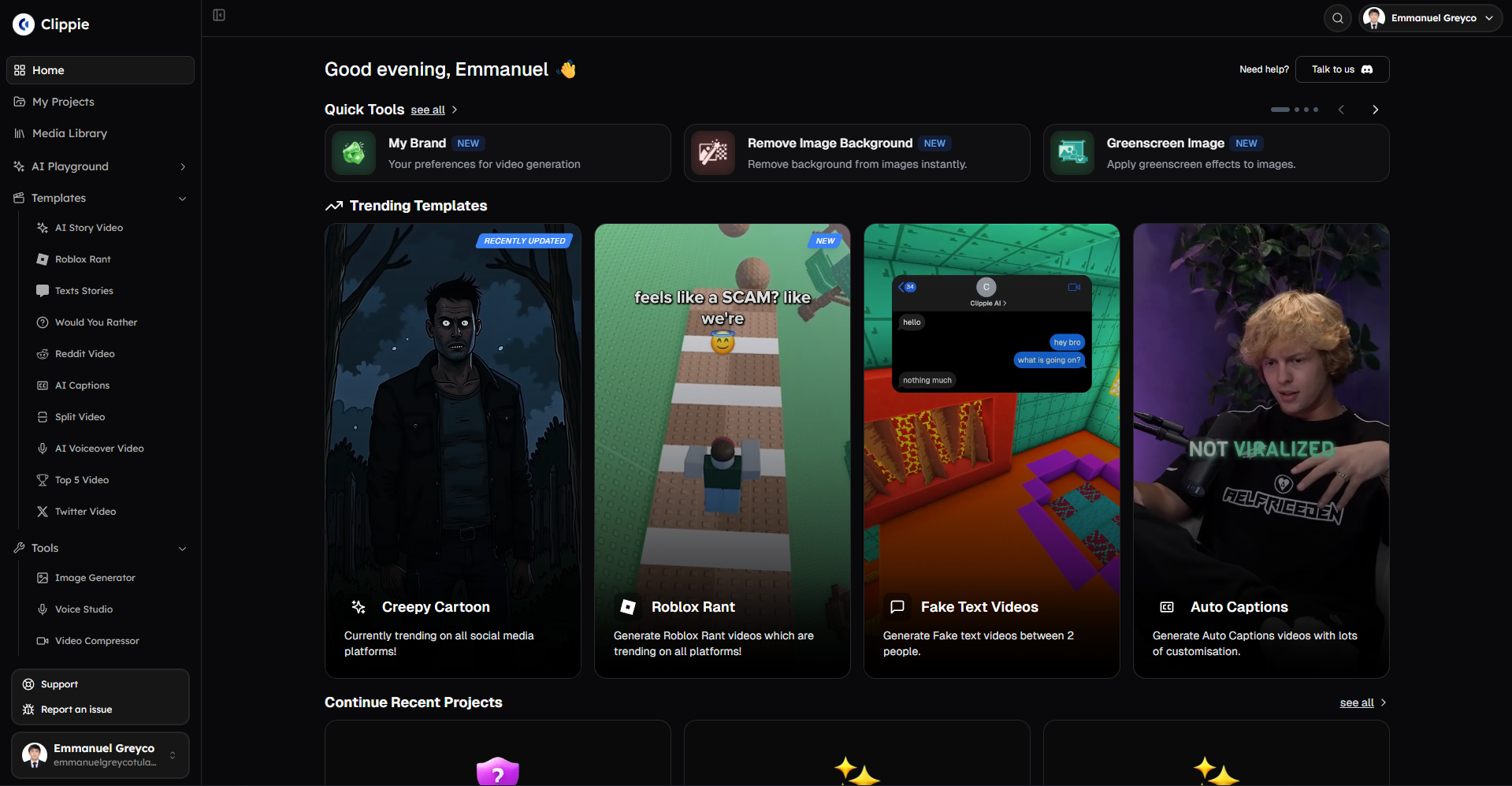
Visit clippie.ai to explore automated workflows combining trending content automation (2-3 min sourcing), AI video generation (10-15 min autonomous), professional trimming (3-6 min) producing complete videos in 20-32 minutes vs. 103 minutes manual enabling 400% capacity increase, premium neural voices delivering 65-80% completion rates, multi-platform export generating simultaneous YouTube/Shorts/TikTok/Reels versions saving 12-18 minutes per-platform adjustments, establishing competitive advantages through 10-20x traditional output, 70-85% time savings, and $12-$70 monthly tools vs. $1,250-$6,250 manual overhead.
Make an AI story video
Write a script or let AI write one. Clippie turns it into a narrated video with AI scenes, voiceover and captions.
Read more

How to Make Top 5 Ranking Videos in 2026 (Step-by-Step)
Build ranking Shorts that can still earn: pick a debatable topic, set clear criteria, source clips you may use, script the countdown, add your commentary.

How to Create Short-Form Videos Using AI: 8 Steps (2026)
A beginner workflow for AI videos on TikTok, Reels and Shorts: pick a format, script a hook, add visuals, voice and captions, export at 9:16, label AI.

7 Free CapCut Alternatives for Short-Form Video (2026)
Compare Edits, YouTube Create, VN, Clipchamp, Canva, DaVinci Resolve and Shotcut: what each gives free users, what it caps first and where it falls short.