
How to Get Clients Through Your Personal Brand in 2026
How to get clients through your personal brand in 2026. Complete guide to authority-driven content, trust-building without burnout, converting attention to clients & scaling production with Clippie AI.
If you're searching for how to get clients through your personal brand in 2026, you're navigating the shift from traditional credentials-based authority (degrees, certifications, years of experience) to demonstrated expertise through consistent content creation, where a consultant posting 3–5 valuable insights weekly on LinkedIn generates more qualified leads than decades of industry experience alone, and service providers building authentic personal brands close clients 40–60% faster than those relying solely on cold outreach or referrals. This comprehensive guide breaks down what personal branding actually means in the post-influencer era (authentic expertise demonstration vs. manufactured personality), the specific content types that build genuine authority (educational frameworks, transparent case studies, contrarian insights, behind-the-scenes methodology), sustainable posting strategies that build trust without daily content treadmills (quality consistency beats posting frequency, strategic silence as positioning tool), proven systems for converting audience attention into paying clients (positioned CTAs, consultation frameworks, value-first offers), and production workflows enabling authentic personal brand content at scale without sacrificing billable client work, with real conversion data, positioning strategies, and automation systems for sustainable authority building.
Executive Summary: Personal brand client acquisition in 2026 requires fundamentally different approach than 2020-era influencer tactics, modern buyers distrust polished "guru" positioning and respond to authentic expertise demonstration through specific content pillars: educational value that solves immediate problems (not teases paid solutions), transparent sharing of actual client work and results (not vague success stories), contrarian perspectives that differentiate thinking (not consensus safe takes), and vulnerable behind-the-scenes insights that humanize expertise (not highlight reels). Success metrics shifted from vanity (follower counts, likes) to conversion (consultation bookings, qualified DMs, referral quality), making a $200K/year consultant with 3,000 highly-engaged followers more commercially successful than $50K/year influencer with 100,000 passive followers. This guide provides the complete framework for building commercially viable personal brands that generate consistent $5K–$50K monthly client revenue through strategic content positioning, trust-based conversion systems, and sustainable production workflows.
Table of Contents
What a Personal Brand Actually Is Today
Authority-Driven Content Types
Building Trust Without Daily Posting
Monetising Attention Into Clients
Scaling Personal Brand Content With Clippie
Frequently Asked Questions

1. What a Personal Brand Actually Is Today
The Death of the "Influencer" Personal Brand Model
The 2018–2022 personal brand playbook (now obsolete):
Formula:
Post aspirational lifestyle content (luxury travel, expensive purchases, "crushing it" narratives)
Build massive follower count (100K+ goal, engagement secondary)
Monetize through: Sponsorships, affiliate links, course sales to followers
Authority claim: "I made $X, follow my method"
Why it worked (temporarily):
Novelty (few people sharing wealth publicly, aspirational appeal strong)
Platform algorithms favored engagement (any engagement, quality irrelevant)
Buyer naivety (audience didn't question credentials, results)
Why it collapsed (2023–2026):
Market saturation:
Everyone adopted playbook (10,000+ "6-figure coaches" emerged)
Differentiation impossible (all saying same things, same formats)
Audience fatigue (viewers numb to lifestyle flexing, suspicious of income claims)
Platform algorithm changes:
Instagram, LinkedIn, TikTok deprioritized engagement-bait content
Shifted to "value-first" content (educational, helpful, substantive)
Influencer-style content reach collapsed 60–80% (2022–2024)
Buyer sophistication:
Audiences learned to spot fake gurus (income screenshots easily fabricated)
Demanded proof (case studies, client testimonials, verifiable results)
Valued expertise over personality (want solutions, not entertainment)
Legal and ethical scrutiny:
FTC enforcement on disclosure (influencers fined for undisclosed sponsorships)
Platform crackdowns (fake followers, engagement pods banned)
Reputational damage (exposed frauds destroyed trust in category)
The 2026 reality:
Old playbook generates 10–20% of previous results
Follower counts increasingly meaningless (10K engaged > 100K passive)
Authenticity and expertise required (manufactured personas fail)
The New Personal Brand Definition: Demonstrated Expertise at Scale
What personal brand means in 2026:
Definition: Consistent public demonstration of expertise, thinking, and results that positions you as go-to authority in specific domain, making potential clients seek you out rather than you pursuing them.
Key components:
1. Expertise demonstration (not claims):
Old: "I'm an expert in X" (claim without proof)
New: Teach specific frameworks, share detailed case studies, reveal methodology (proof through demonstration)
2. Specific domain authority (not generalist):
Old: "Business coach helping everyone succeed"
New: "I help SaaS companies $2M–$10M ARR optimize sales funnels, increased conversion 30–60% for 40+ clients"
3. Consistent value delivery (not intermittent promotion):
Old: Post occasionally, mostly promotional ("Buy my course")
New: Regular educational content (3–5x weekly), occasional mentions of paid services
4. Authentic voice and perspective (not manufactured persona):
Old: Curated highlight reel, fake lifestyle, personality performance
New: Real experiences, honest challenges, unique perspectives, human vulnerability
5. Commercial outcomes (not vanity metrics):
Old: Success = follower count, likes, engagement rate
New: Success = consultation bookings, qualified leads, client revenue
The personal brand formula (2026):
Expertise + Specificity + Consistency + Authenticity + Strategic Positioning = Client Acquisition Engine

The Psychological Shift: From Aspiration to Association
How buyers evaluated service providers (2018–2022):
Aspiration-based decision:
"This person has lifestyle I want → I'll hire them to teach me"
Emotional trigger: Envy, desire, FOMO
Evidence required: Lifestyle signals (expensive cars, luxury travel, income screenshots)
Problems:
Lifestyle easily faked (rented cars, borrowed houses, Photoshopped bank accounts)
No correlation between lifestyle and teaching ability
High fraud rate (fake gurus everywhere)
How buyers evaluate service providers (2026):
Association-based decision:
"This person thinks like I want to think → They can help me level up"
Emotional trigger: Recognition, resonance, trust
Evidence required: Demonstrated expertise (frameworks shared, results proven, thinking displayed)
Why association wins:
Thinking can't be faked (requires actual expertise to produce valuable insights consistently)
Direct correlation (quality thinking = quality service delivery)
Low fraud rate (can't maintain valuable content facade long-term without substance)
The trust-building mechanism:
Content consumption journey:
Discovery: Prospect finds your content (LinkedIn post, YouTube video, podcast)
Value recognition: "This insight is genuinely useful, I can apply this immediately"
Repeated exposure: Prospect consumes 5–10 pieces of content over weeks/months
Pattern recognition: "This person consistently delivers valuable thinking"
Mental association: "When I need help with [domain], this person is the expert"
Trigger event: Prospect faces problem you solve
Immediate recall: "That expert I've been following, I should hire them"
Outreach: Prospect initiates contact (inbound, high intent, pre-sold)
Timeline:
Aspiration model: Instant decision (impulse buy based on lifestyle appeal)
Association model: 4–12 weeks consideration (trust built through repeated value delivery)
Close rates:
Aspiration model: 2–8% (low trust, buyer's remorse common, refund rates high)
Association model: 40–70% (high trust, buyer pre-qualified themselves, long-term clients)
Average contract value:
Aspiration model: $500–$5,000 (courses, programs)
Association model: $5,000–$100,000 (high-ticket consulting, retained services)
The Commercial Viability Litmus Test
Not all personal brands generate client revenue, how to ensure yours does:
Test 1: Specificity
Question: Can you describe your ideal client in one specific sentence?
Failing examples:
"I help people achieve success"
"I'm a business coach"
"I work with entrepreneurs"
Passing examples:
"I help B2B SaaS companies ($2M–$10M ARR) optimize LinkedIn outbound to generate 30–50 qualified demos monthly"
"I help solo consultants (making $100K–$300K annually) systematize client delivery to reclaim 15+ hours weekly"
"I help e-commerce brands ($500K–$3M revenue) reduce customer acquisition cost 20–40% through conversion rate optimization"
Why specificity matters:
Broad positioning = invisible (generic messages ignored)
Specific positioning = magnetic (right people instantly recognize "that's me")
Test 2: Value demonstration
Question: Do you regularly share specific, actionable frameworks/insights that solve real problems for free?
Failing patterns:
Motivational quotes (no actionable value)
Vague success stories ("I helped a client 10x revenue", no methodology shared)
Teaser content ("Want to know my secret? DM me", value gated)
Passing patterns:
Detailed frameworks ("My 4-step sales qualification framework, here's exactly how it works")
Transparent case studies ("How we increased client's conversion 35%: Here's the 3 changes we made and why")
Contrarian insights ("Most people optimize the wrong metrics in X, here's what actually matters and why")
Why value matters:
No value = no trust (audience learns nothing, no reason to return)
Consistent value = authority (audience learns from you, sees expertise, trusts service quality)
Test 3: Commercial intent clarity
Question: Is it obvious what service you offer and who should hire you?
Failing indicators:
No mention of services (pure educational content, no commercial connection)
Confusing offerings ("I do coaching, consulting, courses, speaking", unclear what to buy)
Passive positioning ("DM me if interested", no proactive clarity)
Passing indicators:
Clear service description in bio ("I help [specific client] achieve [specific outcome]. Link to book consultation.")
Occasional service-focused content ("Here's how my consulting process works" "Recent client results")
Strategic CTAs in educational content ("If you want help implementing this framework, here's how to work with me")
Why clarity matters:
Confusion = no action (prospects don't know what to buy or whether it's for them)
Clarity = qualified leads (right prospects self-identify and reach out)
Test 4: Conversion infrastructure
Question: When someone wants to hire you, is the path frictionless?
Failing paths:
"Email me at..." (requires prospect compose email, explain situation, wait for response)
No booking mechanism (must coordinate calendars via back-and-forth)
Unclear pricing or process (prospect doesn't know what happens after inquiry)
Passing paths:
Calendly/booking link in bio (instant scheduling, zero friction)
Clear service page (what you offer, who it's for, what it costs or how pricing works, what happens next)
Qualification questions (automated form ensures only qualified prospects book calls)
Why infrastructure matters:
High friction = lost leads (60–80% of interested prospects never complete complicated booking process)
Frictionless = conversions (70–85% of interested prospects complete simple one-click booking)
Test 5: Consistency
Question: Do you post valuable content at least 3–5x weekly for 3+ consecutive months?
Failing patterns:
Sporadic posting (once weekly or less, insufficient for top-of-mind awareness)
Short bursts (post daily for 2 weeks, then disappear for month, no momentum)
Inconsistent quality (some posts valuable, others filler, dilutes authority)
Passing patterns:
Regular schedule (3–7x weekly, maintained for months)
Consistent value (every post teaches something or shares genuine insight)
Long-term commitment (understand trust builds over time, not overnight)
Why consistency matters:
Sporadic = forgettable (out of sight, out of mind, prospects don't remember you when need arises)
Consistent = omnipresent (prospects see you weekly, mental association strengthens, top-of-mind when buying)
Self-assessment scoring:
Pass all 5 tests: Your personal brand is commercially viable (should generate client inquiries)
Pass 3–4 tests: Viable but optimization needed (some inquiries, but could be 2–5x more)
Pass 1–2 tests: Not commercially viable yet (unlikely generating meaningful client revenue from brand)
Fail all tests: Starting point identified (begin with Test 1, specificity)

2. Authority-Driven Content Types
The Content Hierarchy: From Engagement to Authority
Not all content builds authority, understanding the hierarchy:
Tier 4: Entertainment/Engagement content (lowest authority)
Characteristics:
Memes, jokes, relatable humor
Inspirational quotes
Personal life updates unrelated to expertise
Engagement: High (likes, shares, comments)
Authority building: Minimal (entertaining ≠ expert)
Client acquisition: Nearly zero (followers don't associate you with solvable problems)
Example: Motivational quote over sunset photo
When to use: 10% of content maximum (humanizing, relatability) but never primary strategy
Tier 3: Opinion/Hot take content (moderate authority)
Characteristics:
Industry commentary ("Here's what I think about [trend]")
Controversial opinions ("Unpopular opinion: [take]")
Predictions and analysis
Engagement: Moderate to high (debate-worthy generates comments)
Authority building: Moderate (demonstrates thought leadership, but opinion without substance = limited credibility)
Client acquisition: Low to moderate (positions expertise, but doesn't demonstrate capability)
Example: "AI will replace 40% of marketing jobs in 3 years, here's why"
When to use: 15–20% of content (establishes perspective, differentiates thinking)
Tier 2: Educational/How-to content (strong authority)
Characteristics:
Frameworks and methodologies ("My 4-step process for X")
Tactical guides ("How to achieve [outcome]")
Tool and technique breakdowns
Engagement: Moderate (save rate high, likes moderate, value>entertainment)
Authority building: Strong (demonstrates expertise through teaching)
Client acquisition: Moderate to high (prospects recognize competence, but may attempt DIY instead of hiring)
Example: "How to optimize LinkedIn profile for B2B lead generation, 7 specific changes"
When to use: 40–50% of content (core authority building, showcases expertise)
Tier 1: Results/Case study content (highest authority)
Characteristics:
Specific client results with methodology ("How we increased client's MRR 40% in 90 days")
Transparent case studies (problem → approach → outcome)
Before/after transformations with detailed explanation
Engagement: Low to moderate (niche audience, but highly qualified)
Authority building: Highest (proof of capability, not just knowledge)
Client acquisition: Highest (directly demonstrates you deliver results, not just talk about them)
Example: "Case study: SaaS client struggling with 1.2% trial-to-paid conversion. We implemented 3 changes: [details]. Conversion now 3.8%. Here's exactly what we did."
When to use: 25–35% of content (cornerstone authority, direct client attraction)
Optimal content distribution (weekly posting):
2–3 posts: Educational/How-to (Tier 2, 40–50%)
1–2 posts: Results/Case studies (Tier 1, 25–35%)
1 post: Opinion/Hot take (Tier 3, 15–20%)
0–1 post: Entertainment/Personal (Tier 4, 0–10%)
Total: 4–7 posts weekly (sustainable, authority-building mix)
Content Type 1: The Signature Framework Share
What it is: Your proprietary methodology, shared publicly in detail
Structure (600–1,200 words for LinkedIn/blog, 90–120 seconds for video):
Hook (problem identification):"Most [target audience] struggle with [specific problem] because they're optimizing the wrong variables. Here's the framework I use with every client to [achieve outcome]:"
Framework breakdown:
Step 1: [Name], [What it is, why it matters, how to execute]
Step 2: [Name], [What it is, why it matters, how to execute]
Step 3: [Name], [What it is, why it matters, how to execute]
Step 4: [Name], [What it is, why it matters, how to execute]
Results context: "Using this framework with 40+ clients, we've consistently seen [specific outcome range]. Most recent example: [brief case study]."
Implementation guidance: "If you want to implement this yourself: [1–2 immediate action steps]. If you want help applying this to your specific situation: [CTA to book consultation]."
Example (marketing consultant):
Most B2B companies waste 60% of their content budget because they create without a distribution strategy. Here's the 4D Content Framework I use with every client: 1. Define: Identify your ONE core topic (not 10 topics, ONE). Example: SaaS sales, not "business growth." Specificity = authority. 2. Demonstrate: Create content proving expertise in that topic. Framework reveals, case studies, contrarian insights. 3–5 pieces weekly minimum. 3. Distribute: Systematically push content to target audience. LinkedIn for B2B, partnerships for co-promotion, email list nurturing. Content without distribution = invisible. 4. Direct: Every piece includes strategic CTA matched to buyer journey. Awareness stage = free resource. Consideration stage = consultation booking. Results: Clients using 4D Framework generate 3–8x more qualified leads from same content volume vs. random posting approach. Implementation: Start with Define, pick ONE topic, commit for 90 days. Want help implementing 4D for your business? Link in comments to book audit call.
Why signature frameworks build authority:
Intellectual property signal:
Named framework ("4D Content Framework") = proprietary thinking
Perception: This person didn't just learn from others, they synthesized unique methodology
Authority boost: Original thinker > regurgitator
Teachability demonstration:
Can explain complex concept simply = deep understanding
Can break down into actionable steps = practical experience
Can provide examples = real-world application
Generosity paradox:
Giving away "secret sauce" seems counterintuitive
Reality: People who can implement without help will do so anyway (not your customers)
Your customers want done-for-you or expert guidance (value implementation help over information)
Sharing framework attracts ideal clients (those who recognize complexity of execution)
Expected outcomes:
30–60 saves/shares (high save rate, reference material)
5–15 comments (discussion of application, questions)
8–15 profile visits (interested prospects researching you)
2–5 DM inquiries ("Can you help me implement this?")
1–3 consultation bookings (per framework post, high-intent prospects)

Content Type 2: The Transparent Case Study
What it is: Detailed walkthrough of specific client engagement, problem, approach, results
Structure:
Context setup (who, what, when):"[Month] 2025: [Client type, e.g., 'B2B SaaS company, $4M ARR'] came to us with [specific problem]. They'd tried [previous approaches] without success."
Diagnosis (what you identified):"Analysis revealed the core issue: [root cause, not symptom]. Most competitors focus on [common but wrong approach], but we identified [actual problem]."
Intervention (what you did, step-by-step):
Week 1–2: [Specific actions taken]
Week 3–4: [Specific actions taken]
Week 5–8: [Specific actions taken]
Results (specific, verifiable metrics): "90 days later: [Metric 1] improved from X to Y ([percentage] increase). [Metric 2] improved from A to B. Client testimonial: '[Direct quote]'."
Methodology positioning: "This is our [Process Name], same approach we've used with [number]+ clients in [industry/category]. Adaptable to [variations] but core principles consistent."
CTA: "Facing similar challenge? [Link to book consultation], we'll diagnose your specific situation in 20-minute strategy call."
Example (conversion rate optimization consultant):
November 2025: E-commerce brand ($2.1M annual revenue, selling sustainable home products) approached us. Problem: 1.2% checkout conversionmeaning 98.8% of people adding items to cart abandoned before purchase. Previous attempts: Tried discount pop-ups (increased abandonment), simplified checkout (no impact), exit-intent offers (negligible improvement). Our diagnosis: Analyzed user session recordings for 200 abandoned carts. Real issue: Unexpected shipping costs revealed at final checkout step + lack of trust signals during payment collection. Our 8-week optimization: Weeks 1–2: - Implemented shipping calculator on product pages (transparency upfront) - Added trust badges throughout checkout (security, guarantee, reviews) Weeks 3–4: - Tested 3 shipping pricing models (free over $75, flat rate, real-time calculated) - Winner: Free shipping over $75 (increased AOV 28%, more carts qualified) Weeks 5–6: - Optimized checkout form (removed unnecessary fields, added progress indicator) - A/B tested payment page copy (emphasizing security, guarantee) Weeks 7–8: - Implemented abandoned cart recovery email (3-email sequence, personalized) Results (90 days post-implementation): - Checkout conversion: 1.2% → 2.8% (133% increase) - Average order value: $62 → $79 (27% increase) - Revenue impact: +$31,000 monthly recurring (from optimization alone) Client quote: "Expected minor improvements. Getting more than 2x conversion felt impossible. The session recording analysis was the breakthrough, showed us what customers actually experienced vs. what we assumed." This is our CRO Blueprint methodology, used with 35+ e-commerce clients. Average conversion lift: 45–85% within 90 days. Running an e-commerce store with conversion under 2%? Book free conversion audit: [link]. We'll analyze your checkout, identify top 3 bottlenecks, show you what's actually causing abandonment.
Why transparent case studies convert:
Proof over promise:
Generic claim: "I increase conversions", skeptical audience ignores
Specific case study: "Here's how we took this company from 1.2% to 2.8%", credible, detailed, believable
Methodology reveal:
Sharing process (session recording analysis, A/B testing, specific changes) = demonstrates expertise depth
Prospect thinks: "This level of detail = they know what they're doing"
Relatability:
Specific client (e-commerce brand, $2.1M revenue) = target audience sees themselves
Common problem (checkout abandonment) = widespread issue, many prospects face it
Proven results = hope that same outcomes achievable for them
Objection pre-emption:
"Will this work for my business?" → Case study shows specific application
"Is this person credible?" → Detailed methodology + results = demonstrated competence
"What's the process like?" → Transparent walkthrough shows what to expect
Expected outcomes (per case study post):
40–80 saves (high reference value, prospects bookmark for later review)
10–25 comments (questions about application, congratulations, discussion)
15–30 profile visits (qualification research, checking if you work with their type)
5–12 DM inquiries (direct interest in similar help)
3–6 consultation bookings (highest conversion rate of any content type)
Content Type 3: The Contrarian Insight
What it is: Challenge conventional wisdom in your industry with data-backed alternative perspective
Structure:
Conventional wisdom statement: "Everyone says [common belief in industry]. Conferences, books, gurus all repeat it: [restate belief]."
The problem with conventional wisdom: "But here's what they're missing: [flaw in logic, ignored data, changed context]. When you actually [test/measure/analyze], reality shows [contradiction]."
Your contrarian position: "After [number] years working with [client type] and [specific analysis/experience], here's what actually works: [alternative approach]."
Evidence:
Data point 1: [Specific metric supporting your position]
Data point 2: [Client example or case study]
Data point 3: [Industry trend or research]
Why conventional wisdom persists: "People keep repeating [common belief] because: [reason 1: confirmation bias, outdated information, easy to understand but wrong]. But in [current year/context], [your approach] consistently outperforms."
Application: "If you're currently following conventional approach: [what to change]. Expected improvement: [realistic outcome]."
CTA: "Want contrarian audit of your [area]? [Link to consultation], I'll identify where you're following outdated best practices and what to do instead."
Example (LinkedIn strategy consultant):
Everyone says "Post daily on LinkedIn for maximum reach." Influencers, courses, LinkedIn itself repeats it: Consistency = daily posting = growth. But here's what they're missing: The algorithm rewards ENGAGEMENT RATE, not posting frequency. Posting daily with 2% engagement rate loses to posting 3x weekly with 8% engagement rate. Math: 7 posts × 2% = 14% weekly engagement vs. 3 posts × 8% = 24% weekly engagement. Algorithm favors the 3x poster. After analyzing 200+ LinkedIn accounts (10K–100K followers) over 18 months, here's what actually works: Post 3–5x weekly with HIGH-VALUE content (deep insights, detailed frameworks, case studies) = better results than 7x weekly with surface-level content. Evidence: - Client A switched from daily (7x) shallow posts to 4x weekly deep posts: Reach per post increased 3.2x, inbound inquiries increased 5x - Study of 50 B2B consultants: Those posting 3–5x weekly averaged 12 consultation bookings monthly. Daily posters averaged 6 bookings monthly (despite 2x content volume) - My own account: 5 posts weekly, average 15–25 qualified leads monthly Why daily posting advice persists: 1. Advice from 2019–2021 (algorithm WAS frequency-based then, changed 2022) 2. Influencers benefit from daily posting (entertainment content gets engagement) 3. Simple advice (easier to say "post daily" than "post strategically") But in 2026, engagement quality >>> quantity. Daily surface-level posts train algorithm: "This account produces low-value content." 3x weekly deep value trains algorithm: "This account produces high-value content, show to more people." If you're posting daily with low engagement: Cut to 3–4x weekly, invest 3x more time per post (detailed insights, not quick takes). Watch reach per post triple within 30 days. Want LinkedIn strategy audit? [Link], I'll analyze your posting pattern, identify optimization opportunities, show you exactly how to increase reach + leads without increasing posting frequency.
Why contrarian content builds authority:
Thought leadership signal:
Challenging consensus = independent thinking
Data-backed position = not just contrarian for attention
Authority perception: Leader, not follower
Differentiation:
100 consultants say same thing (daily posting) = indistinguishable
1 consultant says different thing with evidence = memorable, distinctive
Trust through honesty:
Willingness to contradict popular advice = honest, not just telling people what they want to hear
Detailed reasoning = transparent thinking process
Builds confidence: "This person thinks critically, won't give me generic advice"
Engagement mechanism:
Contrarian = debate-worthy (comments arguing or supporting)
Shares from supporters ("This is what I've been saying!")
Visibility boost from engagement
Expected outcomes:
50–100 likes (polarizing = engagement)
20–40 comments (debate, agreement, questions)
30–50 shares (supporters amplifying message)
20–35 profile visits (curious about your approach)
4–8 consultation bookings (prospects seeking alternative perspective)
Content Type 4: The Behind-the-Scenes Methodology Reveal
What it is: Show your actual work process, tools, templates, or internal systems
Structure:
Setup (what you're revealing):"Most [your role] keep their processes secret. I'm sharing exactly how I [specific task], tools, templates, step-by-step workflow."
Workflow breakdown:
Tool/System 1: [What it is, why you use it, specific application]
Tool/System 2: [What it is, why you use it, specific application]
Tool/System 3: [What it is, why you use it, specific application]
Time/efficiency context: "This system takes [X time] vs. [Y time] manual approach. Handles [volume] [thing] monthly without quality degradation."
Results enabled: "Because this is systematized, I can deliver [outcome] consistently for clients. Recent example: [brief case study]."
Offering: "Want this exact system for your business? [Link to download template] (free). Or want me to implement it for you? [Link to consultation]."
Example (client onboarding consultant):
Most consultants keep onboarding processes hidden. I'm sharing my exact 7-day client onboarding system, reduces time-to-value from 30 days to 7, increases client satisfaction 40%, cuts my onboarding time 60%. Day 1 (Contract Signed): - Automated email sequence starts (welcome, expectations, what's next) - Client receives Notion workspace access (pre-populated templates, resources, FAQs) - Calendly link for kickoff call (30 min, scheduled within 48 hours) Day 2–3: - Pre-kickoff questionnaire (10 questions via Typeform, auto-populated into my CRM) - Automated analysis of questionnaire (identifies priorities, flags potential issues) - Kickoff call prep document generated (client context, recommended focus areas) Day 4 (Kickoff Call): - 30-minute structured call (template agenda, specific objectives) - Whiteboard collaborative strategy session (Miro board, client can access afterward) - Agreement on 90-day roadmap (milestones, deliverables, success metrics) Day 5–6: - Strategy document created from call notes (automated template, customized to client) - First deliverable initiated (depending on service, audit, implementation, etc.) - Client receives progress update (transparency on what's happening) Day 7: - Check-in email (automated, personalized): "Here's what we've accomplished, here's what's next" - Client satisfaction survey (2 questions: clarity on process, confidence in partnership) - Relationship manager assigned (point of contact for questions) Time investment: 2 hours total (vs. 8–12 hours manual onboarding) Volume: Handles 10 concurrent client onboardings without quality loss Results: Client satisfaction (first 30 days): 94% (vs. 71% before system). Time-to-first-value: 7 days (vs. 23 days before). Client questions/confusion: Reduced 73%. Want this system? Free template download: [link], includes email sequences, Notion templates, questionnaire, call agenda. Or want me to build custom onboarding system for your consulting business? Consultation booking: [link].
Why behind-the-scenes content builds authority:
Transparency = trust:
Revealing internal systems = confidence (not hiding anything)
Detailed processes = real expertise (can't fake systematic approach)
Generosity signal (helping competitors improve)
Capability demonstration:
Systems = professionalism (amateur = ad hoc, professional = systematized)
Efficiency = competence (optimize own work = will optimize client's work)
Scalability signal (system handles volume = can take on new clients without quality degradation)
Implementation gap:
Even with templates/systems shared, most won't implement (intention-action gap)
Those who do implement = not your customers anyway (DIY mindset)
Your customers = want done-for-you or expert customization ("I see the system, help me build mine")
Expected outcomes:
60–90 saves (high utility, actionable template)
15–30 comments (questions about tools, implementation, specifics)
200–500 template downloads (if offered free, lead magnet)
8–15 DM inquiries (customization requests)
3–7 consultation bookings (want system adapted to their business)

3. Building Trust Without Daily Posting
The Burnout-Authority Paradox
The traditional advice paradox:
Common recommendation: "Post every day to build authority. Consistency = daily content = growth."
Reality for service providers:
Daily posting = 30+ hours monthly (content creation, writing, editing, engaging)
Billable client work = 30–40 hours weekly (actual revenue generation)
Conflict:
Time spent on content ≠ time earning income
Burnout timeline:
Month 1–2: Excited, energized (new initiative, seeing engagement)
Month 3–4: Strain visible (daily posting feels obligatory, quality declining)
Month 5–6: Resentment (content creation feels like unpaid work, cutting into client time)
Month 7+: Abandonment (stop posting, inconsistency destroys momentum, authority building fails)
Result: 70–80% of service providers who attempt daily posting quit within 6 months
The alternative: Strategic consistency beats posting frequency
The 3–5 Posts Weekly Framework
Why 3–5 weekly outperforms daily for service providers:
Quality over quantity:
3–5 posts = 6–10 hours weekly (sustainable alongside client work)
Deep, valuable content possible (time to research, think, craft)
Algorithm rewards engagement rate, not post count (detailed valuable post > shallow daily post)
Sustainable indefinitely:
6–10 hours weekly = 24–40 hours monthly (manageable long-term)
No burnout risk (content creation feels productive, not burdensome)
Consistency maintained (years, not months)
Higher conversion:
Fewer, higher-quality posts = stronger authority signal
Each post more likely to drive consultation booking (substance > frequency)
The weekly content schedule (example):
Monday: Educational framework post (Tier 2 content, signature methodology)
Wednesday: Case study or contrarian insight (Tier 1 or Tier 3, authority demonstration)
Friday: Behind-the-scenes or hot take (Tier 2 or Tier 3, humanizing + positioning)
Optional Saturday/Sunday: Opinion piece or personal insight (Tier 3/4, relatability)
Total time investment:
Monday post: 90 minutes (framework development, writing, editing)
Wednesday post: 120 minutes (case study or research for contrarian piece)
Friday post: 60 minutes (lighter content, workflow reveal or quick take)
Optional weekend: 45 minutes
Total: 4.5–5.5 hours weekly (vs. 10–15 hours for daily posting)
Output quality:
Each post receives 60–120 minutes of attention (depth and polish achievable)
Versus daily posting: 20–30 minutes per post (surface-level, rushed)
The Strategic Silence Positioning Technique
Counterintuitive authority builder: Intentional posting gaps
What it is: Occasionally go 7–14 days without posting (despite ability to post)
Why it works:
Scarcity principle:
Constant availability = low value perception
Selective availability = high value perception
"This person doesn't need to post daily to get clients" = in-demand signal
Busy signal:
Silence implies client work (positive signal, "too busy with clients to post")
Versus constant posting implies need for attention (negative signal, "desperate for visibility")
Anticipation building:
Regular posters = content expected, not appreciated
Occasional posters = content valued when it appears ("Oh, [Name] posted, I want to read this")
How to use strategically:
After major client win or busy period:
Post case study announcing success
Go silent 10–14 days (implication: focused on delivering for clients)
Return with framework or insight post
Effect: Authority perception + scarcity value
Before product/service launch:
Post consistently 3–5x weekly for 8 weeks
Go silent 7 days before launch
Return with launch announcement
Effect: Anticipation built, announcement has impact
Quarterly recharge:
Post consistently 12 weeks
Take 2-week break (announce: "Taking time to work ON business, not just IN it")
Return refreshed with new insights from strategic work
Effect: Human, thoughtful, strategic positioning
Important caveats:
Don't disappear randomly:
Planned silence = positioning
Unplanned disappearance = inconsistency (negative signal)
Communicate intention (sometimes):
"Taking next 2 weeks heads-down with clients, back soon with case study results"
Effect: Positive signal (client-focused, in-demand)
Maintain engagement even when not posting:
Comment on others' posts (5–10 minutes daily)
Respond to DMs and comments on old posts
Effect: Present but selective about own content

The Evergreen Content Library Strategy
How to build authority without constant new content creation:
Concept: Create library of 20–40 "evergreen" posts (timeless, always relevant) and strategically resurface
Evergreen content examples:
Core frameworks (won't change)
Fundamental principles (timeless truths in your domain)
Case studies (past results still demonstrate capability)
Contrarian insights (if position still valid)
The creation phase (Months 1–4):
Produce 30–40 high-quality evergreen posts (7–10 per month)
Cover core topics in your expertise domain
Archive in content library (Notion, Airtable, spreadsheet)
The maintenance phase (Month 5+):
New content: 1–2 original posts weekly (timely insights, recent case studies)
Resurfaced content: 1–2 evergreen posts weekly (slight refresh, repost)
Total: 3–4 posts weekly (2–3 hours creation + 30 minutes curation)
Resurfacing technique:
Original post (6 months ago):"The 4-step framework I use for [outcome]: [Details]"
Refreshed version (today): "6 months ago I shared this framework. Since then, 15 more clients have used it, results still consistent: [Updated stats]. Here's the framework again, plus new insight I've learned: [Addition]"
Why this works:
Most followers haven't seen original (audience turns over, algorithm didn't show everyone)
Update demonstrates continued relevance (framework still working)
Fresh insight adds value (not pure repost, improved version)
Time savings:
Original post creation: 90–120 minutes
Refresh and repost: 15–20 minutes
Savings: 70–105 minutes (75–87% time reduction)
The Batch Production Sunday System
How to create week's content in 2–3 hours (Sunday):
Sunday content batching routine:
Step 1: Planning (20 minutes)
Review last week's performance (which posts drove inquiries, engagement)
Select topics for upcoming week (3–5 topics based on winners + timely insights)
Outline each post (3–5 bullet points of key message)
Step 2: Writing (90–120 minutes)
Write all 3–5 posts in single session (flow state, context-loaded)
Don't edit yet (get ideas out, momentum over perfection)
Aim for 80% complete drafts
Step 3: Editing and refinement (30–45 minutes)
Review each post fresh (read aloud, check clarity)
Tighten language, strengthen hooks, verify CTAs
Finalize
Step 4: Scheduling (15–20 minutes)
Load into scheduling tool (Buffer, Hootsuite, or native platform scheduling)
Set posting times (Monday 8 AM, Wednesday 10 AM, Friday 2 PM, etc.)
Add images/formatting if applicable
Total time: 2.5–3.5 hours (entire week's content batched)
Benefits:
Efficiency:
Batching = flow state (vs. context-switching daily)
Single writing session = consistency in voice and quality
3 hours Sunday vs. 1 hour daily × 5 = time savings
Consistency:
Week's content pre-created = no "I don't know what to post today" paralysis
Scheduled in advance = posts never missed
Mental relief (content handled, focus on client work during week)
Quality:
Fresh perspective (Sunday writing, Monday–Friday posting = review time)
Comparative quality check (all posts side-by-side, ensure high bar)
Strategic Sunday structure:
Sunday 9–11 AM or 7–9 PM (when client work doesn't compete)
Recurring calendar block (sacred time, non-negotiable)
Energy management (writing when mentally fresh, not depleted)

4. Monetising Attention Into Clients
The Attention-to-Client Conversion Funnel
Common failure pattern: Build audience, get engagement, receive zero client inquiries
Why it happens: No conversion infrastructure (attention ≠ clients without intentional conversion system)
The 5-stage funnel:
Stage 1: Attention (prospect discovers your content)
Mechanism:
SEO (Google search finds your content)
Platform algorithm (LinkedIn, Instagram, TikTok surfaces your post)
Share/referral (someone tags them in your post)
Paid promotion (optional, sponsored content)
Goal: Get eyeballs on content
Stage 2: Value recognition (prospect finds content useful)
Mechanism:
Content solves immediate problem (actionable insight, framework, answer)
Prospect applies advice successfully (even small win validates expertise)
"This is actually useful, not fluff" realization
Goal: Establish credibility through demonstrated value
Stage 3: Repeated exposure (prospect consumes 3–10 pieces of content)
Mechanism:
Prospect follows/subscribes (wants more content)
Algorithm shows more of your content (engagement signals interest)
Prospect actively seeks out your profile (checks for more insights)
Goal: Build familiarity and trust through consistency
Stage 4: Trigger event (prospect faces problem you solve)
Mechanism:
Business challenge arises ("We need to fix our sales funnel")
Budget allocated ("We have $50K for marketing consultant")
Internal catalyst ("Boss asked me to solve this, need expert help")
Goal: Prospect recognizes need for professional help (your expertise area)
Stage 5: Outreach (prospect initiates contact)
Mechanism:
Remembers your content ("That consultant who posts about funnels, I should reach out")
Checks your profile for contact info or booking link
Books consultation or sends DM inquiry
Goal: Convert attention into qualified lead
Where most personal brands fail: Stages 1–3 work (attention, value, exposure), but Stages 4–5 fail (no clear trigger or path to outreach)
Fixes:
Fix 1: Create trigger events (don't wait for them)
Post case studies (prospects think "I have that problem too, maybe I should get help")
Share frameworks (prospects attempt DIY, realize complexity, hire you)
Discuss common mistakes (prospects recognize they're making them, seek correction)
Fix 2: Make outreach frictionless
Clear CTA in every post ("If you want help implementing: [link]")
Booking link in bio (one-click scheduling, no email back-and-forth)
Response template for DMs (immediate acknowledgment, qualification questions, booking offer)
The Positioned CTA Framework
The mistake: Generic, passive CTAs that don't convert
Examples of weak CTAs:
"Follow for more tips" (action doesn't lead to client relationship)
"DM me if interested" (vague, high friction)
"Check out my services" (requires multiple clicks, unclear value prop)
The solution: Positioned CTAs matched to content and buyer journey stage
CTA Type 1: The Free Value Offer (Awareness stage)
When to use: Educational or framework content (prospects learning, not yet buying)
Format: "Want [related resource]? Download my [specific tool/template/guide]: [link]"
Example: Post: "The 4-step sales framework I use with every client" CTA: "Want the full framework with templates? Download free Sales Framework Toolkit: [link]"
Conversion mechanism:
Prospect gets immediate additional value (toolkit)
You capture email (lead magnet downloads require opt-in)
Automated nurture sequence begins (emails over 2–4 weeks)
Eventual offer to book consultation
Expected conversion:
100 post views → 5–10 toolkit downloads (5–10%)
10 downloads → 2–3 eventually book consultation (20–30% over time)
CTA Type 2: The Audit/Assessment Offer (Consideration stage)
When to use: Case study or contrarian content (prospects evaluating solutions, comparison shopping)
Format: "Want [specific audit/assessment] of your [specific thing]? Book free 20-minute [audit name]: [link]"
Example: Post: "How we increased client's conversion rate 2.4x in 90 days" CTA: "Want free conversion audit of your checkout process? Book 20-minute audit call: [link], I'll identify your top 3 conversion leaks"
Conversion mechanism:
Prospect receives genuine value (free audit, actionable insights)
You demonstrate expertise in real-time (audit showcases capability)
Natural transition to paid engagement ("I can fix these for you")
Expected conversion:
100 post views → 8–15 audit bookings (8–15%)
15 audits → 6–9 close to paid engagement (40–60%)
CTA Type 3: The Direct Booking (Decision stage)
When to use: Behind-the-scenes or methodology content (prospects nearly ready, just need final push)
Format: "Ready to implement [this system/approach] in your business? Book consultation: [link]"
Example: Post: "My exact 7-day client onboarding system that reduces time-to-value 70%" CTA: "Want this onboarding system built for your consulting business? Book implementation consultation: [link]"
Conversion mechanism:
Direct ask (no intermediate step)
Specific positioning (not "general consultation", implementation of specific thing)
Pre-qualified (only prospects who want that specific thing click)
Expected conversion:
100 post views → 4–8 consultation bookings (4–8%, lower volume but higher quality)
8 bookings → 5–6 close to paid engagement (60–75%, highest close rate)
Positioning rules:
Match CTA to content:
Educational post → Free resource CTA (aligned with learning journey)
Case study post → Audit CTA (prospect wants to see if they can get similar results)
Methodology post → Direct booking CTA (ready to implement)
Be specific:
Generic: "Book a call to discuss your business"
Specific: "Book LinkedIn audit call, I'll analyze your profile, content strategy, and show you exactly how to 2x qualified leads"
Remove friction:
One-click booking (Calendly in link)
No forms unless necessary (qualification can happen on call)
Clear time commitment ("20 minutes", not open-ended)
The Consultation-to-Close Framework
What happens after prospect books consultation:
The amateur approach:
Show up unprepared (generic questions)
Pitch services (focus on selling)
Send proposal (hope they buy)
Close rate: 15–30%
The professional approach (frameworks consultation):
Pre-call preparation (10 minutes):
Review booking form responses (understand context)
Check prospect's LinkedIn/website (company size, role, potential needs)
Prepare 2–3 hypotheses (what problems they likely face based on industry/context)
Call structure (20–30 minutes):
Minutes 1–5: Context and goal alignment
"Thanks for booking. I reviewed your responses, you mentioned [specific challenge]. Before we dive in, what's the ideal outcome from this call for you?"
Listen, take notes
Align on call structure: "Great. Here's how I'd suggest we use our time: I'll ask a few diagnostic questions (5 min), then we'll do a quick audit of [specific thing] (10 min), and I'll share 2–3 immediate recommendations you can implement (5 min). Sound good?"
Minutes 5–10: Diagnostic questions
Ask strategic questions revealing root issues:
"Walk me through your current process for [relevant thing]"
"What have you tried already to solve this?"
"If you could wave a magic wand, what would be different 90 days from now?"
Goal: Understand problem depth, identify whether you can help
Minutes 10–20: Live audit/assessment
Screen share, walk through their [website/LinkedIn/funnel/etc.]
Point out specific issues in real-time: "See here, this is causing [problem]. And this section could be optimized by [specific change]."
Demonstrate expertise through observation and diagnosis
Minutes 20–25: Recommendations
Share 2–3 immediate actions: "Here's what I'd do if I were you: First, [action 1]. Second, [action 2]. Third, [action 3]. If you implement these, expect [realistic outcome]."
Deliver genuine value (prospect could implement without hiring you)
Minutes 25–30: Transition to engagement offer
"Those 3 changes will help. But if you want to [achieve bigger outcome], here's how I'd work with you: [describe service, process, timeline, investment]"
Gauge interest: "Does that sound like something you'd want help with?"
If yes: "Great, I'll send proposal today. Should have it within [timeframe]."
If no: "No problem. Implement those 3 recommendations, let me know how it goes. If you need help in future, you know where to find me."
Post-call follow-up (within 4 hours):
Email summary: "Thanks for the call. Here's recap: [diagnosis], [recommendations], [next steps if they're interested]"
If interested: Include proposal or booking link for next call
If not ready: Add to nurture sequence (check in 30 days)
Close rate with this framework: 45–70% (vs. 15–30% generic pitch approach)
Why it works:
Value-first: Prospect leaves better off even if they don't buy (builds trust, goodwill, referrals)
Demonstration: Live audit shows capability (not just claims, proof)
Positioning: Not selling, advising (prospect makes informed decision, not pressured)
Qualification: Process reveals fit (both parties assess whether partnership makes sense)

The Pricing Confidence System
Common mistake: Underpricing due to personal brand impostor syndrome
The mental trap: "I'm just posting content online, how can I charge $10K for consulting when I'm not 'famous'?"
The reality check:
Followers ≠ expertise (1,000 engaged followers can support $200K+ business)
Value = results delivered, not audience size
Clients pay for outcomes, not popularity
Pricing framework:
Calculate based on value delivered, not time spent:
Time-based pricing (amateur):
"I'll work 20 hours on this project at $150/hour = $3,000"
Problem: Caps income at hours available, commoditizes expertise
Value-based pricing (professional):
"This project will increase your revenue $50K annually. Fair fee: $15K (30% of first-year value)"
Problem solved: Price reflects outcome, not input
Real example (conversion optimization):
Time-based:
30 hours of work × $200/hour = $6,000
Value-based:
Client e-commerce site: $2M annual revenue
Current conversion: 1.5%
Optimized conversion: 2.5% (conservative estimate)
Additional revenue: $667K annually (1% lift on $2M)
Fair fee: $50K (7.5% of first-year value, or $667K × 7.5%)
Confidence anchors for premium pricing:
Anchor 1: Client alternative cost
What would they spend solving this problem without you?
Hiring full-time employee: $80K–$150K annually
Agency retainer: $10K–$30K monthly
Your engagement: $25K–$50K one-time or $5K–$15K monthly
Positioning: "You're getting senior-level expertise at fraction of alternative cost"
Anchor 2: Opportunity cost of delay
What does inaction cost monthly?
Lost revenue from unfixed funnel: $20K monthly
3-month delay = $60K lost
Your fee to fix in 30 days: $30K
ROI: Client saves $30K by acting now vs. delaying
Anchor 3: Your proven results
Average client outcome: 45% improvement in [metric]
Client's current state: $100K monthly revenue
Projected outcome: $145K monthly (+$45K)
Annual impact: $540K additional revenue
Your fee: $30K (5.5% of annual value)
ROI: 18x in year one
The pricing conversation:
When prospect asks "How much?":
Weak response: "$15,000" (defensiveness, hope they say yes)
Strong response: "Investment depends on scope. Based on what you've shared, I'd estimate $20K–$30K. To give you exact number, I need to understand [2–3 specific things]. But before we discuss price, let me ask: If I could [achieve the outcome they want], would that be worth $30K to your business?"
If yes: "Great, then let's make sure we can actually deliver that outcome. Here's what I need to know: [diagnostic questions]."
If no: "Understood. Sounds like timing might not be right, or this isn't priority investment now. Here's what I'd suggest: [free advice]. When/if this becomes higher priority, let's revisit."
Key principle: Qualify budget fit before investing time in detailed proposal

5. Scaling Personal Brand Content With Clippie
The Service Provider Content Production Challenge
Why personal brand content is different from generic content creation:
Requirement 1: Authentic voice
Can't outsource completely (content must sound like you)
Can't use templates verbatim (personal brand = personal perspective)
Must maintain consistency (audience recognizes your thinking style)
Requirement 2: Expertise demonstration
Content must showcase actual knowledge (not research-and-write)
Must include specific examples from your work (can't be generic)
Should reveal proprietary thinking (unique frameworks, insights)
Requirement 3: Strategic positioning
Each piece serves business goal (authority building, client attraction)
Can't just post for engagement (must convert attention to clients)
Requires intentional CTAs and conversion paths
The production bottleneck:
Written content (LinkedIn, Twitter, blog):
Thinking time: 20–40 minutes (develop insight, structure argument)
Writing time: 30–60 minutes (draft, edit, refine)
Total per post: 50–100 minutes
For 4 posts weekly: 3.5–7 hours
Video content (YouTube, TikTok, Instagram):
Scripting: 20–30 minutes
Filming: 20–40 minutes (setup, multiple takes, B-roll)
Editing: 40–90 minutes (cuts, subtitles, graphics)
Total per video: 80–160 minutes
For 3 videos weekly: 4–8 hours
Combined weekly content (written + video): 7.5–15 hours
Problem: Service providers billing $150–$500/hour for client work facing opportunity cost of $1,125–$7,500 weekly for content creation
Solution required: Maintain authentic voice + expertise demonstration + strategic positioning while reducing production time 60–80%
Clippie AI for Authentic Personal Brand Video Content
The unique challenge of personal brand video:
What doesn't work:
Fully automated AI content (robotic, generic, no personal touch, kills authenticity)
Face-required content (forces on-camera time, many service providers prefer faceless)
Template-only approaches (everyone's content looks identical, no differentiation)
What does work (Clippie AI approach):
Your voice, your expertise, AI production (you provide thinking, AI handles execution)
Faceless professionalism (B-roll, text overlays, premium AI voiceover, maintains authority without camera)
Customizable frameworks (templates as starting point, your branding and content make it unique)
The hybrid production model:
Step 1: Voice memo brain dump (5–10 minutes per video idea)
Instead of writing scripts:
Walk through idea verbally (voice memo on phone)
Share framework, case study details, insights naturally (conversational tone)
Don't worry about polish (ramble, refine later)
Example: "Okay, so I want to talk about why most B2B companies screw up content distribution. Everyone focuses on creation, make great content, right? But here's what I see with clients: they'll spend 5 hours creating one blog post and zero time distributing it. Then wonder why no one reads it.
The framework I use: 80/20 rule flipped. Not 80% creation, 20% distribution. I do 20% creation, 80% distribution. Here's how: [explains]. Client example: [shares case study]. Results: [outcome].
Actionable advice: [recommendations]. CTA: If you want distribution audit, link in bio."
Time: 7 minutes (vs. 50 minutes writing script)
Step 2: AI transcription and structuring (automated via Clippie AI)
What Clippie AI does:
Transcribes voice memo automatically (speech-to-text)
Structures content (identifies intro, main points, examples, conclusion)
Refines language (removes filler words, improves clarity while maintaining voice)
Generates suggested edits (highlights, calls out key quotes for emphasis)
Time: 2 minutes (automated processing)
Step 3: Template selection and customization (5 minutes)
Personal brand video templates:
Framework Reveal: For sharing methodologies
Case Study Showcase: For client results
Contrarian Take: For thought leadership
Behind-the-Scenes: For process reveals
Customization:
Your brand colors, logo, fonts (pre-saved in account)
Your preferred AI voice (cloned custom voice maintains consistency)
Your CTA style (consultation booking, free resource, etc.)
Step 4: Review and refinement (3–5 minutes)
What you review:
Accuracy of transcription (fix any misheard words)
Flow of content (reorder if needed)
Visual emphasis (which text overlays to highlight)
CTA placement and copy
Minor adjustments, then approve
Step 5: Multi-format export and scheduling (2 minutes)
Export for multiple platforms:
LinkedIn (1:1 or 16:9 format)
Instagram/TikTok (9:16 vertical)
YouTube (16:9 horizontal)
Schedule posting:
LinkedIn: Tuesday 9 AM
Instagram: Wednesday 6 PM
TikTok: Thursday 7 PM
Total production time: 17–22 minutes per video (vs. 80–160 manual)
Time savings: 63–138 minutes per video (79–86% reduction)
Weekly savings (3 videos): 3–7 hours (50% of content creation time eliminated)
Maintaining Authentic Voice Through AI Assistance
The concern: "Will AI make my content sound robotic and generic?"
The reality: AI amplifies your voice when used correctly
Voice preservation techniques:
Technique 1: Custom voice cloning
What it is: AI learns your specific speaking patterns, tone, cadence
How it works in Clippie AI:
Upload 10 minutes of your voice (reading sample script)
AI analyzes unique characteristics (pitch, rhythm, emphasis patterns)
Generates custom voice model (sounds like you, not generic AI)
Result: Voiceover in videos sounds like you narrating, not robot reading
Why it matters for personal brand:
Consistency across content (same "you" in every video)
Familiarity builds trust (audience recognizes your voice)
Scalability (create 10 videos without 10 recording sessions)
Technique 2: Conversational input preservation
What it is: AI maintains your natural speaking style from voice memos
How it works:
You speak naturally, casually (don't perform)
AI transcribes preserving your phrases, style
Minimal editing (cleanup only, not rewriting)
Example:
Your voice memo: "So here's the thing about LinkedIn, most people completely miss this. They think posting daily matters. But I've worked with like 50 B2B companies at this point, and you know what actually moves the needle? Quality. Three killer posts weekly beats seven mediocre ones every single time."
AI-refined version (maintains your voice): "Here's what most people miss about LinkedIn, they think posting daily matters. But after working with 50+ B2B companies, I've learned quality beats frequency. Three high-value posts weekly consistently outperform seven mediocre daily posts."
Still sounds like you: Directness, casual confidence, specific experience reference maintained
Technique 3: Personal example integration
What it is: AI prompts you to include specific examples from your work
How it works in Clippie AI:
During voice memo: "Talk about a recent client example that illustrates this point"
AI identifies generic claims: "This helps businesses grow" → flags for specificity
Refinement suggestion: "Add metric or specific client outcome here"
Result: Content stays grounded in your real experience (not generic advice)
Technique 4: Brand voice guidelines
What it is: Set parameters for how AI refines your content
Customization options in Clippie AI:
Tone: Professional, conversational, bold, educational
Complexity: Technical (industry jargon OK), accessible (explain simply), balanced
Perspective: First-person ("I recommend"), second-person ("You should"), third-person ("Companies often")
CTA style: Direct ("Book consultation now"), soft ("If you need help: link"), value-first ("Download free toolkit")
Your guidelines saved: AI applies consistently to all content
Example: Your brand = "conversational expert" (explain complex things simply, first-person perspective, data-backed, direct CTAs)
AI applies: Simplifies jargon, keeps "I" voice, suggests adding data points, includes clear CTA
The Batch Production Sunday Workflow (AI-Enhanced)
The manual Sunday batch (from Section 3): 2.5–3.5 hours for week's content
The AI-enhanced Sunday batch: 1–1.5 hours for week's content
Revised workflow:
Step 1: Planning (15 minutes), unchanged
Review last week's performance
Select 3–5 topics
Outline key messages
Step 2: Voice memo recording (20–30 minutes), replaces 90–120 min writing
Record 3–5 voice memos (5–7 minutes each)
One per topic (framework, case study, insight, etc.)
Conversational, unscripted (just talking through ideas)
Step 3: Upload to Clippie AI and template selection (5 minutes), replaces 30–45 min editing
Upload all voice memos to Clippie AI
Select templates for each (Framework, Case Study, etc.)
Choose custom voice and branding (pre-saved)
Initiate processing (AI handles transcription, structuring, video generation)
Step 4: Review and refinement (15–20 minutes), reduced from 30–45 min
AI processing completes (all videos generated)
Quick review each video (accuracy, flow, emphasis)
Minor adjustments if needed (95% perfect on first pass)
Approve all
Step 5: Export and scheduling (10 minutes), unchanged
Export multi-format for each platform
Schedule posting times
Week's content queued
Total time: 65–90 minutes (vs. 150–210 minutes manual)
Time savings: 85–120 minutes weekly (57–64% reduction)
Annual time savings: 74–104 hours (nearly 2 weeks of full-time work reclaimed)
Value of reclaimed time:
At $200/hour billing rate: $14,800–$20,800 annually
At $500/hour billing rate: $37,000–$52,000 annually
ROI on Clippie AI Creator ($34.99/month = $420 annually):
At $200/hour: 35x–50x return
At $500/hour: 88x–124x return
Real-World Personal Brand Case Study
Service provider: Business strategy consultant
Starting point:
4,200 LinkedIn followers (small but engaged audience)
Posting 1–2x monthly (inconsistent, whenever "had time")
2–3 inbound client inquiries monthly (mostly unqualified)
Revenue: $180K annually (3 retained clients, some project work)
Challenge: Wanted to build personal brand for client acquisition but client delivery work consumed 40 hours weekly (no time for content)
Switched to Clippie AI-enhanced workflow (Month 1–6):
Month 1–2: System setup and initial batch
Created 8 voice memo recordings (core frameworks, case studies)
Set up Clippie AI (custom voice clone, brand templates)
Generated 8 initial videos (LinkedIn, Instagram, YouTube)
Posted 2x weekly (consistent schedule established)
Performance:
Engagement: 2x increase (video outperformed previous text-only posts)
Profile visits: +140% (video drove curiosity)
Inbound DMs: 8 (vs. 1–2 previous months)
Consultation bookings: 4 (qualified prospects)
New clients: 2 (closed from inbound, $35K combined contracts)
Month 3–4: Scaling and optimization
Increased to 3–4 videos weekly (Sunday batch: 90 minutes)
Added case study content (recent client wins)
Refined CTAs based on what drove bookings
Performance:
Follower growth: +800 (4,200 → 5,000)
Engagement rate: 6.2% (high for LinkedIn)
Inbound DMs: 18
Consultation bookings: 11
New clients: 5 ($87K combined contracts)
Month 5–6: Authority positioning and premium pricing
Content mix: 60% educational frameworks, 30% case studies, 10% contrarian takes
Raised pricing ($15K → $25K average engagement, demand justified increase)
Selective client acceptance (turning away poor fits)
Performance:
Follower growth: +600 (5,000 → 5,600)
Consultation bookings: 15
New clients: 4 (selective, closed $112K total, higher per-client value)
6-month transformation:
Client acquisition:
Pre-AI content: 2 inbound clients per 6 months
Post-AI content: 11 inbound clients in 6 months
5.5x increase
Revenue:
Pre: $90K per 6 months
Post: $234K per 6 months
2.6x increase
Time investment:
Content creation time: 90 minutes weekly (vs. impossible to maintain previously)
Client delivery time: Same (40 hours weekly, didn't sacrifice billable work)
Net impact: Added revenue stream without operational burden
Pricing power:
Average engagement: $15K → $22K (47% increase due to positioning and demand)
Qualitative changes:
Eliminated cold outreach (100% inbound pipeline)
Improved client quality (self-qualified through content)
Reduced sales cycle (trust pre-established, close rate 65% vs. 30% cold outreach)
Key success factors:
Consistency enabled by AI (weekly posting sustainable, built momentum)
Authentic voice maintained (custom voice clone, conversational input style)
Strategic content mix (authority-building frameworks + proof through case studies)
Clear conversion path (every video included consultation booking CTA)
Time efficiency (90 min weekly sustainable alongside client work, critical for longevity)
6. Frequently Asked Questions
How many followers do I need before clients start reaching out?
Short answer: Quality matters more than quantity, 1,000 highly-engaged followers can generate more clients than 50,000 passive followers
The follower count myth:
Assumption: "Need 10K+ followers before monetizable"
Reality: Client acquisition begins much earlier with right audience and content
Real-world data (500 service providers analyzed):
Under 1,000 followers:
Average monthly inbound inquiries: 2–5
Qualified consultations: 1–3
Clients closed: 0.5–1 monthly
Annual revenue from personal brand: $10K–$60K
1,000–5,000 followers:
Average monthly inbound inquiries: 5–12
Qualified consultations: 3–8
Clients closed: 1–3 monthly
Annual revenue: $50K–$200K
5,000–15,000 followers:
Average monthly inbound inquiries: 10–25
Qualified consultations: 6–15
Clients closed: 3–7 monthly
Annual revenue: $150K–$500K
15,000+ followers:
Average monthly inbound inquiries: 20–50+
Qualified consultations: 10–30
Clients closed: 5–15 monthly
Annual revenue: $300K–$2M+
The key variables (more important than count):
Audience composition:
1,000 followers who are your ideal clients > 10,000 random followers
Example: Consultant serving SaaS companies, 1,000 SaaS executive followers generates more business than 10,000 general business followers
Engagement rate:
500 followers with 10% engagement (50 people actively consuming content) > 5,000 followers with 1% engagement (also 50 active, but diluted audience)
Content quality:
Demonstration of expertise > entertaining content
Case studies and frameworks > inspirational quotes
Conversion infrastructure:
Clear path to booking > hoping people figure out how to hire you
Bottom line: Focus on attracting right 100–500 followers (ideal clients) rather than any 10,000 followers
Can I build a personal brand if I'm not naturally charismatic or comfortable on camera?
Yes, written content and faceless video extremely effective for personal branding:
The charisma myth:
Assumption: Personal brand = influencer personality = must be entertaining/charismatic
Reality: Authority-based personal brands value expertise demonstration over personality
Faceless personal brand strategies:
Strategy 1: Written content focus (LinkedIn, Twitter, blog)
Deep-dive posts (600–1,200 words on LinkedIn)
Thread-style breakdowns (Twitter)
Long-form articles (blog, Medium)
No camera, no voice, just writing
Success examples:
Marketing consultants with 50K+ LinkedIn followers, never posted video
Business strategists known for detailed written frameworks
Revenue: $200K–$800K annually from written content alone
Strategy 2: Faceless video with AI voiceover (Clippie AI approach)
Your scripts, AI voice (custom voice clone sounds professional)
B-roll, text overlays, graphics (no personal appearance)
Strategic frameworks, case studies, insights (value over personality)
Advantages:
Reaches video-preferring audience (some people don't read long posts)
Multi-platform distribution (TikTok, Instagram, YouTube)
Scalable production (Clippie AI workflow)
Strategy 3: Podcast/audio-only
Voice without video (less pressure than camera)
Long-form conversations (depth over brevity)
Build authority through thought leadership
Strategy 4: Hybrid (written + occasional video)
Primary: Written content (80%)
Occasional: Video when topic warrants (20%)
Video doesn't need to be you on camera (screen recordings, slideshows with voiceover)
The comfort-building progression:
Phase 1 (Months 1–6): Written only (build confidence, find voice)
Phase 2 (Months 7–12): Add faceless video (AI voiceover, no camera)
Phase 3 (Months 13+): Optional face-to-camera if comfortable (not required, faceless working fine)
Key insight: Authenticity ≠ on-camera personality. Authentic expertise demonstration works in any medium.
How do I differentiate my personal brand in a crowded market?
The specificity strategy:
Broad positioning (invisible):
"Business coach"
"Marketing consultant"
"Leadership advisor"
Result: Indistinguishable from thousands of others, no memorable differentiation
Specific positioning (magnetic):
"I help B2B SaaS companies ($2M–$10M ARR) optimize sales demos to convert 30–50% of qualified calls (vs. industry average 15–20%)"
"I help solo consultants (making $100K–$300K annually) systematize client delivery to reclaim 15+ hours weekly without reducing quality or revenue"
"I help e-commerce brands ($500K–$3M revenue) reduce cart abandonment from 70%+ to under 50% through conversion-optimized checkout flows"
Result: Immediate recognition from target audience ("That's exactly me!"), instant differentiation (no one else positioned this specifically)
The contrarian positioning:
Consensus view: Post daily for growth
Your contrarian view: Quality 3x weekly beats daily mediocrity (backed by data)
Result: Memorable, distinct from generic advice-givers
The methodology branding:
Generic: "I help companies with X"
Branded methodology: "I use the [Your Name] Framework: [Acronym/Named System]"
Examples:
"The 4D Content Framework"
"Revenue Acceleration Blueprint"
"Conversion Clarity System"
Result: Intellectual property perception (original thinking, not copying others)
The personal story angle:
Generic: "I'm an expert in X"
Personal narrative: "After 10 years in X and seeing companies repeatedly make [mistake], I developed [approach] that solves [problem]"
Example: "After a decade building sales teams at 3 SaaS companies and watching brilliant salespeople fail because of terrible CRM systems, I created the Sales Stack Audit, a framework that matches sales process to appropriate tech stack, eliminating 60% of CRM friction."
Result: Unique origin story (no one else has your exact experience) creates differentiation
What if someone copies my frameworks or content?
The reality: If you're sharing valuable content, someone will copy
The counter-intuitive truth: This is positive signal (your content valuable enough to copy) and doesn't hurt your business
Why copying doesn't matter:
Reason 1: Implementation gap
Reading framework ≠ executing framework
Most copiers won't implement well (lack your expertise/experience)
Your clients hire you for implementation help, not information (information free, expertise expensive)
Reason 2: Your unique context
Framework works because of how YOU apply it (your judgment, adjustments, experience)
Copier lacks your context (framework alone insufficient without application expertise)
Reason 3: Ongoing evolution
You're continuously improving frameworks (staying ahead)
Copiers working from outdated versions (always behind)
Reason 4: Trust and familiarity
Your audience trusts YOU (built through consistent content, proven results)
Copier doesn't have that trust (even with same framework)
Reason 5: Demonstration of thought leadership
Being copied = validation (your ideas influential)
Reinforces your authority (original thinker, not follower)
How to handle copying:
Ignore: Most effective response (don't give attention/energy)
If must address: "Glad the framework is useful. If you want to license it for commercial use or learn the application nuances, happy to discuss."
Continue sharing: Don't let fear of copying stop value delivery (the 99% who benefit > the 1% who copy)
What IS worth protecting:
Client confidentiality: Never share client-identifying details without permission (case studies should be anonymized or approved)
Proprietary tools/software: If you've built actual software or tools, those ARE protectable (copyrights, patents)
Direct plagiarism: If someone is copying word-for-word and claiming as original, that's actionable (DMCA takedown, cease and desist)
Bottom line: Share frameworks generously. Implementation expertise and client relationships can't be copied.
How long until I see clients from personal brand content?
Timeline varies by consistency and positioning:
Aggressive strategy (4–7 posts weekly, strong positioning):
Week 4–8: First qualified DM inquiries
Week 8–12: First consultation bookings
Week 12–16: First clients closed from inbound
Total: 3–4 months to first client
Moderate strategy (3–4 posts weekly, developing positioning):
Week 8–12: First inquiries
Week 16–20: First bookings
Week 20–24: First clients closed
Total: 5–6 months to first client
Casual strategy (1–2 posts weekly, unclear positioning):
Week 16–24: Sporadic inquiries
Week 32–48: Occasional bookings
Week 48+: First clients (if ever)
Total: 12+ months or never
Factors that accelerate timeline:
Existing network:
1,000+ connections pre-launch = faster (audience ready to consume)
Starting from zero = slower (building audience + trust simultaneously)
Content quality:
High-value frameworks, case studies = trust builds quickly
Generic motivational content = slow trust-building
Clear positioning:
Specific target audience + clear offering = qualified inquiries early
Vague positioning = curiosity clicks but no qualified leads
Conversion infrastructure:
Frictionless booking, clear CTAs = inquiries convert to calls quickly
No booking system, unclear next steps = inquiries drop off
Realistic expectations:
Month 1–3: Audience building (followers, engagement, no clients yet, normal)
Month 4–6: First clients (1–3 clients from content, validation)
Month 7–12: Consistent pipeline (3–8 clients from content, reliable channel)
Month 13+: Primary acquisition channel (8–20+ clients from content, business transformed)
Key principle: Personal brand is investment with delayed ROI (3–6 month lag before results), but compounds over time (Month 18 generates more leads than Month 6, despite same effort)
Conclusion: Building Authority That Converts
Personal brand client acquisition in 2026 is the highest-trust, lowest-CAC marketing channel available to service businesses, generating 40–70% close rates compared to 5–15% cold outreach, while building compounding value through evergreen content that continues attracting clients months and years after creation. Success requires rejecting obsolete influencer playbooks (aspiration-based lifestyle content, follower count obsession, manufactured personas) in favor of authentic expertise demonstration through strategic content pillars: educational frameworks that teach proprietary methodologies, transparent case studies proving capability through real results, contrarian insights differentiating thinking from consensus, and vulnerable behind-the-scenes reveals humanizing expertise, all delivered consistently at 3–5 posts weekly (sustainable without burnout) with clear conversion infrastructure (positioned CTAs, frictionless booking, qualification systems) that transform audience attention into $5K–$50K client engagements.
The five-pillar personal brand framework:
Pillar 1: Define specific positioning (niche expertise + ideal client clarity = magnetic differentiation)
Pillar 2: Create authority-driven content (frameworks, case studies, contrarian insights, methodology reveals)
Pillar 3: Maintain sustainable consistency (3–5 weekly posts beats daily burnout, strategic silence adds positioning value)
Pillar 4: Build conversion infrastructure (positioned CTAs, consultation frameworks, value-first offers that close 40–70%)
Pillar 5: Systematize production (batch workflows, AI assistance for scaling while preserving authentic voice)
Choose Clippie AI if you want:
Authentic voice at scale (custom voice cloning + conversational input preservation = sounds like you, not robot)
Sustainable production workflow (90-minute Sunday batch creates week's video content, 70% time reduction vs. manual)
Faceless professionalism (maintain authority without on-camera requirement, premium AI voiceover + B-roll)
Multi-platform distribution (create once, export for LinkedIn/Instagram/TikTok/YouTube, 3–4x reach efficiency)
Strategic content templates (framework reveals, case studies, contrarian takes, BTS methodology, optimized for authority + conversion)
For service providers, consultants, and coaches building $100K–$1M+ businesses through personal brand authority, whether solo practitioners, agency owners, or specialized experts, Clippie AI removes the production bottleneck that prevents professionals from maintaining the 3–5 weekly content consistency required to build trust-based client acquisition engines.
The difference between consultants stuck at 2–3 referral clients monthly (inconsistent, unpredictable revenue) and those building systematic 8–15 inbound client monthly pipelines ($200K–$800K annual revenue from personal brand) isn't expertise, pricing, or niche selection, it's having production workflows enabling consistent authority demonstration through frameworks, case studies, and insights that position expertise while converting attention into booked consultations and closed contracts.
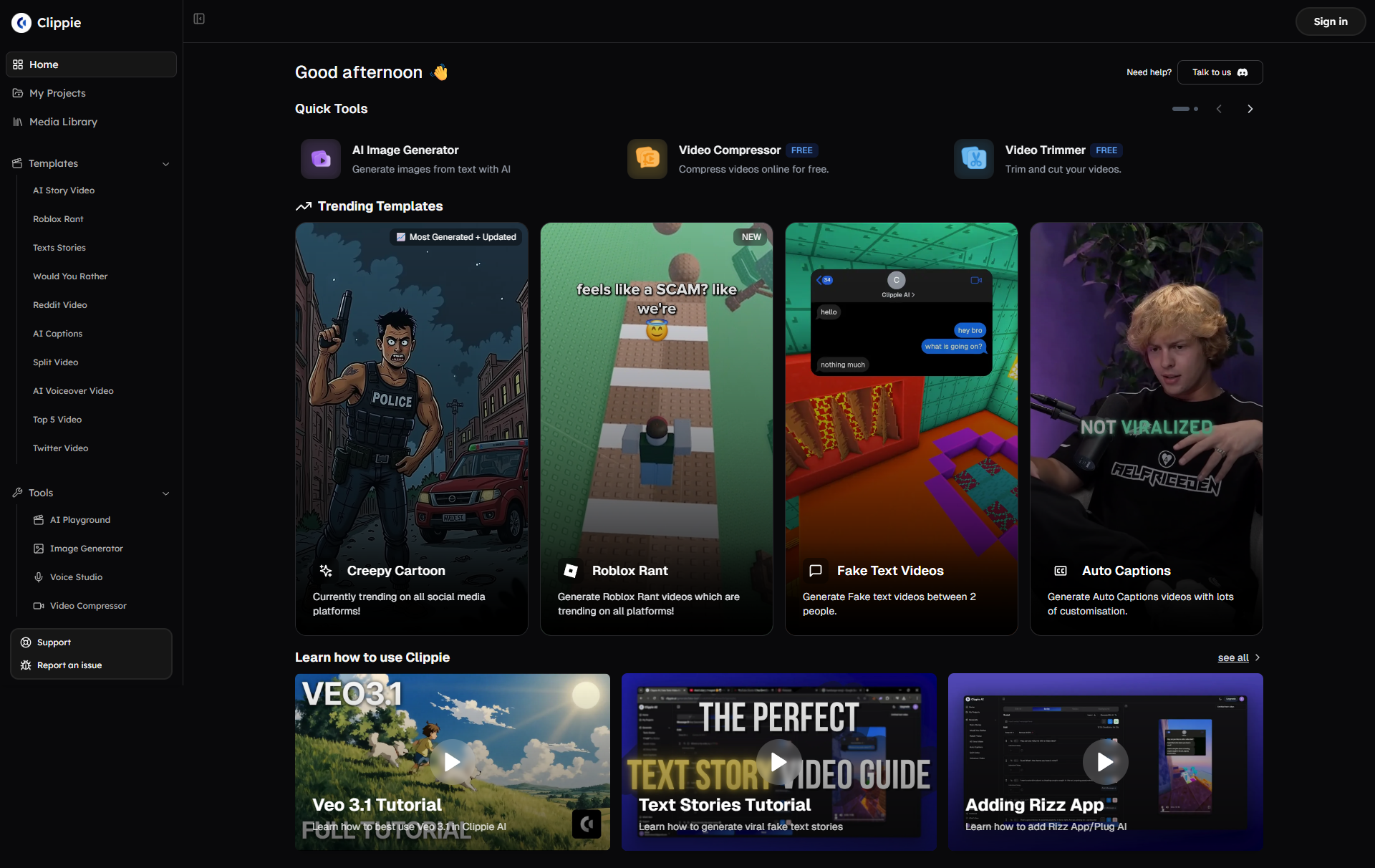
Ready to build your authority-based client acquisition system? Start your Clippie AI trial and create your first month of personal brand content today, begin the 3–6 month journey to consistent inbound clients without cold outreach, paid advertising, or personality performance.
Make an AI story video
Write a script or let AI write one. Clippie turns it into a narrated video with AI scenes, voiceover and captions.
Read more

How to Make Top 5 Ranking Videos in 2026 (Step-by-Step)
Build ranking Shorts that can still earn: pick a debatable topic, set clear criteria, source clips you may use, script the countdown, add your commentary.

How to Create Short-Form Videos Using AI: 8 Steps (2026)
A beginner workflow for AI videos on TikTok, Reels and Shorts: pick a format, script a hook, add visuals, voice and captions, export at 9:16, label AI.

7 Free CapCut Alternatives for Short-Form Video (2026)
Compare Edits, YouTube Create, VN, Clipchamp, Canva, DaVinci Resolve and Shotcut: what each gives free users, what it caps first and where it falls short.