
How to Create High-Converting AI Video Ads in 2026
Create high-converting AI video ads in 2026: What makes ads convert, structure for retention, test variations, build repeatable systems & create faster with Clippie AI.
If you're searching for how to create high-converting AI video ads in 2026, you're recognizing the performance gap separating advertisers generating $4-$9 ROAS from video campaigns (hook-engineered creatives stopping scroll in 1.5 seconds, structured retention arcs maintaining 70-85% completion rates, systematic variation testing identifying top performers before scaling, repeatable production systems generating 15-20 fresh creatives monthly) from those burning budget on underperforming static and poorly structured video ads (1-2% CTR on static equivalents vs. 3-6% on optimized video, single creative running until fatigue kills performance, no testing framework meaning budget spent on gut-instinct creative decisions, manual production bottleneck preventing the creative volume required for proper statistical optimization). This comprehensive guide reveals what actually drives video ad conversion in 2026 (the three psychological triggers separating 5% CTR creatives from 0.8% performers, the platform algorithm changes making 2024-era tactics obsolete, the creative elements responsible for 80% of conversion variance), delivers a complete ad structure framework (hook engineering capturing attention in 1.5 seconds, retention arc preventing dropout before CTA, click-trigger psychology generating action from engaged viewers), provides systematic variation testing methodology (5-variable testing framework identifying winners at $5-$10 daily budget per variation, statistical significance thresholds preventing premature scaling decisions, iteration cycles compounding performance improvements month-over-month), demonstrates repeatable system building (creative templates enabling 10 variations in 2 hours, performance documentation creating institutional knowledge, winner amplification processes scaling proven creatives before fatigue), and positions Clippie AI as the production platform enabling conversion-ready ad creation (reducing per-creative production time 70-85%, enabling batch creation of 15-20 monthly variations, maintaining brand consistency and platform optimization across all ad formats through template-based workflows).
Executive Summary: High-converting AI video ads in 2026 require four compounding systems working simultaneously: psychological conversion engineering (hook mechanisms stopping scroll through pattern interruption and curiosity gaps, retention architecture maintaining 70-85% completion rates through pacing rhythm and open loop structures, click-trigger psychology deploying loss aversion and social proof at the precise moment viewers decide to act), systematic variation testing (5-variable framework isolating which creative elements drive conversion for specific audiences, statistical validation preventing $500-$2,000 budget waste on premature scaling decisions, iteration cycles compounding 15-25% performance improvements each testing round), repeatable production systems (creative templates reducing per-variation production from 45-90 minutes to 8-12 minutes, performance documentation enabling pattern recognition across winning creatives, winner amplification protocols scaling proven performers before fatigue decay), and AI-powered production efficiency (tools like Clippie AI enabling batch creation of 15-20 monthly ad variations in 5-7 hours vs. 30-45 hours manual equivalent, maintaining platform-specific optimization across TikTok, Meta, YouTube, and Instagram simultaneously, freeing advertiser attention from technical execution for strategic creative decisions driving actual conversion improvements). Success requires abandoning the "single creative" approach (running 1-3 variations until fatigue, leaving 60-80% of potential ROAS on the table), replacing production bottlenecks with AI-assisted batch workflows (enabling the 8-10 simultaneous variations required for statistical optimization), and building institutional creative knowledge from performance data (preventing expensive re-learning cycles every campaign refresh).
Table of Contents
What Actually Makes Video Ads Convert in 2026 (And What Stopped Working)
How to Structure Video Ads for Maximum Retention and Click-Through Rate
How to Test Multiple Ad Variations Without Wasting Budget
How to Turn Your Best-Performing Ads Into a Repeatable Conversion System
How to Build Conversion-Ready Video Ads Faster With Clippie AI
Frequently Asked Questions

1. What Actually Makes Video Ads Convert in 2026 (And What Stopped Working)
The video ad landscape has undergone significant shifts since 2023. Tactics generating 4-6% CTR two years ago now struggle to break 1.5%. Understanding what changed, and why, separates advertisers who adapt and scale from those who keep optimizing the wrong variables while ROAS steadily deteriorates.
What Changed Between 2023 and 2026
Platform algorithm shifts:
Meta (Facebook/Instagram):
2023 priority: Reach and frequency (show same creative to large audiences repeatedly)
2026 priority: Engagement quality (completion rate, shares, meaningful interactions weighted 3-5x more)
Impact: Creatives optimized for impressions now penalized (low completion = algorithm suppression)
Adaptation required: Engineer for completion first, clicks second
TikTok:
2023 priority: Trend participation (trending audio, popular formats)
2026 priority: Native authenticity (content indistinguishable from organic performs 40-60% better than polished ads)
Impact: High-production ads perform worse than authentic-looking content (platform trains viewers to skip obvious ads)
Adaptation required: Match organic aesthetic, avoid "ad" visual language
YouTube:
2023 priority: Pre-roll completion (5-second hook before skip button)
2026 priority: Post-skip engagement (viewers who choose not to skip have far higher conversion intent)
Impact: Hook optimization matters more than ever (first 5 seconds determine entire campaign economics)
Adaptation required: 5-second hook must earn continued attention, not just prevent immediate skip
Google Display:
2023 priority: Remarketing frequency (show same ad until conversion)
2026 priority: Creative freshness (same creative after 7+ exposures actively hurts conversion, negative ROAS)
Impact: Creative rotation essential (not optional)
Adaptation required: Minimum 4-6 active variations in rotation at all times
Audience behavior shifts:
Ad blindness evolution:
2020: Viewers processed first 3 seconds before deciding to skip
2022: Decision made within 2 seconds
2024: Decision made within 1.5 seconds
2026: First frame (before autoplay) influences engagement decision
Implication: Creative optimization has shifted from "first 5 seconds" to "first 1.5 seconds", an 70% tighter window requiring fundamentally different hook engineering.
Trust threshold elevation:
2020: Brand logo + product shot sufficient for click consideration
2023: Social proof (review count, testimonials) required
2026: Authentic demonstration required (claims without proof dismissed immediately)
Implication: Promotional language ("best product ever," "amazing results") generates skepticism not conversion. Demonstration-first structure (show, don't tell) is now baseline expectation.
Saturation effect by format:
Talking head direct-to-camera: Oversaturated (every advertiser using this format, viewer fatigue)
Stock footage montage: Oversaturated (immediately recognizable as ad, triggers skip response)
UGC-style authentic: Undersaturated (still performing well, native platform aesthetic)
Screen recording/demonstration: Undersaturated (high information density, retains attention)
POV/first-person: Growing format (immersive, hard to ignore, novel enough to retain attention)

What Still Works (And Why It's Immune to Platform Changes)
Psychological principles unchanged since 2020:
Principle 1: Curiosity gaps drive retention
The human brain cannot tolerate unresolved questions. Ads that open a curiosity gap in the first 3 seconds and promise resolution by the end generate completion rates 40-60% higher than ads delivering complete information upfront.
Works in 2020: "I discovered something that tripled my conversion rate"
Works in 2026: Same principle, updated execution
Principle 2: Social proof eliminates risk perception
Purchase decisions involve perceived risk. Social proof (real customers, real numbers, real results) reduces perceived risk proportionally to its specificity and credibility.
Weak proof (low impact): "Thousands of happy customers"
Strong proof (high impact): "14,247 businesses increased ROAS in their first 30 days"
Principle 3: Loss aversion outperforms gain framing
Prospect theory: Losses feel approximately twice as powerful as equivalent gains. Ads framed around avoiding loss consistently outperform gain-framed equivalents.
Gain framing: "Increase your ROAS by 40%"
Loss framing: "Stop losing 40% of your ad budget to underperforming creative"
Performance difference: Loss-framed typically achieves 25-40% higher CTR
Principle 4: Specificity creates credibility
Vague claims trigger skepticism. Specific, detailed claims trigger belief, even when specificity itself can't be independently verified.
Vague: "Save time with our tool"
Specific: "Reduces editing time from 3.5 hours to 22 minutes per video"
Performance difference: Specific claims generate 35-50% higher conversion rates
What stopped working completely:
Logo intro sequences: First 3 seconds used for brand ID instead of hook (viewers gone before brand registers)
Feature lists: Audiences don't buy features, they buy outcomes (feature lists trigger rational analysis not emotional response)
Generic stock footage: Visually indistinguishable from thousands of other ads (zero differentiation = zero retention)
Promotional language without proof: "Best in class," "industry-leading," "revolutionary" (all meaningless without evidence)
Long-form brand stories: 2-minute brand narrative ads achieving 15-25% completion rates (insufficient attention economy)
2. How to Structure Video Ads for Maximum Retention and Click-Through Rate
Ad structure is the architecture determining whether psychological conversion principles get delivered to viewers or lost to dropout before they land. Even the most compelling creative elements fail if delivered after viewers have already scrolled past. This framework ensures maximum psychological impact through optimal sequencing.
The 4-Part Conversion Structure
Part 1: The Hook (0-1.5 Seconds)
The only goal: Generate the "wait, what?" response causing involuntary scroll stop
The neuroscience: The scroll decision happens in the limbic system (pre-rational, automatic) before the prefrontal cortex (conscious attention) can engage. Hooks must bypass rational evaluation entirely and trigger automatic attention response.
Hook mechanisms that trigger automatic attention:
Pattern interruption:
Unexpected visual or audio that doesn't match feed context
Examples: Unusual color combination, unexpected sound, visually jarring transition
Why it works: Brain automatically investigates anomalies (evolutionary threat detection)
Unfinished statement:
Sentence that can't be understood without watching more
Example: "The reason your ads aren't converting has nothing to do with your product..."
Why it works: Cognitive completion drive (brain needs to resolve incomplete information)
Extreme specificity:
Number or detail too specific to ignore
Example: "We spent $847,293 on video ads last year. Here's the one thing that changed everything."
Why it works: Specificity signals credibility (vague claims dismissed, specific details trigger curiosity)
Direct address:
Speak to specific identity
Example: "If you're a Shopify store owner spending $50+ daily on ads..."
Why it works: Identity recognition triggers automatic attention (brain monitors for self-references)
Hook testing priority:
Of all creative variables, hook testing delivers highest performance lift:
Same ad, different hook: Can produce 200-400% CTR variance
Hook quality determines: Whether anyone sees the rest of the creative
First optimization priority: Always test hooks before any other variable
Part 2: The Problem-Agitation (1.5-8 Seconds)
The goal: Make viewer feel the pain of their current situation acutely enough to want the solution
Why agitation matters:
Viewers don't buy solutions, they buy relief from problems. The more acutely they feel the problem during the ad, the more motivated they are to click the solution.
Problem-agitation framework:
Name the problem precisely:
Generic: "Editing videos takes too long"
Precise: "Spending 3+ hours editing a single 60-second video while your competitors post daily"
Difference: Precision creates "that's exactly me" recognition (generic creates "sort of, I guess" acknowledgment)
Quantify the cost:
Time cost: "20 hours weekly on editing that could be spent on strategy"
Money cost: "Paying $500-$800 per video to agencies eating your entire ad budget"
Opportunity cost: "Watching competitors grow while you're stuck in post-production"
Avoid over-agitation:
Spending 8-12 seconds on agitation loses viewers before solution presented
Target: 4-6 seconds maximum (enough to feel pain, not enough to disengage)
Part 3: The Solution-Demonstration (8-45 Seconds)
The goal: Show (not tell) how your product solves the exact problem just agitated
Demonstration vs. description:
Description: "Our AI automatically edits your videos in minutes"
Demonstration: Screen recording showing footage uploaded at timestamp 0:00, AI processing, polished video output at timestamp 2:47
Performance difference: Demonstration converts 3-5x better than description (removes "but does it actually work?" doubt)
Demonstration structure:
Before state (2-3 seconds):
Show problem being solved (messy timeline, manual process, frustrated creator)
Establishes relevance (this is the situation viewer is in)
Process reveal (8-15 seconds):
Show the mechanism (not just the outcome, viewers want to understand how)
Keep technical detail minimal (just enough to believe it works)
After state (5-8 seconds):
Show outcome (polished result, time stamp, measurable improvement)
Emphasize contrast with before (transformation visible, not implied)
Social proof integration (5-8 seconds):
Weave in proof at natural demonstration moment
Options: Customer result overlay, review quote, user count, before/after metric
Placement: After demonstration (viewer already believes it works, proof amplifies rather than substitutes)
Retention mechanics within demonstration:
Pacing changes every 8-12 seconds (visual variety prevents dropout)
Text overlay highlights key points (85% watching muted, captions carry narrative)
Open micro-loops: "And that's not the most impressive part..." (creates forward momentum)
Part 4: The Click Trigger (45-60 Seconds)
The goal: Convert engaged, convinced viewer into action through psychological click triggers
Why most CTAs fail:
Generic CTAs ("Shop Now," "Learn More," "Click Here") generate low click rates because they ask for action without completing the psychological conversion process. Effective CTAs deploy specific triggers at the moment of maximum engagement.
Click trigger mechanisms:
Trigger 1: Specificity of outcome
Generic CTA: "Try Clippie AI today"
Specific CTA: "Start editing 10x faster, your first video free"
Difference: Specific outcome CTA tells viewer exactly what clicking delivers (reduces uncertainty, increases confidence)
Trigger 2: Loss aversion framing
Gain CTA: "Get 20% off your first month"
Loss CTA: "Don't keep paying $800/video, get the same quality for $35/month"
Performance: Loss-framed CTAs typically achieve 25-35% higher click rates
Trigger 3: Social proof in CTA
Basic CTA: "Sign up now"
Proof CTA: "Join 47,000 creators already editing 10x faster, start free"
Effect: CTA itself provides final reassurance (others doing this = safe decision)
Trigger 4: Urgency (when authentic)
General: "Limited time offer"
Specific: "Price increases to $49.99 on March 1st, lock in $34.99 today"
Rule: Urgency only works when genuine (false urgency destroys trust if discovered)
Trigger 5: Risk reversal
Without reversal: Viewer weighs benefit against risk of wasted money
With reversal: "Start free, no credit card required" or "30-day money-back guarantee"
Effect: Eliminates primary purchase barrier (risk of being wrong)
CTA delivery:
Verbal: Say it clearly (voice reinforces visual)
Visual: Text overlay with URL or button (serves muted viewers)
Duration: CTA visible minimum 3-4 seconds (enough to read and respond)
Platform-Specific Structure Adaptations
TikTok structure (native aesthetic required):
Hook: UGC-style (phone camera, natural lighting, unpolished opening)
Problem: Conversational delivery (not scripted-sounding)
Solution: Screen recording or authentic demonstration (high credibility format)
CTA: Soft ("Link in bio" or "Comment [word] for link", hard sell performs poorly)
Total: 20-45 seconds (platform sweet spot)
Meta (Facebook/Instagram) structure:
Hook: First frame designed as still image (appears before autoplay begins)
Problem: Establish in first 3 seconds (feed scroll speed high)
Solution: Demonstration with heavy caption support (many watch without audio)
CTA: Direct ("Shop Now" button + verbal CTA + text overlay, triple reinforcement)
Total: 30-60 seconds (15 seconds for simple products, 60 for complex)
YouTube pre-roll structure:
Hook: 5 seconds MUST earn continued attention (skip button appears at 5 seconds)
Problem: 5-15 seconds post-skip (they chose to watch, now earn it)
Solution: 15-45 seconds (more detail tolerated, engaged viewer)
CTA: 45-60 seconds (companion banner + verbal + end card)
Total: 60-90 seconds (longer format justified by higher-intent audience)
3. How to Test Multiple Ad Variations Without Wasting Budget
Creative testing is the highest-ROI activity in paid advertising, consistently delivering 30-80% performance improvements when executed systematically. Most advertisers fail at testing not because they don't test, but because they test the wrong variables, with insufficient statistical rigor, at budgets too high to sustain meaningful iteration cycles.
The 5-Variable Testing Framework
Why isolate variables:
Testing multiple elements simultaneously (different hook + different CTA + different length) produces uninterpretable results, when one variation outperforms another, you can't identify which element caused the difference. Isolated variable testing creates actionable, replicable knowledge.
Variable 1: Hook testing (test first, highest impact)
Why test hooks first:
Hook quality determines: View-through rate, completion rate, overall campaign efficiency
Hook variance: Same ad with different hook can produce 200-400% CTR difference
Testing cost: Cheapest variable to test (only first 1.5-3 seconds different, minimal production)
Hook test setup:
Create 5 variations of same ad (identical from 3 seconds onwards)
Hook 1: Pain point hook ("Still spending 3 hours editing one video?")
Hook 2: Result hook ("I cut my editing time by 89% using this")
Hook 3: Curiosity hook ("The editing mistake costing creators 20 hours weekly")
Hook 4: Social proof hook ("47,000 creators switched to this, here's why")
Hook 5: Direct address hook ("Shopify store owners spending $50+ on ads, watch this")
Budget: $5-$10 daily per variation ($25-$50 total daily)
Duration: 7 days minimum (sufficient data for significance)
Total test cost: $175-$350
Winning signal: Hook with highest 3-second retention rate AND lowest CPM
Variable 2: Format testing (test second)
Format options to test:
Talking head: Creator/founder speaking directly to camera
Screen recording: Software demonstration or process walkthrough
UGC-style: Authentic customer testimonial feel
Text-on-screen: Primarily visual with text carrying narrative
Before/after: Split-screen or sequential transformation
Why format matters:
Different audiences trust different formats (B2B audiences often prefer demonstrations, consumer audiences prefer testimonials)
Platform context affects format performance (TikTok rewards native/UGC, YouTube rewards detailed demonstrations)
Format test setup:
Same message, hook, and CTA across all format variations
Test 3 formats simultaneously (wider test requires larger budget)
Budget: $8-$15 daily per variation
Duration: 14 days (format impact takes longer to manifest than hook impact)
Variable 3: Length testing (test third)
Length options:
15 seconds: Impulse purchase trigger (minimal information, strong CTA)
30 seconds: Standard consideration (hook + brief demo + CTA)
60 seconds: Full funnel (complete hook-problem-solution-CTA arc)
90 seconds: High consideration (objection handling included)
Length performance patterns:
Products under $30: 15-30 seconds typically optimal
Products $30-$100: 30-60 seconds optimal
Products $100-$500: 60-90 seconds often needed
Products $500+: 90+ seconds (high-ticket requires trust building)
Exception: Always test (audience-specific patterns override general rules)
Variable 4: CTA testing (test fourth)
CTA elements to isolate:
Offer framing: Discount vs. free trial vs. guarantee vs. risk-free
Action word: "Shop" vs. "Try" vs. "Start" vs. "Get" vs. "Claim"
Urgency: Deadline present vs. absent
Social proof: Customer count included vs. excluded
Loss vs. gain: "Stop losing..." vs. "Start gaining..."
CTA test setup:
Identical ads, only CTA section different (last 10-15 seconds)
Test winner from hook and format tests (known-performing base)
Budget: $10-$15 daily per variation
Duration: 10-14 days
Variable 5: Audience-creative matching (test last)
Why test last:
Audience testing with unoptimized creative wastes budget (can't separate audience effect from creative effect)
Test audiences only after creative optimized (hook, format, length, CTA determined)
Audience segments to test:
Interest-based: Broad interest categories relevant to product
Behavioral: Purchase behavior, device usage, content consumption
Lookalike: 1%, 2%, 5% similarity to customer list
Retargeting: Website visitors, video viewers, email list
Audience-creative matching:
Different audiences respond to different hooks (segment-specific pain points)
Once best overall creative identified: Create segment-specific versions using winning structure
Example: Same ad structure, different hook addressing segment-specific problem

Statistical Significance Requirements
Why premature scaling destroys ROAS:
Most advertisers see one variation performing 30-50% better after 3 days and immediately scale budget. In the majority of cases, early performance differences reflect random variance, not true creative superiority. Scaling random variance wastes 30-60% of budget.
Minimum data thresholds before declaring winner:
For CTR optimization:
Minimum impressions: 1,000 per variation
Minimum clicks: 50 per variation
Confidence threshold: 90%+ statistical significance
Typical timeline: 7-10 days at $5-$10 daily per variation
For conversion optimization:
Minimum conversions: 25-50 per variation
Minimum spend: $200-$500 per variation (depending on CPA)
Confidence threshold: 95%+ statistical significance
Typical timeline: 14-21 days (longer needed for lower-volume conversion events)
Practical significance check:
Even statistically significant results need practical significance:
Variation A: 2.4% CTR, Variation B: 2.6% CTR (statistically significant difference)
Practical significance: 0.2% CTR difference at $50 daily budget = 1 additional click daily
Decision: Not worth scaling, test different variable with larger potential impact
When to call a test:
Clear winner (95%+ confidence, 20%+ performance difference): Scale winner, pause losers
Inconclusive (similar performance across variations): Test different variable entirely
Clear loser emerging early (variation performing 60%+ worse): Pause early (budget conservation)
Unexpected winner (format/hook you expected to lose winning): Investigate why, insights valuable
Budget Allocation Framework
Monthly testing budget allocation:
Phase 1: Discovery testing (40% of budget)
Purpose: Finding winning hooks, formats, lengths
Budget: $5-$10 per variation daily
Variations: 5-8 running simultaneously
Output: 2-3 winning creative directions
Phase 2: Validation testing (30% of budget)
Purpose: Confirming winners with larger data sets
Budget: $15-$25 per variation daily
Variations: 2-3 confirmed winners
Output: Statistically validated top performer
Phase 3: Scaling (30% of budget)
Purpose: Maximum revenue from proven creative
Budget: Scale 20-30% every 3 days (not sudden doubling)
Variations: 1-2 validated winners in rotation
Output: Revenue generation while maintaining ROAS
Monthly budget example ($2,000 total):
Discovery: $800 (5 variations × $8/day × 20 days)
Validation: $600 (2 variations × $15/day × 20 days)
Scaling: $600 (1-2 winners × $20-$30/day × remaining days)
Expected outcome: 2-3 validated winners generating 3-6x ROAS on scaling budget
4. How to Turn Your Best-Performing Ads Into a Repeatable Conversion System
Winning ads eventually fatigue, performance decays as the same audience sees the same creative repeatedly. The difference between advertisers who maintain consistent ROAS and those who experience boom-bust performance cycles is systematic winner documentation and creative iteration, converting individual wins into replicable frameworks generating new winners on demand.
The Winner Documentation System
Why documentation creates compounding returns:
Without documentation: Every campaign refresh starts from scratch (re-learning what works at full testing cost) With documentation: Each campaign builds on previous learnings (progressive optimization, declining per-winner testing cost)
The creative knowledge base:
Create a documented record for every winning creative containing:
Creative specifications:
Hook type: (pain point / curiosity / social proof / direct address / result)
Hook text/visual: (exact content that performed)
Problem agitation: (specific pain points that resonated)
Demonstration format: (talking head / screen recording / UGC / before-after)
CTA type: (offer framing, action word, urgency element)
Length: (exact seconds)
Platform: (where it performed)
Performance data:
CTR: (click-through rate)
CPM: (cost per thousand impressions)
CPC: (cost per click)
Conversion rate: (clicks to purchases)
ROAS: (return on ad spend)
Fatigue date: (when performance dropped below acceptable threshold)
Total spend: (before scaling down)
Total revenue attributed: (lifetime value of creative)
Pattern identification:
After documenting 5-10 winners, patterns emerge:
"Pain point hooks consistently outperform curiosity hooks for our audience"
"Screen recording demonstrations generate 40% lower CPC than talking head"
"Loss-framed CTAs outperform gain-framed by 32% in our account"
"45-second ads outperform 15-second and 90-second consistently"
These patterns become creative briefs (predictive frameworks for next winner, not just documentation of last winner)
The Creative Iteration Framework
What iteration means:
Iteration is not recreating winning ads from scratch, it's systematically varying individual elements of proven winners to extend performance and find improvements.
Iteration hierarchy (most to least impactful):
Tier 1: Hook refresh (every 3-4 weeks)
Keep: Proven structure, demonstration, CTA
Change: Opening hook only (new attention trigger on same proven body)
Production time with Clippie AI: 30-45 minutes (re-record hook, batch edit)
Expected performance extension: 3-5 additional weeks from fatiguing creative
Tier 2: Angle pivot (every 6-8 weeks)
Keep: Proven format and CTA
Change: Problem framing (different pain point, same solution)
Example: Winning ad addresses "editing takes too long" → pivot to "editing costs too much"
Production time: 90-120 minutes
Expected performance: 70-90% of original winner's ROAS (new audience segment)
Tier 3: Format variation (every 8-12 weeks)
Keep: Proven message and CTA
Change: Delivery format (talking head winner → screen recording version)
Expands: Audience segments (different formats resonate with different demographics)
Production time: 3-4 hours
Expected performance: 50-80% of original (proven message in new format)
Tier 4: Full creative refresh (quarterly)
New creative direction based on accumulated pattern knowledge
Uses documented learnings as brief (not intuition)
Tests fresh hooks against previous winners
Production: Full batch session (6-8 hours with Clippie AI)
Expected performance: 80-120% of previous winners (pattern-informed)
The Creative Rotation Protocol
Why rotation prevents fatigue:
Ad fatigue occurs when the same audience sees the same creative 3-5 times (frequency). After 5+ exposures:
CTR drops 35-50% (viewer recognizes and ignores)
CPM increases 20-40% (algorithm recognizes declining engagement)
Conversion rate drops 40-60% (even engaged viewers stop converting)
Rotation framework:
Active creative pool: Always maintain 4-6 creatives in simultaneous rotation
2 proven winners (scaling budget allocation)
2 recent iterations (extending winners)
2 new tests (discovering next winners)
Rotation triggers:
Frequency alert: Average frequency exceeds 2.5 (same person saw ad 2.5 times), rotate immediately
CTR decline: Week-over-week CTR drops 25%+, introduce new creative
CPM increase: CPM rises 20%+ from baseline, creative fatigue signal
Calendar trigger: 4 weeks running same creative, rotate regardless of performance
Seasonal creative planning:
Plan creative calendar 60-90 days ahead:
Q1 (Jan-Mar): New year messaging, fresh start angles
Q2 (Apr-Jun): Spring, growth, momentum angles
Q3 (Jul-Sep): Summer, efficiency, scale angles
Q4 (Oct-Dec): Holiday, urgency, year-end angles
Advance planning with Clippie AI:
Batch-produce 8-10 creatives per quarter (single 6-8 hour production session)
Schedule releases across quarter (creative fresh throughout, no last-minute scramble)
Test immediately (4-6 weeks lead time before season peak = optimization complete before budget scales)
Scaling Validated Winners
The budget scaling protocol:
Day 1 (validation confirmed): Current budget maintained
Day 4: Increase 20-25% (algorithmic learning preserved, no reset)
Day 7: Increase 20-25% again (if performance maintained)
Day 11: Increase 20-25% (if performance maintained)
Day 15: Evaluate, continue scaling or plateau
Warning signs to pause scaling:
CPM increasing faster than budget increase (audience saturation)
ROAS declining more than 15% per scaling step
Frequency rising above 3.0 (same audience seeing too often)
Horizontal scaling (expanding reach without budget concentration):
Instead of increasing budget on single campaign:
Duplicate campaign with new audience segment
Same creative, different targeting
Maintains algorithm learning from original while expanding reach
Benefit: Higher total spend with lower saturation risk per segment
Vertical scaling (increasing spend on best-performing ad sets):
Identify top 20% of ad sets by ROAS
Concentrate budget increases on these (not uniform across all)
Pause bottom 20% performers (freed budget redistributed to top performers)
Result: Same total budget, higher weighted average ROAS
5. How to Build Conversion-Ready Video Ads Faster With Clippie AI
The production bottleneck, not strategic knowledge, is what prevents most advertisers from executing systematic creative testing. Building 8-10 variations monthly, maintaining creative rotation, and producing quarterly refreshes requires 30-50 hours of manual production time most businesses and marketers simply don't have. Clippie AI reduces this to 5-8 hours through integrated AI workflows specifically suited to ad creative production.
The Ad Creative Production Workflow
Step 1: Creative brief development (30 minutes)
Before filming, document for each ad variation:
Hook approach: (which of the 5 hook types, exact opening line)
Problem statement: (specific pain point, quantified where possible)
Demonstration point: (what feature/result to show, in what sequence)
CTA: (exact wording, offer, urgency element)
Platform target: (TikTok / Meta / YouTube, determines filming orientation and length)
Length target: (15 / 30 / 60 / 90 seconds)
Brief output: 8-10 documented ad variations ready to film efficiently
Step 2: Batch filming session (90-120 minutes, produces 8-10 raw variations)
Setup (15 minutes, one-time per session):
Camera/phone in position (vertical for TikTok/Instagram, horizontal for YouTube)
Lighting optimized (natural window light or ring light, consistent across all takes)
Background clean and on-brand
Screen recording software ready (OBS or built-in) for demonstration segments
Filming protocol (75-105 minutes):
Film all hooks consecutively (5 variations × 3 takes each = 15 hook clips in 20 minutes)
Film all problem-agitation segments (same issue, film all at once = 20 minutes)
Screen record all demonstration segments (systematic capture of all product moments = 30 minutes)
Film all CTA segments (all variations in sequence = 15 minutes)
Output: All raw components for 8-10 variations captured
Efficiency principle: Modular filming (each section filmed independently) enables Clippie AI to assemble variations without re-filming, one filming session generates material for 3-4x the variations
Step 3: Clippie AI batch processing (10-15 minutes autonomous)
Upload:
Import all raw components to Clippie AI (batch upload, 2-3 minutes)
Organize by variation (folder structure or project labels)
Template application:
Select "Ad Creative" template (pre-configured for platform requirements)
Platform-specific versions automatically configured (TikTok 9:16, Meta 1:1 and 9:16, YouTube 16:9)
Brand elements pre-loaded (intro, outro, logo placement, color grade)
AI processing (10-15 minutes, all variations simultaneously):
Clippie AI applies across all variations concurrently:
Silence and filler removal (tightens pacing, increases completion rate)
Caption generation in brand style (serves 85% muted viewers)
Audio normalization (consistent levels across all variations)
Multi-platform version creation (all aspect ratios from single master)
Hook-to-body assembly (modular components assembled per brief)
CTA overlay application (text, URL, brand elements)
Use processing time for: Updating performance documentation, reviewing analytics, planning next test cycle
Step 4: Conversion optimization review (8-12 minutes per variation)
Critical human judgment layer:
Hook timing: Verify hook completes within 1.5 seconds (trim if running long)
Caption accuracy: Fix 1-3 AI errors typical per variation (especially for numbers, product names)
CTA visibility: Confirm CTA text overlay visible for minimum 3-4 seconds
Platform crop: Verify no critical elements cut off in platform-specific versions
Pacing feel: Check that silence removal hasn't created unnatural speech rhythm
Brand consistency: All brand elements correctly positioned per platform
Step 5: Launch and tracking setup (20-30 minutes total)
Upload all variations to ad platform (Meta Ads Manager, TikTok Ads, Google Ads)
Create test campaign structure (each variation in separate ad set, isolates performance data)
Set UTM parameters (tracks each variation's performance in analytics)
Configure tracking events (purchase, add-to-cart, sign-up, depends on conversion goal)
Set budget caps (prevents overspend before optimization confirms winner)
Document in creative knowledge base (variation details recorded before performance data available)
Total production time per batch (8-10 variations):
Brief development: 30 minutes
Batch filming: 100 minutes
AI processing: 12 minutes autonomous
Review and refinement: 80 minutes (8 variations × 10 min)
Launch and tracking: 25 minutes
Total active time: 4 hours 7 minutes for 8-10 conversion-ready ad variations
Manual production equivalent: 8 variations × 60-90 minutes = 8-12 hours
Time reduction: 65-75%
Clippie AI Features Specific to Ad Creative Production
Feature: Multi-platform export = single production, all placements covered
Every ad needs platform-specific versions:
TikTok: 9:16 vertical, 1080×1920, captions prominent
Instagram Feed: 1:1 square, 1080×1080
Instagram Stories/Reels: 9:16 vertical, 1080×1920
Facebook Feed: 16:9 horizontal, 1920×1080
YouTube Pre-roll: 16:9 horizontal, 1920×1080
Manual creation: 5 platform versions × 45 minutes = 225 minutes per creative
Clippie AI: All 5 versions from single master file = 5-10 additional minutes per creative
Monthly savings (10 creatives × 5 platforms): 2,125 minutes = 35+ hours
Feature: Caption generation = muted viewer conversion
85% of social media video watched without audio. Captions convert muted viewers:
Manual captioning: 15-20 minutes per variation
Clippie AI caption generation: 2-3 minutes (95-98% accuracy)
Per batch savings (8 variations): 100-136 minutes = 1.7-2.3 hours
Feature: AI image generation = thumbnail A/B testing
YouTube ad thumbnails dramatically impact CTR before video plays:
Manual thumbnail creation: 20-30 minutes per option
Clippie AI image generation: 3-5 minutes per option (100-1,000 images per plan)
A/B test 5 thumbnail options: 15-25 minutes vs. 100-150 minutes manual
Clippie AI Plans for Ad Creative Production
Clippie Lite ($19.99/month):
30 minutes video export
30 minutes AI voice generation
30 minutes speech to subtitles
Captions in 102+ languages
50+ AI voices
100 AI images
1 custom voice
Best for: Small businesses testing video ads (3-5 variations monthly)
Clippie Creator ($34.99/month):
120 minutes video export
120 minutes AI voice generation
120 minutes speech to subtitles
Captions in 102+ languages
50+ AI voices
500 AI images
10 custom voices
Best for: Active advertisers running systematic creative testing (8-15 variations monthly)
Recommended: Ideal for most businesses scaling paid video advertising
Clippie Pro ($69.99/month):
250 minutes video export
250 minutes AI voice generation
250 minutes speech to subtitles
Captions in 102+ languages
50+ AI voices
1,000 AI images
30 custom voices
Best for: Agencies and high-volume advertisers managing multiple accounts (20-40+ variations monthly)
ROI calculation (Creator plan, $2,000 monthly ad spend):
Plan cost: $34.99 monthly
Creative variations enabled: 15 monthly (vs. 3-4 manual)
ROAS improvement from systematic testing: 40-80% (industry benchmark for proper creative testing)
Additional monthly revenue: $800-$1,600 (40-80% of $2,000 baseline revenue)
ROI on Clippie AI subscription: 2,286-4,572%
Start building conversion-ready video ads today at clippie.ai.
6. Frequently Asked Questions
How many ad variations should I be running simultaneously?
Answer: Most businesses should run 5-8 active ad variations simultaneously at minimum, with fewer than 5 providing insufficient data for meaningful optimization decisions (can't identify patterns from 2-3 data points), more than 12 spreading budget too thin for individual variations to reach statistical significance quickly, with the optimal number determined by daily budget (minimum $5-$10 per variation daily to generate actionable data within 7-14 days) and campaign objective (CTR optimization requires fewer variations and less spend than conversion optimization requiring 25-50 purchases per variation for statistical confidence)
Variation count by budget:
$50/day total budget:
Maximum variations: 5 ($10/day each, minimum viable spend)
Recommended: 3-4 variations ($12-$17 each, faster to significance)
Test priority: Hook variations only (highest impact variable at this budget)
$100/day total budget:
Maximum variations: 10 ($10/day each)
Recommended: 6-8 variations ($12-$17 each)
Test priority: Hook + format variables simultaneously
$200/day total budget:
Maximum variations: 15-20 ($10-$15/day each)
Recommended: 10-12 variations (optimal testing volume)
Test priority: All 5 variables testable simultaneously
$500+/day total budget:
Full testing framework possible (all variables, audience segments, platform-specific versions)
Recommended: 15-20 variations across multiple objectives and platforms
Scaling budget available alongside testing budget
Common mistakes:
Running 1-2 variations: No comparative data (can't improve what you can't compare)
Running 20+ variations at low budget: Each variation starved of data (takes months to reach significance)
Changing multiple variables simultaneously: Can't attribute performance differences to specific changes
The variation math: At $10/day per variation, reaching 1,000 impressions per variation (minimum CTR significance threshold):
CPM of $8: 1,000 impressions = $8 = less than 1 day
CTR significance: 50 clicks needed = approximately 7-10 days at 1,000 daily impressions per variation
Practical timeline: 7-10 days to first meaningful performance data per variation
What's the biggest mistake advertisers make with video ad creative?
Answer: The single most costly mistake is running the same creative until performance collapses rather than proactively rotating before fatigue, causing the account to experience boom-bust ROAS cycles where strong initial performance (week 1-2 at 4-6x ROAS) gradually decays to unprofitable performance (week 5-8 at 1-2x ROAS) as frequency rises and engagement drops, with the compounding damage of algorithm penalties for declining engagement metrics taking 2-4 weeks to recover from even after new creative introduced, meaning proactive rotation maintains consistent ROAS while reactive rotation experiences unavoidable performance valleys between creative cycles
The fatigue decay timeline:
Week 1-2 (fresh creative):
Frequency: 1.0-1.5 (most viewers seeing for first time)
CTR: Peak performance (3-5% for optimized video)
CPM: Lowest (algorithm rewards engagement)
ROAS: 4-7x (optimal performance window)
Week 3-4 (early fatigue):
Frequency: 2.0-2.8 (significant percentage on second+ exposure)
CTR: 15-25% decline from peak
CPM: 10-20% increase (algorithm detects declining engagement)
ROAS: 3-5x (still profitable but declining)
Week 5-6 (active fatigue):
Frequency: 3.0-4.0 (most audience seen multiple times)
CTR: 35-50% decline from peak
CPM: 25-40% increase
ROAS: 1.5-3x (approaching break-even)
Week 7-8 (severe fatigue):
Frequency: 4.0+ (audience exhausted)
CTR: 50-70% decline from peak
CPM: 40-60% increase
ROAS: Below 1.5x (unprofitable)
The algorithm penalty:
When creative fatigues severely before replacement:
Algorithm associates account with low-engagement content
New creative introduced into "penalized" campaign environment
Takes 2-4 weeks for algorithm to re-establish positive engagement signals
Cost: 2-4 weeks of suboptimal performance on fresh creative
Proactive rotation protocol:
Set frequency alert at 2.5 (not 3.5, intervene before fatigue, not after)
Introduce new creative at frequency 2.5 (while original still performing)
Transition budget gradually (don't cut original immediately, let data confirm new creative)
Result: Performance trough avoided, consistent ROAS maintained throughout transition
How long does it take to build a complete video ad testing system from scratch?
Answer: A functional video ad testing system, covering creative production workflow, testing framework, performance documentation, and rotation protocol, takes 4-6 weeks to fully establish from scratch (week 1: production workflow and first batch of 5-8 variations, week 2-3: first testing cycle generating initial performance data, week 4: winner identification and documentation system, week 5-6: first iteration cycle proving system works end-to-end), with Clippie AI reducing the production component from the primary bottleneck to the fastest part of the process, enabling focus on the higher-value strategic decisions (which variables to test, how to interpret results, when to scale) that determine long-term system performance
Week-by-week build timeline:
Week 1: Production foundation
Set up Clippie AI account and create first ad template (2 hours)
Develop creative brief for 5-8 initial variations (1 hour)
Batch film all variations (2 hours)
Process through Clippie AI and review (2 hours)
Launch first test campaign with proper tracking (1 hour)
Time investment: 8 hours
Output: First 5-8 variations live, testing clock started
Week 2-3: Data collection
Monitor daily (15 minutes per day): Check for early losers to pause
No major decisions yet (insufficient data)
Begin creative knowledge base document (30 minutes)
Plan iteration variations based on emerging patterns (30 minutes)
Time investment: 4-5 hours across 2 weeks
Output: First statistically meaningful performance data
Week 4: Winner identification
Analyze full results (1 hour)
Document winners in creative knowledge base (30 minutes)
Identify patterns (which hook type won, which format performed)
Brief first iteration batch (30 minutes)
Time investment: 2 hours
Output: First documented winners, first pattern insights
Week 5-6: Iteration cycle
Produce iteration batch based on winner patterns (3-4 hours with Clippie AI)
Launch iteration test alongside scaling original winner (1 hour)
Begin seeing compound improvement (iteration informed by documented learnings)
Time investment: 5-6 hours
Output: System fully operational, compounding improvement beginning
Total build investment: 19-21 hours over 6 weeks
System ongoing maintenance:
Weekly: 1 hour (monitor performance, update documentation)
Monthly: 4-6 hours (new creative batch, iteration cycle, performance review)
Quarterly: 6-8 hours (full creative refresh, deep pattern analysis, strategy adjustment)
Expected performance trajectory:
Week 1-2: Baseline ROAS established (2-4x typical starting point)
Week 4-6: First optimizations showing 15-25% ROAS improvement
Month 3: Compound improvements generating 40-70% ROAS above baseline
Month 6: Documented pattern library enabling consistent winner production
Month 6 target: 4-8x ROAS on optimized creative (vs. 2-4x uninformed baseline)
Conclusion: Building a Video Ad System That Compounds
High-converting AI video ads in 2026 emerge from systematic execution across four compounding systems, psychological engineering (hook mechanisms stopping scroll through pattern interruption and curiosity gaps in 1.5 seconds, retention architecture maintaining 70-85% completion rates through pacing rhythm and open loop structures, click-trigger psychology deploying loss aversion and social proof at peak engagement moments), structured variation testing (5-variable isolated testing framework identifying winning elements at $175-$350 test cost before scaling, statistical significance thresholds preventing the premature scaling decisions wasting 30-60% of budgets, iteration cycles compounding 15-25% performance improvements each testing round toward 4-8x sustainable ROAS), repeatable production systems (creative templates enabling 8-10 variations in 4 hours vs. 8-12 hours manual, performance documentation converting individual wins into predictive creative frameworks, proactive rotation protocols maintaining consistent ROAS by preventing fatigue valleys costing 2-4 weeks of suboptimal performance), and AI-powered production infrastructure enabling the creative volume systematic optimization requires.
The video ad system implementation roadmap:
Week 1-2: Production foundation (establishing Clippie AI workflow enabling 8-10 variation batch production in 4 hours, creating first ad creative template with brand elements and platform-specific presets, filming and launching first systematic test with 5-8 hook variations, setting up creative knowledge base for performance documentation)
Week 3-4: Testing discipline (resisting premature scaling decisions before statistical significance thresholds met, monitoring frequency and CTR decline signals indicating early fatigue, documenting all performance data against creative specifications, identifying first winner and beginning iteration brief)
Month 2: Iteration and scaling (producing first iteration batch informed by documented winner patterns, scaling validated winners using 20-25% progressive budget increases, introducing horizontal scaling to expand reach without single-audience saturation, beginning to see compound improvements from pattern-informed creative decisions)
Month 3-6: System maturity (creative knowledge base containing 10-15 documented winners enabling pattern recognition, quarterly refresh cycles producing 80-120% of previous winner performance through brief-informed production, consistent 4-8x ROAS sustained through proactive rotation preventing fatigue valleys, Clippie AI-powered production maintaining creative freshness at 5-8 monthly hours vs. 30-50 manual)
Choose Clippie AI if you want:
Creative volume enabling systematic testing (8-10 variation batch production in 4 hours enabling the statistical optimization impossible with 1-3 manual creatives, monthly variation output of 15-20 maintaining rotation freshness preventing the fatigue decay costing 40-70% ROAS)
Platform-complete production (multi-platform export creating TikTok, Meta, Instagram, and YouTube versions from single master file, eliminating 35+ monthly hours of manual platform-specific production)
Professional quality at testing speed (AI silence removal, caption generation, audio normalization, and brand element application producing broadcast-quality ad variations in minutes rather than hours per creative)
Compound system building (template infrastructure enabling creative briefs to become finished ads efficiently, batch workflows making quarterly refresh cycles feasible alongside ongoing testing, production consistency supporting the documentation systems that create compound performance improvements over time)
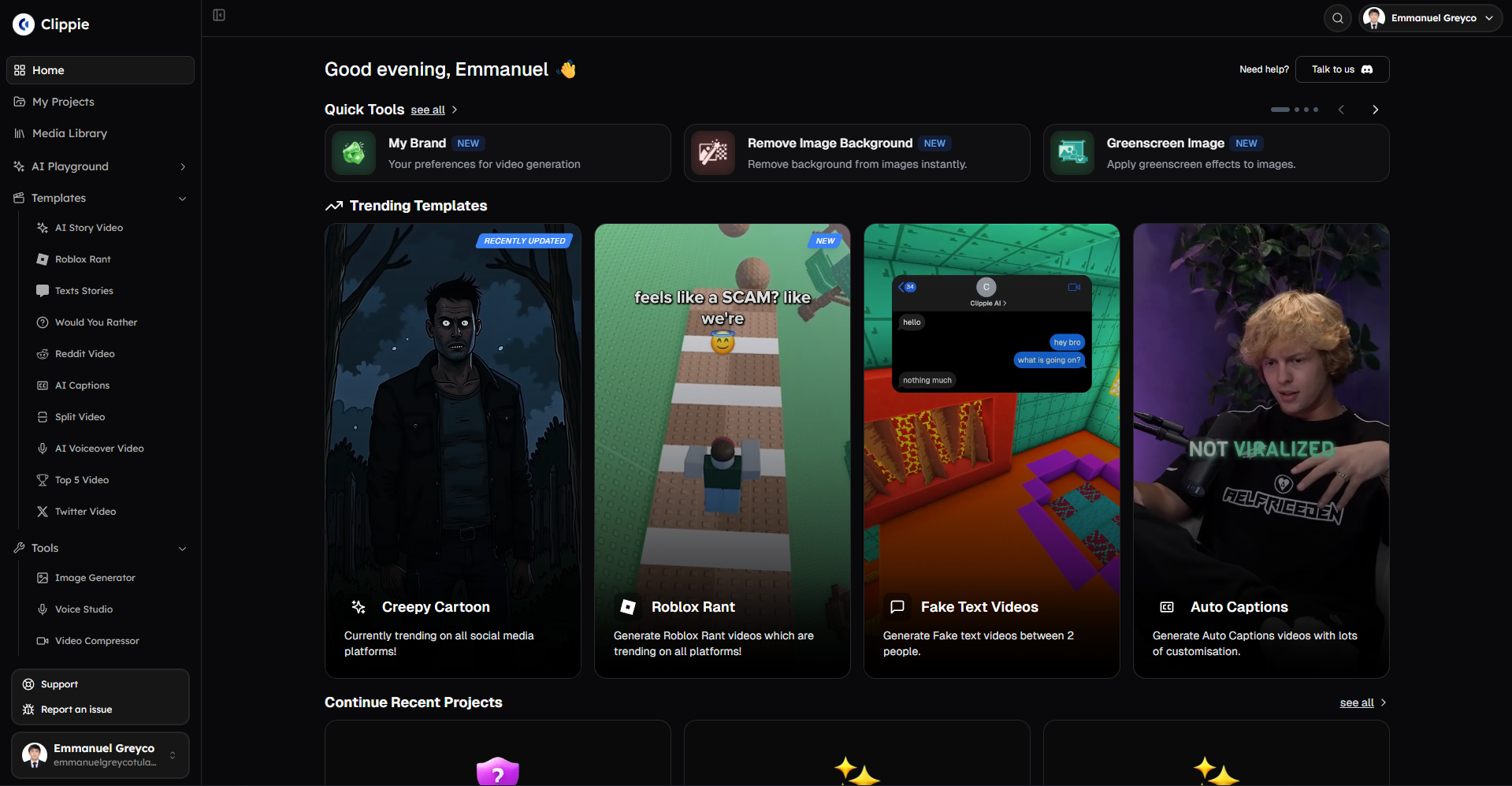
For advertisers at every stage, whether spending $500 monthly on first video campaigns, scaling $5,000 monthly budgets demanding consistent creative rotation, or managing agency accounts across multiple clients requiring simultaneous multi-account production, systematic video ad creation through Clippie AI removes the production constraint preventing proper creative testing: the 30-50 monthly hours required to produce sufficient variation volume for statistical optimization. Visit clippie.ai to explore how AI-powered production infrastructure enables the creative velocity required to build compounding ad systems generating consistent 4-8x ROAS from tested, iterated, and systematically optimized video creative.
Make an AI story video
Write a script or let AI write one. Clippie turns it into a narrated video with AI scenes, voiceover and captions.
Read more

How to Create Short-Form Videos Using AI: 8 Steps (2026)
A beginner workflow for AI videos on TikTok, Reels and Shorts: pick a format, script a hook, add visuals, voice and captions, export at 9:16, label AI.
7 Free CapCut Alternatives for Short-Form Video (2026)
Compare Edits, YouTube Create, VN, Clipchamp, Canva, DaVinci Resolve and Shotcut: what each gives free users, what it caps first and where it falls short.

Pictory vs Clippie AI (2026): Which Fits Your Video Workflow?
Compare Pictory and Clippie AI on workflow, 2026 pricing, voices and templates to see which one suits article repurposing and which suits faceless shorts.