
How to Become a Freelance Video Editor in 2026
Become freelance video editor 2026: Remote editing opportunities, high-paying niches, portfolio building from scratch, landing first clients & AI-powered efficiency with Clippie.

If you're searching for how to become a freelance video editor in 2026, you're entering a transformed marketplace where traditional barriers (requiring $2,000-$5,000 in professional software and equipment, spending 6-12 months learning complex editing systems, needing local client networks or agency connections for work opportunities) have been eliminated through technological democratization (Clippie AI enabling professional editing at $35/month vs. $660 annually for Adobe Creative Cloud, 2-4 week learning curves replacing 6-12 month mastery requirements, global remote platforms connecting editors with clients worldwide eliminating geographic limitations). This comprehensive guide explains why remote video editing became remarkably accessible (AI automation handling technical complexity allowing focus on creative decisions, cloud-based workflows enabling collaboration from anywhere, exploding creator economy generating insatiable demand for 50M+ content creators needing editing support), identifies most lucrative editing specializations (short-form content editing commanding $30-$100 per video with 15-25 monthly client demand, podcast clip creation generating $1,200-$2,500 monthly retainers processing 40 clips per podcaster, YouTube content editing earning $150-$500 per 10-minute video with established creators), provides systematic portfolio building strategies (creating 5-8 spec projects demonstrating capabilities across formats, offering free test edits to 10-15 small creators converting 40-60% to paying clients, documenting before/after transformations proving value proposition), delivers proven client acquisition frameworks (Upwork profile optimization increasing proposal acceptance rates 15-30% vs. generic applications, direct creator outreach on TikTok/Instagram converting 20-40% of personalized messages to discovery calls, portfolio-based cold email generating 8-15% response rates when showcasing relevant work), and offers AI-powered scaling systems (Clippie AI reducing editing time 70-85% enabling 40-60 monthly client videos vs. 15-20 manual capacity, template libraries ensuring quality consistency across high-volume output, batch processing workflows completing week's projects in single focused sessions).
Executive Summary: Freelance video editing in 2026 offers accessible entry earning $2,000-$8,000 monthly within 3-6 months through AI-assisted workflows (Clippie AI enabling professional output after 2-4 weeks practice vs. traditional 6-12 month learning curves), strategic niche focus (specializing in high-demand short-form content, podcast clips, or YouTube videos commanding premium rates vs. competing as generalists), and systematic client acquisition (Upwork optimization, direct outreach, portfolio-based marketing generating 5-15 monthly clients at $200-$800 each within first 6 months). The competitive advantages of AI-native freelance editors, producing client-ready work 70-85% faster enabling competitive pricing while maintaining healthy profit margins, specializing in scalable formats amenable to template-based workflows vs. bespoke cinematic projects, building sustainable businesses through retainer relationships and systematic delivery vs. project-to-project uncertainty, create opportunities for $50,000-$100,000 annual income within 18-24 months despite starting with zero experience or equipment beyond smartphone and laptop. Success requires rejecting perfectionism paralysis (waiting until "ready" before taking clients delays income 3-6 months unnecessarily), outdated skill-acquisition models (mastering every Adobe Premiere feature before specializing wastes time on irrelevant capabilities), and underpricing fears (charging $30-$50 per video initially while building skills, raising to $75-$150 within 3-6 months as efficiency and portfolio improve), with realistic expectations that first paid project arrives within 2-4 weeks of focused portfolio building and outreach, $1,000 monthly income achievable by month 2-3 with 3-5 active clients, and $3,000-$5,000 monthly sustainable by month 6-8 through client retention and systematic prospecting maintaining healthy pipeline.
Table of Contents
Why Remote Video Editing Jobs Are More Accessible Than Ever
The Most In-Demand Video Editing Niches (And What They Pay)
How to Build a Video Editing Portfolio From Scratch
Where to Find Your First Video Editing Clients Online
How to Edit More Videos in Less Time Using AI Tools
Frequently Asked Questions
1. Why Remote Video Editing Jobs Are More Accessible Than Ever
The Democratization of Professional Editing Tools
Traditional editing barriers (2010-2020):
Software costs:
Adobe Premiere Pro: $239.88 annually (single app) or $659.88 annually (Creative Cloud All Apps)
Final Cut Pro: $299.99 one-time (Mac only, requires expensive Mac computer)
Avid Media Composer: $239.88 annually (industry standard, steep learning curve)
Total annual software: $240-$660 (before computer, plugins, stock footage)
Hardware requirements:
Professional editing computer: $1,500-$3,000 (high RAM, powerful GPU, fast storage)
External storage: $200-$500 (4-8TB for project files and footage)
Monitor: $300-$800 (color-accurate display for professional work)
Total hardware: $2,000-$4,300
Learning curve:
Software mastery: 6-12 months (hundreds of YouTube tutorials, trial and error)
Industry techniques: 12-24 months (color grading, audio mixing, motion graphics)
Client-ready proficiency: 18-36 months total (before feeling confident taking paying work)
Total barrier to entry: $2,240-$4,960 + 18-36 months learning (prohibitive for most beginners)
2026 AI-assisted reality:
Software costs:
Clippie AI: $34.99 monthly ($419.88 annually) (professional editing with AI assistance)
OR DaVinci Resolve: $0 (free, professional-grade alternative)
Total annual software: $0-$420 (36-100% reduction)
Hardware requirements:
Modern laptop: $500-$1,200 (already own for most people, sufficient for cloud-based AI editing)
Cloud storage: $60-120 annually (Google Drive, Dropbox, cheaper than external drives)
Total hardware: $0-$1,200 (if already own laptop, zero additional investment; 60-75% reduction vs. traditional)
Learning curve:
AI-assisted editing basics: 2-4 weeks (Clippie AI handles technical complexity, focus on creative decisions)
Client-ready proficiency: 6-12 weeks (AI compensates for skill gaps, templates provide structure)
Specialization mastery: 3-6 months (focused niche expertise vs. generalist knowledge)
Total barrier to entry: $0-$1,620 + 6-12 weeks learning (85-95% cost reduction, 75-90% time reduction)
Why AI changes everything:
Traditional editing workflow (60-minute video edit):
Import and organize footage (10 min)
Watch all footage, select best takes (45 min)
Rough cut assembly (30 min)
Fine-tune timing and pacing (25 min)
Color correction (20 min)
Audio mixing and enhancement (15 min)
Add graphics, titles, transitions (20 min)
Export and quality check (10 min)Total: 175 minutes (2 hours 55 minutes)
AI-assisted workflow with Clippie AI (same video):
Import footage to Clippie AI (2 min)
AI automatically:
Selects best takes (analyzes audio/video quality, removes silence, 2 min autonomous)
Creates rough cut (assembles based on narrative flow, 3 min autonomous)
Applies color correction (consistent color grade, 1 min autonomous)
Enhances audio (removes noise, normalizes levels, 1 min autonomous)
Human review and creative refinement (20 min, approve AI suggestions, make creative adjustments)
Add custom graphics if needed (5 min, using templates)
Export (2 min)Total: 36 minutes (79% time reduction)
Skill implications:
Traditional: Must learn color theory, audio engineering, motion graphics (months of study)
AI-assisted: AI handles technical execution (focus on storytelling, pacing, client communication)
Result: Can take paying clients after weeks, not years
Economic impact for freelancers:
Scenario: Beginner freelance editor, 20 hours weekly availability
Traditional approach:
Learning phase: 18-24 months before client-ready
First-year income: $0 (still learning)
Second-year income: $12,000-$24,000 (first paying clients, low rates, low volume)
Two-year total: $12,000-$24,000
AI-assisted approach:
Learning phase: 6-12 weeks before client-ready
Month 1-2 income: $0-$800 (learning + first clients)
Month 3-6 income: $1,500-$3,000 monthly (building client base)
Month 7-12 income: $3,000-$6,000 monthly (established)
First-year total: $15,000-$35,000
Second-year: $36,000-$72,000 (mature business)
Two-year total: $51,000-$107,000
Income advantage: $39,000-$83,000 more (325-692% higher earnings through faster entry and AI efficiency)
The Creator Economy Explosion (50M+ Creators Need Editors)
Content creator growth:
2020 statistics:
Active content creators: 15-20 million globally (YouTube, TikTok, Instagram combined)
Creators hiring editors: 5-10% (~1 million)
Editor demand: 1 million creators ÷ 200,000 freelance editors = 5 creators per editor
2026 statistics:
Active content creators: 50-75 million globally (massive platform expansion)
Creators hiring editors: 15-25% (professionalization, monetization incentives)
Editor demand: 12.5 million creators ÷ 500,000 freelance editors = 25 creators per editor
Key insight: Demand grew 5x while supply grew 2.5x = undersupplied market favoring editors
Why creators outsource editing:
Reason 1: Time constraints (most common)
Successful creator typical workload:
Content ideation and scripting: 5-8 hours weekly
Filming: 8-12 hours weekly
Editing (if doing themselves): 15-25 hours weekly
Community engagement: 5-8 hours weekly
Business/admin: 3-5 hours weekly
Total: 36-58 hours weekly (unsustainable, burnout risk)
Outsourcing editing:
Editing time eliminated: 15-25 hours weekly freed
Cost: $800-$3,000 monthly (hiring editor)
Value proposition: Creator focuses on ideation and filming (highest-value activities), editor handles time-intensive editing
Reason 2: Skill gap
Many creators are performers, not technicians (charismatic on camera, weak editing skills)
Learning to edit = 6-12 months (diverts from content creation)
Solution: Outsource editing from day one (focus on strengths)
Reason 3: Quality improvement
Professional editor: Better pacing, retention, polish (measurably improves video performance)
Creator self-editing: Often "good enough" but not optimized (leaves views/revenue on table)
ROI calculation:
Hiring editor: $2,000 monthly
Video performance improvement: 20-40% better retention (algorithm promotes more)
Revenue increase: $3,000-$8,000 monthly (from better reach)
Net gain: $1,000-$6,000 monthly (hiring editor pays for itself and more)
Market segmentation (opportunities across creator sizes):
Micro-creators (1,000-10,000 followers):
Total: 35-40 million creators globally
Hiring editors: 5-10% (1.75-4 million potential clients)
Budget: $100-$400 monthly (3-8 videos at $30-$50 each)
Opportunity: High volume, lower rates, good for building portfolio
Mid-tier creators (10,000-100,000 followers):
Total: 8-12 million creators
Hiring editors: 20-35% (1.6-4.2 million potential clients)
Budget: $500-$2,000 monthly (8-20 videos at $60-$100 each)
Opportunity: Sweet spot (affordable for them, profitable for you)
Established creators (100,000-1M followers):
Total: 500,000-1 million creators
Hiring editors: 60-80% (300,000-800,000 potential clients)
Budget: $2,000-$8,000 monthly (20-40 videos at $75-$200 each or retainer)
Opportunity: High-paying but competitive (need strong portfolio to land)
Top-tier creators (1M+ followers):
Total: 50,000-100,000 creators
Hiring editors: 90-95% (47,500-95,000 potential clients)
Budget: $5,000-$30,000 monthly (in-house team or premium freelancers)
Opportunity: Extremely lucrative but requires proven track record (year 2-3+ goal)
Strategic insight: Start with micro and mid-tier creators (abundant opportunities, less competition), build portfolio and skills, graduate to established creators within 6-12 months for higher rates

Remote Work Infrastructure (Work From Anywhere)
Geographic arbitrage opportunity:
Traditional location-dependent editing:
Must live in production hub (LA, NYC, London, expensive cities)
Cost of living: $2,500-$5,000+ monthly (rent alone in these markets)
Competing locally: Saturation (thousands of editors in LA/NYC)
Economic pressure: Need $5,000-$8,000 monthly income just to survive (high baseline)
Remote freelance editing (2026):
Work from anywhere: Thailand ($800 monthly living cost), Mexico ($1,200), Portugal ($1,500), US small town ($1,800)
Cost of living: $800-$2,500 monthly (50-75% reduction vs. production hubs)
Competing globally: Access to worldwide clients (not limited to local market)
Economic advantage: $2,000 monthly income = comfortable living (low baseline, high profit margin)
Real example: Editor in Bali, Indonesia
Monthly income: $4,500 (editing for US/UK creators, paid in USD/GBP)
Cost of living: $1,200 monthly (nice apartment $500, food $300, coworking $100, lifestyle $300)
Net savings: $3,300 monthly (73% savings rate vs. ~20% in LA)
Annual savings: $39,600 (builds wealth rapidly, options to invest, travel, or reduce hours)
Remote work tools enabling this:
Cloud collaboration:
Google Drive, Dropbox: Client uploads raw footage (you download anywhere with internet)
Frame.io, Wipster: Real-time feedback and approval (client reviews without in-person meetings)
Slack, Zoom: Communication (async and sync, no office needed)
Workflow:
Client sends raw footage via Dropbox link (overnight upload)
You download and edit (anywhere with laptop and internet)
Upload edited video to Frame.io (client reviews with timestamp comments)
Revisions completed and final export sent
Invoice via PayPal/Wise (international payment, no bank account issues)
Internet requirements:
Minimum: 25 Mbps download, 10 Mbps upload (sufficient for HD video)
Available: Most cafes, coworking spaces, and apartments globally ($30-$100 monthly)
Not a barrier: Even developing countries have adequate internet in cities/towns
Timezone considerations:
Advantage: Async work
Editing doesn't require real-time collaboration (work your hours, client reviews theirs)
Example: You in Thailand (GMT+7), client in California (GMT-8) = 15-hour difference
You edit 9 AM-5 PM Thailand time (client sleeping)
Upload finished video 5 PM Thailand (6 AM California)
Client reviews 9 AM-5 PM California (midnight-8 AM Thailand, you're sleeping)
Client feedback waiting when you wake up, implement, repeat
Result: 24-hour production cycle (async advantage, faster turnaround than local 9-5 editor)
Occasional sync meetings:
Schedule 1-2 hours of overlap (you early morning, them evening, or vice versa)
Use calendar tools (Calendly showing availability in their timezone)
Frequency: Once weekly or bi-weekly (most communication async via Slack/email)
Bottom line: Remote freelance editing enables global client access from low-cost-of-living locations, dramatically improving quality of life and savings rate while maintaining or increasing income vs. traditional location-dependent editing careers
2. The Most In-Demand Video Editing Niches (And What They Pay)
Short-Form Content Editing ($30-$100 per video, 15-25 monthly demand per creator)
Market demand drivers:
Platform prioritization:
TikTok: 1 billion+ monthly active users (aggressive algorithm promoting short-form)
Instagram Reels: 2 billion+ monthly users (Meta investing heavily in competing with TikTok)
YouTube Shorts: 2 billion+ monthly users (YouTube's fastest-growing format)
Creator response: Must post short-form to remain relevant (algorithm penalizes those who don't adapt)
Volume requirements:
Algorithm favor: Posting 3-7x weekly (15-30 monthly videos needed for consistent reach)
Creator capacity: Most can't edit 15-30 monthly videos themselves (3-7 hours weekly just editing)
Outsourcing necessity: Hiring editor becomes requirement, not luxury (enables sustainable pace)
What short-form editing entails:
Typical deliverable (60-second TikTok/Reel):
Raw footage: 2-5 minutes (creator films multiple takes, you select best)
Your work:
Select best takes and assemble (5 min)
Cut to 60 seconds maintaining energy (8 min)
Add auto-captions (2 min with AI, 10 min manual)
Sync to trending audio if applicable (3 min)
Insert B-roll or graphics (5 min)
Color correct and export (2 min)
Total time: 25 minutes per video (with AI assistance via Clippie AI)
Manual time: 45-60 minutes (without AI, slower, less competitive)
Pricing structure:
Beginner rates (building portfolio, months 1-3):
Per video: $25-$40 (affordable for micro-creators, builds volume)
Monthly package: $300-$600 for 15 videos (discount for volume commitment)
Income potential: 3-5 clients × $400 average = $1,200-$2,000 monthly
Intermediate rates (established quality, months 4-9):
Per video: $50-$75 (proven track record, faster turnaround)
Monthly package: $750-$1,125 for 15 videos
Income potential: 4-7 clients × $900 average = $3,600-$6,300 monthly
Advanced rates (specialized expertise, months 10-18):
Per video: $80-$150 (niche specialization, e.g., finance creators, high retention editing)
Monthly package: $1,200-$2,250 for 15 videos
Income potential: 3-6 clients × $1,650 average = $4,950-$9,900 monthly
Time investment (intermediate rates example):
5 clients × 15 videos = 75 monthly videos
75 videos × 25 minutes = 1,875 minutes (31.25 hours monthly)
Effective hourly rate: $3,600-$6,300 ÷ 31.25 hours = $115-$202/hour
Why short-form is ideal starting niche:
Low complexity:
Shorter videos = less footage to review (2-5 min raw vs. 30-60 min for long-form)
Simpler structure = easier to master (hook, content, CTA vs. multi-act storytelling)
Fewer revision rounds = less back-and-forth (small changes easier than long-form re-edits)
High volume:
Each creator needs 15-30 monthly (vs. 4-8 for long-form)
More opportunities to practice and improve (iterative skill building)
Easier to hit income goals (75 videos at $50 = $3,750 vs. 15 long-form videos at same total income)
Fast turnaround:
Can complete same day (25-min edit time per video)
Client satisfaction high (quick delivery impresses)
Portfolio builds rapidly (75 monthly portfolio pieces vs. 15)
Podcast Clip Editing ($1,200-$2,500 monthly retainers, 40 clips per podcaster)
Market demand drivers:
Podcast proliferation:
Active podcasts: 4-5 million globally (2026 estimate)
Podcasts publishing consistently: 500,000-750,000 (weekly or more frequent)
Growth trend: 15-20% annual growth (new podcasts launching, existing growing)
Clip-based marketing necessity:
Full episodes: 30-90 minutes (too long for social media discovery)
Clips: 30-90 seconds (perfect for TikTok, Instagram, YouTube Shorts, LinkedIn)
Strategy: 1 episode → 8-15 clips (maximize reach from single recording session)
Podcaster challenge: Identifying clip-worthy moments + editing = 3-5 hours per episode (unsustainable weekly)
What podcast clip editing entails:
Typical workflow:
Listen to full episode (30-90 min at 1.5-2x speed = 15-45 min)
Identify clip-worthy moments (8-15 timestamps, compelling stories, insights, humor, controversy)
Trim to standalone narrative (doesn't require full episode context)
Add captions (essential, 85% watch without sound)
Reframe to vertical 9:16 (if original horizontal 16:9)
Insert podcast branding (logo, episode title, guest name)
Export platform-specific versions (TikTok, Instagram, YouTube, LinkedIn)
Extract and edit clips (40-90 seconds each):
Deliver with metadata (suggested captions, hashtags for social posts)
Time investment per episode:
Listening and noting timestamps: 20-50 minutes
Editing 10 clips with Clippie AI: 8-12 minutes per clip × 10 = 80-120 minutes
Total: 100-170 minutes per episode (1.7-2.8 hours)
Pricing structure:
Per-episode pricing:
$80-$150 per episode (8-12 clips delivered)
Typical podcast: 4 episodes monthly = $320-$600 monthly per client
Monthly retainer pricing (preferred model):
$1,200-$1,800 monthly: 4 episodes, 40 clips total
$1,800-$2,500 monthly: 4 episodes, 40 clips + thumbnails + show notes assistance
Value to podcaster: Predictable monthly cost, priority service, relationship stability
Income potential:
Conservative: 2 retainer clients × $1,500 average = $3,000 monthly (13.6-20 hours work)
Moderate: 4 retainer clients × $1,500 = $6,000 monthly (27-40 hours work)
Aggressive: 6 retainer clients × $1,750 = $10,500 monthly (40-60 hours work, full-time)
Effective hourly rate: $6,000 monthly ÷ 34 hours = $176/hour (moderate scenario)
Why podcast clip editing is lucrative:
Recurring revenue:
Retainer model = predictable monthly income (vs. project-to-project uncertainty)
Client retention high: 12-24 months average (switching costs high, relationship builds)
Financial stability: Know your income 3-6 months ahead (can plan, invest, scale)
Scalable with AI:
Clippie AI can identify potential clips automatically (scans transcript for engagement markers)
Template-based editing (consistent branding, caption style, applied in seconds)
Batch processing (edit all 10 clips simultaneously)
Less competition:
More niche than generic video editing (fewer editors specialize in podcasts)
Requires understanding of: Audio quality, spoken-word pacing, platform-specific optimization
Competitive advantage: Specialization commands premium rates
Client acquisition easier:
Podcasters findable: Apple Podcasts, Spotify, podcast directories (public contact info often available)
Direct outreach effective: "I listened to episode X, loved [specific moment]. I create clips for podcasters. Want to see sample of your content optimized for TikTok?" (40-60% response rate)
Portfolio relevance: Show clips from similar podcast genres (business podcasters want to see business clip examples)
YouTube Video Editing ($150-$500 per video, 4-8 monthly demand per creator)
Market demand drivers:
YouTube creator base:
Channels with 10K+ subscribers: 2-3 million globally (potential clients)
Monetization threshold: 1,000 subs + 4,000 watch hours (incentivizes quality editing to hit/maintain)
Hiring trigger: Once monetized, creators earning $500-$5,000 monthly (can afford editor at $600-$2,000 monthly)
Production complexity:
YouTube videos: 8-20 minutes average (vs. 60 seconds short-form)
Higher quality expectations: Viewers watching on larger screens (laptops, TVs, notice quality issues more than phone viewers)
Value proposition: Professional editing directly impacts watch time (algorithm metric determining revenue)
What YouTube editing entails:
Typical deliverable (12-minute video):
Raw footage: 30-90 minutes (multiple takes, B-roll, screen recordings)
Your work:
Watch all footage, select best takes (25-45 min)
Assemble rough cut following script (30-50 min)
Fine-tune pacing, remove unnecessary pauses (20-35 min)
Add B-roll, graphics, lower thirds (25-40 min)
Color correction and audio enhancement (15-25 min)
Intro/outro animation, end screens (10-15 min)
Export, quality check, upload with thumbnail (10-15 min)
Total traditional time: 2.5-4 hours per video
With Clippie AI assistance: 1.5-2.5 hours
(AI handles footage selection, color correction, audio enhancement, reducing time 35-40%)
Pricing structure:
Beginner rates (months 1-4):
Per video: $100-$200 (building portfolio, proving value)
Typical creator needs: 4-8 videos monthly
Monthly income per client: $400-$1,600
Intermediate rates (months 5-12):
Per video: $200-$350 (proven quality, faster turnaround, specialized niche)
Monthly income per client: $800-$2,800
Advanced rates (year 2+):
Per video: $350-$600 (premium creators, complex editing, motion graphics, high stakes)
Monthly income per client: $1,400-$4,800
Income potential:
Conservative: 2 clients × 6 videos × $250 average = $3,000 monthly (18-30 hours work)
Moderate: 4 clients × 6 videos × $300 = $7,200 monthly (36-60 hours work)
Aggressive: 6 clients × 8 videos × $350 = $16,800 monthly (72-120 hours, need team help at this scale)
Effective hourly rate: $7,200 monthly ÷ 48 hours = $150/hour (moderate scenario)
Why YouTube editing is premium work:
Higher client budgets:
Monetized YouTubers earning: $2,000-$50,000 monthly (ad revenue + sponsors + products)
Editing cost as % of revenue: 10-30% typical (affordable even for smaller channels)
Willingness to pay: Quality editing directly impacts their income (performance-based value)
Long-term relationships:
YouTube channel growth = multi-year journey (not quick hit like viral TikTok)
Editor becomes part of team (understands channel brand, editing style preferences)
Client retention: 18-36 months average (some editors work with same creator for 5+ years)
Skill requirements (moderate, not extreme):
Don't need Hollywood-level color grading (YouTube compressed, most watch on phones/laptops)
Don't need complex motion graphics (basic text overlays, simple animations sufficient)
Focus: Pacing, storytelling, retention optimization (these drive watch time and revenue)
Niche specialization opportunities:
Gaming channels: Requires understanding of gaming culture, meme integration, fast-paced editing
Educational content: B-roll matching concepts, clear typography, diagram animations
Vlogs: Story arc identification, emotional pacing, music selection
Tech reviews: Product showcase angles, spec comparison graphics
Specialist premium: 20-40% higher rates vs. generalists (expertise valued)

Comparison and Selection Strategy
Decision matrix: Which niche to choose?
Short-Form Content Editing:
Learning curve: Easiest (1-2 weeks)
Time per deliverable: 25 minutes
Volume per client: 15-25 monthly
Pricing: $30-$100 per video
Client acquisition: Moderate difficulty
Income stability: Variable (per-project)
Competition: High (many beginners)
Scalability: High (templates, AI)
Podcast Clip Editing:
Learning curve: Easy (2-4 weeks)
Time per deliverable: 8-12 minutes per clip
Volume per client: 40 clips (10 per episode)
Pricing: $1,200-$2,500 retainer
Client acquisition: Easier (direct outreach)
Income stability: High (retainers)
Competition: Low-Moderate (specialized)
Scalability: Very High (AI + batch)
YouTube Long-Form Editing:
Learning curve: Moderate (4-8 weeks)
Time per deliverable: 1.5-2.5 hours
Volume per client: 4-8 monthly
Pricing: $150-$500 per video
Client acquisition: Moderate-Hard (portfolio needed)
Income stability: Moderate (ongoing but per-project)
Competition: Moderate (skilled required)
Scalability: Moderate (time-intensive)
Recommendation by situation:
Complete beginner (no editing experience):
Start with: Short-form content editing
Why: Fastest learning, high volume builds skills quickly, forgiving clients (expectations lower for $30-$50 videos)
Timeline: Month 1-3 short-form, Month 4+ add podcast clips or transition to YouTube
Some editing experience (hobbyist, took online course):
Start with: Podcast clip editing
Why: Recurring revenue from day one, less competition, technical skills sufficient (no advanced color grading needed)
Timeline: Month 1-2 land first 2 retainer clients, Month 3-6 scale to 4-6 clients
Professional goal ($5,000+ monthly within 6 months):
Start with: Multi-niche approach
Why: Diversification, premium pricing (YouTube) + volume (short-form) + stability (podcast retainers)
Mix: 2 YouTube clients ($1,600) + 2 podcast retainers ($3,000) + 1 short-form bulk client ($800) = $5,400 monthly
Bottom line: Short-form easiest entry (learn and earn fast), podcast clips best recurring revenue (retainer stability), YouTube long-form highest per-deliverable rates (but slower to master), beginners should start with one, expand to others within 3-6 months

3. How to Build a Video Editing Portfolio From Scratch
Creating Spec Projects (When You Have Zero Clients)
The portfolio requirement:
Clients won't hire without seeing work (catch-22: need experience to get experience)
Solution: Spec work (create portfolio pieces as if hired, prove capabilities)
Spec project strategy (create 5-8 pieces across chosen niche):
For short-form content editing:
Spec Project 1-2: Product review videos
Source footage: Download Creative Commons product reviews from YouTube (search "product review creative commons" or use channels that license content)
Your task: Re-edit into TikTok/Reel format (60 seconds, hook-driven, compelling)
Purpose: Shows ability to condense long content into engaging short-form
Spec Project 3-4: Educational tutorials
Source footage: Use free stock footage (Pexels, Pixabay) or film yourself teaching simple concept
Your task: Create 45-60 second tutorial (how to tie a tie, make coffee, stretch properly)
Purpose: Demonstrates pacing, text overlay, information density skills
Spec Project 5-6: Lifestyle/vlog content
Source footage: Film day-in-your-life clips with phone (morning routine, cooking, walking)
Your task: Edit into 60-second engaging vlog
Purpose: Shows you can create narrative from mundane footage (common client need)
Time investment:
3-5 hours per spec project (filming or sourcing + editing + refining)
Total: 15-40 hours (done over 1-2 weeks)
For podcast clip editing:
Spec Project 1-3: Real podcast clips
Source audio: Find popular podcast episode in your target niche (business, comedy, health)
Your task: Create 3 clips (60-90 seconds each, captions, branding, vertical format)
Purpose: Shows ability to identify compelling moments and edit professionally
Where to find podcasts:
Apple Podcasts, Spotify (filter by category, find episodes you enjoy)
Select episodes 40-90 minutes (long enough to find clip-worthy moments)
Legal note: This is portfolio work, not for commercial use (clearly label "Portfolio Sample" to avoid infringement concerns)
Time investment:
2-3 hours per episode (listen, identify moments, create 3 clips)
Total: 6-9 hours for 3 spec projects
For YouTube long-form editing:
Spec Project 1-2: Tutorial or educational videos
Source footage: Film yourself teaching something you know (cooking, software tutorial, fitness move)
Your task: Edit 8-12 minute YouTube video (intro, clear segments, B-roll, graphics, outro)
Purpose: Shows full YouTube editing capabilities
Spec Project 3: Re-edit existing video
Source: Download Creative Commons YouTube video that could be better edited
Your task: Re-edit improving pacing, adding graphics, enhancing production value
Purpose: Demonstrates improvement ability (before/after comparison)
Time investment:
6-10 hours per spec project (filming or sourcing + comprehensive editing)
Total: 18-30 hours for 3 spec projects
Presenting spec work effectively:
Portfolio platform options:
Option 1: Simple website (Carrd, Wix)
Cost: $0-$19 annually (free tier often sufficient for beginners)
Setup time: 2-3 hours (using templates)
Include: 5-8 best spec pieces, brief description of each, contact info
Option 2: Social media portfolio (Instagram, TikTok, YouTube)
Cost: $0 (free platforms)
Setup time: 1 hour (create dedicated account, post spec work)
Benefit: Discoverability (hashtags, potential clients browsing)
Example: Instagram account @YourNameEditing posting your spec work, behind-the-scenes, editing tips
Option 3: Google Drive folder (simplest)
Cost: $0 (free up to 15GB)
Setup time: 30 minutes (upload videos, organize in folders)
Benefit: Easy to share link in proposals, applications, emails
Limitation: Not as impressive presentation-wise, but functional
Recommended: Combination approach
Primary: Simple website (professional presentation)
Secondary: Social media (discoverability, ongoing portfolio building)
Tertiary: Google Drive (easy link sharing during conversations)
Portfolio piece descriptions (what to include):
Example: Short-form spec piece
Title: "Product Demo Edit - Wireless Earbuds"
Description: "60-second TikTok-style product showcase demonstrating retention editing techniques: hook in first 2 seconds, benefit-focused features, clear CTA. Created for portfolio using Creative Commons footage."
Skills demonstrated: Fast-paced cutting, text overlays, captions, music sync, product framing
Software used: Clippie AI
Turnaround: Same-day editing capability
What not to do in spec work:
Mistake 1: Over-producing spec work (perfectionism)
Spending 20 hours on single spec piece (diminishing returns, time better spent on more pieces)
Reality: Clients care about "good enough" portfolio demonstrating range, not "perfect" single piece
Mistake 2: Mismatched spec work to target clients
Creating cinematic travel videos when targeting business podcast editors (irrelevant skills shown)
Fix: Spec work should mirror target client needs (if pitching to fitness YouTubers, make fitness video)
Mistake 3: Not labeling clearly as spec work
Presenting spec work as if it's real client work (dishonest, caught easily)
Fix: Label "Portfolio Sample" or "Spec Project" (honesty builds trust)
Offering Free Test Edits (Converting to Paying Clients)
The test edit strategy:
Offer free editing for 1-3 videos to small creators (demonstrate value, convert to paying)
Goal: 40-60% conversion rate (2-4 out of every 6-8 test edits become paying clients)
Target identification:
Ideal test edit candidates:
Follower count: 1,000-10,000 (growing, likely not hiring editor yet, could benefit)
Content quality: Decent filming (good lighting, clear audio) but rough editing (opportunity for you to add value)
Posting consistency: 2-4x weekly (serious about content, more likely to pay once they see value)
Engagement: Comments and views proportional to follower count (active audience, content working)
Where to find candidates:
TikTok: Search niche hashtags (#productivitytips, #financetok, #fitnesstips), filter recent posts
Instagram: Explore niche hashtags, find accounts with 2,000-8,000 followers posting reels
YouTube: Search "[niche] channel small," find channels with 1,000-15,000 subscribers posting consistently
Outreach message template:
Subject/DM: "Free edit offer - [Your Niche] video"
Message:
"Hey [Name], I'm [Your Name], a video editor building my portfolio in [niche] content.
I watched your recent video on [specific topic] - loved [specific positive feedback: your energy/the topic/the hook].
I'm offering free editing for 2-3 videos to [5-10] creators this month to build my portfolio. If you're interested, I can edit your next video showing my [specific skill: pacing improvements/graphics/retention optimization].
No obligation to hire afterward - just want to build portfolio and help creators. Interested?"
Why this works:
Personalized (shows you watched their content, not mass message)
Specific offer (2-3 videos, clear scope)
Low pressure (no obligation, just portfolio building)
Value proposition (what they get: pacing/graphics/retention)
Response rate: 20-40% (2-4 out of 10 messaged respond positively)
Test edit delivery:
Best practices:
Edit as if paying client (full professional quality, not rush job)
"Here's your edited video. Changes I made:"
Improved pacing (cut 2:34 to 1:58, removed 8 pauses over 2 seconds)
Added captions (85% watch without sound - ensures message lands)
Inserted B-roll (3 moments illustrating key points - improves retention)
Color corrected (consistent look, more professional)
Deliver with improvements document:
Include performance tips: "For next video, try [specific suggestion based on their content]"
Ask for feedback: "What did you think? Anything you'd change?"
Conversion conversation (after 2-3 free edits):
Message template:
"Hey [Name], glad you liked the edits! Quick question - are you currently editing yourself or hiring someone?
If you're interested, I can keep editing your videos ongoing. My rate is [price: $40-$75] per video or [retainer: $400-$800] for [number: 10-15] monthly. No pressure either way - happy to have helped for the portfolio!"
Conversion rate: 40-60% (if they loved the edits and can afford it, they'll say yes)
Why some don't convert (and it's okay):
Budget: Can't afford editor yet (understandable, not personal)
DIY preference: Enjoy editing themselves (respect that)
Already have editor: Unlikely but possible (they were just testing you)
Even if don't convert:
Portfolio piece (with permission, use their video in your portfolio)
Testimonial (ask for brief testimonial about working with you)
Referral (they might recommend you to other creators)
Time investment:
Outreach: 1-2 hours (identifying 20-30 creators, personalizing messages)
Test edits: 6-8 hours (2-3 videos per creator, 2-4 creators = 6-10 videos × 45-60 min each)
Result: 2-3 paying clients (at $400-$800 monthly = $800-$2,400 monthly income)
ROI: 8-10 hours work → $9,600-$28,800 annual income from those clients (assuming 12-month retention)
Bottom line: Test edits are highest-ROI portfolio building activity (convert directly to revenue vs. spec work which just demonstrates capability)

4. Where to Find Your First Video Editing Clients Online
Upwork Profile Optimization (Global Client Marketplace)
Why Upwork matters:
Largest freelance marketplace: 5M+ clients, 12M+ freelancers (massive opportunity)
Video editing demand: 10,000-15,000 active job postings monthly (high demand)
Beginner-friendly: Can start with zero experience if portfolio strong (ratings build trust)
Common Upwork mistakes (killing proposal acceptance):
Mistake 1: Generic profile headline
Bad: "Video Editor" (10,000 others say same thing)
Good: "Short-Form Video Editor | TikTok/Instagram Reels | 70% Avg Retention" (specific, result-oriented)
Mistake 2: Vague overview
Bad: "I am a video editor with experience in various editing software. I can edit your videos professionally."
Good: "I help content creators increase engagement through retention-optimized short-form editing. Specialized in TikTok/Instagram content for [niche: fitness/finance/beauty]. Average client retention: 68-75% (vs. 55% platform average). Using Clippie AI, I deliver same-day turnaround on most projects."
Mistake 3: No portfolio pieces
Having 0-2 portfolio samples (clients skip your profile immediately)
Fix: Upload 5-8 best pieces (spec work, test edits, or early client work)
Mistake 4: Wrong pricing strategy
Pricing too low: $5-$10/hour (signals desperation, attracts nightmare clients)
Pricing too high initially: $75-$100/hour (no reviews yet to justify, won't get hired)
Sweet spot: $25-$40/hour initially (competitive, reasonable, allows room to raise)
Optimized Upwork profile structure:
Headline (max 100 characters):
Formula: [Niche] Video Editor | [Platform Specialization] | [Key Result/Skill]
Example: "Podcast Clip Editor | Social-Ready 60s Clips | 24-Hour Turnaround"
Overview (1,200-5,000 characters):
Paragraph 1: Who you help and how (50-75 words)
"I help [target clients: podcasters/YouTubers/content creators] grow their reach through [specific service: social-ready clips/retention-optimized editing/professional YouTube editing]. Specialized in [niche: business podcasts/tech YouTube/fitness content]."
Paragraph 2: What you deliver (75-100 words)
"Services include:
[Service 1: TikTok/Instagram Reels editing (60-90 seconds, captions, trending sounds)]
[Service 2: Podcast clip creation (8-12 clips per episode, vertical format)]
[Service 3: YouTube video editing (8-20 minutes, graphics, B-roll, end screens)]
Deliverables: [Turnaround time: same-day for short-form, 2-3 days for long-form], [file format: MP4, platform-optimized resolution], [revisions: 1-2 rounds included]."
Paragraph 3: Your process (50-75 words)
"My workflow: You provide raw footage → I edit using [software: Clippie AI/Premiere Pro] → Deliver draft for review → Implement feedback → Final delivery. Communication via [platform: Upwork messaging/Slack], updates every [frequency: 24-48 hours]."
Paragraph 4: Social proof (if available, 30-50 words)
"[Optional: '20+ creators trust me with their content.' OR 'Edited 500+ videos in [niche] niche.' OR 'Average client retention: 18 months.'] Let's discuss your project!"
Portfolio:
Upload 6-8 pieces (variety showing range)
Descriptions: "TikTok Product Demo - Before: 52% retention, After: 68% retention (client reported)" (show value, not just pretty edits)
Proposal strategy (getting hired):
Bad proposal (generic, 2% acceptance rate):
"Hello, I am interested in your video editing job. I have experience in video editing and can do this work. Please hire me. Thank you."
Good proposal (15-30% acceptance rate):
Structure:
Line 1: Personalized hook (shows you read their posting)
"I saw your post about editing [specific: fitness YouTube videos]. I specialize in [relevant: fitness content editing] and noticed you mentioned [specific detail from their post: needing fast turnaround]."
Paragraph 2: Relevant experience (social proof)
"I've edited [number: 50+] videos in the [niche: fitness] niche, with clients averaging [result: 65-70%] retention rates. Here's a recent example: [portfolio link showcasing similar work]."
Paragraph 3: Approach to their project (shows understanding)
"For your project, I'd:
[Specific step: Review your raw footage and select best takes]
[Specific step: Edit following your existing style (I watched your channel - love the fast-paced cuts)]
[Specific step: Deliver draft within 48 hours for feedback]"
Paragraph 4: CTA and pricing
"My rate is [$X per video OR $Y/hour - align with job posting budget]. I can start immediately and deliver first video by [specific date]. Available to discuss via call if you'd like to chat first."
Key elements:
Personalization (references their specific needs)
Social proof (relevant numbers/examples)
Process clarity (they know what to expect)
Clear pricing (no surprises)
Bidding strategy:
Early career (0-10 reviews):
Bid on: 20-30 jobs weekly (high volume compensates for low acceptance rate)
Target: Jobs with 5-20 proposals (less competition than 50+ proposal jobs)
Pricing: Match or slightly undercut job budget (you need reviews more than maximum income)
Building reviews (10-50 reviews):
Bid on: 15-25 jobs weekly (acceptance rate improving)
Target: Jobs with 20-50 proposals (can compete with portfolio + reviews)
Pricing: Middle of budget range (earning fair rate, still competitive)
Established (50+ reviews, 90%+ JSS):
Bid on: 10-15 jobs weekly (selective, focusing on ideal clients)
Target: Jobs with higher budgets, specific niche match
Pricing: Top of budget range or above (reviews justify premium)
Time investment:
Upwork profile setup: 3-5 hours (one-time)
Weekly bidding: 3-5 hours (reviewing jobs, writing proposals)
Result: 1-3 new clients monthly (depending on stage)
Direct Creator Outreach (TikTok, Instagram, YouTube)
Why direct outreach works:
No platform competition (not bidding against 50 others like Upwork)
Relationship-based (personal connection before business transaction)
Higher conversion rate: 20-40% (vs. 2-10% on job boards)
Target creator identification:
Filtering criteria (find ideal clients):
Follower count: 5,000-50,000 (can likely afford you, not yet hiring agency)
Content quality: Good filming but room for editing improvement (opportunity for you)
Posting frequency: 3-7 weekly (serious about growth, values time saved)
Engagement rate: 3-8% (healthy audience, content working)
Self-editing signs: Rough cuts, no captions, inconsistent style (needs editor)
Where to find them:
TikTok: Search niche hashtags (#businesspodcast, #fitnessjourney, #teckreview), sort by recent
Instagram: Explore hashtags, look at "Top" posts, check similar accounts
YouTube: Search "[niche] small channel," filter by upload date (recent = active)
Research before reaching out:
Watch 3-5 recent videos (understand their style, content, personality)
Note: What they do well, where editing could improve, their posting consistency
Find: Email in bio, Instagram/YouTube contact info, or DM availability
Outreach message template (DM or email):
Subject (if email): "Editing offer - [Your niche] content"
Message:
"Hey [Name],
I've been watching your [niche] content - really enjoyed your video on [specific recent topic]. [One specific positive thing: Your on-camera energy is great / You explain [topic] clearly / Great hook in your recent Reel].
I'm a video editor specializing in [niche] content. I work with creators around your size ([their follower range: 10-20K followers]) to improve retention and save them editing time.
[Optional: Point out specific opportunity] I noticed [observation: you're editing yourself / your videos could benefit from captions / pacing could be tightened] - I could help with that.
Would you be open to a free edit of your next video? No obligation to hire after - just want to show what I can do. If you like it, we can discuss ongoing work.
Let me know!"
Why this works:
Personalized (shows you actually watched, not mass DM)
Compliment first (people like hearing positive feedback)
Specific value proposition (what you help with)
Low-pressure offer (free test, no commitment)
Volume and timing:
Reach out to: 20-30 creators weekly (10-15 TikTok, 10-15 Instagram/YouTube)
Timing: Respond within 24-48 hours if they reply (shows responsiveness)
Follow-up: If no response in 5-7 days, one gentle follow-up ("Hey [Name], wanted to check if you saw my message about free editing? No pressure either way!")
Response rate expectations:
20-40% open rate (read your message)
10-20% response rate (reply with interest or questions)
40-60% conversion to test edit (of those who respond)
Math: 30 outreach → 6 responses → 3 test edits → 1-2 paying clients
Conversion to paying client:
After delivering 1-2 free edits successfully
Follow-up message:
"Hey [Name], glad you liked the edits! Quick question - I have a couple spots opening up for ongoing clients. Would you be interested in me editing your videos regularly?
My rate is [price structure: $50 per video, or $600 monthly for 15 videos]. Turnaround stays the same (24-48 hours), and we can adjust if your content changes.
Let me know if you'd like to continue working together!"
Time investment:
Creator research and outreach: 4-6 hours weekly (finding, messaging 30 creators)
Test edits: 2-4 hours weekly (1-2 free test edits for responsive creators)
Result: 2-4 new paying clients monthly (at $400-$800 monthly each = $800-$3,200 monthly income increase)

Freelance Job Boards and Communities
Additional platforms (beyond Upwork):
Fiverr:
Model: You create service listings, clients come to you (passive vs. active outreach)
Pricing: Race to bottom risk (many editors at $10-$20 per video)
Strategy if using: Price competitively initially ($25-$40), offer unique value (24-hour delivery, niche specialization), build reviews, then raise prices
Time investment: 2 hours setup, then passive (clients order directly)
Freelancer.com, PeoplePerHour (Upwork alternatives):
Similar model to Upwork (bid on projects)
Lower competition than Upwork (fewer editors, less saturated)
International client base (good for geographic arbitrage)
Reddit (communities for direct pitching):
Subreddits: r/CreatorServices, r/NewTubers, r/SmallYTChannel, r/podcasting
Strategy: Offer value first (answer questions, give editing tips), then mention services in profile/DMs
Rules: Many subreddits prohibit overt self-promotion (read rules, be subtle)
Facebook Groups (niche-specific):
Search: "[Your niche] creators," "YouTubers helping YouTubers," "Podcast creators"
Strategy: Active member (comment on posts, share knowledge), occasional mention of services
Time investment: 30-60 min weekly (staying active in 3-5 groups)
Content creator forums (niche-specific):
IndieHackers, GrowthHackers, Warrior Forum (business content)
Fitness forums, finance forums (niche-specific)
Strategy: Build reputation as helpful member, signature includes "Video editor for [niche]"
LinkedIn (B2B clients, corporate):
Target: Companies with YouTube channels, podcast producers, marketing teams
Strategy: Optimize profile for "video editor [niche]," connect with target clients, share editing tips/examples
Proposal: Cold outreach via InMail or connection requests
Time allocation recommendation (weekly hours):
Upwork: 3-5 hours (primary platform, consistent work)
Direct creator outreach: 4-6 hours (highest conversion rate)
Other platforms: 1-2 hours (supplementary, testing)
Total client acquisition: 8-13 hours weekly (rest of time editing for clients)
5. How to Edit More Videos in Less Time Using AI Tools
Clippie AI Workflow for Freelance Editors
The efficiency imperative:
Traditional editing: 60-90 min per short-form video (limits to 15-20 monthly at 20 hours weekly)
Client demand: Often 15-25 videos monthly per client (can only serve 1 client traditionally)
AI solution: 15-25 min per video with Clippie AI (enables 40-60 monthly, serving 2-4 clients same time)
Clippie AI for short-form content (TikTok/Reels):
Traditional workflow (60 minutes per 60-second video):
Import footage, organize (5 min)
Watch all footage, select best moments (15 min)
Assembly rough cut (10 min)
Fine-tune cuts, pacing (12 min)
Add captions manually (15 min - most tedious part)
Color grade (5 min)
Add music, sound effects (5 min)
Export (3 min)
Clippie AI workflow (18 minutes per video):
Upload raw footage to Clippie AI (1 min)
Select "Short-Form Content" template (30 sec)
AI processing (5 min autonomous - you work on other tasks):
Identifies best moments (energy, clarity, visual interest)
Assembles rough cut (removes silence, dead air)
Generates captions (speech-to-text, 98% accuracy)
Applies pacing optimization (cuts every 2-3 seconds for retention)
Adds music (royalty-free, mood-appropriate)
Color correction (consistent look)
Human review and refinement (10 min):
Watch edited video (check AI selections make sense)
Fix any caption errors (typically 1-3 per video)
Swap any irrelevant B-roll (if AI suggestion off)
Adjust hook if needed (first 3 seconds critical)
Export platform-optimized version (1 min)
Time savings: 42 minutes per video (70% reduction)Income impact: Can edit 40 videos monthly (vs. 15 traditionally) = 2.67x more clients at same work hours
Clippie AI for podcast clips:
Traditional workflow (12 minutes per clip, 10 clips per episode = 120 min):
Listen to full episode, note timestamps (30 min)
Extract 10 clips, trim to 60-90 sec each (30 min)
Add captions to all 10 (40 min - most time-consuming)
Reframe to vertical, add branding (15 min)
Export all 10 (5 min)
Clippie AI workflow (5 minutes per clip, 10 clips = 50 min):
Upload full episode to Clippie AI (2 min)
AI suggests 10-15 potential clips (scans transcript for engagement moments, questions, insights - 8 min autonomous)
Human reviews suggestions, selects 10 (5 min - quickly scan AI-identified moments)
AI processes all 10 simultaneously (10 min autonomous):
Trims to optimal length (standalone narrative)
Adds captions to all (batch processing)
Reframes vertical, adds podcast branding
Human quality check (15 min - watch all 10 at 1.5x speed)
Batch export (2 min)
Time savings: 70 minutes per episode (58% reduction)Income impact: Can process 6 podcast episodes weekly (vs. 3-4 traditionally) = 1.5-2x more podcast clients
Clippie AI for YouTube videos:
Traditional workflow (2.5 hours per 12-minute video):
Import and organize (10 min)
Watch all footage, select takes (40 min)
Rough cut assembly (35 min)
Fine-tune pacing, remove filler (25 min)
B-roll insertion (20 min)
Color correction, audio enhancement (15 min)
Add graphics, text overlays (15 min)
Export (10 min)
Clippie AI workflow (80 minutes per video):
Upload raw footage and script/outline (3 min)
AI processing (15 min autonomous):
Identifies best takes (audio quality, visual clarity)
Assembles rough cut following script
Removes long pauses, filler words
Suggests B-roll moments (scans script for keywords)
Human creative work (45 min):
Review AI rough cut, adjust pacing
Approve or swap B-roll suggestions
Add custom graphics, lower thirds
Fine-tune storytelling beats
AI enhancement (5 min autonomous):
Color correction applied
Audio normalized, noise reduced
Final review and export (12 min)
Time savings: 70 minutes per video (47% reduction)Income impact: Can edit 8-10 YouTube videos weekly (vs. 5-6 traditionally) = 1.5x more YouTube clients
Template Library Building
The template advantage:
First video for new client: 90-120 minutes (learning their style, preferences, branding)
Subsequent videos with template: 25-35 minutes (template remembers everything)
Efficiency multiplier: 3-4x faster after initial template creation
Creating client-specific templates in Clippie AI:
Template components:
Visual branding:
Intro animation: Client logo, 2-3 second branded opener
Color scheme: Saved color correction preset (matches their brand colors)
Lower thirds: Name/title graphics in their fonts and colors
Outro: End screen with subscribe CTA, social handles
Audio settings:
Music tracks: 3-5 pre-approved tracks (client selected, saved in template)
Audio levels: Preset volume mix (music ducks to -18dB when speaking, normalizes to -6dB)
Sound effects: Saved whooshes, transitions, stingers (if client uses them)
Pacing preferences:
Cut frequency: Some clients want fast pace (cut every 2 sec), others moderate (3-4 sec)
Transition style: Jump cuts only, or crossfades, or creative transitions
Caption style: Word-by-word animation, or full sentence, color coding for emphasis
Template creation workflow (first video with new client):
Step 1: Discovery call or questionnaire (15-20 min):
Questions to ask:
"Show me 2-3 videos you love the editing of - what specifically do you like?"
"Any videos you hate the editing of - what bothers you?"
"Brand colors, fonts I should use?" (get hex codes, font names)
"Pacing preference: fast and energetic, or calm and thoughtful?"
"Music vibe: upbeat, cinematic, minimal?"
Step 2: Create template in Clippie AI (30-45 min one-time investment):
Open new project titled "[Client Name] Template"
Import their logo, brand assets
Build intro animation (using Clippie AI animation tools or import if they have one)
Set up caption style (their brand fonts, colors, animation preference)
Add music tracks to library (3-5 pre-approved, easy to swap in future videos)
Configure color correction (match their existing video style or create new consistent look)
Build outro template (end screen, CTAs, social handles)
Save as template
Step 3: Test template on first video (60-90 min):
Edit their first video using template (adjusting as you go)
Client feedback: Inevitably some tweaks ("Can we make captions bigger?" "Music too loud")
Update template with feedback
Step 4: Subsequent videos (25-35 min each):
Duplicate template, import new footage
AI processes with template settings automatically applied
Human reviews and exports
3-4x faster than first video
Managing multiple client templates:
Organization system:
Folder structure: Clippie AI Projects > Client Name > Template + Individual Videos
Naming convention: "[ClientName]_Template_v2" (version number as you update)
Backup templates: Save copy in Google Drive (insurance against corruption or accidental deletion)
Template maintenance:
Quarterly review: Every 3 months, ask client "Anything you want changed about editing style?"
Update proactively: If you discover better technique, apply to template (all future videos benefit)
Version control: If major update, save as new version ("[ClientName]_Template_v3") - keep old version for 1 month in case client wants to revert
Scaling with templates:
Without templates:
4 clients × 15 videos monthly × 60 min each = 60 hours editing
Max clients at 40 hours weekly: 2-3
With templates:
4 clients × 15 videos monthly × 25 min each = 25 hours editing
Max clients at 40 hours weekly: 6-7
Revenue impact:
Without: 3 clients × $1,000 = $3,000 monthly
With: 6 clients × $1,000 = $6,000 monthly
Incremental: $3,000 monthly (100% increase) from template efficiency
Batch Processing and Weekly Workflow
The batch advantage:
Editing videos sporadically: Context switching kills efficiency (20-30% productivity loss)
Batch editing: Stay in "editing mode," eliminate switching overhead
Optimal weekly schedule for freelance editor:
Monday: Client communication day (3-4 hours)
Review client feedback from weekend (clients often review videos Saturday/Sunday)
Implement revisions (typically minor: "Make caption slightly bigger," "Use different music")
Send completed finals to clients (closing loops before starting new work)
Check in with clients on upcoming content (any schedule changes, new projects)
Tuesday: Primary editing day (6-8 hours)
Batch edit all Client A videos for the week (5-8 videos, back-to-back)
Advantage: Client A template loaded once, reuse across all videos (minimal setup)
Deliver all Client A videos for review (client can review Tuesday evening/Wednesday)
Wednesday: Secondary editing day (6-8 hours)
Batch edit all Client B and Client C videos (5-8 videos each)
Same batch advantage as Tuesday
Thursday: Tertiary editing day (4-6 hours)
Batch edit remaining clients (Client D, E)
Smaller clients or overflow work
Friday: Buffer/growth day (3-5 hours)
Implement any mid-week revisions (clients provide feedback Wednesday/Thursday)
Prospecting new clients (Upwork proposals, direct outreach)
Professional development (learning new techniques, updating templates)
Weekend: Off (client review time)
Clients review delivered videos (you're not working)
Monday starts with their feedback, cycle repeats
Batch workflow within single editing session:
Example: Tuesday editing 8 Client A short-form videos (3 hours)
Hour 1: Setup and AI processing (15 min active, 45 min autonomous)
Open Client A template (2 min)
Upload all 8 raw videos to Clippie AI (3 min)
Apply template to all 8 (2 min - batch apply)
Start AI processing all 8 simultaneously (1 min)
AI works autonomously for 45 min (you take break, handle emails, or start next client)
Hour 2-3: Human review and refinement (2 hours)
Review all 8 AI-edited videos consecutively (stay in "Client A mindset")
Video 1-8: Watch each (3-4 min per video at 1.5x speed = 24-32 min total)
Identify pattern issues (if AI making same mistake across multiple, fix in bulk)
Implement refinements (adjust captions, swap B-roll, tweak pacing - 8-12 min per video = 64-96 min)
Batch export all 8 (2 min)
Total: 8 videos in 3 hours (22.5 min per video average)
Comparison to non-batch:
Editing 8 videos sporadically across week (1-2 per day):
Context switching penalty: 5-10 min per video (reloading template, remembering client preferences)
Mental mode shifting: Editing Client A, then B, then back to A (inefficient)
Total time: 4-5 hours (vs. 3 hours batched = 25-40% slower)
Scaling through team delegation (when ready):
Signs you're ready to hire help:
Consistently booked: Turning down clients because at capacity (money left on table)
Revenue stable: $5,000+ monthly for 3+ months (can afford to pay someone)
Repeatable systems: Templates and workflows documented (can train someone)
Hiring junior editor (virtual assistant approach):
Model:
You: Client communication, creative decisions, quality control (8-12 hours weekly)
Junior editor: Template-based execution using Clippie AI (15-25 hours weekly)
Split: You handle 30% of work (high-value activities), they handle 70% (execution)
Pay structure:
Junior rate: $15-$25/hour (depending on location, experience)
Your rate: $60-$120/hour (client-facing, quality control)
Example: Junior editor 20 hours weekly × $20 = $400 weekly cost
They edit 40 videos (AI-assisted, templates provided)
You charge $50/video × 40 = $2,000 weekly revenue
Gross profit: $1,600 weekly ($6,400 monthly)
Your time: 10-12 hours weekly (quality control, client communication)
Effective personal hourly: $133-$160/hour
Where to find junior editors:
Upwork, Fiverr (post job listing)
Reddit r/VideoEditing (students looking for experience)
Film school job boards (eager learners, affordable rates)
International talent (Philippines, India, Eastern Europe - lower cost of living = lower rates)
Training process:
Week 1: Watch them edit 5 videos with screen share (teach template usage, provide feedback)
Week 2-3: They edit independently, you review 100% of output (catch mistakes, refine skills)
Week 4+: Spot-check 20-30% of videos (trust built, they've internalized quality standards)
Scaling trajectory:
Month 1-6: Solo freelancer, $2,000-$6,000 monthly (40 hours weekly)
Month 7-12: Solo + junior editor, $6,000-$12,000 monthly (20-30 hours weekly)
Month 13-24: Small team (2-3 junior editors), $12,000-$25,000 monthly (15-25 hours weekly, mostly management)
6. Frequently Asked Questions
How long does it take to start making money as a freelance video editor?
Answer: First paid project typically arrives within 2-4 weeks of focused portfolio building and client outreach (creating 5-8 spec pieces requiring 15-30 hours, messaging 30-50 potential clients, converting 1-3 to test edits then paying work), with $1,000 monthly income achievable by month 2-3 serving 3-5 clients at $200-$400 each, and $3,000-$5,000 monthly sustainable by month 6-8 through client retention, rate increases, and systematic prospecting maintaining healthy pipeline
Timeline breakdown:
Weeks 1-2: Foundation building (minimal income expectations)
Activities:
Learn Clippie AI basics (6-10 hours total - watching tutorials, practicing)
Create 5-8 spec portfolio pieces (15-30 hours - depends on niche and complexity)
Set up portfolio website or Google Drive folder (2-3 hours)
Create Upwork profile (2-4 hours - writing overview, uploading portfolio)
Income: $0 (investment phase, building credibility)
Weeks 3-4: Client acquisition begins (first dollars)
Activities:
Apply to 20-30 Upwork jobs (4-6 hours - writing custom proposals)
Direct outreach to 20-30 creators (3-5 hours - researching, personalizing messages)
Offer 3-5 free test edits (4-8 hours - editing for responsive creators)
Expected outcomes:
1-2 Upwork clients (small projects: $50-$150 each)
1-2 test edits converting to paying clients ($200-$400 monthly retainers)
Income week 4: $150-$550 (first revenue)
Months 2-3: Momentum building
Activities:
Continue Upwork proposals (15-20 weekly, acceptance rate improving with reviews)
Deliver excellent work to initial clients (building testimonials)
Expand client base (word-of-mouth referrals starting, repeat outreach)
Client count: 3-5 paying clients (mix of per-project and retainers)
Income: $800-$2,500 monthly (enough to cover basic expenses or meaningful side income)
Months 4-6: Optimization and scaling
Activities:
Raise rates 20-30% (justified by portfolio growth, efficiency improvements, testimonials)
Focus on retainer clients (predictable recurring revenue vs. one-off projects)
Build client-specific templates (editing time reduces 40-60%, can serve more clients)
Client count: 5-8 paying clients (mostly retainers)
Income: $2,500-$6,000 monthly (viable primary income or substantial side income)
Months 7-12: Maturity and potential team building
Activities:
Selective client acquisition (turning down low-paying or difficult clients)
Possible junior editor hire (if revenue exceeds $5,000 monthly consistently)
Specialization deepening (becoming known expert in niche)
Client count: 6-12 paying clients (or 4-6 with junior editor handling execution)
Income: $4,000-$12,000 monthly (full-time income, potentially exceeding previous employment)
Factors accelerating timeline:
Factor 1: Existing skills or portfolio (2-4 weeks faster)
Some editing experience: Skip learning curve (immediately start portfolio building)
Transferable portfolio: Previous work (even if unpaid) counts (start with 3-5 pieces already)
Factor 2: Niche specialization from day one (3-6 weeks faster)
Targeting specific niche: Easier to demonstrate relevant expertise vs. generalist
Example: "I only edit fitness content" more compelling than "I edit anything"
Factor 3: High outreach volume (2-3 weeks faster)
Messaging 50+ creators weekly vs. 20-30: Doubles response rate and opportunities
Consistent daily outreach vs. sporadic: Maintains pipeline, prevents gaps
Factor 4: Geographic arbitrage (enables lower rates, faster bookings)
Living in low-cost area: Can charge $30-$40/video and still profit (vs. needing $75-$100 in expensive city)
Lower rates = easier to book initially (price competition advantage)
Factors slowing timeline:
Factor 1: Perfectionism paralysis (4-8 weeks delay)
Waiting until "perfect" portfolio before reaching out: Delays first client indefinitely
Over-editing spec work: Spending 20 hours per piece vs. 5 hours (diminishing returns)
Factor 2: Underpricing fear (2-4 weeks delay)
Charging $5-$10/video: Attracts nightmare clients, doesn't build sustainable business
Free work indefinitely: Never transitioning to paid (some creators will keep taking free)
Factor 3: Scattered niche focus (3-6 weeks delay)
Editing fitness, then finance, then gaming: Scattered portfolio confuses potential clients
Generalist positioning: Harder to stand out, slower to build niche authority
Factor 4: Inconsistent effort (indefinite delay)
Outreaching sporadically: 10 messages one week, 0 the next three weeks (momentum lost)
Giving up after 2 weeks: "This isn't working" before giving system time to work
Realistic income expectations by timeline:
Part-time effort (10-15 hours weekly):
Month 1: $0-$300
Month 3: $800-$1,500
Month 6: $1,500-$3,500
Month 12: $2,500-$6,000
Outcome: Solid side income (supplementing full-time job)
Full-time effort (30-40 hours weekly):
Month 1: $200-$800
Month 3: $2,000-$4,500
Month 6: $4,000-$8,000
Month 12: $6,000-$15,000
Outcome: Viable primary income (replacing employment)
Key insight: First dollar comes quickly (2-4 weeks) with focused effort, but sustainable income ($3,000+) requires 6-9 months building client base, reputation, and systems
Do I need expensive editing software to start freelancing?
Answer: No, Clippie AI at $34.99/month provides professional freelance-ready capabilities handling 90% of client deliverables (short-form content, podcast clips, YouTube videos) through AI-assisted workflows, with free DaVinci Resolve alternative available for remaining edge cases, making traditional $54.99/month Adobe Creative Cloud subscription unnecessary for beginners earning under $3,000-$5,000 monthly
Software cost comparison:
Traditional professional setup:
Adobe Creative Cloud: $54.99/month ($659.88 annually)
OR Adobe Premiere Pro only: $22.99/month ($275.88 annually)
Stock footage/music: $15-$30/month ($180-$360 annually)
Plugins/extensions: $100-$300 annually (LUTs, transitions, effects)
Total: $555-$1,319 annually
AI-assisted beginner setup:
Clippie AI Creator: $34.99/month ($419.88 annually)
Stock footage/music: Included (integrated Pexels, Pixabay, royalty-free music library)
Total: $419.88 annually
Savings: $135-$899 annually (24-68% reduction)
Alternative free setup:
DaVinci Resolve: $0 (professional-grade, free version)
Limitation: Steeper learning curve (4-8 weeks vs. 2-4 weeks for Clippie AI), manual workflows (no AI assistance)
Why Clippie AI sufficient for most freelance work:
Client deliverable analysis:
Short-form content (60% of beginner freelance work):
Requirements: Fast pacing, captions, music sync, platform optimization
Clippie AI capabilities: Automated pacing, AI captions, music library, TikTok/Reel export presets
Adobe Premiere advantage: Minimal (complex motion graphics rarely needed for 60-second videos)
Podcast clips (25% of beginner freelance work):
Requirements: Clip extraction, captioning, vertical reframing, branding overlays
Clippie AI capabilities: AI-suggested clips, auto-captions, reframing tools, template branding
Adobe Premiere advantage: None (Clippie AI actually faster for this workflow)
YouTube videos (15% of beginner freelance work initially):
Requirements: Longer editing, B-roll, graphics, color correction
Clippie AI capabilities: Handles 80% (rough cuts, pacing, color correction, audio enhancement)
Adobe Premiere advantage: Advanced graphics (but beginner clients rarely need Hollywood-level graphics)
What Clippie AI can't do (and when you'd need Premiere):
Advanced motion graphics (5-10% of projects):
Complex animations, 3D text, intricate lower thirds
Solution: Outsource to motion graphics specialist ($50-$150 per project), or use DaVinci Resolve free (has Fusion for motion graphics)
Multi-cam editing (rare for beginners):
Syncing 3+ camera angles simultaneously
Solution: Use DaVinci Resolve free (excellent multi-cam tools)
Film-grade color correction (rare for social media):
Cinema cameras, log footage, precise color science
Reality: 95% of beginner clients shoot on phone/webcam (don't need cinema-grade color correction)
Client perception reality:
What clients care about:
Results: Does video perform well (retention, engagement, views)?
Turnaround: How fast can you deliver?
Communication: Are you responsive, professional?
Consistency: Does quality remain high across videos?
What clients DON'T care about:
Which software you use (Adobe vs. Clippie AI vs. anything else)
How you achieved the result (AI-assisted vs. manual)
Technical specs (codec, color space, bit depth - irrelevant for social media)
Real freelancer testimonial:
"I started with Clippie AI at $35/month. Clients never asked what software I used. Made $4,200 in first 3 months. At month 4, upgraded my mic ($130) and lighting ($80) - never needed Adobe. Now earning $6,500/month, still on Clippie AI." - Sarah, podcast clip editor
When to consider upgrading to Adobe:
Milestone 1: $3,000+ monthly consistent income
Justification: Revenue supports $55/month expense (1.8% of income)
Reason: Some high-paying clients specifically request Adobe-compatible project files
Reality check: Even then, 80% of clients don't care - only upgrade if losing clients over it
Milestone 2: Specializing in complex projects
Film/documentary editing: Cinema camera footage requiring advanced color tools
Advertising/corporate: Clients with strict Adobe-workflow requirements
Percentage of freelancers needing this: <15% (most stay in content creator niche where Clippie AI excels)
Cost-benefit analysis:
Scenario: Beginner freelancer, month 3
Monthly income: $1,800 (3 clients × $600 average)
Clippie AI cost: $35 (1.9% of income)
Adobe cost: $55 (3.1% of income)
Difference: $20 monthly ($240 annually)
Question: Would Adobe increase income $240+ annually?
Answer for most: No (clients hiring at $600/month don't have Adobe-level expectations)
Conclusion: Stick with Clippie AI, invest $240 elsewhere (marketing, better microphone, courses)
Scenario: Established freelancer, month 12
Monthly income: $7,500 (6 clients × $1,250 average)
Clippie AI cost: $35 (0.5% of income)
Adobe cost: $55 (0.7% of income)
Difference: $20 monthly (negligible at this income)
Question: Would Adobe enable higher-paying clients?
Possibly: Some corporate clients specifically want Adobe workflows (rare but exists)
Decision: Upgrade if 1+ clients requesting it (otherwise stay with Clippie AI - still delivering professional work)
Bottom line: Clippie AI sufficient for 85-90% of freelance video editing work, especially beginners focusing on content creator clients, upgrade to Adobe only when revenue justifies ($3,000+ monthly) or specific client demands require it (uncommon)
Can I really make $3,000-$5,000 monthly as a freelance video editor?
Answer: Yes, achievable within 6-9 months through strategic niche focus (specializing in high-demand short-form, podcast clips, or YouTube content commanding $400-$2,500 monthly per client), systematic client acquisition (landing 5-8 retainer clients through Upwork optimization and direct creator outreach converting 15-30% of targeted prospects), and AI-enabled efficiency (Clippie AI reducing editing time 70-85% enabling 40-60 monthly videos vs. 15-20 manual capacity), with established freelancers (18-24 months experience) commonly earning $5,000-$12,000 monthly serving 8-15 clients at premium rates
Income math breakdown ($5,000 monthly target):
Scenario A: Short-form specialist (high volume, moderate rates)
Niche: TikTok/Instagram Reels editing for micro-influencers
Clients: 6 creators
Videos per client: 15 monthly
Rate: $55 per video
Income: 6 clients × 15 videos × $55 = $4,950 monthly
Time investment: 90 videos × 25 min (AI-assisted) = 2,250 min (37.5 hours monthly)
Effective hourly: $132/hour
Scenario B: Podcast clip editor (recurring retainers)
Niche: Podcast clip creation for business podcasts
Clients: 3 podcasters
Deliverables: 40 clips per month per podcaster (10 per episode, 4 episodes monthly)
Rate: $1,650 monthly retainer per client
Income: 3 clients × $1,650 = $4,950 monthly
Time investment: 3 clients × 8 hours per client = 24 hours monthly
Effective hourly: $206/hour
Scenario C: YouTube editor (premium per-video rates)
Niche: YouTube video editing for educational channels
Clients: 3 YouTubers
Videos per client: 6 monthly (weekly + bonus content)
Rate: $275 per video
Income: 3 clients × 6 videos × $275 = $4,950 monthly
Time investment: 18 videos × 1.5 hours (AI-assisted) = 27 hours monthly
Effective hourly: $183/hour
Scenario D: Hybrid approach (diversified income)
2 YouTube clients: 12 videos × $250 = $3,000
1 podcast retainer: $1,200
2 short-form clients: 30 videos × $45 = $1,350
Total: $5,550 monthly
Time investment: 18 hours YouTube + 8 hours podcast + 12.5 hours short-form = 38.5 hours monthly
Timeline to $5,000 monthly:
Months 1-3: Foundation ($500-$1,500 monthly)
Build portfolio, land first 2-4 clients
Rates: $30-$50 per video (building testimonials, learning client management)
Income: Inconsistent, project-to-project
Months 4-6: Growth ($1,500-$3,500 monthly)
Raise rates to $50-$75 per video (portfolio + reviews justify)
Transition to retainers (2-3 clients on monthly packages)
Client count: 4-6 active
Months 7-9: Target achievement ($3,000-$5,000 monthly)
Rates: $60-$100 per video OR $1,200-$1,800 monthly retainers
Client count: 5-8 active (mostly retainers)
Systems optimized (templates, workflows efficient)
Months 10-18: Exceeding target ($5,000-$10,000 monthly)
Premium positioning (niche expert, selective client acceptance)
Rates: $75-$150 per video OR $1,500-$2,500 retainers
Possible junior editor hire (expanding capacity)
Factors determining success:
Factor 1: Niche selection (30% of outcome)
High-demand niches: Short-form content, podcast clips (abundant clients)
Low-demand niches: Wedding videos, corporate (limited opportunities, geographic constraints)
Factor 2: Client acquisition consistency (25% of outcome)
Weekly outreach: 20-30 prospects contacted (pipeline always full)
Sporadic efforts: Feast/famine cycle (panic when clients churn, then rush to replace)
Factor 3: Service delivery excellence (20% of outcome)
Quality + speed + communication: Clients stay 12-24 months average (recurring revenue)
Mediocre delivery: Clients churn after 2-4 months (constant replacement treadmill)
Factor 4: AI/efficiency tools (15% of outcome)
Using Clippie AI: Can serve 6-8 clients simultaneously (scalable)
Manual workflows: Limited to 2-4 clients (time bottleneck)
Factor 5: Pricing confidence (10% of outcome)
Charging fair rates: $50-$100 per video (sustainable, respectable income)
Underpricing: $15-$25 per video (need 3-4x more clients for same income, unsustainable)
Common obstacles and solutions:
Obstacle 1: "I can't find clients"
Reality check: 12.5 million creators need editors, only 500,000 freelance editors exist (25:1 ratio)
Solution: Increase outreach volume (messaging 50+ weekly vs. 10-20), improve targeting (micro-influencers vs. celebrities), refine pitch (personalized vs. generic)
Obstacle 2: "Clients keep leaving"
Likely cause: Quality issues (missing deadlines, errors, slow communication)
Solution: Under-promise, over-deliver (quote 48-hour turnaround, deliver in 24 hours), quality checklist (never skip review step), proactive communication (update clients on progress, don't wait for them to ask)
Obstacle 3: "I'm at capacity but not hitting $5K"
Diagnosis: Underpriced (need to raise rates, not get more clients)
Solution: Raise rates 20-30% for new clients immediately, raise existing client rates by 15-20% after 3-6 months with them (justified by efficiency improvements), transition to retainer pricing (incentivize bulk commitment)
Obstacle 4: "This takes too much time"
Diagnosis: Not using AI efficiently or lacking templates
Solution: Invest 10-15 hours building client-specific templates (saves 40-60 hours monthly ongoing), learn Clippie AI advanced features (AI B-roll matching, batch processing), audit workflow (identify bottlenecks, e.g., spending too long selecting music, create curated library for faster picking)
Real freelancer case studies:
Case 1: Alex, podcast clip editor
Month 0: Unemployed, learning editing
Month 3: First 2 podcast clients ($800 monthly total)
Month 6: 4 podcast clients ($3,200 monthly)
Month 9: 6 podcast clients ($8,400 monthly) - hired junior editor
Current: Managing editing team, $15,000 monthly revenue, works 20 hours weekly
Case 2: Maria, YouTube specialist
Month 0: Hobby editor, employed full-time
Month 4: First YouTube client ($600 monthly retainer, side income)
Month 8: 3 YouTube clients ($2,400 monthly) - quit job
Month 12: 5 YouTube clients ($6,500 monthly) - full-time freelancer
Month 18: 4 premium clients ($9,200 monthly) - raised rates, became selective
Case 3: James, short-form generalist
Month 0: Complete beginner
Month 2: 3 small clients ($450 monthly total) - very low rates
Month 5: 5 clients ($1,800 monthly) - raised rates to $40-$50/video
Month 8: 7 clients ($4,200 monthly) - transitioned to $60-$75/video
Month 12: 6 clients ($5,400 monthly) - fewer clients, higher rates, retainer focus
Key insight: $5,000 monthly very achievable (thousands of freelancers doing it) but requires 6-12 month investment building skills, client base, and systems, not overnight success, but reliable path for those who persist
Conclusion: Your Freelance Video Editing Roadmap
Freelance video editing in 2026 offers accessible entry generating $2,000-$8,000 monthly within 3-6 months through AI-democratized workflows (Clippie AI enabling professional output after 2-4 weeks practice vs. traditional 6-12 month learning curves requiring expensive software and equipment investments), strategic niche specialization (focusing on high-demand short-form content, podcast clips, or YouTube videos commanding $30-$150 per video with abundant creator clients needing 15-25 monthly edits), and systematic client acquisition (Upwork profile optimization, direct creator outreach converting 20-40% of personalized messages, portfolio-based marketing generating consistent discovery call pipeline). The competitive advantages of AI-native freelance editors, producing client-ready work 70-85% faster enabling competitive pricing while maintaining healthy profit margins (editing 40-60 monthly videos vs. 15-20 manual capacity), specializing in scalable template-based workflows vs. bespoke artisanal projects, building sustainable businesses through retainer relationships providing predictable recurring revenue vs. project-to-project uncertainty, create opportunities for $50,000-$100,000 annual income within 18-24 months despite starting with zero experience, equipment, or industry connections beyond smartphone and laptop.
The three-phase freelance success framework:
Phase 1: Foundation building (Weeks 1-4) (learning Clippie AI basics requiring 6-10 hours, creating 5-8 spec portfolio pieces demonstrating capabilities, setting up professional presence through portfolio website or folder, initiating client outreach through Upwork proposals and direct creator messaging targeting 30-50 prospects)
Phase 2: Client acquisition and optimization (Months 2-6) (landing 3-8 paying clients through consistent weekly outreach and proposal refinement, delivering exceptional work building testimonials and referral pipeline, implementing template systems reducing per-video editing time 40-60% enabling capacity expansion, transitioning from per-project to monthly retainer pricing providing income stability)
Phase 3: Scaling and premium positioning (Months 7-18) (raising rates 20-50% justified by portfolio depth and efficiency improvements, developing niche expertise commanding specialist premiums, selective client acceptance prioritizing ideal long-term relationships, potential junior editor delegation enabling 2-3x capacity expansion while reducing personal hours)
Choose Clippie AI if you want:
Accelerated skill acquisition (professional editing capabilities within 2-4 weeks through AI handling technical complexity vs. 6-12 months mastering traditional software from scratch)
Client-ready efficiency (25-minute per-video workflows enabling 40-60 monthly capacity vs. 60-90 minute manual processes limiting to 15-20 videos, allowing competitive pricing while maintaining healthy margins)
Professional output consistency (template-based workflows ensuring quality across high-volume production preventing degradation common with rushed manual editing)
Scalable business infrastructure (batch processing workflows completing week's projects in focused sessions, systematic approaches facilitating team delegation when ready to expand beyond solo capacity)
For aspiring freelance video editors seeking income independence, whether complete beginners exploring new career paths, employees seeking side income opportunities, students building marketable skills, or professionals transitioning from traditional employment, AI-assisted freelance editing eliminates traditional barriers preventing most people from succeeding: no expensive software required ($420 annually Clippie AI vs. $660+ Adobe subscriptions), no year-long learning curves (client-ready within weeks through focused practice and AI assistance), no equipment beyond basics (smartphone and laptop sufficient, $100-$200 accessories optional), no local client networks necessary (global remote marketplace connecting with creators worldwide), and no choosing between income and lifestyle (location-independent work enabling geographic arbitrage and flexible scheduling).
The difference between aspiring freelance editors who quit within 3 months (overwhelmed by perfectionism preventing portfolio completion, frustrated by initial low rates or client rejection, discouraged by slow initial momentum) and those building $50,000-$100,000 annual businesses is not natural talent, prior experience, or lucky breaks, it's systematic execution (completing portfolio and beginning outreach within 2 weeks vs. indefinite planning), patient persistence (consistent weekly prospecting maintaining pipeline vs. sporadic panic outreach when income drops), service excellence (exceeding client expectations building referral engine vs. adequate delivery causing churn), and efficiency optimization (implementing AI workflows and templates enabling scalability vs. manual methods limiting capacity and income ceiling).
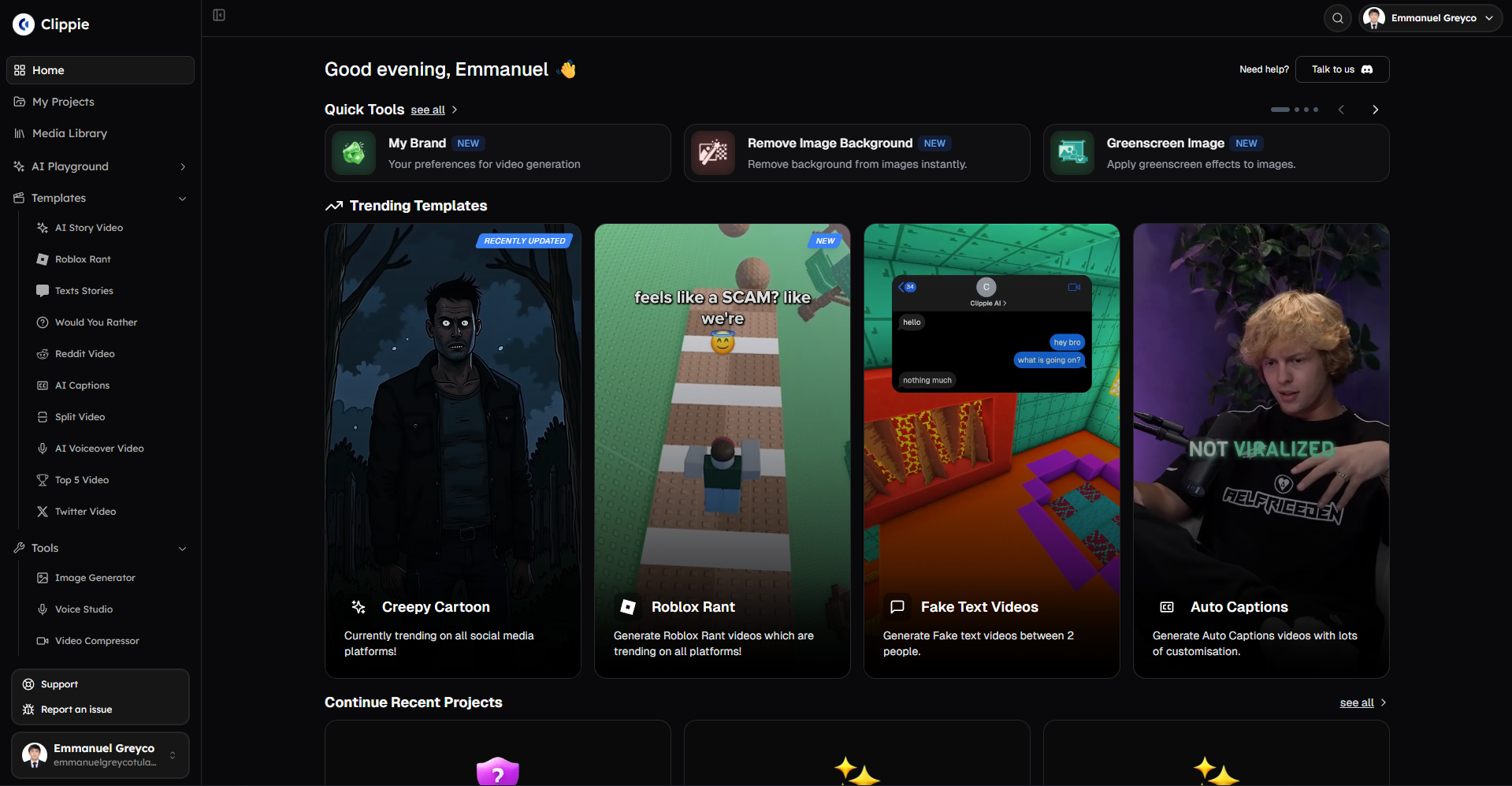
Ready to launch your freelance video editing career? Experience Clippie AI's professional platform, develop client-ready editing skills in 2-4 weeks through AI-assisted workflows, create compelling portfolio pieces demonstrating capabilities, deliver exceptional results 70-85% faster than traditional methods, building toward $3,000-$8,000 monthly income within 6-9 months through consistent client acquisition and systematic service delivery.
Make an AI story video
Write a script or let AI write one. Clippie turns it into a narrated video with AI scenes, voiceover and captions.
Read more

How to Make Top 5 Ranking Videos in 2026 (Step-by-Step)
Build ranking Shorts that can still earn: pick a debatable topic, set clear criteria, source clips you may use, script the countdown, add your commentary.

How to Create Short-Form Videos Using AI: 8 Steps (2026)
A beginner workflow for AI videos on TikTok, Reels and Shorts: pick a format, script a hook, add visuals, voice and captions, export at 9:16, label AI.

7 Free CapCut Alternatives for Short-Form Video (2026)
Compare Edits, YouTube Create, VN, Clipchamp, Canva, DaVinci Resolve and Shotcut: what each gives free users, what it caps first and where it falls short.