
Best Hashtags and Captions for AI-Generated Short Videos in 2026 (Full Strategy Guide)
Learn the best hashtag and caption strategies for AI-generated short videos in 2026, covering TikTok, YouTube Shorts, and Reels, with a full testing framework and Clippie AI production workflow.

Searching for the best hashtags and captions for AI-generated short videos in 2026?
You've already done the hard part, producing the video. But if your hashtags are generic and your captions are an afterthought, you're leaving a significant amount of reach on the table before your video even gets its first view.
This guide covers everything you need to know about hashtag strategy, caption writing, platform-specific differences, performance testing, and how to generate optimised captions at scale, so your videos reach the right audiences every time you post.
Executive Summary
This guide is for AI video creators and faceless content producers who want to maximise the organic reach of every short video they publish in 2026. It covers how hashtags and captions actually influence algorithmic distribution, the best hashtag strategies by platform, a proven caption writing framework, how to test and improve performance over time, and how Clippie AI fits into a high-volume caption and content production workflow. Whether you post on TikTok, YouTube Shorts, or Instagram Reels, this guide gives you a repeatable system.
Table of Contents
How Hashtags Actually Impact Reach on Short-Form Platforms in 2026
How to Write Captions That Drive Engagement and Watch Time
Platform-Specific Hashtag and Caption Strategies for 2026
How to Test and Improve Your Hashtag and Caption Performance
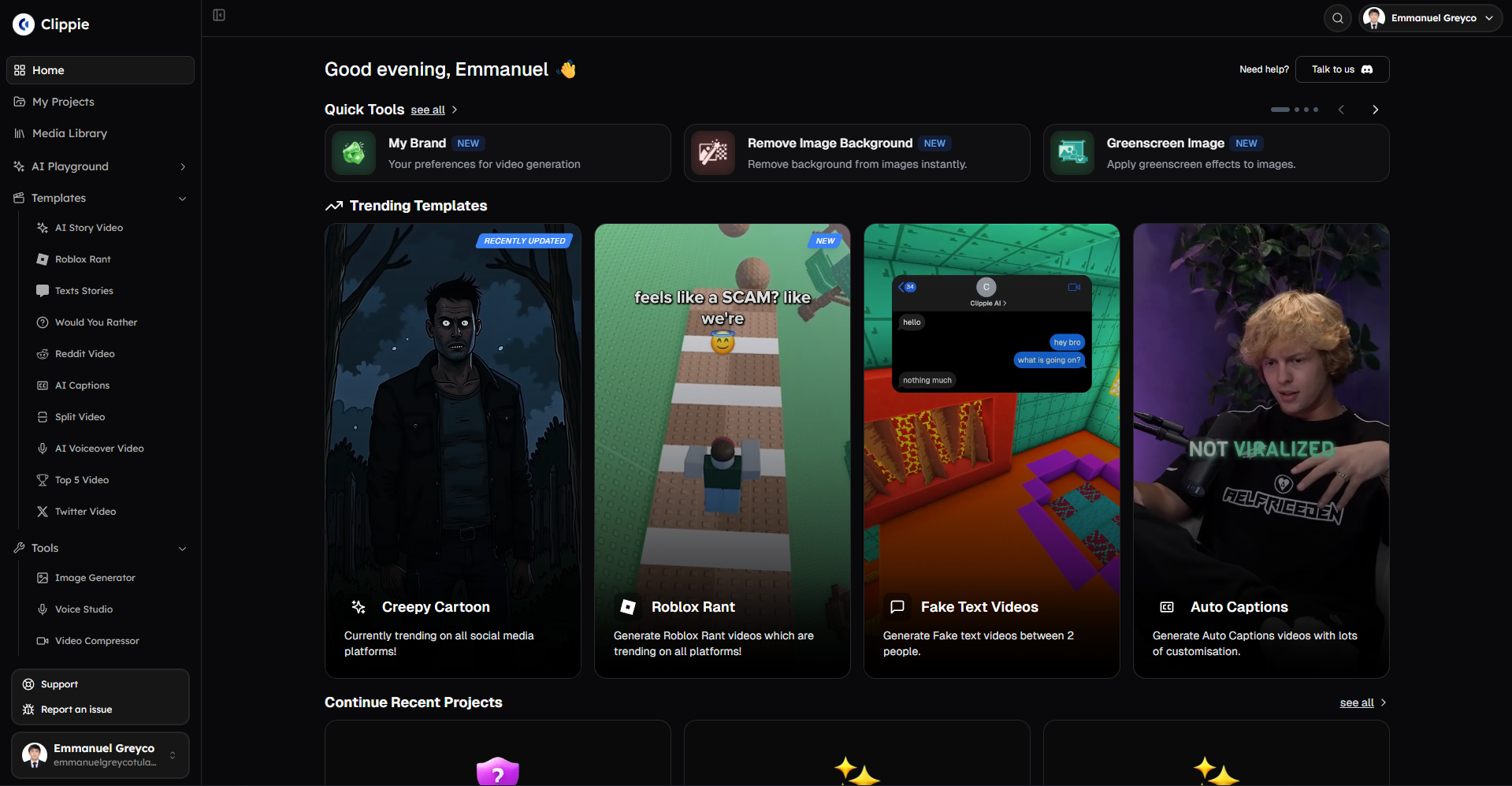
How to Generate Captions and Short Videos at Scale With Clippie AI
Frequently Asked Questions

1. How Hashtags Actually Impact Reach on Short-Form Platforms in 2026
Hashtags are widely misunderstood. Most creators either ignore them entirely or stuff every post with 30 generic tags. Neither approach works.
Here's how hashtags actually function in 2026, and what that means for your strategy.
What Hashtags Do (And What They Don't)
Hashtags serve two distinct functions depending on the platform:
Function 1: Content Classification: On TikTok and Instagram, hashtags help the algorithm understand what your video is about. They're a classification signal, not a distribution guarantee. A video tagged #AIvideo tells the algorithm who to show it to. A video with no hashtags forces the algorithm to rely entirely on audio, visual, and caption signals to classify it, slower and less accurate.
Function 2: Discovery Surface: Users actively search hashtags on TikTok and Instagram. A video tagged with a high-intent niche hashtag appears in that hashtag's feed, giving it exposure to audiences actively looking for that content type.
What hashtags don't do:
Hashtags do not directly boost views
A poorly performing video with perfect hashtags will still perform poorly
Hashtag volume (using 30 tags) does not multiply reach, quality and relevance do

The 3-Tier Hashtag Framework
The most effective hashtag strategy in 2026 uses three tiers per post:
Tier 1: Broad Category Tags (1–2 tags): Large-volume hashtags that define your general space.
Examples:
#AIvideo
#shortformcontent
#facelesscontent
#contentcreator
These reach large audiences but face high competition. They provide broad classification, not niche targeting.
Tier 2: Niche-Specific Tags (2–3 tags): Mid-volume hashtags that define your specific content category.
Examples:
#AIgeneratedvideo
#facelessyoutube
#AItools2026
#videocreation
These reach smaller but more targeted audiences. Competition is lower, relevance is higher. This tier drives the most qualified new viewers.
Tier 3: Content-Specific Tags (1–2 tags): Low-volume, highly specific hashtags that describe the exact topic of this video.
Examples:
#robloxrant
#tiktokniche2026
#shortformgrowth
#aivoiceover
These reach tiny but highly engaged audiences. Strong for comment generation and niche community discovery.
Total per post: 4–7 hashtags. Not 30. Not 3. Four to seven, across all three tiers.
Why Fewer Hashtags Outperform More in 2026
Platform algorithms in 2026 have become significantly better at interpreting content without hashtag assistance. Overloading a post with hashtags, especially irrelevant ones, can actually dilute the algorithm's confidence in what your content is about.
Think of it this way: 30 hashtags send 30 weak signals. 5 highly relevant hashtags send 5 strong signals. The algorithm responds better to strong, consistent classification.

2. How to Write Captions That Drive Engagement and Watch Time
Captions, the text that accompanies your video post, are underused by most creators. Done well, they extend the value of your video by adding context, driving comments, and creating a second opportunity to capture viewers who are scrolling past.
The 4 Jobs a Caption Should Do
Every strong caption does at least one of these four things. The best captions do two or three.
Job 1: Hook the scroller: The first line of a caption appears before the "more" cutoff on TikTok and Instagram. This line needs to work as a standalone hook, compelling enough to make someone tap "more" or watch the video they were scrolling past.
Weak: "New video up! Check it out 🔥"
Strong: "This AI tool replaced 3 apps in my workflow. Here's which one."
Job 2: Reinforce the video's value: The caption can summarise what viewers will learn or experience, especially useful for educational and tutorial content where viewers are deciding whether to invest their time.
"In this video: the exact hashtag strategy I used to go from 200 to 20,000 views per post."
Job 3: Trigger a specific action: Every caption should include a clear, specific CTA, not a vague "follow me." The CTA should be tied to the video's content.
"Save this so you have it when you need it."
"Drop your niche in the comments, I'll tell you which hashtag tier to prioritise."
"Tag a creator who's still using 30 hashtags."
Job 4: Boost searchability: On TikTok and YouTube Shorts, captions are now indexed for search. Including your primary keyword naturally in the caption, not stuffed, but present, improves your video's discoverability in platform search results.
The Caption Formula for AI-Generated Short Videos
Use this structure for every post:
Line 1: Hook (1 sentence): The most compelling claim, question, or statement from your video. This appears above the fold.
Lines 2–3: Context or value reinforcement (2–3 sentences): Briefly explain what the video covers or who it's for. Include your primary keyword naturally here.
Line 4: CTA (1 sentence): A specific, content-relevant action. Save, comment, share, or follow, one CTA, not all four.
Line 5: Hashtags (4–7, using the 3-tier framework): Place hashtags at the end, they create visual noise above the fold if placed earlier.

Caption Length by Platform
TikTok
Maximum: 2,200 characters
Optimal: 100–150 characters above the fold (before "more"), up to 300 total
Hashtags: 4–6, placed at the end
YouTube Shorts
Maximum: 5,000 characters (but the Shorts interface shows very little)
Optimal: Focus on the first 100 characters, that's what appears in the Shorts feed
Hashtags: 3–5, placed within the description naturally (not as a block at the end)
Instagram Reels
Maximum: 2,200 characters
Optimal: Strong first line before the "more" cutoff, 150–300 total characters
Hashtags: 5–7, placed after a line break from the main caption
Words That Drive Engagement in Short-Form Captions
These words and phrases consistently increase comment rates and save rates across AI-generated short video content:
For saves:
"Save this for later"
"You'll need this"
"Bookmark this"
"Reference this when you start"
For comments:
"What's your take?"
"Drop your [X] below"
"Tell me if this worked for you"
"Am I wrong?"
For shares:
"Tag someone who needs to see this"
"Send this to a creator friend"
"This applies to anyone doing [X]"

3. Platform-Specific Hashtag and Caption Strategies for 2026
Each platform has distinct algorithmic behaviour. The same hashtag and caption approach does not perform equally across TikTok, Shorts, and Reels.
TikTok Hashtag and Caption Strategy
TikTok's algorithm is the most aggressive content discovery engine of any short-form platform. It distributes content to non-followers by default, making hashtag classification especially important.
Hashtag best practices for TikTok:
Use 4–6 hashtags total
Always include 1 broad category tag, 2–3 niche-specific tags, 1 content-specific tag
Avoid banned or flagged hashtags, they suppress distribution silently
Check hashtag health: a hashtag showing mostly old viral content (6+ months old) may be declining in algorithm weight
Trending hashtags from TikTok's Creative Centre can be added as a 6th tag when genuinely relevant
Caption best practices for TikTok:
First line must hook within 100 characters
Ask a question or make a provocative statement, TikTok rewards comment velocity
Place all hashtags after the main caption text, separated by a line break
Avoid external links in captions, TikTok algorithmically suppresses posts that push users off-platform
YouTube Shorts Hashtag and Caption Strategy
YouTube Shorts operates differently from TikTok because it sits inside a search-first ecosystem. Hashtags on Shorts function more like SEO signals than discovery tools.
Hashtag best practices for YouTube Shorts:
Use 3–5 hashtags placed naturally in the description
Prioritise hashtags that match actual YouTube search queries (e.g., #AIvideo2026 over generic #content)
The first hashtag in the description appears above the Shorts title, choose it carefully
Adding #Shorts as one of your tags tells YouTube's system to classify the video correctly in the Shorts feed
Caption best practices for YouTube Shorts:
The Shorts interface shows very little caption text, focus entirely on the first 80–100 characters
Use the full description field for SEO: include your primary keyword in the first sentence
Write a 100–200 word description with naturally included related keywords, this impacts search rank
End the description with a soft CTA ("Like for more AI content" or "Subscribe for weekly AI video strategies")
Instagram Reels Hashtag and Caption Strategy
Instagram Reels prioritises saves and shares above all other engagement signals. Caption and hashtag strategy should be optimised for save-worthy content.
Hashtag best practices for Instagram Reels:
Use 5–7 hashtags placed after the main caption, separated by a line break
Mix 1–2 broad tags, 2–3 niche tags, 1–2 content-specific tags
Avoid hashtag blocks of 20–30 tags, Instagram's algorithm in 2026 treats these as spam signals
Research hashtags in Instagram's search to confirm they're active (recent posts visible)
Caption best practices for Instagram Reels:
Open with a save trigger: "Save this before you post your next Reel"
Use line breaks generously, wall-of-text captions perform significantly worse on Instagram
Include a specific, content-relevant CTA mid-caption (not just at the end)
Emojis used sparingly as visual separators improve readability without appearing spammy

Cross-Platform Caption Adaptation
When posting the same AI-generated video across all three platforms, don't copy-paste the identical caption. Adapt it:
TikTok version: Punchy hook, question-based CTA, 4–6 hashtags
Shorts version: SEO-keyword-led description, soft subscribe CTA, 3–5 hashtags
Reels version: Save-trigger opener, line-break formatting, 5–7 hashtags
Same video. Three optimised captions. Three distribution algorithms working in your favour simultaneously.

4. How to Test and Improve Your Hashtag and Caption Performance
Without a testing framework, hashtag and caption optimisation is guesswork. Here's a systematic approach.
Step 1: Establish Your Baseline Metrics
Before testing, know your current averages:
Average views per video (last 30 posts)
Average completion rate
Average save rate
Average comment rate
These are your benchmarks. Every test is measured against them.
Step 2: Test One Variable at a Time
Change only one element per testing cycle to isolate what's actually driving change.
Testing cycles:
Cycle 1: Hashtag tier ratio:
Test 4 hashtags vs 7 hashtags across 10 similar videos. Compare average reach.
Cycle 2: Caption hook style:
Test question-based hooks vs statement-based hooks across 10 videos. Compare comment rates.
Cycle 3: CTA type:
Test save CTAs vs comment CTAs vs share CTAs. Compare save rate and comment rate separately.
Cycle 4: Hashtag specificity:
Test broad hashtags vs niche-specific hashtags as your primary tag. Compare new follower rate.

Step 3: Read Platform Analytics Correctly
TikTok Analytics, what to focus on:
Traffic source breakdown: "For You" traffic indicates algorithmic distribution; high "For You" share means hashtags and content classification are working
Average watch time percentage: below 40% means your hook or pacing needs work, no hashtag strategy fixes a low-retention video
Follower vs non-follower ratio in views: high non-follower percentage means discovery is working
YouTube Shorts Analytics, what to focus on:
Impressions click-through rate: low CTR means your thumbnail or title needs work before hashtags matter
Average percentage viewed: Shorts need above 70% to unlock broader distribution
Traffic source: "YouTube Search" traffic indicates your description SEO is working
Instagram Reels Analytics, what to focus on:
Reach from non-followers: primary indicator of algorithmic distribution
Saves per reach: the most important metric, above 2% is strong
Shares: the highest-value signal for Reels distribution
Step 4: Iterate Every 30 Days
Run each testing cycle for a minimum of 10 videos before drawing conclusions, short-form performance has too much variance at the individual video level. Review findings monthly and implement the winning approach as your new baseline.
What to document:
Hashtag combinations that produced above-baseline reach
Caption hooks that generated above-baseline comment rates
CTA types that drove above-baseline save rates
Over 90 days of consistent testing, most creators identify a repeatable hashtag and caption formula that outperforms their original approach by 30–60% on key metrics.

5. How to Generate Captions and Short Videos at Scale With Clippie AI
Optimising captions and hashtags is only valuable if you're publishing consistently. At 5–7 posts per week across three platforms, caption creation alone becomes a significant time investment.
Clippie AI addresses the production volume problem, so your optimised caption strategy is actually applied to enough videos to generate meaningful data and growth.
What Clippie AI Handles in Your Short Video Production Workflow
AI Voiceover
50+ natural-sounding AI voices
Custom voice cloning for consistent channel identity
Narration generated from your script in seconds
AI Image Generation
Scene visuals, title cards, and supporting imagery generated inside the platform
No stock library required
Images immediately available in the production workflow
Auto-Captioning (Speech-to-Subtitles)
Captions auto-synced to your AI voiceover
102+ languages, reach international audiences without additional production effort
No manual subtitle alignment
Video Export
Export-ready output for TikTok, Shorts, and Reels
Vertical format optimised for short-form platforms
Fast turnaround, production to export in under 30 minutes per video
The Short Video Production Workflow With Clippie AI
Step 1: Script (10 minutes): Write a tight 120–200 word script. Hook in the first line. CTA in the last sentence.
Step 2: Voiceover (3 minutes): Paste script into Clippie. Select or clone your voice. Generate narration.
Step 3: Visuals (5–8 minutes): Generate title card and 2–3 scene images using Clippie's built-in AI image generation.
Step 4: Captions (automatic): Clippie auto-syncs subtitles to your voiceover. Select language. Review.
Step 5: Export (3 minutes): Export in vertical format. Ready for upload.
Step 6: Caption and hashtag copy (5 minutes): Using the formula from this guide, write your platform-specific caption and hashtag set for each platform before uploading.
Total per video: 25–35 minutes.
Clippie AI Plans: Matched to Short Video Volume
Lite: $19.99/month
30 mins video export (~3–5 videos/month)
30 mins AI voice generation
30 mins speech-to-subtitles
100 AI images
1 custom voice
Captions in 102+ languages
50+ AI voices
24/7 support
Best for: Creators publishing 3–5 short videos per month and testing caption and hashtag strategies before scaling
Creator: $34.99/month
120 mins video export (~10–15 videos/month)
120 mins AI voice generation
120 mins speech-to-subtitles
500 AI images
10 custom voices
Captions in 102+ languages
50+ AI voices
24/7 support
Best for: Creators posting consistently across TikTok, Shorts, and Reels with a defined niche and tested caption formula
Pro: $69.99/month
250 mins video export (~15–25 videos/month)
250 mins AI voice generation
250 mins speech-to-subtitles
1,000 AI images
30 custom voices
Captions in 102+ languages
50+ AI voices
24/7 support
Best for: High-volume creators or multi-channel operators running parallel posting schedules across platforms
No free tier is available on Clippie AI.
💡 For a full breakdown of how to build a faceless short video production system from scratch, read our guide on Best Tools for Faceless Video Creation in 2026 (Ranked by Use Case)
💡 For platform-specific growth strategies that pair with this caption approach, see Best Short-Form Video Formats for Monetisation in 2026
Conclusion: Hashtags and Captions Are the Last 10% That Determines the First 90% of Reach
Your video's quality determines whether viewers stay. Your hashtags and caption determine whether viewers find it in the first place.
In 2026, the creators with the widest organic reach are not necessarily the ones with the best videos. They're the ones who understand how the algorithm classifies and distributes content, and who write every hashtag set and caption with that understanding built in.
The 3-tier hashtag framework, the 4-job caption formula, and the platform-specific strategies in this guide give you a repeatable system. Apply it consistently, test methodically, and let 90 days of data tell you what works in your specific niche.
Start producing and publishing AI short videos with Clippie AI →
Frequently Asked Questions
Q1: How many hashtags should I use on TikTok for AI-generated short videos in 2026?
Use 4–6 hashtags per TikTok post. Distribute them across three tiers: 1–2 broad category tags, 2–3 niche-specific tags, and 1 content-specific tag. Avoid using 20–30 hashtags, platform algorithms in 2026 have become better at content classification without hashtag overloading, and excessive tags dilute your signal strength rather than amplifying it.
Q2: Do hashtags still matter for YouTube Shorts in 2026?
Yes, but they function differently than on TikTok. YouTube Shorts hashtags act primarily as SEO signals within a search-first ecosystem rather than discovery tools. Use 3–5 hashtags that match actual YouTube search queries, place them naturally in the description, and always include #Shorts to ensure correct feed classification. The first hashtag in your description appears above your Shorts title, choose it as your most important keyword.
Q3: What is the most important element of a short-form video caption in 2026?
The first line, the hook, is the single most important element. On TikTok and Instagram, everything before the "more" cutoff is the only text most viewers see. A weak first line means the caption does nothing for reach or engagement. The hook should make a specific claim, ask a provocative question, or state an unexpected outcome, something compelling enough to stop a scrolling viewer.
Q4: Should I use the same hashtags on every video?
No. Repeating identical hashtag sets across every post can signal repetitive or low-effort content to some platform algorithms. More importantly, every video has a different specific topic, the content-specific tier (Tier 3) of your hashtag set should change per video to accurately classify what that video is about. Keep your broad and niche-specific tiers consistent, but refresh content-specific tags with every post.
Q5: How long does it take to see results from an improved hashtag and caption strategy?
Expect 30–60 days of consistent posting before the data is statistically meaningful. Short-form video performance has high individual variance, a single video can dramatically outperform or underperform its expected benchmarks for reasons unrelated to hashtags and captions. Measure performance across batches of 10+ videos per testing cycle, not individual posts. Most creators who implement the 3-tier hashtag framework and the 4-job caption formula see measurable reach improvement within 45–60 days.
Q6: Can Clippie AI help with writing captions and hashtags?
Clippie AI handles the video production workflow, voiceover, image generation, auto-captioning (subtitles synced to your video audio), and export. Caption copy and hashtag selection for the post description are currently written manually using frameworks like the ones in this guide. The time saved on video production with Clippie AI (15–25 minutes per video) gives creators the bandwidth to write strong, thoughtful captions for every post rather than rushing them.
Read more

How to Post One Faceless Video to TikTok, Reels and Shorts
One vertical export works on all three platforms, but the rules don't. Lengths, payout thresholds, caption styles and what you should never cross-post.

Best AI Tools for Faceless YouTube Channels in 2026
A faceless YouTube channel needs one good tool per stage, not thirty. Research, scripting, voice, video and thumbnail picks, plus three stacks by budget

Best AI Video Tools for Faceless Content in 2026
The right tool depends on what you make: story shorts, prompt-to-video, repurposing, captions or avatars. Honest picks for each, plus where each one fails.