
How Video Editors Can Transition Into AI-Powered Editing Workflows in 2026
Video editors transition to AI workflows in 2026: Why traditional editing can't sustain rates, 8 tasks to automate saving 15-20 hours weekly, combine expertise with AI for 3-5x output, stay competitive & adapt with Clippie AI.

If you're searching for how video editors can transition into AI-powered editing workflows in 2026, you're recognizing the market bifurcation separating editors achieving 3-5x output increases while maintaining or raising rates (AI-assisted workflows completing projects in 8-12 hours that previously required 30-40 hours, automated tedious tasks freeing capacity for high-value creative direction, premium positioning as AI-enhanced editors commanding $75-$150/hour vs. $35-$65 manual-only rates) from those facing declining opportunities and rate compression (manual-only editors competing against AI-accelerated peers producing equivalent quality faster, clients increasingly expecting video deliverables in 48-72 hours not 7-14 days, commoditization of basic editing driving rates down 25-40% for editors refusing automation adoption). This guide explains why traditional editing alone no longer sustains competitive rates, identifies 8 manual tasks to automate immediately saving 15-20 hours weekly, delivers frameworks combining creative expertise with AI automation for 3-5x output, provides competitive positioning strategies as AI adoption accelerates, and demonstrates workflow adaptation using Clippie AI as practical implementation example.
Executive Summary: Video editors transitioning to AI-powered workflows in 2026 achieve sustainable competitive advantage through strategic automation adoption, automating tedious manual tasks (color correction, audio normalization, caption generation, rough cuts, filler word removal, multi-format exports saving 15-20 hours weekly), elevating role focus to creative direction and storytelling (client communication, narrative structure, emotional pacing, brand alignment where AI cannot compete), implementing hybrid workflows achieving 3-5x productivity increases (AI handles technical execution in 20% of time while editors focus on creative decisions driving premium value), positioning as AI-enhanced specialists commanding premium rates ($75-$150/hour vs. $35-$65 manual rates), and adopting tools like Clippie AI reducing post-production time 70-85% while maintaining creative control and quality standards enabling editors to serve 3-5 clients simultaneously vs. 1-2 manual capacity ceiling.
Table of Contents
Why Traditional Editing Alone No Longer Sustains Competitive Rates in 2026
The 8 Manual Editing Tasks You Should Automate Immediately to Save 15-20 Hours Weekly
How to Combine Creative Expertise With AI Automation for 3-5x Higher Output
How to Stay Competitive and Command Premium Rates as AI Editing Adoption Accelerates
How to Adapt Your Editing Workflow to AI-Powered Tools Using Clippie AI
Frequently Asked Questions

1. Why Traditional Editing Alone No Longer Sustains Competitive Rates in 2026
The video editing market has fundamentally restructured around AI adoption, editors integrating automation achieve productivity multiples enabling premium positioning while manual-only editors face commoditization and rate pressure. Understanding the specific market dynamics driving this shift enables strategic positioning rather than reactive survival.
The Rate Compression Reality
Traditional manual editing rates (2020-2023):
Freelance video editor benchmarks:
Junior editors (1-3 years): $25-$45/hour
Mid-level editors (3-7 years): $45-$75/hour
Senior editors (7+ years): $75-$125/hour
Specialist editors (niche expertise): $100-$200/hour
Market dynamics:
Stable demand: Content creation growing 40% annually
Steady rates: Experienced editors maintaining $60-$90/hour average
Competitive but sustainable: Enough work for skilled editors
AI-disrupted market reality (2024-2026):
Rate bifurcation by AI adoption:
AI-resistant editors (manual-only):
Rates declining: $35-$65/hour (down 20-30% from 2023)
Client pressure: "Other editors deliver faster for same price"
Project scarcity: Losing bids to AI-enhanced competitors
Survival mode: Racing to bottom competing on price
AI-enhanced editors (hybrid workflow):
Rates stable or increasing: $75-$150/hour (up 15-25%)
Client perception: Premium service (speed + quality)
Project abundance: Capacity to serve 3-5 clients vs. 1-2 manual
Thriving: Charging more while working less per project
The market message:
Manual editing = commodity (price competition)
AI-enhanced editing = premium service (value competition)
The Client Expectation Shift
What clients expected (2020-2023):
Typical project timeline:
10-minute promotional video
Filming: 1 day
Editing: 5-7 business days
Revisions: 2-3 business days
Total delivery: 7-10 business days from raw footage
Client acceptance:
"Good editing takes time"
Week-long turnaround normal
Premium paid for quality work
What clients expect now (2026):
Same 10-minute video:
Filming: 1 day
Editing: 1-2 business days (AI-enhanced editors deliver here)
Revisions: Same-day turnaround expected
Total delivery: 2-3 business days expected standard
Client perspective shift:
"AI makes editing faster, why does yours take a week?"
Rapid turnaround expected, not premium
Week-long delivery = "slow" or "outdated workflow"
The editor dilemma:
Manual workflow (unchanged):
Same 30-40 hours editing time required
Same quality output
Clients now view as "slow"
Rate pressure: Can't justify $75/hour for "slow" delivery
AI-enhanced workflow:
8-12 hours editing time (AI handles technical tasks)
Same or better quality output
Meets 2-3 day expectation
Rate justification: $75-$150/hour for "efficient" delivery

The Productivity Gap Economics
Manual editor monthly capacity:
Time breakdown per project (10-minute video):
Organizing footage: 2 hours
Rough cut assembly: 6 hours
Fine-cut editing: 8 hours
Color correction: 4 hours
Audio mixing and cleanup: 3 hours
Caption creation: 2 hours
Revisions: 4 hours
Export and delivery: 1 hour
Total: 30 hours per project
Monthly capacity:
Available hours: 160 (40 hours/week × 4 weeks)
Projects completed: 5.3 monthly (160 ÷ 30)
At $60/hour average: $9,600 monthly revenue
Effective utilization: 100% (maxed out, no growth capacity)
AI-enhanced editor monthly capacity:
Time breakdown per project (same 10-minute video):
Organizing footage: 1 hour (AI-assisted sorting)
Rough cut assembly: 2 hours (AI generates, human refines)
Fine-cut editing: 4 hours (focused creative decisions)
Color correction: 30 minutes (AI applies LUTs, human adjusts)
Audio mixing and cleanup: 45 minutes (AI removes noise, normalizes)
Caption creation: 15 minutes (AI generates, human verifies)
Revisions: 2 hours (faster iteration with AI tools)
Export and delivery: 15 minutes (AI batch processes)
Total: 11 hours per project (63% time reduction)
Monthly capacity:
Available hours: 160
Projects completed: 14.5 monthly (160 ÷ 11)
At $80/hour average: $11,600 monthly revenue
Effective utilization: 100% but 173% more projects
Plus strategic options:
Work same 5 projects at higher rate: $75-$100/hour (premium for speed)
Or serve 10-14 projects: 2-3x revenue at comparable rates
Or mix: 8 projects at premium rates + personal time
The compounding advantage:
Year 1:
Manual editor: 64 projects annually, $115,200 revenue
AI-enhanced editor: 174 projects annually, $139,200 revenue
Difference: $24,000 (21% higher)
Year 2:
Manual editor: Same capacity (plateau)
AI-enhanced editor: Raises rates 20% ($96/hour), selective clients
AI-enhanced revenue: $167,040
Difference: $51,840 (45% higher)
Year 3:
Manual editor: Rate pressure (drops to $55/hour)
AI-enhanced editor: Premium positioning ($120/hour), 10 monthly projects
Manual revenue: $105,600
AI-enhanced revenue: $192,000
Difference: $86,400 (82% higher)
The Skill Obsolescence vs. Skill Evolution
Misunderstanding: "AI will replace video editors"
Reality: AI replaces manual tasks, not creative expertise
Tasks AI can do (technical execution):
Cut out silence and filler words
Color correct to standard levels
Remove background noise
Generate captions from audio
Create rough cuts based on transcript
Export multiple format versions
Organize footage by content
These were never the valuable skills
Tasks AI cannot do (creative judgment):
Understand client brand and messaging
Make storytelling decisions (pacing, emotional arc)
Select moments that resonate emotionally
Balance information density with engagement
Create unique visual style
Judge what "feels right" for audience
Iterate based on subjective feedback
These are the valuable skills, and they're irreplaceable
The evolution path:
2020: Editor = Technician + Creative
70% time: Technical execution (organizing, cutting, correcting)
30% time: Creative decisions (story, pacing, style)
Value perception: Technical skill + creative eye
2026: Editor = Creative Director (AI = Technical Assistant)
20% time: Technical oversight (AI does execution, human verifies)
80% time: Creative direction (all decisions, AI executes)
Value perception: Creative expertise (premium service)
Editors who adapt: Become more valuable (focused on irreplaceable skills)
Editors who resist: Become less valuable (competing on replaceable tasks)

2. The 8 Manual Editing Tasks You Should Automate Immediately to Save 15-20 Hours Weekly
Strategic automation focuses on high-time, low-creative-value tasks, freeing capacity for work requiring human judgment while eliminating tedious manual execution preventing scalability.
Task #1: Filler Word and Silence Removal (Saves 3-5 Hours Weekly)
The manual workflow:
Typical interview or talking-head video (10 minutes final):
Raw footage: 25-30 minutes (speaker includes pauses, filler words)
Manual process:
Listen to entire footage
Identify every "um," "uh," "like," "you know" (60-100+ instances)
Cut each individually
Trim excessive silence (30-50 instances)
Maintain natural pacing (not robotic)
Time required: 90-120 minutes per 10-minute video
Weekly workload:
3 talking-head videos weekly (typical freelancer)
Total time: 4.5-6 hours on filler removal alone
The AI-automated workflow:
Using Clippie AI or equivalent:
Upload raw footage
AI detects and removes filler words automatically
AI reduces excessive silence while maintaining natural pacing
Human review: Verify flow feels natural (5-10 minutes)
Time required: 10-15 minutes per video
Weekly time savings:
Manual: 4.5-6 hours
AI-assisted: 30-45 minutes
Savings: 4-5.25 hours weekly (enough time for entire additional project)
Quality considerations:
Common concern: "AI will make it sound unnatural"
Reality:
Modern AI: Maintains natural speech patterns (context-aware cutting)
Adjustable sensitivity: Control aggressiveness of cuts
Human oversight: Always review and adjust if needed
Result: Indistinguishable from careful manual editing
Test: Clients cannot tell difference in blind comparison
Task #2: Caption and Subtitle Generation (Saves 2-3 Hours Weekly)
The manual workflow:
Creating captions for 10-minute video:
Watch entire video
Type captions while watching (or after)
Sync timing for each caption
Adjust position and formatting
Export caption file or burn into video
Time required: 45-60 minutes per video
Weekly workload:
80% of videos need captions (accessibility + social media)
4 videos weekly
Total time: 3-4 hours weekly
The AI-automated workflow:
Speech-to-text with timing:
Upload video
AI generates synchronized captions (95-98% accuracy)
Human review: Fix any errors (typically 5-10 errors per 10-minute video)
Apply styling and export
Time required: 8-12 minutes per video
Weekly time savings:
Manual: 3-4 hours
AI-assisted: 32-48 minutes
Savings: 2.5-3.5 hours weekly
Accuracy improvements:
2020-2022: AI captions were frustrating
Accuracy: 75-85% (required heavy editing)
Terminology: Struggled with proper nouns, industry jargon
Conclusion: Manual faster than fixing AI errors
2024-2026: AI captions are reliable
Accuracy: 95-98% (minimal corrections needed)
Terminology: Custom dictionaries for industry terms
Conclusion: AI 5-6x faster than manual
Task #3: Color Correction and Grading (Saves 2-4 Hours Weekly)
The manual workflow:
Color correcting multi-camera shoot:
Match cameras: Ensure color consistency across 2-4 cameras
Exposure correction: Fix under/overexposed shots
White balance: Correct color temperature issues
Apply creative grade: Achieve desired look
Shot-by-shot adjustments: Fine-tune each clip
Time required: 60-90 minutes per 10-minute video
Weekly workload:
3-4 videos requiring color work
Total time: 3-6 hours weekly
The AI-automated workflow:
AI-powered color correction:
Auto-match: AI matches camera colors automatically
Exposure correction: AI balances highlights/shadows
Apply LUT: Choose creative look, AI applies uniformly
Human refinement: Adjust 5-10 shots needing special attention
Time required: 15-25 minutes per video
Weekly time savings:
Manual: 3-6 hours
AI-assisted: 60-100 minutes
Savings: 2-4.5 hours weekly
When AI color grading works (90% of projects):
Corporate videos (standard professional look)
Social media content (consistent brand colors)
Interview/talking head (natural skin tones)
Event coverage (documentary style)
When human color grading still essential (10% of projects):
Cinematic projects (unique artistic vision)
Commercial work (specific brand color requirements)
Narrative storytelling (mood-driven grading)
Solution: Use AI for base correction, human for creative grade
Task #4: Audio Cleanup and Mixing (Saves 2-3 Hours Weekly)
The manual workflow:
Audio post-production for interview:
Noise reduction: Remove background hum, room tone
EQ adjustment: Enhance voice clarity
Compression: Even out volume levels
De-esser: Reduce harsh "s" sounds
Music balancing: Duck music under dialogue
Time required: 45-60 minutes per video
Weekly workload:
All videos require audio work
5 videos weekly
Total time: 3.75-5 hours weekly
The AI-automated workflow:
Automated audio enhancement:
AI noise reduction: Removes background noise automatically
AI voice enhancement: Optimizes clarity without harsh EQ
Auto-leveling: Normalizes volume throughout
Music ducking: AI automatically lowers music when speech present
Human review: Adjust music balance, verify quality
Time required: 10-15 minutes per video
Weekly time savings:
Manual: 3.75-5 hours
AI-assisted: 50-75 minutes
Savings: 3-4 hours weekly
Quality comparison:
Audio engineers' initial skepticism:
"AI can't understand musical context"
"Automated noise reduction sounds processed"
Valid in 2020-2022
Current AI audio capabilities:
Context-aware: Distinguishes speech, music, ambient sound
Natural processing: Transparent noise reduction (no artifacts)
Professional assessment: 85-90% of projects need no manual audio work beyond AI processing
Task #5: Rough Cut Assembly (Saves 3-5 Hours Weekly)
The manual workflow:
Creating rough cut from 60 minutes of footage:
Watch all footage: Note usable segments
Drag clips to timeline: Build sequence structure
Trim clips: Remove bad takes, mistakes
Arrange: Order clips logically
Review: Watch rough cut, adjust
Time required: 3-4 hours per project
The AI-automated workflow:
Transcript-based editing:
AI transcribes all footage automatically
Human reads transcript: Highlights good segments (20-30 minutes)
AI assembles: Generates rough cut from highlighted text
Human review: Rearrange, refine (45-60 minutes)
Time required: 75-90 minutes per project
Time savings per project: 50-58%
Weekly savings (2 projects):
Manual: 6-8 hours
AI-assisted: 2.5-3 hours
Savings: 3.5-5 hours weekly
The transcript editing advantage:
Why it's faster:
Reading: 3-4x faster than watching video
Selection: Click to include/exclude (vs. dragging clips)
Overview: See entire content at glance (vs. timeline scrubbing)
Cognitive load: Lower (text easier to process than video)
Task #6: Multi-Format Export (Saves 1-2 Hours Weekly)
The manual workflow:
Delivering video for multiple platforms:
YouTube: 1920×1080 (16:9)
Instagram Feed: 1080×1080 (1:1)
Instagram Stories: 1080×1920 (9:16)
TikTok: 1080×1920 (9:16, different safe zones)
LinkedIn: 1920×1080 (16:9, optimized for mobile)
Manual process:
Re-edit for each format: Reposition text, adjust framing (30-45 minutes per format)
Export each separately: 5 formats × 8 minutes = 40 minutes
Time required: 2.5-3.5 hours per project needing multi-format
The AI-automated workflow:
Smart reframing:
AI identifies subjects in frame
Automatically reframes for vertical/square (maintains subjects centered)
Adjusts text placement per format
Batch export all formats simultaneously
Time required: 20-30 minutes (setup + verification)
Weekly savings (2 multi-format projects):
Manual: 5-7 hours
AI-assisted: 40-60 minutes
Savings: 4-6 hours weekly
Task #7: B-Roll Organization and Selection (Saves 1-2 Hours Weekly)
The manual workflow:
Sorting through b-roll footage:
Import: 200-400 clips of b-roll
Watch each: Determine usability
Organize: Create bins by category
Tag: Add keywords for searchability
Time required: 90-120 minutes per project
The AI-automated workflow:
AI-powered organization:
AI analyzes: Identifies content in each clip (objects, people, scenes)
Auto-organizes: Creates bins automatically (people, products, locations, etc.)
Searchable: Text search finds specific shots ("woman smiling," "product close-up")
Human selection: Choose clips from organized library
Time required: 20-30 minutes
Weekly savings:
Manual: 1.5-2 hours
AI-assisted: 20-30 minutes
Savings: 1-1.5 hours weekly
Task #8: Template Application and Branding (Saves 1-2 Hours Weekly)
The manual workflow:
Applying client brand to video:
Import brand assets: Logos, colors, fonts
Create lower thirds: Design and animate
Apply color grade: Match brand guidelines
Add intro/outro: Create branded sequences
Time required: 60-90 minutes first video, 30-45 minutes subsequent
The AI-automated workflow:
Brand template system:
Create once: Brand template with all assets (90 minutes one-time)
Apply to projects: 1-click application (2-3 minutes)
AI adjusts: Timing and positioning automatically
Time required: 3-5 minutes per video (after template created)
Weekly savings (4 videos for same client):
Manual: 2-3 hours (initial + subsequent applications)
AI-assisted: 12-20 minutes
Savings: 1.75-2.75 hours weekly

Total Weekly Time Savings
Cumulative automation impact:
Filler removal: 4-5.25 hours
Captions: 2.5-3.5 hours
Color correction: 2-4.5 hours
Audio cleanup: 3-4 hours
Rough cuts: 3.5-5 hours
Multi-format export: 4-6 hours (when applicable)
B-roll organization: 1-1.5 hours
Template application: 1.75-2.75 hours
Total savings: 22.75-32.5 hours weekly (more than initial estimate due to project variations)
Conservative estimate (not all tasks every week): 15-20 hours weekly savings
What this enables:
Serve 3-5 clients instead of 1-2 (2-3x capacity increase)
Same client volume with 50% more personal time (work-life balance)
Mix: 40% more capacity + 40% more personal time (sustainable growth)

3. How to Combine Creative Expertise With AI Automation for 3-5x Higher Output
Strategic AI integration positions editors as creative directors using automation as execution assistant, multiplying output without sacrificing quality or creative control while increasing hourly value through higher-leverage activities.
The Human-AI Division of Labor
The fundamental principle:
AI excels at:
Repetitive tasks
Technical precision
Pattern recognition
Speed/volume
Humans excel at:
Creative judgment
Emotional resonance
Brand understanding
Subjective decisions
Optimal workflow: AI handles execution, human provides direction
Traditional workflow (100% human):
10-minute corporate video timeline:
Organization and logging: 2 hours (human)
Rough cut assembly: 6 hours (human)
Fine-cut editing: 8 hours (human)
Color correction: 4 hours (human)
Audio mixing: 3 hours (human)
Graphics and text: 3 hours (human)
Revisions: 4 hours (human)
Export: 1 hour (human)
Total: 31 hours (100% human labor)
AI-enhanced workflow (20% human direction, 80% AI execution):
Same 10-minute video:
Organization: 30 min (AI auto-organizes, human verifies)
Rough cut: 90 min (AI assembles from transcript, human refines)
Fine-cut: 4 hours (HUMAN, creative decisions, pacing, storytelling)
Color correction: 30 min (AI applies corrections, human adjusts)
Audio mixing: 45 min (AI cleans/balances, human reviews)
Graphics/text: 90 min (AI applies templates, human customizes)
Revisions: 2 hours (HUMAN, client communication, creative adjustments)
Export: 15 min (AI batch processes all formats)
Total: 10.5 hours (30% human creative work, 70% AI/automation)
Time reduction: 66%Output multiplier: 3x (can complete 3 projects in time previously required for 1)
The Creative Direction Framework
Redefining the editor's role:
Old role: Editor (executor)
"Make this footage into a video"
Focus: Technical execution
Value: Technical skill
New role: Creative Director (decision-maker)
"Bring this story to life"
Focus: Creative vision
Value: Creative judgment
The decision hierarchy:
Level 1: Technical execution (100% AI)
Color balance
Audio levels
File organization
Caption timing
Human involvement: 0% (verify output only)
Level 2: Standard creative choices (80% AI, 20% human)
Rough cut assembly
Music selection (AI suggests, human chooses)
B-roll placement (AI suggests, human approves)
Human involvement: Final selection and refinement
Level 3: Distinctive creative choices (20% AI, 80% human)
Pacing and rhythm
Emotional arc
Brand alignment
Storytelling structure
Human involvement: Primary creator, AI assists with execution
Level 4: Client-specific decisions (100% human)
Interpreting feedback
Brand voice and messaging
Strategic content choices
Human involvement: 100% (irreplaceable)
The 3-5x Output Multiplication Model
Scenario: Freelance editor serving multiple clients
Manual workflow capacity:
Hours available weekly: 40
Hours per project: 30
Projects monthly: 5-6
Revenue (at $60/hour): $9,600/month
Utilization: 100% (maxed out, no growth possible)
AI-enhanced workflow capacity:
Option 1: Maintain same client volume, increase rates
Hours per project: 10 (AI-assisted)
Projects monthly: 5-6 (same)
Hours used: 50-60 (vs. 120-180 manual)
Rate increase: Charge for value (speed + quality), not time
New rate: $90-$120/hour (premium for efficiency)
Revenue: $13,500-$16,200/month
Increase: 41-69% with better work-life balance
Option 2: Serve more clients, same rates
Hours per project: 10
Projects monthly: 15-18 (3x volume)
Hours used: 150-180 (still within 40-hour weeks)
Rate: Maintain $60/hour
Revenue: $27,000-$32,400/month
Increase: 181-238%
Option 3: Hybrid (recommended)
Increase rates modestly: $75/hour
Serve more clients: 10-12 monthly
Hours used: 100-120
Revenue: $22,500-$27,000/month
Work hours: 25-30 weekly (vs. 40 manual)
Increase: 134-181% with improved lifestyle
The compounding advantage over time:
Year 1:
Manual editor: $115,200 annual
AI-enhanced editor: $270,000 annual (Option 2)
Difference: $154,800
Year 2:
Manual editor: $115,200 (same, plateaued)
AI-enhanced editor: Raises rates to $90/hour, selective clients
12 projects monthly × $90/hour × 10 hours × 12 months = $324,000
Difference: $208,800
Year 3:
Manual editor: Rates decline to $55/hour (market pressure)
$105,600 annual
AI-enhanced editor: $120/hour, 10 premium projects monthly
$360,000 annual
Difference: $254,400

The Quality Control Framework
Common fear: "AI will lower quality"
Reality: AI enables higher quality through capacity reallocation
Manual workflow quality allocation:
70% time: Technical tasks (necessary but not creative)
30% time: Creative decisions (what makes video great)
Result: Good technical execution, limited creative refinement
AI-enhanced quality allocation:
20% time: Technical oversight (AI executes, human verifies)
80% time: Creative refinement (storytelling, pacing, emotion)
Result: Good technical execution + extensive creative refinement
Example: Corporate interview video
Manual approach:
6 hours: Cutting out filler words (tedious, exhausting)
2 hours: Creative storytelling decisions (exhausted from technical work)
Result: Technically clean, creatively adequate
AI-enhanced approach:
30 minutes: AI removes filler, human verifies
5.5 hours: Creative decisions (narrative structure, b-roll selection, emotional pacing)
Result: Technically clean + creatively excellent
Client perception: AI-enhanced version feels more polished and engaging (because it is, more creative attention invested)
4. How to Stay Competitive and Command Premium Rates as AI Editing Adoption Accelerates
Market positioning determines whether AI automation threatens livelihood or enables premium pricing, strategic positioning as AI-enhanced specialist creates competitive moats while manual-only commoditization invites rate pressure and declining opportunities.
The Premium Positioning Strategy
The positioning mistake:
Competing on efficiency alone:
"I can edit your video faster than others"
Problem: Race to bottom (someone always cheaper/faster)
Client perception: Commodity service
Rate pressure: Inevitable
The premium positioning approach:
Competing on outcomes:
"I create videos that achieve your business goals"
Advantage: Value-based pricing (not time-based)
Client perception: Strategic partner
Rate justification: Results, not hours
How to communicate AI-enhanced value:
Wrong approach (technical focus):
"I use AI tools to edit faster"
Client hears: "I automate my job" (why pay premium?)
Right approach (outcome focus):
"I leverage advanced workflows to deliver broadcast-quality videos in 2-3 days with unlimited revisions"
Client hears: "I get fast, high-quality results with flexibility" (worth premium)
The AI is invisible, client sees results, not process
The Service Packaging Transformation
Old model: Hourly billing
Problems:
Penalizes efficiency (faster = less revenue)
Clients focus on hours (price sensitivity)
Caps revenue (only 40 hours weekly)
New model: Value-based packages
Package 1: Essential
1 video monthly (up to 3 minutes)
2 revision rounds
Multi-platform formats (YouTube, social)
5-day turnaround
Price: $1,200/month
Your time: 6 hours (AI-assisted)
Effective rate: $200/hour
Package 2: Growth (recommended)
4 videos monthly (up to 5 minutes each)
3 revision rounds
Multi-platform formats
3-day turnaround
Priority support
Price: $3,800/month
Your time: 20 hours (AI-assisted)
Effective rate: $190/hour
Package 3: Premium
8 videos monthly (up to 8 minutes each)
Unlimited revisions
All formats + custom sizes
48-hour turnaround
Dedicated communication
Price: $6,500/month
Your time: 35 hours (AI-assisted)
Effective rate: $186/hour
Client capacity:
Package 1: Can serve 6-7 clients (42 hours monthly)
Package 2: Can serve 2 clients (40 hours monthly)
Package 3: Can serve 1 client (35 hours monthly)
Strategic mix (optimal):
1 Premium client: $6,500
1 Growth client: $3,800
2 Essential clients: $2,400
Total: $12,700 monthly (vs. $9,600 hourly at max capacity)
Hours used: 77 (can work 30-hour weeks, or add more clients)
The Specialization Advantage
Generalist positioning:
"I edit all types of videos"
Problem: Competing against everyone
Pricing: Market rate (commodity)
Specialist positioning:
"I specialize in [niche] video editing"
Advantage: Narrow competition
Pricing: Premium (expertise)
Profitable specializations:
Industry-specific:
Real estate video specialist (virtual tours, listings)
SaaS product demo specialist (explainer videos)
E-commerce product video specialist (Amazon, Shopify)
Advantage: Industry knowledge + editing = premium value
Format-specific:
YouTube optimization specialist (retention editing, pacing)
Social media content specialist (Instagram, TikTok)
Podcast video editor (audio-driven storytelling)
Advantage: Platform expertise + technical skill
Technique-specific:
Motion graphics specialist (animated explainers)
Documentary editor (narrative storytelling)
Testimonial specialist (interview editing)
Advantage: Refined skillset = superior results
Specialization + AI = multiplied advantage:
Example: SaaS product demo specialist
Manual workflow:
Generic editing skills
Learn each product (time-consuming)
Standard editing approach
Rate: $60-$75/hour
AI-enhanced specialist:
SaaS expertise (understand product communication)
Template library (20+ SaaS demo templates)
AI handles technical execution
Focus: Messaging optimization
Rate: $120-$180/hour (2-3x higher for same client type)
Capacity: 3x more projects (AI efficiency)
Combined advantage: 6-9x revenue potential

The Client Communication Framework
How to discuss AI with clients:
What clients care about:
Speed: How fast will I get my video?
Quality: Will it look professional?
Cost: Is this affordable/good value?
Reliability: Will you deliver consistently?
What clients don't care about:
Your tools (Premiere vs. DaVinci vs. AI)
Your process (manual vs. automated)
Your time investment (efficiency is your advantage, not client concern)
Client conversation scripts:
When client asks: "Do you use AI?"
Wrong response:
"Yes, AI does most of the work" (devalues your service)
Right response:
"I use advanced workflows combining professional editing with automation to deliver exceptional quality faster. This means you get broadcast-level videos in 2-3 days with unlimited revisions, best of both worlds."
Focus: Their benefit (speed + quality), not your process
When client says: "I can use AI myself"
Wrong response:
"AI can't replace professional editors" (defensive, weak)
Right response:
"Absolutely, AI tools are increasingly accessible. What I provide is creative direction, brand alignment, storytelling expertise, and production quality that takes years to develop. AI is one tool in my toolkit, similar to how professional photographers use auto-focus, the tool doesn't replace the eye."
Focus: Irreplaceable expertise, AI as amplifier not replacement
The Rate Increase Strategy
When to raise rates:
Trigger 1: Booked 4+ weeks out
Demand signal: More work than capacity
Action: Increase rates 15-25% for new clients
Existing clients: Maintain current rates (loyalty)
Trigger 2: AI efficiency achieved
Productivity: Completing projects in 30-50% less time
Action: Transition to value-based pricing (not hourly)
Client communication: "Upgrading service model for better outcomes"
Trigger 3: Specialization established
Expertise: 20+ projects in specific niche
Portfolio: Proven results in specialization
Action: Premium rates justified by specialized knowledge
Rate increase implementation:
Gradual approach (recommended):
Every 6 months: Increase rates 10-15% for new clients
Every project: Slightly better than last (skill compounding)
Year 1: $60/hour → $75/hour
Year 2: $75/hour → $95/hour
Year 3: $95/hour → $125/hour
Sustainable: Matches value increase, not shocking to market
Immediate approach (when justified):
Significant productivity leap (AI adoption)
Specialization launch
Major portfolio additions
Jump: $60/hour → $90/hour immediately
Communication: "Updated service model reflecting advanced capabilities"

5. How to Adapt Your Editing Workflow to AI-Powered Tools Using Clippie AI
Practical AI workflow integration requires systematic tool adoption and process redesign, Clippie AI serves as implementation example demonstrating broader principles applicable across AI editing platforms.
The Workflow Transition Timeline
Month 1: Foundation (learning without client pressure)
Week 1-2: Tool familiarization
Sign up for Clippie AI Creator or Pro plan
Process 3-5 personal projects (not client work)
Experiment with all features (filler removal, captions, color, audio)
Goal: Comfort with tool before client deadlines
Week 3-4: Parallel workflows
Take 2 client projects
Edit one manually (traditional workflow)
Edit duplicate with Clippie AI (test workflow)
Compare: Quality, time, results
Goal: Validate AI quality matches standards
Month 2: Partial integration (low-risk adoption)
Week 1-2: Automate tedious tasks only
Use AI for: Filler removal, captions, audio cleanup
Manual for: Creative editing, storytelling decisions
Hybrid approach: AI handles technical, human handles creative
Week 3-4: Expand to rough cuts
Use transcript-based editing for rough cuts
Manually refine: Pacing, b-roll, transitions
Goal: 40-50% time savings while maintaining quality
Month 3: Full integration (AI-first workflow)
Week 1-2: Complete AI workflow for suitable projects
Corporate videos, social content, interviews: Full AI workflow
Complex narrative projects: Still primarily manual
Goal: 60-70% time savings on AI-appropriate projects
Week 3-4: Client communication
Inform clients of enhanced capabilities (faster turnaround)
Offer: Reduced timelines or increased deliverables
Test: Client satisfaction with AI-enhanced work
Month 4+: Optimization and scaling
Ongoing refinement:
Build template library (brand presets, style templates)
Optimize: AI settings for specific project types
Scale: Increase client capacity using time savings
Goal: 3-5x output vs. pre-AI baseline
The Clippie AI Feature Integration Guide
Feature #1: Automated filler word removal
How to use:
Upload raw footage (interviews, talking heads, narration)
Enable filler word detection
Adjust sensitivity (conservative to aggressive)
Review: Watch through, verify natural flow
Time savings: 90-120 minutes → 10-15 minutes per video
Best practices:
Conservative setting first: Can always remove more, harder to add back
Review first minute carefully: Ensure pacing feels right
Client-specific: Some prefer natural speech patterns (minimal removal)
Feature #2: AI caption generation
How to use:
Upload video
Generate auto-captions
Review accuracy: Fix names, technical terms (add to custom dictionary)
Apply styling: Brand colors, fonts, positioning
Export: Burned-in or separate .srt file
Time savings: 45-60 minutes → 8-12 minutes per video
Best practices:
Custom dictionary: Add client names, product names, industry jargon
Template styles: Create brand-specific caption templates
Accessibility: Always include captions (improves reach + SEO)
Feature #3: Intelligent color correction
How to use:
Upload footage
AI analyzes: Exposure, white balance, color cast
Apply corrections: Auto-balance
LUT application: Choose creative look
Manual refinement: Adjust specific shots if needed
Time savings: 60-90 minutes → 15-25 minutes per video
Best practices:
Use for: Corporate, social, standard content
Manual for: Cinematic projects, specific artistic vision
Consistency: Apply same settings across multi-part series
Feature #4: Audio enhancement
How to use:
Upload audio/video
AI processing: Noise reduction, normalization, clarity enhancement
Review: Verify natural sound (not over-processed)
Music ducking: AI lowers music during speech automatically
Time savings: 45-60 minutes → 10-15 minutes per video
Best practices:
Gentle processing: Avoid over-correction (sounds unnatural)
Music balance: Always manually review (AI suggestion + human judgment)
Voice priority: Ensure dialogue always clear and prominent
Feature #5: Transcript-based rough cuts
How to use:
AI transcribes: All footage automatically
Read transcript: Highlight good segments (faster than watching)
Generate rough cut: AI assembles timeline from highlighted text
Refine: Adjust pacing, add b-roll, transitions
Time savings: 3-4 hours → 90 minutes per project
Best practices:
Multiple passes: First pass = keep too much, second pass = tighten
Speaker labels: Identify speakers for multi-person interviews
Visual markers: Note action moments needing b-roll while reading
Feature #6: Multi-format batch export
How to use:
Set export presets: YouTube (16:9), Instagram (1:1, 9:16), TikTok (9:16)
AI reframes: Automatically adjusts framing for vertical/square
Batch export: All formats simultaneously
Review: Verify text positioning in each format
Time savings: 2-3 hours → 20-30 minutes per multi-format project
Best practices:
Safe zones: Design with multi-format in mind (text centered)
Manual check: Verify important visual elements visible in all formats
Client preview: Show all formats for approval
The Template System for Recurring Clients
One-time setup per client (60-90 minutes):
Create comprehensive brand template:
Import: Logos, brand colors, fonts
Design: Lower thirds, title cards, transitions
Configure: Color grading LUTs, audio processing presets
Save: Clippie AI project template
Future projects: 2-3 minute application time
Template components:
Visual branding:
Intro sequence (3-5 seconds): Branded animation
Lower thirds: Name/title graphics matching brand
Transition style: Consistent across all videos
Outro sequence: Logo, CTA, social handles
Color and audio:
Color grade: Brand-specific look
Audio processing: Consistent voice/music treatment
Music library: Pre-approved tracks for client
Export settings:
Platform formats: All platforms client uses
File naming: Consistent convention
Delivery method: Automated upload to client folder
Monthly time savings (4 videos for same client):
Manual branding per video: 30-45 minutes × 4 = 2-3 hours
Template application: 2-3 minutes × 4 = 8-12 minutes
Savings: 1.75-2.75 hours monthly per client
The Quality Control Checklist
Pre-delivery review (15-20 minutes):
Technical verification:
☐ Audio levels consistent (-12 to -6 dB dialogue)
☐ Color balanced (no color casts, proper exposure)
☐ Captions accurate (no errors in names/terms)
☐ Visual elements on-screen (text readable, logos visible)
☐ Smooth pacing (no jarring cuts from AI editing)
Creative assessment:
☐ Story flows logically (AI rough cut makes sense)
☐ Emotional pacing appropriate (music and editing aligned)
☐ Brand messaging clear (communicates intended message)
☐ Call-to-action prominent (end card/outro effective)
☐ Client brief fulfilled (deliverable matches request)
Platform optimization:
☐ Correct aspect ratios for all platforms
☐ Text safe zones respected (readable on mobile)
☐ File sizes appropriate (under platform limits)
☐ Metadata complete (titles, descriptions, tags)
Clippie AI Plans for Video Editors
Clippie Creator ($34.99/month):
120 minutes video export monthly
Best for: Part-time editors or testing AI workflow (4-6 videos monthly)
Clippie Pro ($69.99/month):
250 minutes video export monthly
Best for: Full-time freelance editors (10-15 videos monthly)
Recommended: Optimal for professional editing business
Enterprise (Custom pricing):
Unlimited video export
Team collaboration features
Custom brand templates
Priority support
Best for: Agencies or high-volume editors (20+ videos monthly)
ROI calculation (Pro plan, 12 videos monthly):
Time saved:
Manual editing: 360 hours annually (12 videos × 30 hours × 12 months)
AI-assisted editing: 120 hours annually (12 videos × 10 hours × 12 months)
Savings: 240 hours annually
Value of time saved:
At $60/hour rate: $14,400 annual value
At $90/hour rate: $21,600 annual value
Plan cost: $839.88 annually
ROI: 1,616-2,475% ($840 enabling $14,400-$21,600 in time value)
Plus: Enables 3x client capacity (revenue multiplication)
Start transitioning to AI-powered editing at clippie.ai.
6. Frequently Asked Questions
Will AI eventually replace video editors completely?
Answer: AI replaces manual editing tasks but cannot replace creative editorial judgment, making video editors more valuable not obsolete, with AI handling technical execution (color correction, audio normalization, caption generation, rough cut assembly completing in minutes what previously required hours) while human editors provide irreplaceable creative direction (storytelling decisions, emotional pacing, brand alignment, subjective aesthetic choices requiring cultural understanding and artistic sensibility), creating market bifurcation where AI-enhanced editors commanding premium rates 40-70% higher than manual-only editors while achieving 3-5x higher output, making fundamental principle clear that editors who adapt become creative directors using AI as execution assistant while editors resisting automation face commoditization competing on increasingly devalued manual labor
What AI can do (and will improve):
Technical tasks: Color, audio, organization
Pattern recognition: Identifying good takes, matching shots
Speed execution: Processing faster than humans
Consistency: Never tired, always precise
What AI cannot do (foreseeable future):
Understand client brand essence and translate to visual language
Make subjective creative decisions requiring cultural context
Interpret vague feedback and determine intent
Create unique artistic vision differentiating work
Manage client relationships and expectations
These require human intelligence, empathy, creativity
The historical parallel:
Photography: Digital cameras didn't replace photographers
Film → Digital: Technical barrier lowered
Result: More photographers, but...
Premium photographers: Command higher rates (artistic vision valued more)
Commodity photographers: Struggle (technical skill alone insufficient)
Same pattern emerging in video editing
Editing: AI tools won't replace editors
Manual → AI-assisted: Technical barrier lowered
Result: More people can edit, but...
Creative editors: Command premium (storytelling, brand expertise)
Technical-only editors: Struggle (technical skill commoditized)
The opportunity:
AI eliminates barrier to entry → floods market with basic editors
But: Basic editing = commodity (low value, low rates)
Simultaneously: AI elevates ceiling for skilled editors
Result: Skilled editors differentiate further (higher value, higher rates)
Winners: Editors who embrace AI and develop irreplaceable creative skills
Losers: Editors who resist AI and rely solely on technical execution
Should I tell clients I'm using AI tools?
Answer: Strategic transparency focuses on client benefits not technical process, proactively mentioning AI usage unnecessary and potentially undermining perceived value (similar to photographers not discussing auto-focus or color correction software used), while honest disclosure appropriate when directly asked (framing AI as professional tool enabling superior speed and consistency), with optimal approach emphasizing outcomes achieved ("I deliver broadcast-quality videos in 2-3 days with unlimited revisions") rather than methods employed, making clear clients hire results and creative expertise not specific software choices, though educational transparency with fellow editors and industry discussions advancing collective knowledge benefits entire profession
When NOT to mention AI:
Client cares about results, not process:
They want: Fast, high-quality video
They don't care: Whether you use Premiere, DaVinci, or AI tools
Analogy: Restaurant diners don't ask which oven chef uses
Unprompted disclosure undermines value:
"I use AI to edit faster" → Client thinks "So it's automated/cheap"
Better: "I deliver in 2-3 days" → Client thinks "Efficient professional"
Focus: Results achieved, not tools used
When transparency is appropriate:
If client asks directly: "Do you use AI?"
Response framework: "Yes, I use advanced tools including AI to deliver higher quality faster. AI handles technical tasks like color correction and audio cleanup, while I focus on creative storytelling and brand alignment. This means you get professional results in a fraction of typical timeframes, best of both worlds."
Key points:
Honest (yes, I use AI)
Contextual (AI role clarified)
Client-benefit focused (what they gain)
If client expresses concern: "I don't want AI-generated content"
Clarification: "I completely understand. To clarify: AI doesn't generate or create your content, I do. AI is a tool that handles technical tasks (like auto-focus in cameras), allowing me more time for creative decisions that make your video effective. Every creative choice is mine, based on your brand and goals."
Distinction:
AI-generated: AI creates content (concerning)
AI-assisted: Human creates, AI executes (professional tool)
The professional standard emerging:
2026 industry norm:
Photographers: Don't disclose Lightroom presets, auto-focus use
Designers: Don't list every Photoshop filter applied
Writers: Don't mention spell-check, grammar tools
Editors: Increasingly won't disclose every software tool
What matters:
Portfolio quality: Does work look professional?
Results delivered: Do videos achieve goals?
Client satisfaction: Happy with outcome and experience?
Tools used: Client doesn't care (and shouldn't need to)
How long does it take to become proficient with AI editing tools?
Answer: Basic AI editing proficiency achievable in 2-4 weeks with deliberate practice while advanced optimization requiring 2-3 months of consistent use, with learning curve dramatically shorter than mastering traditional editing software (1-2 years typically) because AI tools automate technical complexity, making initial adoption timeline including Week 1-2 tool familiarization through personal projects without client pressure, Week 3-4 parallel workflows comparing manual vs AI on duplicate projects validating quality, Month 2 partial integration automating tedious tasks while manually handling creative decisions, Month 3 full workflow integration on appropriate project types, and Month 4+ optimization building template libraries and refining settings, with realistic expectation that Month 1 productivity may temporarily decrease 10-20% during learning before Month 2+ showing 40-60% productivity increases making short-term investment worthwhile for long-term competitive advantage
Learning timeline breakdown:
Week 1-2: Initial familiarization (4-6 hours investment)
Day 1-3: Platform navigation (upload, basic features, export)
Day 4-7: Feature exploration (filler removal, captions, color)
Day 8-14: Process 3-5 personal projects (practice without pressure)
Proficiency level: Comfortable with basic features
Week 3-4: Validation testing (6-8 hours)
Take 2 client projects
Edit one manually (control)
Edit duplicate with AI (test)
Compare: Quality, time, client satisfaction
Proficiency level: Confident AI meets quality standards
Month 2: Partial integration (normal working time)
Use AI for tedious tasks (filler, captions, color, audio)
Manual for creative decisions
Result: 30-40% time savings, no quality loss
Proficiency level: Productive hybrid workflow
Month 3: Full integration (normal working time)
AI-first workflow for suitable projects (corporate, social, interviews)
Manual for complex narrative (documentary, commercial)
Result: 50-70% time savings on AI-appropriate work
Proficiency level: Strategic tool selection
Month 4-6: Optimization (ongoing improvement)
Build template library (brand presets, recurring clients)
Refine AI settings (project-specific optimization)
Systematic efficiency gains
Result: 70-85% time savings, 3-5x output
Proficiency level: Expert optimization
Comparison to traditional software learning:
Adobe Premiere Pro (traditional):
Basic proficiency: 3-6 months
Professional level: 12-24 months
Mastery: 3-5 years
Reason: Complex interface, manual technical execution
Clippie AI (AI-assisted):
Basic proficiency: 2-4 weeks
Professional level: 2-3 months
Optimization: 4-6 months
Reason: Simplified interface, automated technical execution
Learning curve advantage: 10-20x faster to proficiency
Accelerating the learning process:
Best practices:
Start small: Don't migrate entire workflow Day 1
Personal projects first: Practice without client deadlines
Parallel workflows: Validate quality before full commitment
Community learning: Join editor communities using same tools
Avoid: Perfectionism (progress over perfection)
Common mistakes slowing adoption:
Trying to learn everything immediately (overwhelming)
Using on critical client project first (stressful)
Expecting perfection immediately (unrealistic)
Not reviewing AI output (blind trust leads to errors)
Conclusion: Building Sustainable Editing Careers Through Strategic AI Integration
Video editors transitioning to AI-powered workflows in 2026 achieve sustainable competitive advantage and premium positioning through systematic automation adoption, automating high-time low-creative-value tasks (filler word removal, caption generation, color correction, audio cleanup, rough cut assembly, multi-format exports saving 15-20 hours weekly), elevating professional focus to irreplaceable creative direction (client communication, narrative structure, emotional pacing, brand alignment where AI cannot compete and human expertise commands premium), implementing hybrid workflows achieving 3-5x productivity multipliers (AI handling technical execution in 20-30% of previous time while editors concentrate creative decisions driving client value), positioning as AI-enhanced specialists commanding rates 40-70% higher than manual-only competitors ($75-$150/hour vs. $35-$65 manual rates), and adopting tools like Clippie AI reducing post-production time 70-85% while maintaining creative control enabling editors to serve 3-5 clients simultaneously vs. 1-2 manual capacity ceiling creating revenue multiplication unavailable through manual workflows.
The video editor AI transition roadmap:
Month 1-2: Foundation and validation (familiarizing with AI editing tools through personal projects eliminating client pressure, implementing parallel workflows comparing manual vs AI quality on duplicate projects, validating AI output meets professional standards before full client adoption, identifying which project types benefit most from AI acceleration vs requiring primarily manual creative work, beginning partial integration automating tedious tasks while maintaining manual creative control)
Month 3-4: Systematic integration (implementing full AI workflow on appropriate project types achieving 50-70% time savings, developing client template libraries enabling 2-3 minute brand application vs 30-45 minute manual setup, transitioning from hourly to value-based pricing models justified by enhanced capabilities, communicating enhanced service delivery to existing clients offering faster turnaround or increased deliverables, beginning capacity expansion serving additional clients using reclaimed time)
Month 5-6: Optimization and scaling (refining AI settings and workflows achieving 70-85% time savings, building specialized template libraries for recurring client needs and project types, implementing premium positioning strategy commanding 40-70% rate increases, achieving 3-5x output multiplication vs pre-AI baseline, establishing sustainable competitive moat where manual-only competitors cannot match speed-quality-price combination)
Month 7-12: Market leadership (recognized as AI-enhanced specialist within niche commanding premium rates, serving 3-5x client capacity vs manual ceiling enabling selective client acceptance, developing training or consultation services teaching AI workflows to other editors, achieving work-life balance through productivity gains enabling 25-30 hour work weeks at higher income, building sustainable editing business resilient to continued AI advancement through strategic positioning as creative director using AI as execution assistant)
Choose Clippie AI if you want:
Immediate productivity gains (70-85% post-production time reduction per project enabling 3-5x output multiplication, automated tedious task handling freeing 15-20 hours weekly for creative work or additional clients, maintaining quality standards while dramatically reducing technical execution time)
Professional-grade automation (intelligent filler word removal preserving natural speech patterns, caption generation achieving 95-98% accuracy requiring minimal correction, color correction and audio enhancement matching manual quality in fraction of time, multi-format export creating platform-optimized versions simultaneously)
Competitive positioning tools (template systems enabling instant brand application across recurring clients, batch processing workflows supporting multi-client operations, quality control automation ensuring consistent professional output across all projects, enabling premium service delivery impossible through manual workflows)
Sustainable career infrastructure (scalable business model supporting 3-5 clients simultaneously vs 1-2 manual limit, premium rate justification through speed-quality combination, future-proof positioning as AI-enhanced creative director rather than manual technician, enabling long-term career sustainability as automation advances)
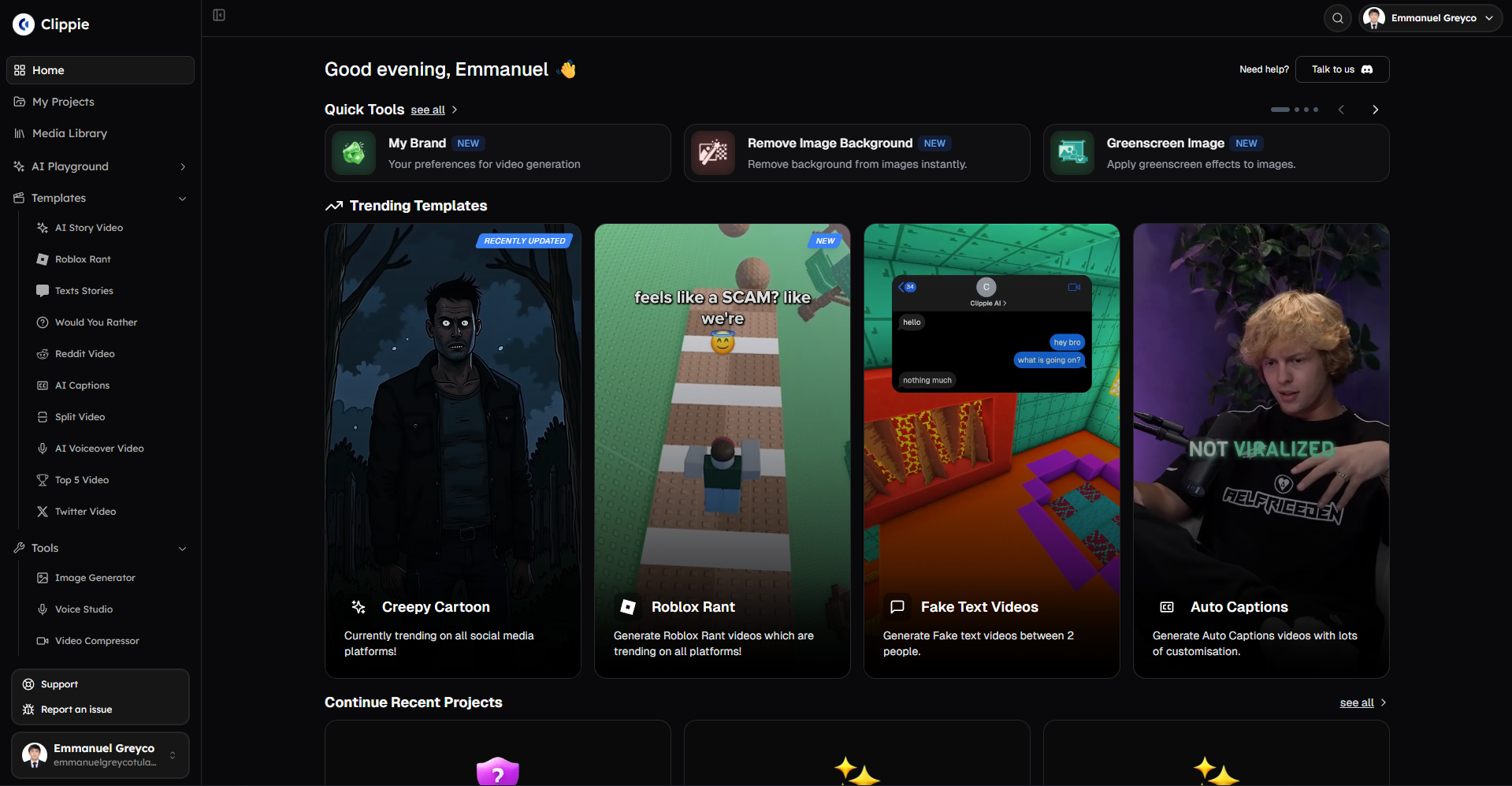
For video editors at every stage, whether experienced professionals seeking productivity multiplication, mid-career editors facing rate pressure from AI-enhanced competitors, or emerging editors building careers in AI-native environment, AI workflow transition through strategic automation adoption combined with tools like Clippie AI removes fundamental constraints limiting editing careers: the linear relationship between time investment and output capping monthly revenue regardless of skill level, and the commoditization pressure from basic editing task automation making technical execution alone insufficient for competitive rates. Visit clippie.ai to explore how video editors are achieving 3-5x productivity increases, commanding premium rates 40-70% higher than manual-only competitors, and building sustainable careers positioning AI as creative amplifier rather than competitive threat.
Read more

The Future of Faceless Content in 2026 (What to Expect)
The future of faceless content in 2026: where AI video, the rules, and monetization are heading, and what to do now.

The Best TikTok Niches for High CPM in 2026
The best high-CPM TikTok niches in 2026: which are worth the most, what CPM really means, and how to earn from them.

How to Make Money With Whop Clipping in 2026
How to make money with Whop clipping in 2026: how pay-per-view campaigns work, realistic earnings, and how to start.