
How to Start Video Editing in 2026 and Get Your First Paid Client
Start video editing in 2026 and land first paid client: Build 5 foundational skills, learn high-retention short-form editing, choose right tools accelerating growth, practice monetizable formats, use AI multiplying speed & avoid common mistakes.

If you're searching for how to start video editing in 2026 and get your first paid client, you're entering a market where AI-assisted editors earning $3,000-$8,000 monthly within 6-12 months dramatically outperform traditional editors struggling at $500-$1,500 monthly through strategic skill focus on high-demand formats (short-form content, performance ads, educational videos commanding premium rates), systematic tool selection emphasizing AI-accelerated workflows over manual complexity, and portfolio development targeting monetizable video types actually generating client inquiries rather than random practice clips. This guide delivers the five foundational editing skills mattering in 2026's AI-augmented landscape, systematic training in high-retention short-form and performance ad editing driving majority of paid opportunities, tool selection frameworks accelerating skill growth, practice project strategies building hire-ready portfolios, AI workflow integration multiplying output 3-5x, and positions Clippie AI as learning and production infrastructure enabling beginner-to-paid-client transition impossible through manual-only workflows.
Executive Summary: Aspiring video editors starting in 2026 achieve first paid client within 3-6 months through strategic skill development and AI workflow adoption, building five foundational skills (pacing and rhythm for viewer retention, audio clarity ensuring professional polish, visual storytelling conveying messages without words, brand consistency maintaining client standards, export optimization for platform requirements) through deliberate practice rather than tutorial consumption, specializing in high-demand formats (15-60 second short-form content, direct-response video ads, educational and tutorial videos, customer testimonials, social media content where 80% of paid opportunities concentrate), selecting tools strategically (Clippie AI for rapid learning and client work, supplemented by platform-specific skills as needed, avoiding expensive professional software until earning $2,000+ monthly), practicing with portfolio-building formats (recreating successful brand content, editing creator footage, producing mock client projects demonstrating real-world capability), integrating AI workflows via Clippie AI reducing editing time 70-85% enabling 3-5x output increase critical for landing and serving initial clients, and avoiding common mistakes (tutorial hell consuming content without practice, perfectionism preventing portfolio completion, underpricing first clients, ignoring client communication skills, targeting wrong markets) that delay or prevent monetization for 70% of aspiring editors.
Table of Contents
Step 1: Build the 5 Foundational Editing Skills That Matter in 2026
Step 2: Learn High-Retention Short-Form & Performance Ad Editing
Step 3: Choose Editing Tools That Accelerate Skill Growth
Step 4: Practice With Monetizable Video Formats (Not Random Clips)
Step 5: Use AI to Multiply Your Editing Speed
Common Beginner Mistakes to Avoid
FAQ: Starting Video Editing in 2026
Your Next Move
1. Step 1: Build the 5 Foundational Editing Skills That Matter in 2026
Professional editing quality emerges from five core competencies rather than software mastery, systematic development of pacing, audio, storytelling, consistency, and technical optimization enables client-ready work within 30-60 hours of deliberate practice regardless of tool choice.
Skill #1: Pacing and Rhythm (Retention Editing)
What it is: The ability to maintain viewer attention through strategic cutting, silence removal, and momentum building, preventing boredom and drop-off through intentional pacing decisions.
Why it matters most in 2026:
Platform algorithms reward watch time (retention = distribution)
Client success metrics: Completion rate, not just views
60-80% of viewers drop off in first 10 seconds of poorly paced content
Market demand: Retention editing skills command 40-70% premium rates
Core pacing techniques:
Technique 1: Dead space elimination
Remove: Pauses longer than 1-2 seconds (unless intentional)
Tighten: Space between sentences to 0.3-0.5 seconds
Result: Content feels dynamic, not sluggish
Practice: Take 5-minute talking-head video, remove all dead space (should reduce to 3-4 minutes)
Technique 2: Strategic cutting on action
Cut: During movement or gesture (not stillness)
Why: Brain doesn't notice cut during motion (invisible edit)
Result: Seamless flow, professional feel
Practice: Edit interview cutting only when subject moves hands, shifts position, or changes expression
Technique 3: Rhythm variation
Fast pacing: Product features, exciting moments (2-4 second clips)
Medium pacing: Explanations, demonstrations (4-8 second clips)
Slow pacing: Emotional moments, important points (8-15 second clips)
Result: Natural breathing rhythm, not monotonous
Practice: Edit same content three ways (fast, medium, slow), compare feel
The 3-second rule:
Principle: No single shot should exceed 3-5 seconds unless absolutely necessary
Why it works:
Human attention: Wanders after 3-4 seconds on static image
Engagement: Dynamic cutting maintains interest
Modern expectations: TikTok/Reels trained audiences for quick cuts
Application:
Count: Time each clip in timeline
If >5 seconds: Find B-roll, cutaway, or different angle to insert
Result: Video feels professional, not amateur
Retention optimization checklist:
Before declaring edit complete, verify:
☐ First 3 seconds hook viewer (pattern interrupt, curiosity, value promise)
☐ No dead space >2 seconds (unless intentional dramatic pause)
☐ Filler words removed ("um," "uh," "like", unless character-building)
☐ Pacing varies (not all fast, not all slow, rhythm)
☐ Every 8-10 seconds: Something new happens (visual change, new information)
☐ Watch yourself: Would you keep watching? (honest assessment)
Time to competency: 15-25 hours deliberate practice (30-50 videos edited)
Skill #2: Audio Clarity and Balance
What it is: Ensuring dialogue is clear, music complements without overpowering, and overall audio levels are consistent and professional, the most overlooked but critical skill.
Why it matters:
Viewers forgive mediocre visuals, not bad audio (research: 85% abandon videos with poor audio)
Professional vs. amateur: Audio quality is clearest differentiator
Client satisfaction: Bad audio = refund requests, no referrals
Core audio techniques:
Technique 1: Dialogue leveling
Target: -12dB to -6dB for spoken content (consistent throughout)
Tool: Use normalization or compressor (available in all editing software)
Result: Voice never too quiet or suddenly loud
Practice: Edit podcast episode, ensure all speakers at same volume level
Technique 2: Background music mixing
Music during dialogue: -24dB to -18dB (audible but not competing)
Music during no dialogue: -12dB to -8dB (prominent)
Ducking: Music automatically lowers when dialogue present
Result: Professional balance, not amateur clash
Practice: Add music to interview video, practice ducking when person speaks
Technique 3: Noise reduction
Remove: Background hum, room tone, HVAC noise
Preserve: Natural voice quality (don't over-process)
Result: Clean audio without "processed" sound
Practice: Take noisy audio, clean with noise reduction (compare before/after)
Technique 4: Room tone and transitions
Room tone: Natural ambient sound (not silence)
Transitions: Audio crossfades between clips (0.1-0.3 seconds)
Result: Smooth audio flow, no jarring cuts
Practice: Record 30 seconds of room tone, use as layer under edited dialogue
The audio priority hierarchy:
Priority 1: Clarity (can viewer understand words?)
If unclear: Fix or re-record (nothing else matters if unintelligible)
Priority 2: Consistency (is volume steady?)
If inconsistent: Level and normalize
Priority 3: Cleanliness (is there distracting noise?)
If noisy: Apply noise reduction
Priority 4: Enhancement (does music support?)
If music missing or bad: Add appropriately mixed music
Priority 5: Polish (professional sweetening)
EQ, compression, subtle effects
Most beginners: Start at Priority 5 (effects) before mastering 1-3 (fundamentals)
Correct approach: Master 1-3 before touching 4-5
Audio skills checklist:
Before delivering to client, verify:
☐ Dialogue intelligible (no parts where you strain to understand)
☐ Volume consistent (no sudden loud or quiet sections)
☐ Background noise minimized (no distracting hum, buzz, or echo)
☐ Music balanced (complements, doesn't overpower dialogue)
☐ No audio pops or clicks (smooth transitions between clips)
☐ Export levels appropriate (-1dB to -0.5dB peak, never 0dB)
Time to competency: 10-20 hours focused practice (20-40 videos)
Skill #3: Visual Storytelling Without Words
What it is: Using visuals, pacing, and sequencing to convey emotion, progression, and meaning, enabling understanding even with sound off (how 85% of social media consumed).
Why it matters:
Platform viewing: Most scroll with sound off (captions + visuals = message delivery)
Universal communication: Visual storytelling transcends language
Client value: Videos working without audio = more effective
Core visual storytelling techniques:
Technique 1: Shot progression (wide → medium → close)
Establish: Wide shot (context and setting)
Connect: Medium shot (subject and action)
Emphasize: Close-up (emotion and detail)
Result: Natural viewing progression mimicking how eyes explore scene
Practice: Edit product demo using only shot progression (no dialogue), ensure viewer understands product use
Technique 2: Visual contrast and comparison
Before/After: Show transformation clearly
Problem/Solution: Demonstrate contrast
Result: Message clear without explanation
Practice: Edit fitness transformation using only visuals showing progression
Technique 3: Text overlay storytelling
Key points: On-screen text reinforcing spoken message
Captions: Full dialogue for sound-off viewing
Graphics: Visual data, lists, frameworks
Result: Information conveyed even muted
Practice: Edit educational video, add text making 100% understandable without audio
Technique 4: B-roll as narrative
Support dialogue: Visual examples of concepts discussed
Fill gaps: Cover jump cuts with relevant footage
Enhance emotion: Visual metaphors and mood-setting
Result: Layered storytelling, not just talking head
Practice: Edit interview, use B-roll telling parallel visual story
The caption and text overlay strategy:
Modern necessity (not optional):
85% watch with sound off (mobile viewing)
Captions increase comprehension 56%
Text overlays boost retention 30-45%
Caption best practices:
Size: Large enough to read on phone (80-100% width)
Position: Lower third or center (doesn't cover subject's face)
Style: High contrast (white text on dark background or vice versa)
Timing: Synchronized precisely with speech
All professional 2026 content requires captions (not optional)
Text overlay types:
Title cards: Introducing sections or topics
Key points: Emphasizing important information
CTAs: Driving action (subscribe, buy, click)
Transitions: Connecting segments
Visual storytelling checklist:
Test video by watching with sound off:
☐ Can viewer understand message without audio?
☐ Do visuals support and enhance spoken content?
☐ Are key points reinforced with text overlays?
☐ Do transitions feel natural and motivated?
☐ Does pacing maintain interest through visual variety?
Time to competency: 20-30 hours practice (40-60 videos)
Skill #4: Brand Consistency and Template Systems
What it is: Maintaining visual and stylistic consistency across multiple videos, ensuring recognizable brand identity through repeated elements (colors, fonts, animations, pacing).
Why it matters for client work:
Clients need consistency (every video should feel related)
Efficiency: Templates eliminate starting from scratch
Professional perception: Consistency = established, trustworthy brand
Core brand consistency elements:
Element 1: Color grading consistency
Brand palette: Same color treatment across all videos
Mood: Warm/cool tones matching brand personality
Result: Instant brand recognition from colors alone
Practice: Edit 5 videos from same brand, ensure identical color feel
Element 2: Typography standards
Font family: 1-2 fonts maximum (brand-consistent)
Sizes: Standardized (headlines, body text, captions)
Animation: Consistent treatment (all titles enter same way)
Result: Cohesive, professional look
Practice: Create title template, use across 10 different videos
Element 3: Intro/outro sequences
Duration: Consistent length (3-5 seconds typical)
Elements: Logo, tagline, music sting
Placement: Always same position
Result: Brand bookends on all content
Practice: Design intro/outro, apply to 20 videos
Element 4: Transition style
Type: 1-2 transition styles maximum (not every available effect)
Usage: Consistent application (between sections, not random)
Restraint: Invisible edits preferred, transitions sparingly
Result: Professional polish without distracting viewer
Template system benefits:
For you (editor):
Speed: 60-75% faster than starting fresh
Consistency: Automatic brand adherence
Client happiness: Predictable quality
For clients:
Efficiency: Lower cost per video (your speed = their savings)
Reliability: Know what they're getting
Scalability: Easy to produce series
Building templates:
Create: After 3-5 videos for same client (identify patterns)
Include: Intro, outro, title cards, lower thirds, transitions, color grade
Refine: Update as brand evolves
Invest 4-6 hours creating template = Save 45-60 minutes per future video
Brand consistency checklist:
For client work, ensure:
☐ Color grade matches previous videos (consistency)
☐ Fonts and text styles follow brand guidelines
☐ Intro/outro present and consistent
☐ Transitions match established style
☐ Music genre and energy level appropriate for brand
☐ Overall "feel" matches client's other content
Time to competency: 10-15 hours (creating and refining templates)
Skill #5: Export Optimization for Platform Requirements
What it is: Technical knowledge ensuring videos export correctly for each platform, proper resolution, aspect ratio, codec, file size preventing quality loss or upload failures.
Why it matters:
Wrong specs = rejected uploads, quality issues
Platform optimization = better performance (algorithms favor properly formatted content)
Professional competency: Clients expect you to handle technical details
Platform-specific export requirements:
YouTube:
Resolution: 1920×1080 (1080p minimum) or 3840×2160 (4K)
Aspect ratio: 16:9 horizontal
Codec: H.264 (MP4)
Bitrate: 8-12 Mbps (1080p), 35-45 Mbps (4K)
Frame rate: Match source (23.976, 24, 25, 29.97, 30, 60 fps)
Instagram Feed:
Resolution: 1080×1080 (square)
Aspect ratio: 1:1
Codec: H.264 (MP4)
Duration: Up to 60 seconds (feed), 15 minutes (IGTV)
File size: Under 4GB
Instagram Reels / TikTok:
Resolution: 1080×1920 (vertical)
Aspect ratio: 9:16
Codec: H.264 (MP4)
Duration: 15-90 seconds optimal
Frame rate: 30 fps minimum
Facebook:
Resolution: 1920×1080
Aspect ratio: 16:9 (landscape), 1:1 (square), 9:16 (vertical)
Codec: H.264 (MP4)
Bitrate: 4-8 Mbps
LinkedIn:
Resolution: 1920×1080
Aspect ratio: 16:9 or 1:1
Codec: H.264 (MP4)
Duration: Up to 10 minutes
File size: 5GB maximum
The multi-platform export strategy:
Master file approach:
Edit: At highest resolution (1080p or 4K, 16:9)
Export master: Uncompressed or high-quality (archive)
Platform exports: Generate from master for each platform
Efficient workflow:
Edit once: Don't re-edit for each platform
Export variations: Use presets for each platform
Time savings: 5 minutes per platform vs. 30+ minutes re-editing
Export optimization checklist:
Before delivering to client:
☐ Resolution appropriate for platform (1080p minimum)
☐ Aspect ratio correct (16:9, 9:16, or 1:1 based on platform)
☐ Codec supported (H.264 MP4 universal)
☐ File size reasonable (under platform limits, under 500MB typically)
☐ Audio and video in sync (test first 10 seconds and last 10 seconds)
☐ No quality degradation (export settings preserve original quality)
Time to competency: 5-10 hours (learning and testing export settings)

2. Step 2: Learn High-Retention Short-Form & Performance Ad Editing
Market demand concentrates in high-retention short-form content and direct-response ads, specializing in these formats generates 70-85% of beginner editing opportunities while commanding premium rates due to skill scarcity.
Why Short-Form Dominates 2026 Editing Opportunities
Market reality:
Content creation trends:
78% of businesses produce short-form content (Reels, Shorts, TikTok)
65% increased short-form budget in 2025-2026
Average: 40-80 short-form videos needed monthly per business
Editor demand: Massive and growing
Long-form decline for beginners:
Long-form editing: Saturated market (experienced editors dominate)
Entry barrier: Clients want proof of capability (portfolio requirement high)
Price competition: Commoditized, lower rates
Opportunity: Limited for beginners
Short-form advantage:
New format: Skill gap (many editors haven't adapted)
Lower barrier: 30-second portfolio piece easier than 10-minute
Higher volume: More projects = more opportunities to practice and earn
Recommendation: Start with short-form, expand later
High-Retention Short-Form Structure
The 15-30 second formula:
0-3 seconds: Hook (stop the scroll)
Pattern interrupt: Unexpected visual, bold statement, question
Value promise: "Here's how to..."
Curiosity: Incomplete information creating need to know
Objective: Prevent immediate scroll-past
3-15 seconds: Value delivery
Core message: One clear point (not 5 different things)
Visual support: B-roll, graphics, demonstration
Pacing: Quick cuts, momentum maintained
Objective: Deliver promised value
15-20 seconds: Payoff and CTA
Conclusion: Wrap up message
Call-to-action: Like, follow, buy, click
Brand recall: Logo, product shot, tagline
Objective: Drive desired action
Editing techniques for retention:
Technique 1: Jump cuts on beats
Cut: Every 2-4 seconds aligned with dialogue pauses
Purpose: Maintains visual interest, prevents static feeling
Result: Video feels energetic, not slow
Technique 2: Strategic text overlays
Emphasize: Key words or phrases (3-5 per video)
Timing: Appear in sync with spoken word
Style: Animated entrance (subtle, not distracting)
Result: Reinforces message, aids sound-off viewing
Technique 3: B-roll layering
Support: Visual examples of concepts discussed
Frequency: Every 5-8 seconds, alternate between speaker and B-roll
Relevance: Directly related to current topic
Result: Visual variety preventing boredom
Technique 4: Zoom and pan (subtle)
Zoom: Slow push-in during important points (105-110% over 2-3 seconds)
Pan: Slight movement across static images (creates life)
Restraint: Subtle, not nauseating
Result: Static footage feels dynamic
Short-form practice assignments:
Assignment 1: Recreate viral content
Find: 5 viral short-form videos in your target niche
Analyze: What makes them work (hook, pacing, payoff)
Recreate: Edit your own version using same structure
Learning: Pattern recognition of what retains viewers
Assignment 2: 30-in-30 challenge
Edit: 30 short-form videos in 30 days (one daily)
Constraint: All under 60 seconds
Variety: Different formats (tutorial, testimonial, product demo, etc.)
Learning: Speed and versatility through repetition
Assignment 3: Retention testing
Edit: Same content 3 different ways (slow, medium, fast pacing)
Test: Get feedback on which version holds attention best
Learn: What pacing choices affect retention
Learning: Cause-and-effect of editing decisions
Time to competency: 40-60 hours practice (100-150 short-form videos)
Performance Ad Editing (High-Value Skill)
What makes ad editing different:
Purpose-driven editing:
Goal: Drive clicks and conversions (not just views)
Optimization: Every decision supports conversion objective
Testing: Multiple variations needed (not single "perfect" version)
Ad-specific techniques:
Technique 1: Benefit-forward editing
First 3 seconds: Problem or result (not brand logo)
Visual hierarchy: Product benefit > production quality
Text overlays: Benefits and offer clear
Result: Viewer immediately understands value
Technique 2: Pattern interrupt hooks
Visual: Unexpected imagery (stops scroll)
Audio: Attention-grabbing sound (if sound-on)
Text: Bold claim or question
Result: Viewer pauses to watch
Technique 3: Multiple CTA placements
Throughout: Not just at end (many don't finish)
Frequency: Every 10 seconds, reminder of offer
Clarity: Unmistakable what action to take
Result: Higher conversion regardless of watch time
Technique 4: Social proof integration
Statistics: "50,000 sold" visually prominent
Testimonials: Quick clips from customers
Trust badges: Reviews, ratings, certifications
Result: Credibility built quickly
Ad editing practice assignments:
Assignment 1: Competitor analysis
Find: 10 direct-response video ads in your target industry
Analyze: Structure, hooks, CTAs, pacing
Document: What patterns work repeatedly
Learning: Industry-specific ad conventions
Assignment 2: Variation creation
Take: Same footage
Create: 5 different ad variations (different hooks, offers, CTAs)
Learning: Systematic testing approach (what clients need)
Assignment 3: Mock client campaign
Choose: Local business without video ads
Create: 3-5 ad variations for them (pro bono or spec work)
Result: Portfolio pieces demonstrating real-world capability
Learning: Client-focused editing (not art, business)
Time to competency: 30-50 hours practice (50-80 ad edits)
3. Step 3: Choose Editing Tools That Accelerate Skill Growth
Strategic tool selection focuses on learning efficiency and client-work capability, avoid expensive professional software initially, prioritize AI-assisted tools enabling faster skill development and competitive output from day one.
The Tool Selection Framework
Beginner tool priorities:
Priority 1: Speed to competency
How fast can you learn to produce client-ready work?
Metric: Hours to first portfolio-worthy video
Priority 2: Output multiplier
How much can you produce in available time?
Metric: Videos completed per hour
Priority 3: Market relevance
Does tool enable work clients actually pay for?
Metric: Job listings mentioning tool
Priority 4: Cost efficiency
Can you afford it before earning?
Metric: Months to ROI at typical beginner rates
De-prioritize (for beginners):
Feature breadth (don't need 95% of pro features)
Industry prestige (clients care about results, not tools used)
Tool recommendations by learning stage:
Stage 1: First 30 days (learning fundamentals)
Primary tool: Clippie AI ($35/month Creator plan)
Why start here:
AI assistance: Automates technical complexity (focus on creative decisions)
Templates: Built-in structures teach good practices
Speed: Produce portfolio pieces in 25-45 minutes vs. 2-4 hours manual
Client-ready output: Professional quality from day one
What you learn:
Pacing decisions (AI removes technical execution barrier)
Brand consistency (templates demonstrate standards)
Retention editing (built-in best practices)
Outcome: Portfolio-ready videos in weeks, not months
Supplementary: CapCut (free)
Purpose: Learning mobile editing (valuable skill)
Use case: TikTok/Reels native creation
Benefit: Expands service offerings
Stage 2: Months 2-6 (building client base)
Continue: Clippie AI (primary production)
Client work: 80% of projects handled efficiently
Speed: Critical for serving multiple clients
Consistency: Templates ensure quality
Add: DaVinci Resolve (free) OR Adobe Premiere Pro (if client requires)
Purpose: Advanced techniques (color grading, complex compositing)
Frequency: 10-20% of projects need advanced features
Learning: Supplement Clippie AI, not replace
Learning strategy:
Clippie AI: Speed and volume (most projects)
Advanced tool: Specific techniques when needed
Avoid: Abandoning AI efficiency for manual complexity
Stage 3: Months 6-12+ (scaling and specialization)
Primary: Clippie AI + specialized tools
Clippie AI: Efficiency at scale (20-60 videos monthly)
After Effects (if motion graphics specialist): $22.99/month
Color grading software (if colorist path): DaVinci Resolve Studio $295 one-time
Strategic specialization:
Deep expertise: One specific technique or format
Premium rates: Specialist commands 40-80% higher rates
Tool mastery: Invest in specialist tools once earning $3,000+ monthly
The "expensive software" trap:
Common beginner mistake:
Buy: $600+ annual Adobe Creative Cloud subscription
Believe: "I need professional tools to get professional results"
Reality: Spends 60-80 hours learning software, not practicing editing
Outcome: No portfolio, no clients, $600 poorer
Better approach:
Start: Affordable AI-assisted tool (Clippie AI $35-$70/month)
Focus: Portfolio building and client acquisition
Revenue: $2,000+ monthly from clients
Then: Invest in advanced tools if needed
Outcome: Profitable within 3-6 months, tools paid by client revenue
Tool learning time investment:
Clippie AI:
Basic competency: 4-8 hours
Client-ready work: 15-25 hours total
Advantage: AI handles complexity, focus on creative decisions
Adobe Premiere Pro:
Basic competency: 30-60 hours
Client-ready work: 100-200 hours total
Challenge: Must learn technical execution before creative work
DaVinci Resolve:
Basic competency: 40-80 hours
Client-ready work: 150-300 hours total
Challenge: Steeper learning curve, powerful but complex
Recommendation for beginners:
Month 1-3: Clippie AI exclusively (build portfolio fast)
Month 4-6: Add free tool (DaVinci Resolve) for learning
Month 7+: Invest in specialized tools if revenue justifies
4. Step 4: Practice With Monetizable Video Formats (Not Random Clips)
Portfolio effectiveness determines client acquisition speed, editing monetizable formats businesses actually pay for generates inquiries while random practice clips demonstrate no commercial value.

The Portfolio Strategy
What clients look for:
Not: Technical skill demonstration
Mistake: "Look at this amazing transition I created!"
Client thinking: "Cool effect, but can you help my business?"
Yes: Business problem solving
Correct: "Here's a product demo that increased conversions 40%"
Client thinking: "This person understands business outcomes"
Portfolio should answer:
Can you create content that achieves my goals?
Have you worked in my industry or with similar content?
Will your work match my brand standards?
Monetizable format #1: Product demonstration videos
Why clients hire editors for these:
Volume: Need 10-30 monthly for different products
Consistency: Brand standards crucial
Performance: Directly tied to sales (measurable ROI)
Practice project:
Select: 5 products (ecommerce, SaaS, physical goods)
Create: 20-30 second demo for each
Show: Problem → Product → Solution → CTA
Portfolio piece: "Product Demo Portfolio - 5 Brands"
Client appeal:
Demonstrates: E-commerce and retail understanding
Shows: Brand adaptation across different products
Proves: Can deliver what they need
Monetizable format #2: Social media content (Reels/Shorts/TikTok)
Why clients hire for these:
Volume: Need 40-80+ monthly
Expertise: Most businesses can't produce in-house
Results: Directly impacts reach and engagement
Practice project:
Choose: 3 target businesses (local or online)
Create: 5-10 piece content series for each
Vary: Educational, entertaining, promotional
Portfolio piece: "Social Media Content Series"
Client appeal:
Shows: Volume production capability
Demonstrates: Platform understanding (vertical, captions, hooks)
Proves: Can handle ongoing content needs
Monetizable format #3: Video ads (Facebook/Instagram/TikTok)
Why clients hire for these:
Direct ROI: Ads drive revenue (measurable value)
Testing: Need 10-20 variations monthly
Expertise: Ad-specific editing different from organic content
Practice project:
Find: 5 businesses in your target niche
Create: 3 ad variations for each (different hooks/offers)
Include: Clear CTAs, benefit statements, urgency
Portfolio piece: "Video Ad Campaign Portfolio"
Client appeal:
Highest-value work: Ad editing commands premium rates ($75-$150/hour vs. $35-$65 general editing)
Shows: Understanding of direct-response marketing
Proves: Can contribute to revenue growth
Monetizable format #4: Customer testimonials
Why clients hire for these:
Social proof: Critical for trust building
Volume: Need testimonials from multiple customers
Quality: Must look professional to be credible
Practice project:
Record: 5 friends/family giving testimonials (for anything - book, restaurant, product)
Edit: 20-40 seconds each highlighting key points
Variety: Different visual styles (interview, b-roll, text-focused)
Portfolio piece: "Customer Testimonial Showcase"
Client appeal:
Demonstrates: Storytelling ability
Shows: Can work with real people (not just stock footage)
Proves: Understanding of social proof principles
Monetizable format #5: Educational/tutorial videos
Why clients hire for these:
Authority building: Positions clients as experts
Customer education: Reduces support burden
Evergreen content: One video works indefinitely
Practice project:
Create: 5 tutorial videos (teach anything - cooking, software, DIY)
Format: Screen recording or demonstration
Length: 3-8 minutes each
Portfolio piece: "Educational Content Portfolio"
Client appeal:
Shows: Ability to explain complex topics clearly
Demonstrates: Screen recording capability (valuable for SaaS/tech clients)
Proves: Can create long-form content when needed
Portfolio assembly best practices:
Format: Website or PDF portfolio
Organize: By video type or industry
Include: Brief context for each piece (goal, approach, outcome if measurable)
Show: Before/after or original footage vs. edited result
Provide: Easy navigation and contact information
Length: 12-20 portfolio pieces
Variety: Multiple formats and industries
Quality over quantity: Better to have 12 excellent pieces than 30 mediocre
Update: Replace weakest pieces as skills improve
Presentation tips:
Lead: With your strongest, most relevant piece
Context: Explain business objective (not just "I edited this")
Results: Include metrics when possible ("Increased CTR 40%")
Call to action: Clear next step for potential clients
Time to build portfolio: 40-80 hours (creating 12-20 pieces)

5. Step 5: Use AI to Multiply Your Editing Speed
AI workflow integration enables 3-5x output increase critical for beginner success, Clippie AI and complementary AI tools reduce per-video editing time from 2-4 hours to 25-45 minutes enabling portfolio building, client service, and competitive pricing impossible through manual-only workflows.
The AI-Enhanced Editing Workflow
Traditional manual workflow (3-4 hours per 5-minute video):
Phase 1: Organization (20-30 min)
Import footage
Create bins and organize
Review all clips
Phase 2: Assembly (60-90 min)
Build rough cut
Select best takes
Sequence clips
Phase 3: Refinement (80-120 min)
Remove filler words manually
Tighten pacing
Add transitions
Color correction
Audio mixing
Phase 4: Polish (30-45 min)
Add captions manually
Create graphics
Final review
Export
Total: 190-285 minutes (3.2-4.75 hours)
AI-enhanced workflow with Clippie AI (30-50 min per 5-minute video):
Phase 1: Upload and template selection (5 min)
Upload raw footage to Clippie AI
Select appropriate template (product demo, testimonial, educational)
Configure brand settings if needed
Phase 2: AI autonomous processing (15-20 min)
AI removes filler words automatically
AI tightens pacing (removes dead space)
AI generates and syncs captions
AI applies color correction
AI balances audio levels
Happening automatically while you work on other tasks
Phase 3: Human review and refinement (20-30 min)
Review AI output
Make creative decisions (pacing adjustments, select best takes)
Add custom graphics or B-roll
Verify brand consistency
Approve final cut
Phase 4: Export (2-5 min)
Batch export multiple formats (YouTube, Instagram, TikTok)
Automatic: Multiple aspect ratios generated simultaneously
Total: 42-60 minutes active work (65-75% time reduction)
Clippie AI Specific Features for Beginners
Feature: Template-based learning
How it accelerates skill development:
Traditional learning:
Watch tutorials: 40-80 hours (theoretical knowledge)
Practice randomly: 60-120 hours (trial and error)
Total: 100-200 hours to produce consistent quality
Template-based learning (Clippie AI):
Select template: Immediately see professional structure
Edit within framework: Learn by doing (templates guide decisions)
Iterate quickly: Produce 5-10 videos in time of 1 manual video
Total: 30-60 hours to client-ready competency
Why it works:
Constraints: Templates provide structure (decision fatigue reduced)
Best practices: Built-in (learn what works through examples)
Repetition: Volume enables pattern recognition faster
Feature: Automatic caption generation
Why critical for beginners:
Manual captions:
Time: 15-25 minutes per 5-minute video
Accuracy: Easy to make errors (typos, timing mistakes)
Barrier: Tedious work discourages practice
AI captions (Clippie AI):
Time: 30 seconds (review and approve)
Accuracy: 95-98% (minimal corrections needed)
Enabler: Removes tedious barrier, enables more practice
Business impact:
Portfolio: Captions on all pieces (professional standard)
Client work: Faster delivery (competitive advantage)
Pricing: Can charge less (efficiency) or same (higher profit)
Feature: Batch processing for variations
The beginner advantage:
Client request: "I need 5 variations of this ad testing different hooks"
Manual approach:
Edit variation 1: 2-3 hours
Edit variation 2: 2-3 hours (mostly same work, slight changes)
Edit variations 3-5: 6-9 hours total
Total: 10-15 hours (unprofitable at beginner rates)
Clippie AI batch approach:
Upload all components (5 hooks, same body, same CTA)
AI generates all 5 variations automatically
Human review: 20 minutes each × 5 = 100 minutes
Total: 2-2.5 hours (profitable even at lower rates)
Competitive advantage:
Can accept: Projects manual editors decline (too time-consuming)
Deliver faster: Client receives variations in days not weeks
Profit margin: Higher (efficiency enables competitive pricing)
Feature: Multi-format export
Why beginners need this:
Client expectation (2026):
"I need this for YouTube, Instagram feed, Instagram Stories, and TikTok"
Manual: Re-edit and export each format separately (3-5 hours)
Problem: Eats into profit margin significantly
Clippie AI solution:
Edit once: Master 16:9 horizontal version
Export all: AI generates 9:16, 1:1, optimized for each platform
Time: 5-10 minutes total (vs. 3-5 hours manual)
Result: Can offer multi-platform delivery without sacrificing profit
Complementary AI Tools
Tool: ChatGPT for scriptwriting
Use case: Client needs video script
Without AI:
Research topic: 30-60 min
Write outline: 20-30 min
Write full script: 60-90 min
Total: 110-180 minutes
With AI:
Prompt: "Write 90-second product demo script for [product], highlighting [benefits], targeting [audience]"
Generate: 2-3 minutes
Refine: 15-20 minutes (edit AI output)
Total: 17-23 minutes (85-90% time savings)
Beginner advantage:
Can offer: Scriptwriting as service (additional revenue)
Deliver faster: Scripts in hours not days
Learn faster: See good script examples repeatedly
Tool: Runway ML or similar for AI video generation (supplementary)
Use case: Need B-roll footage client didn't provide
Without AI:
Stock footage search: 30-60 min (finding right clips)
Purchase: $50-$200 per project
Problem: Time consuming and expensive
With AI video generation:
Prompt: "Generate 5-second clip of [description]"
Generate: 2-5 minutes
Cost: Included in tool subscription
Result: Fast, affordable B-roll supplementation
Beginner advantage:
Portfolio building: Create B-roll for practice projects
Client work: Fill gaps without expensive stock footage
Creative flexibility: Generate exactly what's needed
The 3-Month AI-Accelerated Learning Plan
Month 1: Foundation + AI tool mastery (60-80 hours)
Week 1-2: Clippie AI fundamentals (20-30 hours)
Tutorial: Complete all Clippie AI training (4-6 hours)
Practice: Edit 10 short-form videos using templates (15-20 hours)
Experiment: Try all templates, understand when to use each
Week 3-4: First portfolio pieces (40-50 hours)
Create: 8-12 monetizable format videos
Focus: Quality over speed (learning patterns)
Include: Product demos, social content, testimonials
Outcome: Initial portfolio (8-12 pieces)
Month 2: Volume + specialization (80-100 hours)
Week 1-2: High-volume practice (40-50 hours)
Edit: 30-40 short-form videos (increasing speed)
Goal: Reduce time per video 30-50%
Track: Timing each edit (measure improvement)
Week 3-4: Specialization + advanced portfolio (40-50 hours)
Choose: One high-value format (ads, educational, or specific niche)
Create: 5-8 advanced portfolio pieces in specialty
Polish: Refine earlier work (replace weakest pieces)
Outcome: 15-20 piece portfolio with specialty focus
Month 3: Client acquisition + delivery (60-80 hours)
Week 1-2: Marketing and outreach (30-40 hours)
Build: Simple portfolio website (Wix, Squarespace)
Outreach: Contact 30-50 potential clients
Networking: Join relevant communities
Goal: First client inquiry
Week 3-4: First client projects (30-40 hours)
Deliver: 1-3 paid projects (even if lower rates)
Experience: Real client feedback and iteration
Refine: Workflow based on real-world demands
Outcome: First paid client + testimonial
Total investment: 200-260 hours over 3 months
Typical outcome: 1-3 paying clients, $500-$2,000 earned, clear path to $3,000+ monthly by Month 6
6. Common Beginner Mistakes to Avoid
Understanding failure patterns enables strategic avoidance, these five mistakes cause 70% of aspiring editors to quit within 6 months while recognizing and correcting them dramatically improves success probability.
Mistake #1: Tutorial Hell (Consumption Without Practice)
The trap:
Watch: 40-80 hours of editing tutorials
Believe: "I need to learn more before I start"
Reality: No portfolio, no skills (knowledge ≠ ability)
Why it fails:
Theory overload: Information without application forgotten
Perfectionism: "I'm not ready yet" (never feel ready)
No portfolio: Can't get clients without proof of work
The fix:
80/20 rule: 20% learning, 80% doing
Start immediately: Edit first practice video after 2-4 hours of learning
Embrace mistakes: Learning through error correction
Action plan:
Watch: 1-2 hour tutorial on one specific technique
Practice: Apply that technique in 3-5 videos immediately
Repeat: Learn → Do → Learn → Do (alternating)
Result: Portfolio of 20-30 videos in time others watch 100 hours of tutorials
Mistake #2: Perfectionism Preventing Portfolio Completion
The trap:
Edit: 20-30 hours on single portfolio piece
Obsess: Over minute details (shadow slightly wrong, color 2% off)
Outcome: 2-3 portfolio pieces in 3 months (insufficient to land clients)
Why it fails:
Diminishing returns: 80% quality in 20% time, 20% improvement takes 80% time
Portfolio quantity: Clients need to see variety and volume capability
Real-world mismatch: Clients want good work fast, not perfect work slow
The fix:
Time-box edits: Set 60-90 minute limit per practice piece
"Good enough" standard: 80% quality gets clients, not 100%
Volume over perfection: 15 good pieces > 3 perfect pieces
Action plan:
Set timer: Force completion in allocated time
Move on: Once time expires, piece is done (don't revisit)
Accept imperfection: Portfolio shows range, not perfection
Result: Complete portfolio in weeks not months, land clients faster
Mistake #3: Underpricing First Clients (Race to Bottom)
The trap:
Desperation: "I'll edit for $10/video to get experience"
Client acquisition: Attract wrong clients (cheapest seekers)
Burnout: Work 40 hours for $200-$400 monthly (unsustainable)
Why it fails:
Time investment: Editing takes same time regardless of price
Client quality: Cheap clients demand most, appreciate least
Reputation: Hard to raise rates (you're "the cheap editor")
The fix:
Minimum rates: Start at $50-$100 per video (minimum)
Value positioning: "Affordable rates while building portfolio" (not "cheap")
Quality clients: Target businesses not individuals (budget exists)
Recommended first-client pricing:
Short-form (15-60s): $75-$150 per video
Mid-form (2-5 min): $200-$400 per video
Long-form (5-15 min): $400-$800 per video
Package discount: 5 videos = 10-15% off
Rationale:
Time investment: Your 2-4 hours valued at $25-$75/hour (entry-level acceptable)
Client filtering: Businesses able to pay this = serious clients
Growth path: Easier to raise from $100 to $150 than $10 to $50
Mistake #4: Ignoring Client Communication Skills
The trap:
Focus: 100% on editing skills
Ignore: How to talk to clients, manage expectations, handle feedback
Reality: Great editor with poor communication = unemployed
Why it fails:
Client satisfaction: 50% quality, 50% communication/expectations
Referrals: Happy clients refer (communication matters most)
Retention: Repeat clients = stable income (communication builds relationships)
The fix:
Establish: Clear project scope and timeline upfront
Communicate: Proactive updates (don't wait for client to ask)
Manage: Expectations around revisions (2-3 rounds included, then charge)
Listen: Client feedback carefully (what they need, not what you want to create)
Essential communication skills:
Skill 1: Discovery questions
"What's the primary goal of this video?" (conversions, awareness, education)
"Who's the target audience?" (understand viewer)
"What's your timeline and budget?" (set realistic expectations)
Skill 2: Progress updates
Rough cut delivery: 48-72 hours (show work in progress)
Check-ins: Every 2-3 days on longer projects
Proactive: Notify of delays before deadline passes
Skill 3: Revision management
Clarify: "Can you point to the timestamp where changes are needed?"
Document: All feedback in writing (avoid miscommunication)
Boundaries: "This project includes 2 revision rounds, additional rounds are $X"
Result: Reputation for professionalism = referrals and repeat business
Mistake #5: Targeting Wrong Markets (Competing on Price)
The trap:
Target: General "I'll edit anything for anyone"
Compete: Against thousands of other generalist beginners
Result: Price competition (whoever charges least wins)
Why it fails:
Commoditization: If anyone can do it, price is only differentiator
No expertise: Cannot command premium for specialized knowledge
Scalability: Cannot build reputation in "everything"
The fix:
Niche selection: Choose specific industry or content type
Specialized portfolio: All pieces demonstrate niche expertise
Authority positioning: "I edit for [X industry]" not "I edit videos"
Profitable niches for beginners:
Niche 1: Local business video marketing
Target: Restaurants, gyms, salons, retail stores
Need: Social media content, ads, testimonials
Volume: 10-30 videos monthly per client
Your advantage: Local businesses lack video expertise
Niche 2: E-commerce product videos
Target: Shopify/Amazon sellers
Need: Product demos, unboxings, comparison videos
Volume: 5-20 videos monthly per client
Your advantage: Directly tied to sales (measurable ROI)
Niche 3: Course creators/educators
Target: Online course creators, coaches, consultants
Need: Course content, promotional videos, testimonials
Volume: 10-40 videos per course + ongoing content
Your advantage: Recurring work as they create new courses
Niche 4: Real estate agents
Target: Realtors, property managers
Need: Property tours, agent introductions, market updates
Volume: 5-15 videos monthly per agent
Your advantage: High budget tolerance (commission-based income)
Selection criteria:
Demand: Industry actively hiring editors (check job boards)
Budget: Businesses can afford $500-$2,000+ monthly
Volume: Ongoing need (not one-time projects)
Result: Become known expert in niche, command premium rates
7. FAQ: Starting Video Editing in 2026
How long does it realistically take to get your first paid client?
Answer: First paid client acquisition typically occurs within 3-6 months of focused practice for editors following systematic skill development and portfolio building approach, with timeline breakdown showing Month 1-2 spent building foundational skills and creating 12-20 portfolio pieces through deliberate practice totaling 80-120 hours, Month 3-4 dedicated to outreach and networking contacting 30-50 potential clients while refining portfolio based on initial feedback, Month 5-6 experiencing first paid projects converting initial inquiries into $500-$2,000 total revenue, making critical factors include daily practice consistency (3-5 hours daily faster than 10 hours weekly due to momentum and pattern recognition), portfolio quality targeting monetizable formats businesses actually hire for rather than random practice clips, and strategic outreach to businesses with budget rather than competing in overcrowded freelance marketplaces, with realistic expectation that 60-70% of beginners quit within first 3 months before timeline allows success while those persisting through initial slow period achieving sustainable $2,000-$5,000 monthly income by Month 9-12
Realistic timeline milestones:
Month 1-2: Skill building phase
Hours invested: 80-120 total (10-15 hours weekly)
Portfolio pieces: 12-20 completed
Paid work: $0 (not ready yet)
Focus: Learning and practice, not marketing
Month 3-4: Outreach phase
Hours invested: 60-80 (outreach, networking, portfolio refinement)
Clients contacted: 30-50
Response rate: 10-20% (3-10 responses)
Paid work: $0-$500 (maybe first small project)
Focus: Marketing yourself, not just creating
Month 5-6: Conversion phase
Proposals/pitches: 5-15
Conversions: 1-3 clients
Revenue: $500-$2,000 total
Milestone: First testimonial and case study
Month 7-12: Growth phase
Active clients: 3-8
Monthly revenue: $2,000-$5,000
Repeat business: 30-50% (clients coming back)
Outcome: Sustainable editing income
Factors accelerating timeline:
Daily practice (vs weekly):
Recommendation: Daily practice, even 1-2 hours, beats sporadic long sessions
Network access:
Existing connections: Friends/family business owners (warm leads)
Cold outreach only: Longer timeline (building trust from zero)
Advantage: Leverage existing relationships for first clients
Niche focus:
Specialist: "I edit for fitness brands" (differentiated)
Generalist: "I edit videos" (commodity)
Result: Niche specialists land clients 40-60% faster
Warning: Unrealistic expectations
Avoid believing:
"I'll be making $5,000/month in 2 months" (extremely rare, causes discouragement)
"First client will pay $1,000+ per video" (unlikely at beginner skill level)
"Clients will find me automatically" (requires active marketing)
Embrace reality:
First clients pay modestly ($500-$1,500 total project value)
Building to $3,000+ monthly takes 6-12 months of consistent work
Success requires both editing skill AND business/marketing effort
Should I specialize in one type of editing or stay generalist as a beginner?
Answer: Strategic specialization in one high-demand format or industry accelerates client acquisition and enables premium pricing compared to generalist positioning, with data showing specialized beginners landing first client 40-60% faster and commanding 30-50% higher rates due to perceived expertise even at entry level, making optimal approach selecting specialization within first 2-3 months based on personal interest, market demand, and competitive landscape, with profitable specialization options including short-form social content (highest volume demand, 40-80 monthly videos per client, moderate rates $50-$150 per video), performance advertising (high-value work, direct ROI connection, premium rates $100-$300 per variation), educational/tutorial content (evergreen demand, recurring client relationships, mid-range rates $200-$500 per video), or industry-specific focus (real estate, e-commerce, fitness, SaaS enabling domain expertise positioning), while generalist approach appropriate only after establishing baseline income $3,000+ monthly providing safety net for experimentation and diversification.
Specialization vs. Generalist comparison:
Specialized beginner (example: E-commerce product videos):
Portfolio: 15-20 product demo videos across different brands
Pitch: "I specialize in product videos that increase conversions"
Client perception: Expert in their specific need
Pricing: $100-$200 per video (specialized premium)
Competition: Small (most editors are generalists)
Time to first client: 3-5 months typical
Generalist beginner:
Portfolio: Mix of random video types
Pitch: "I edit all types of videos"
Client perception: Jack-of-all-trades (unproven in their specific need)
Pricing: $50-$100 per video (commodity rates)
Competition: Massive (competing with everyone)
Time to first client: 5-8 months typical
How to choose your specialization:
Step 1: Assess interests (what content do you consume?)
Fitness content? → Specialize in fitness brand editing
Business podcasts? → Specialize in B2B educational content
Fashion/beauty? → Specialize in e-commerce product videos
Principle: Edit content you understand and enjoy
Step 2: Evaluate market demand
Research: Job boards (Upwork, Fiverr, Indeed) for "video editor [niche]"
Count: How many listings in last 30 days?
Target: Niches with 20+ monthly job postings (sufficient demand)
Step 3: Assess competition level
Search: "[Niche] video editor" + your location
Count: How many specialists already exist?
Target: Moderate competition (some exist proving demand, but not saturated)
Step 4: Validate budget capacity
Question: Can businesses in this niche afford $500-$2,000 monthly?
Examples with budget: SaaS, real estate, e-commerce, professional services
Examples without budget: Nonprofits, startups, very small local businesses
Target: Industries with proven marketing budgets
Recommended beginner specializations (2026):
Option 1: Short-form social content (Instagram/TikTok)
Demand: Extremely high (every business needs)
Barrier: Relatively low (quick to learn)
Volume: 40-80 videos monthly per client (consistent work)
Rates: $50-$150 per video
Monthly income potential: $2,000-$5,000 from 2-3 clients
Option 2: Video ads (Facebook/Instagram/TikTok)
Demand: High (paid traffic essential for growth)
Barrier: Medium (requires understanding of direct response)
Volume: 10-30 variations monthly per client
Rates: $100-$300 per variation
Monthly income potential: $3,000-$7,000 from 2-3 clients
Option 3: Real estate videos
Demand: Moderate-high (every listing needs video)
Barrier: Low (straightforward format)
Volume: 5-15 videos monthly per agent
Rates: $150-$400 per property video
Monthly income potential: $2,500-$6,000 from 3-5 agents
Option 4: E-commerce product videos
Demand: Very high (Amazon/Shopify sellers)
Barrier: Low-medium (product demo skills)
Volume: 10-40 videos monthly per brand
Rates: $75-$250 per product video
Monthly income potential: $3,000-$8,000 from 2-4 brands
When to stay generalist:
Already earning $3,000+ monthly:
Safety net: Established income allows experimentation
Diversification: Multiple client types reduces risk
Learning: Exposure to different formats expands skills
Very small market (rural area with limited businesses):
Necessity: May need to serve all local needs
Strategy: Generalist locally, specialist when expanding online
Working toward agency/production company:
Goal: Need breadth of capabilities
Timeline: Build specialist income first, then expand
Can I realistically learn video editing while working full-time?
Answer: Video editing skill development entirely compatible with full-time employment through strategic time management and focused practice, with successful part-time learners dedicating 10-15 hours weekly (1-2 hours daily plus 5-6 hours weekend) achieving client-ready competency within 4-6 months compared to 2-3 months for full-time learners, making critical success factors include morning routine consistency (editing 6-7am before work eliminates excuses and decision fatigue), focused practice sessions on specific skills rather than aimless experimentation, AI tool adoption via Clippie AI reducing required practice hours 40-60% through template-based learning and automated technical execution, and realistic expectation management accepting slower timeline than full-time commitment while maintaining momentum through daily engagement preventing skill decay, with data showing 60% of successfully monetizing editors started part-time while employed transitioning to full-time editing only after reaching $4,000-$6,000 monthly income providing financial safety.
Part-time learning schedule (10-15 hours weekly):
Weekday routine (1-2 hours daily, 5-10 hours weekly):
Option 1: Early morning (recommended)
6:00-7:30am: Editing practice before work
Advantage: No distractions, fresh mind, consistent routine
Disadvantage: Requires earlier bedtime
Option 2: Evening
8:00-10:00pm: After dinner and wind-down
Advantage: Fits traditional schedule
Disadvantage: Fatigue, competing priorities, easy to skip
Weekend blocks (5-6 hours):
Saturday morning: 3-hour focused session (skill building)
Sunday afternoon: 2-3 hour session (portfolio work)
Total weekly: 10-15 hours (achievable while full-time employed)
4-month part-time plan to first client:
Month 1: Fundamentals (40-50 hours)
Week 1-2: Learn Clippie AI, complete tutorials (10-12 hours)
Week 3-4: Edit 8-12 practice videos (30-38 hours)
Milestone: Comfortable with basic editing workflow
Month 2: Portfolio building (50-60 hours)
Weeks 5-8: Create 12-15 portfolio pieces (50-60 hours)
Focus: Monetizable formats (product demos, social content, testimonials)
Milestone: Complete portfolio ready for client outreach
Month 3: Skill refinement + marketing (45-55 hours)
Weeks 9-10: Advanced practice, refine specialty (20-25 hours)
Weeks 11-12: Portfolio website, outreach planning (25-30 hours)
Milestone: Professional online presence
Month 4: Client acquisition (40-50 hours)
Weeks 13-16: Active outreach, proposals, first client work (40-50 hours)
Milestone: First paid client secured
Total investment: 175-215 hours over 4 months (achievable part-time)
Time management strategies:
Strategy 1: Time-blocking
Calendar: Block editing time like meetings (non-negotiable)
Consistency: Same times daily/weekly (builds habit)
Protection: Treat as important appointment (don't cancel for low-priority items)
Strategy 2: Micro-sessions
Lunch breaks: 30-minute skill drills (captioning practice, color correction)
Commute: Listen to editing podcasts/analysis (passive learning)
Short gaps: 15-20 minute sessions add up
Strategy 3: Batch similar tasks
One session: All portfolio filming
Another session: All editing
Efficiency: Reduces context-switching overhead
Strategy 4: Leverage AI tools
Clippie AI: Reduces editing time 70-85% (critical for part-timers)
Without AI: Would need 25-30 weekly hours (impossible while employed)
With AI: 10-15 weekly hours achievable
Balancing full-time work and learning:
What to sacrifice (temporarily):
TV/entertainment: Reduce 1-2 hours daily (redirect to editing)
Social media scrolling: Replace with productive practice
Some social activities: 4-6 months of reduced social time acceptable
What NOT to sacrifice:
Sleep: Need 7-8 hours (editing quality suffers when exhausted)
Relationships: Communicate goals to family/partner (support crucial)
Day job performance: Don't let editing learning hurt current income
Mental framework:
Temporary: 4-6 month intense focus, not permanent lifestyle
Investment: Trading leisure time now for career flexibility later
Goal-oriented: Clear target (first client) maintains motivation
Transition timeline (part-time to full-time):
Phase 1: Learning while employed (Months 1-4)
Income: 100% from day job
Focus: Skill development and portfolio
Editing income: $0
Phase 2: First clients while employed (Months 5-8)
Income: 95% day job, 5% editing
Focus: Delivering first projects, building testimonials
Editing income: $500-$1,500 monthly
Phase 3: Growing side hustle (Months 9-14)
Income: 80-85% day job, 15-20% editing
Focus: Consistent client base, raising rates
Editing income: $2,000-$4,000 monthly
Phase 4: Transition consideration (Months 15-18)
Income: 60% day job, 40% editing
Focus: Scaling to match or exceed salary
Editing income: $4,000-$6,000 monthly
Decision point: When editing = 80-100% of salary, transition safe
Phase 5: Full-time editor (Month 18+)
Income: 100% editing
Focus: Scaling business, raising rates, team building
Editing income: $6,000-$12,000+ monthly
Recommendation: Don't quit day job until editing income consistently matches or exceeds salary for 3-6 months (safety buffer)
8. Your Next Move
Immediate action plan (next 7 days):
Day 1: Commit and setup (2 hours)
Decision: Commit to 4-month learning timeline
Setup: Create Clippie AI account (start with Creator $34.99/month)
Download: CapCut (free) as supplementary mobile tool
Schedule: Block out 10-15 weekly hours in calendar
Day 2-3: Foundation learning (4-6 hours)
Tutorial: Complete Clippie AI onboarding and training
Learn: Basic editing concepts (pacing, audio, visual storytelling)
Practice: Edit 2-3 sample videos using templates
Day 4-5: First portfolio pieces (6-8 hours)
Create: 3 short-form videos (15-30 seconds each)
Format: Choose one (product demo, testimonial, or educational)
Requirement: Finished and uploaded (not perfect, just done)
Day 6-7: Portfolio continuation (6-8 hours)
Create: 3 more portfolio pieces (different from first 3)
Review: Watch all 6, identify what to improve
Plan: Outline next 10 portfolio pieces for next 3 weeks
Week 1 outcome: 6 portfolio pieces completed (momentum established)
Month 1 roadmap (weeks 2-4):
Week 2: High-volume practice (12-15 hours)
Edit: 8-10 short-form videos (speed focus)
Goal: Reduce time per edit by 20-30%
Track: Time each edit (measure progress)
Week 3: Specialized format deep-dive (12-15 hours)
Choose: One format to specialize (ads, product demos, social content)
Create: 6-8 pieces in that format
Study: Successful examples in that format (what makes them work)
Week 4: Portfolio completion + presentation (12-15 hours)
Create: Final 4-6 pieces (total 20-24 portfolio pieces)
Organize: Simple portfolio website or PDF
Polish: Your best 12-15 pieces (quality over quantity)
Month 1 outcome: 20-24 total portfolio pieces, 12-15 polished for client presentation
Getting your first client (Month 2-4):
Strategy 1: Warm outreach (easiest first client)
List: 20 people you know who own businesses or have influence
Message: "I'm building a video editing service and offering discounted rates for first clients. Would [business type] benefit from [video type]?"
Offer: 2-3 videos at 40% off normal rate (not free)
Goal: 1-2 clients from network
Strategy 2: Local business direct outreach
Identify: 30 local businesses without video marketing
Visit: In person (better than email) or call
Pitch: "I noticed you don't have video content. I specialize in [niche] and can create 3 videos for $XXX as a trial package."
Goal: 1-3 local clients
Strategy 3: Online marketplaces (supplement, not primary)
Platforms: Upwork, Fiverr, Freelancer (apply to 5-10 jobs weekly)
Profile: Specialized (not generic "I edit videos")
Pricing: Competitive but not cheapest (middle of range)
Goal: 0-1 client (low conversion but worth trying)
Strategy 4: Content creator partnerships
Find: YouTube/TikTok creators in your target niche (10K-100K followers)
Pitch: "I noticed you [observation about their content]. I specialize in [format] editing and have availability for 1-2 clients. Would you like to see my portfolio?"
Value: Ongoing content needs (not one-time)
Goal: 1-2 creator clients (recurring work)
Pricing your first clients:
Don't underprice (common mistake):
Too low: $10-$25 per video (unsustainable, attracts wrong clients)
Correct minimum: $50-$100 per video (respects your time, filters quality clients)
First client pricing structure:
Short-form (15-60 seconds):
Single video: $75-$150
Package of 5: $300-$600 (20% discount)
Package of 10: $500-$1,000 (30% discount)
Mid-form (2-5 minutes):
Single video: $200-$400
Package of 3: $500-$1,000
Long-form (5-15 minutes):
Single video: $400-$800
Rarely: Don't target this initially (too complex for beginners)
Rationale:
Time investment: 1-2 hours per short-form × $50-$75/hour = $50-$150
Learning curve: Priced low enough to win despite beginner status
Not free: Paying clients take work seriously (free clients waste time)
Start today:
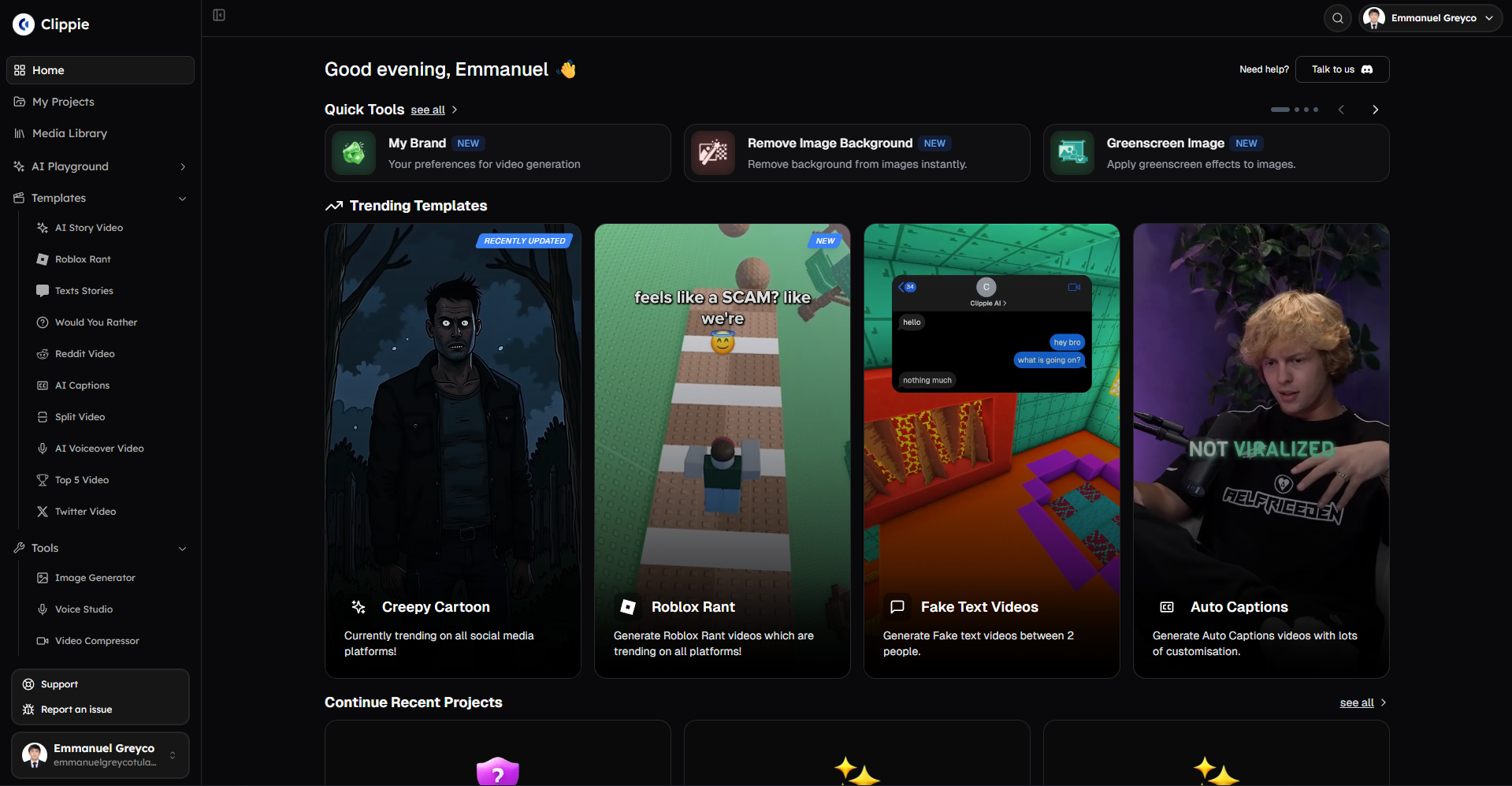
Sign up for Clippie AI: clippie.ai (Creator plan $34.99/month)
Block calendar: Next 7 days, 2 hours daily for editing practice
Download free resources: Stock footage (Pexels, Pixabay) for practice
Set goal: 6 portfolio pieces by end of Week 1
Join community: Find video editor Discord/Facebook groups for support
Remember: Every professional editor started exactly where you are, the difference between those earning $5,000+ monthly and those who quit was simply continuing through the first 3-6 months when progress feels slow. Your first client is 60-120 hours of deliberate practice away.The market opportunity in 2026 is unprecedented, businesses need 40-80 videos monthly, AI tools like Clippie AI have eliminated technical barriers making this the best time in history to start video editing, and strategic specialization enables premium rates even as a beginner. The only question: Will you commit to the 4-6 month journey? Start now at clippie.ai.
Make an AI story video
Write a script or let AI write one. Clippie turns it into a narrated video with AI scenes, voiceover and captions.
Read more

How to Make Top 5 Ranking Videos in 2026 (Step-by-Step)
Build ranking Shorts that can still earn: pick a debatable topic, set clear criteria, source clips you may use, script the countdown, add your commentary.

How to Create Short-Form Videos Using AI: 8 Steps (2026)
A beginner workflow for AI videos on TikTok, Reels and Shorts: pick a format, script a hook, add visuals, voice and captions, export at 9:16, label AI.
7 Free CapCut Alternatives for Short-Form Video (2026)
Compare Edits, YouTube Create, VN, Clipchamp, Canva, DaVinci Resolve and Shotcut: what each gives free users, what it caps first and where it falls short.