
How to Build a Faceless YouTube Channel From 0 to Monetisation in 90 Days (2026 Roadmap)
The complete 90-day roadmap to build a faceless YouTube channel from 0 to monetisation in 2026, daily action plan, production workflow, optimisation strategy, and Clippie AI production system.

Searching for a realistic, week-by-week roadmap to build a faceless YouTube channel and hit monetisation in 90 days in 2026?
Most guides tell you what to do. Very few tell you what to do in what order, and why the sequence matters as much as the tactics. This is not a motivation post. It is a 90-day operational plan with specific actions, measurable milestones, and a production system built around Clippie AI that makes the volume required for monetisation achievable for a solo creator.
Every day is accounted for. Every week has a defined objective. Every month has a measurable growth target.
Start today. 90 days from now, you will have a monetised faceless YouTube channel, or the clearest possible understanding of exactly what needs to change.
Executive Summary
This guide gives faceless content creators a precise, day-by-day roadmap from channel launch to YouTube Partner Programme eligibility in 90 days. It covers why 90 days is the critical algorithmic window for new channels in 2026, the exact actions to take in each phase of the roadmap, how to optimise at each stage based on performance data rather than intuition, and how Clippie AI powers the production system that makes the required output volume sustainable. This is written for creators starting from zero, no subscribers, no existing audience, no prior YouTube experience required.
Table of Contents
Why 90 Days Is the Critical Window for Faceless YouTube Channel Growth in 2026
Days 1–7: Niche Selection, Channel Setup, and Building Your First Workflow
Days 8–30: Producing and Publishing Your First 10 Videos With AI
Days 31–60: Optimising for Watch Time, CTR, and Algorithm Momentum
Days 61–90: Scaling Output, Hitting Monetisation, and Activating Income Streams
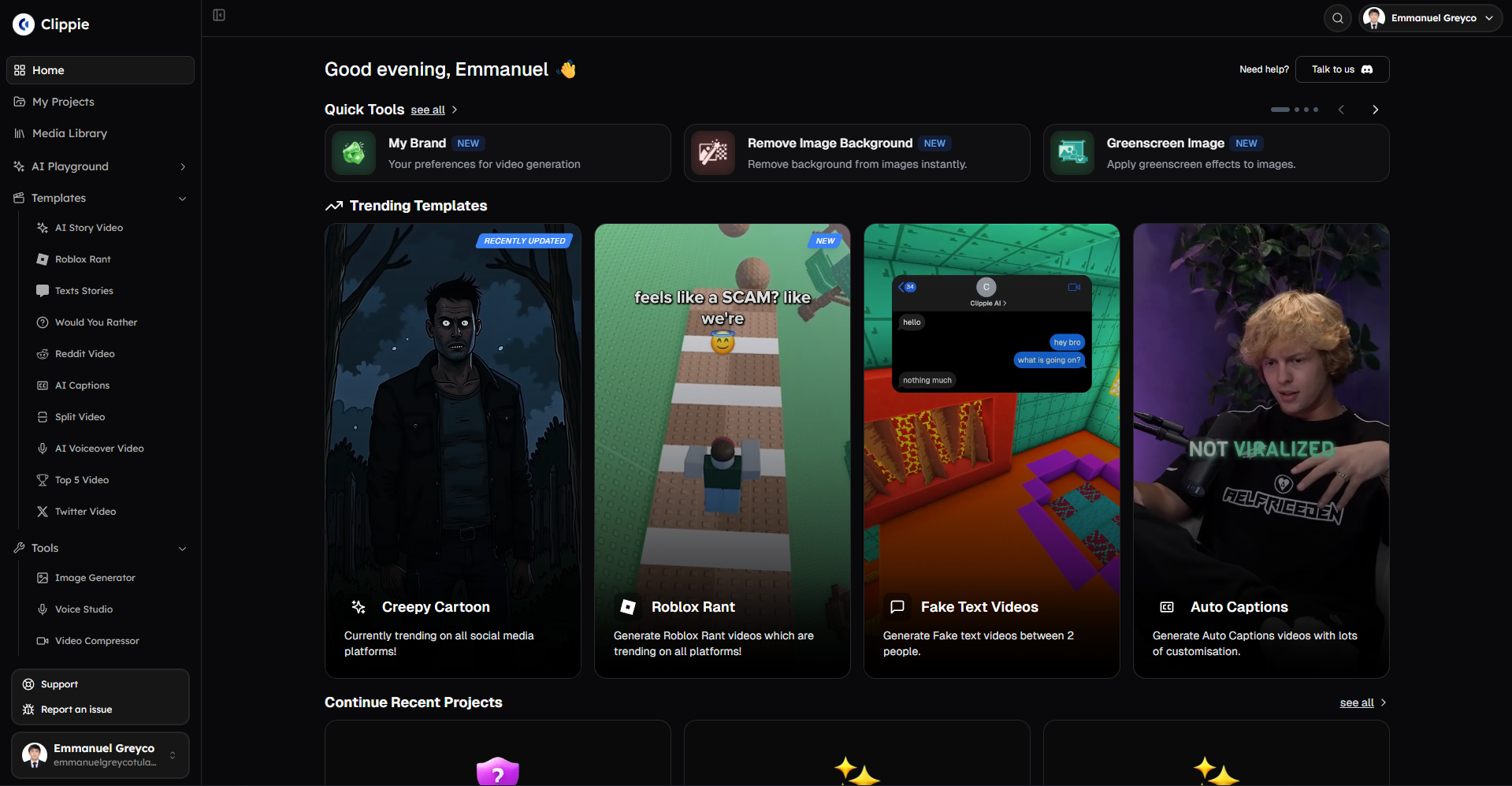
How to Run the Full 90-Day Roadmap Using Clippie AI
Frequently Asked Questions

1. Why 90 Days Is the Critical Window for Faceless YouTube Channel Growth in 2026
Ninety days is not an arbitrary timeframe. It is the period that YouTube's algorithm needs to build a reliable audience model for a new channel, and the period within which the compounding effect of consistent publishing begins to produce measurable, sustainable growth.
How YouTube's Algorithm Treats New Channels
When a new channel publishes its first video, YouTube has no data about the channel's audience, topic, or quality. The algorithm cannot yet determine who to show the content to because it does not know what the content consistently is.
The algorithm's data collection process works in phases:
Videos 1–5: The algorithm tests each video with small audience pools to collect initial engagement data. Distribution is limited and inconsistent.
Videos 6–15: The algorithm begins identifying patterns, which topics generate the most watch time, which viewer types engage most, which formats hold retention. Distribution increases for videos that perform above niche benchmarks.
Videos 16–30: With consistent posting and consistent content quality, the algorithm builds an audience model. It knows who to show the channel to and begins proactively recommending videos to new viewers.
What this means for the 90-day window:
A creator who publishes 2–3 videos per week reaches the algorithmically productive phase (videos 16–30) within 6–10 weeks. Consistent posting over the full 90 days gives the algorithm enough data to move from test distribution to reliable recommendation distribution, which is the phase where subscriber and watch time compounding accelerates toward monetisation.
Channels that post inconsistently, 5 videos in month one, nothing in month two, 3 in month three, never give the algorithm enough consistent data to build a model. They stagnate in the test phase indefinitely.

The YouTube Partner Programme Requirements in 2026
To activate YouTube AdSense monetisation, a channel must meet one of two thresholds:
Path 1: Long-Form Monetisation:
1,000 subscribers
4,000 watch hours in the last 12 months
Path 2: Shorts Monetisation:
1,000 subscribers
10 million Shorts views in 90 days
For most faceless creators, Path 1 is the primary target. Path 2 is achievable in high-performing niches with Shorts cross-posting but is not guaranteed within 90 days without a viral event.
Realistic 90-day targets for Path 1:
A faceless channel posting 2–3 long-form videos per week in a validated high-search-volume niche with good production quality can reach:
500–1,000 subscribers by day 90
2,000–4,000 watch hours by day 90
Some channels hit full eligibility within 90 days. Others are at 70–80% of the threshold, close enough to reach monetisation within 30 additional days of consistent posting.
The 90-day roadmap is designed to get you as close to both thresholds as possible within that window, with a clear path to completion for channels that need a few additional weeks.
Why Faceless AI Channels Have an Advantage in This Window
The 90-day window is a volume and consistency challenge. The creator who produces the most consistently high-quality content in the shortest time accumulates algorithmic data fastest and reaches the recommendation distribution phase fastest.
Manual video production at 2–3 videos per week requires 20–40 hours of weekly work, unsustainable alongside most life and professional commitments.
Clippie AI's integrated production platform, voiceover, image generation, captioning, and export in one place, compresses that production time to 6–10 hours per week at the same output volume. That compression is what makes the 90-day roadmap achievable for a solo creator without a production team.

2. Days 1–7: Niche Selection, Channel Setup, and Building Your First Workflow
The first week establishes the infrastructure the entire 90-day plan runs on. Actions taken in Week 1 determine the efficiency of every production session that follows.
Day 1: Niche Selection and Validation
Niche selection is the most consequential decision of the entire 90-day roadmap. A strong niche with average production grows faster than an average niche with perfect production.

The 5-Question Niche Validation Framework
Before committing to a niche, run it through these five questions. All five must produce a yes before proceeding.
Question 1: Can you generate 50 video topics in this niche right now? Open a blank document and write 50 video titles. If this takes longer than 20 minutes or the titles become repetitive before 50, the niche is too narrow for a 90-day channel build.
Question 2: Does this niche have affiliate products paying 15%+ commission? Search "[niche] affiliate programme" and confirm that products with meaningful commissions exist. Finance (investing platforms, credit cards), AI tools (SaaS subscriptions), health (supplements, fitness equipment), and career development (courses, platforms) all have strong affiliate ecosystems.
Question 3: Are there existing channels in this niche with under 200k subscribers getting consistent views? Search your niche keyword on YouTube. Find 5 channels with under 200k subscribers. Check whether their recent videos are getting 5,000–50,000 views. This confirms that demand exists without oversaturation, a new channel can compete.
Question 4: Is the CPM above $5 per thousand views? Use published CPM benchmarks for your niche category. Finance ($8–$25), technology ($6–$18), and health ($5–$15) all exceed this threshold. Entertainment and gaming ($1–$5) do not.
Question 5: Can the content be produced entirely without showing your face? Confirm that the niche's primary content formats, explainers, tutorials, list videos, commentary, can be produced with AI voiceover over visuals without requiring on-camera presence.
The 5 Highest-Performing Niches for 90-Day Faceless Channels
Personal finance and investing - highest CPM, strongest affiliate ecosystem
AI tools and technology - fastest growing search volume, strong SaaS affiliate commissions
True crime and mystery - highest engagement rate, strong cross-platform distribution
Self-improvement and productivity - highest digital product conversion, consistent search demand
History and documentary - highest average watch time, strong evergreen traffic
Pick one. Not two. Not a hybrid. One niche with a clear primary keyword.
Day 2: Channel Creation and Branding
Create the channel:
Set up a dedicated Google account for the channel, separate from personal accounts
Create the YouTube channel in YouTube Studio
Channel name: keyword-adjacent or brand-adjacent. "Finance Fundamentals," "The AI Brief," "Dark History Channel", clear, memorable, niche-specific.
Basic branding:
Channel banner: 2560 x 1440px, simple text-based design in a consistent colour palette works better than complex graphics at the start
Profile image: a simple logo or text-based icon at 800 x 800px, no face required
Channel description: 100–200 words including the primary niche keyword, what the channel covers, and who it is for
Channel description template: "[Channel Name] covers [niche topic] for [target audience]. Every [posting schedule] we publish [content type] on [specific topics]. If you want to [audience outcome], you are in the right place. Subscribe for new videos every [day/week]."
Day 3: Clippie AI Setup and Voice Selection
Create your Clippie AI account (Lite plan: $19.99/month to start)
Navigate to the voice library and test 3–5 voices on a 200-word sample script
Select the voice that sounds most natural and authoritative for your niche
If cloning your voice: record a clean 2–3 minute sample in a quiet environment and upload it to Clippie AI
Day 4: Topic Research and Content Calendar
Research process (90 minutes):
YouTube autocomplete: Type your primary niche keyword and note every autocomplete suggestion. Record 20 topic ideas.
Google Trends: Check the rising queries section for your niche. Record 10 topic ideas.
Reddit: Browse the top 3 subreddits in your niche. Record 10 topic ideas from common questions and popular posts.
Competitor comment sections: Read the comment sections on the top 10 videos in your niche. Record 10 topic ideas from viewer questions.
Total: 50 validated topic ideas
Organise into a simple content calendar:
Week 1 (Days 5–7): First 2 videos
Weeks 2–4 (Days 8–30): 10 videos at 2–3 per week
Weeks 5–8 (Days 31–60): 12–15 videos at 3 per week
Weeks 9–13 (Days 61–90): 15–18 videos at 3–4 per week
Day 5: First Script
Use ChatGPT to generate a first draft using this prompt template:
"Write a faceless YouTube script about [topic]. Audience: [specific demographic]. Length: approximately 1,000–1,200 words (7–9 minute video). Open with a hook that creates immediate curiosity or forward tension. Include 4 clearly numbered sections. Use short sentences under 15 words for AI voiceover delivery. Tone: [authoritative/conversational/dramatic as appropriate for niche]. Close with a CTA asking viewers to subscribe for more [niche content]."
Review the draft for:
Hook quality - does the opening sentence create immediate forward tension?
Factual accuracy - verify every statistic and claim
Sentence length - shorten any sentences over 15 words
Section clarity - each section should have one clear takeaway
Days 6–7: First Production Session and Upload
Day 6: Production in Clippie AI (60–90 minutes):
Voiceover generation: paste script, select voice, generate (3–5 minutes)
Image generation: create title card + 5–6 section images (20–25 minutes)
Caption review: review auto-generated captions for accuracy (5–8 minutes)
Export: 16:9 MP4 at 1080p (5 minutes)
Create thumbnail in Canva (20 minutes)
Day 7: Upload and Optimise:
Title: primary keyword in first 60 characters, clear outcome promise
Description: 150–250 words with natural keyword inclusion
Tags: 5–8 niche-relevant tags
End screen: subscribe prompt + video recommendation card
Publish, do not schedule the first video, publish immediately and begin collecting data

3. Days 8–30: Producing and Publishing Your First 10 Videos With AI
The first 23 days of active production are about two things: building publishing consistency and completing the workflow efficiently enough to sustain the required volume.
The Week 2–4 Publishing Schedule
Publish on Monday, Wednesday, and Friday of each week where possible
Minimum: 2 videos per week, any fewer and algorithmic data accumulates too slowly
Target: 10 total videos published by Day 30

The Weekly Production Routine (Weeks 2–4)
Monday: Research and Ideation (30–45 minutes)
Check comment sections from videos published last week, capture every viewer question as a topic idea
Run YouTube autocomplete on 3–4 keyword variations
Check Google Trends for any trending topics this week
Select 2–3 topics for the week from the content calendar
Tuesday: Scripting (1.5–2 hours)
Generate first drafts for 2–3 videos using ChatGPT prompt template
Review each script for accuracy, hook quality, sentence length
Finalise all scripts before opening Clippie AI, never script and produce in the same session
Wednesday: Production Batch in Clippie AI (1.5–2 hours)
For each video (15–20 minutes each):
Paste script → select voice → generate voiceover: 3–5 minutes
Generate title card + 5–6 section images: 5–8 minutes
Review auto-captions: 2–3 minutes
Export 16:9 + 9:16 (for Shorts): 5 minutes
Total batch for 3 videos: approximately 55–65 minutes
Thursday: Publishing Preparation (60–75 minutes)
Create thumbnails for all 3 videos in Canva (15 minutes each)
Write YouTube titles, descriptions, and tags (10 minutes per video)
Write TikTok and Reels captions for Shorts cross-posts
Schedule in YouTube Studio
Friday: Analytics Review (20–30 minutes)
Review YouTube Studio data for all live videos:
Metrics to check:
Click-through rate (CTR): below 2% → title or thumbnail issue
Average view duration: below 35% → hook or pacing issue
Subscriber gain per video: tracks which topics convert viewers to subscribers
Top traffic sources: confirms whether the algorithm is beginning to recommend the channel
Record findings in a simple notes file, these patterns inform the following week's topic and format decisions.
The 10-Video Milestone Targets (Day 30)
By Day 30 with consistent posting, realistic targets are:
Total videos published: 10–12
Subscribers: 50–200 (early stage, algorithm still learning)
Total watch hours: 200–600
Average CTR: 2–4% (improving as thumbnail and title patterns are refined)
Average view duration: 35–50% (improving as hook quality improves with each script)
These numbers are modest intentionally. The value of Days 1–30 is not in the subscriber count, it is in the algorithmic data accumulated and the production workflow refined to the point where Week 5+ output can increase without proportional effort increase.

4. Days 31–60: Optimising for Watch Time, CTR, and Algorithm Momentum
By Day 30, the channel has 10+ videos, a functioning production workflow, and enough performance data to make informed optimisation decisions. Days 31–60 shift from pure production to production plus data-driven improvement.
The 3 Optimisation Priorities for Days 31–60
Priority 1: CTR Optimisation (Thumbnail and Title)
Click-through rate is the first algorithmic filter. Before watch time matters, viewers must click on the video. A CTR below 3% indicates a title or thumbnail problem.
Thumbnail audit (Day 31):
Review all 10 thumbnails from the first month. Identify which 3 performed best (highest CTR). Identify which 3 performed worst. Look for patterns:
Do the high-CTR thumbnails share a visual element (bright contrast, single focal point, specific text style)?
Do the low-CTR thumbnails share a weakness (cluttered, low contrast, text too small)?
Apply the high-CTR patterns to all future thumbnails. The goal is a channel thumbnail style that is immediately recognisable and consistently above 4% CTR by Day 60.
Title optimisation patterns for faceless channels:
Numbers work: "7 Finance Mistakes Costing You Thousands" outperforms "Common Finance Mistakes" consistently
Specificity works: "How to Open a Roth IRA in 15 Minutes" outperforms "How to Start Investing"
Tension works: "The Investing Mistake Everyone Makes in Their 30s" outperforms "Investing Tips for 30-Somethings"
Year anchoring works: "The Best Budgeting Method in 2026" outperforms "The Best Budgeting Method"
Priority 2: Watch Time Optimisation (Hook and Pacing)
Average view duration below 40% indicates a hook or pacing problem. YouTube distributes content with strong completion rates significantly more aggressively than content with weak completion.
Hook audit (Day 32):
Review the first 30 seconds of your lowest-retention videos. Identify where viewer drop-off is steepest (YouTube Studio provides this data in the "Audience retention" graph).
Common hook problems:
Starting with context instead of tension, viewers leave before the interesting part
Value promise delivered too late, promise the outcome by second 15, not second 45
Slow narration pace in the opening, the first 30 seconds should be the fastest-paced section
Pacing improvements for the next 15 videos:
Add a retention hook at the midpoint of every video: "The most important part of this is coming up"
Keep section transitions under 5 seconds, no long pauses or re-introduction of context
End each section with a forward-looking statement: "Now that you understand X, here is why Y changes everything"
Priority 3: Subscriber Conversion Optimisation
Low subscriber conversion despite decent views indicates a mismatch between the video content and the channel's brand promise, or a weak subscribe CTA.
CTA audit:
Review the subscribe CTA in the last 30 seconds of the first 10 videos. Is it:
Specific to the channel's value proposition? ("Subscribe for weekly finance explainers" outperforms "Subscribe for more content")
Positioned immediately after the video's highest-value moment?
Reinforced with an end screen subscribe prompt?
Update all future video CTAs based on findings.
Days 31–60 Production Targets
By Day 60 with consistent posting at 3 videos per week plus Shorts cross-posting:
Total videos published: 22–27 (long-form + Shorts)
Subscribers: 200–600
Total watch hours: 800–2,000
Average CTR: 3–5%
Average view duration: 40–55%
The channel should be showing clear upward trends on at least two of these metrics by Day 60. Flat or declining metrics across all dimensions by Day 60 indicate a niche or format problem that requires strategic reconsideration, not more production volume.
Days 31–60 Weekly Production Schedule
Same structure as Weeks 2–4 with two additions:
Addition 1: Shorts cross-posting (Monday)
Every long-form video should produce one YouTube Short, the strongest 45–60 second segment from the video, exported in 9:16 format during the Wednesday production batch and uploaded to Shorts, TikTok, and Instagram Reels on Monday of the following week.
Addition 2: Evergreen topic prioritisation
From Day 31, prioritise evergreen topics that will continue generating search traffic for months after publication. Trending topics drive short-term views; evergreen topics compound watch hours over time. A ratio of 70% evergreen to 30% trending is optimal for watch hour accumulation toward the 4,000-hour threshold.

5. Days 61–90: Scaling Output, Hitting Monetisation, and Activating Income Streams
Days 61–90 are the execution and harvest phase. The workflow is established. The optimisation patterns are identified. The algorithmic model is building. This phase is about scaling output, crossing the monetisation thresholds, and activating income streams that generate revenue from day one of eligibility.
Days 61–90 Production Target
Post 3–4 long-form videos per week plus 3–5 Shorts per week.
At this volume, a channel in a validated niche with a refined production workflow accumulates:
300–500 additional subscribers
1,500–3,000 additional watch hours
Combined with the Days 1–60 accumulation:
Total subscribers by Day 90: 500–1,100
Total watch hours by Day 90: 2,300–5,000
Many channels hit full Partner Programme eligibility (1,000 subscribers + 4,000 watch hours) within this window. Channels that do not quite reach the threshold by Day 90 are typically within 30–60 days of crossing it with continued consistent posting.
The Subscriber Acceleration Tactics for Days 61–90
Tactic 1: Series Content
Launching a dedicated series in Days 61–90 is the single highest-impact tactic for subscriber acceleration.
How to structure a series:
Plan 5–7 episode series on a deep niche topic: "The Complete Investing Guide for Beginners, Parts 1–7"
Release episodes on a fixed schedule, every Monday and Thursday
Every episode's end screen links to the next in the series and includes a subscribe prompt
The series title appears in every episode title: "Part 4: How to Choose Your First Stock"
Viewers who watch Part 1 and want Part 2 subscribe to ensure they see it. Subscribe conversion rates on series content are 3–5x higher than standalone videos.
Tactic 2: Comment Section Engagement
Reply to every comment on every video published in Days 61–90. YouTube's algorithm weights comment section activity as a channel quality signal. Channels with active comment engagement receive slightly higher recommendation rates than channels with the same view numbers but no comment replies.
For a faceless channel, comment engagement also personalises a format that is otherwise entirely impersonal, and subscribers who feel heard are significantly less likely to unsubscribe.
Tactic 3: Shorts Acceleration
In Days 61–90, increase Shorts output to 5 per week from three sources:
Repurposed clips from long-form videos (2–3 per week, lowest production effort)
Standalone Shorts on niche topics that are too brief for long-form treatment (1–2 per week)
"Hook" Shorts that preview long-form video content and direct viewers to the full video (1 per week)
Shorts that generate strong views contribute to the 10 million Shorts view path to Partner Programme eligibility as a secondary route.
Activating Income Streams Before Official Monetisation
YouTube AdSense requires Partner Programme approval. But affiliate income, digital product revenue, and community monetisation have no eligibility requirements, they can be activated from Day 1.
Income Stream 1: Affiliate Marketing (Activate Immediately)
Add affiliate links to every video description from the first upload.
Setup (Days 61–65):
Join the affiliate programmes for the top 3 products in your niche
Create a simple link-in-description template with your affiliate links and a brief description of each
Add this template to every video description going forward
Mention affiliate products verbally in relevant videos: "I've linked the best option in the description below"
Even a channel with 200 subscribers can generate $100–$500/month in affiliate income if the content drives buying-intent traffic to the right products.
Income Stream 2: Digital Product (Launch in Days 70–80)
A simple digital product directly tied to the channel's most popular content generates revenue that scales with channel growth.
For a finance channel: Budget spreadsheet template ($9–$19)
For an AI tools channel: Prompt pack or workflow template ($19–$37)
For a self-improvement channel: Goal-setting workbook or productivity system ($19–$47)
Create the product once. It generates income indefinitely. A Gumroad or Stan Store page takes 30–45 minutes to set up. Link it in every relevant video description.
Income Stream 3: Email List (Start Building Day 61)
Create a free lead magnet, a PDF guide, checklist, or template, and begin directing viewers to it from video descriptions.
Why this matters before monetisation:
The email list is an audience asset that is not subject to algorithmic changes. If YouTube's algorithm changes in Year 2 of the channel, an email list of 500–1,000 subscribers provides direct access to the most engaged viewers regardless of what happens to the channel's organic distribution.
Start building it before it feels necessary.
Days 61–90 Milestone Targets
Day 75 checkpoint:
Subscribers: 400–800
Watch hours: 1,800–3,500
Affiliate income: $100–$500/month (from the audience already built)
Email list: 50–200 subscribers
Day 90 checkpoint:
Subscribers: 500–1,100
Watch hours: 2,500–5,000
Partner Programme status: eligible or within 30–60 days of eligibility
Monthly income (affiliate + digital product): $200–$800

6. How to Run the Full 90-Day Roadmap Using Clippie AI
The 90-day production volume, 35–45 total videos including long-form and Shorts, requires a production system that is fast enough to sustain without burning out. Clippie AI's integrated workflow is what makes this output achievable for a solo creator.
What Clippie AI Handles in the 90-Day Workflow
Voiceover, replaces recording entirely
50+ natural-sounding AI voices
Custom voice cloning for channel identity from Day 3
Narration generated from script in under 2 minutes
AI image generation, replaces stock footage sourcing
Custom scene images, title cards, and section visuals
No stock library subscription required
Images generated within the production session, no external sourcing
Auto-captioning, replaces manual subtitle creation
Speech-to-subtitles synced automatically to voiceover
102+ languages, international audience reach from Day 1
No manual timing or alignment adjustments
Video export, production-ready output
16:9 for YouTube long-form
9:16 for Shorts, TikTok, and Reels
Both exports in one production session
The 90-Day Production Timeline With Clippie AI
Days 1–30 (Lite plan: $19.99/month):
Target: 10 long-form videos
Total export minutes required: ~80–100 minutes
Clippie AI Lite capacity: 30 minutes per month
Note on plan upgrade timing:
The Lite plan's 30-minute export capacity covers approximately 3–5 videos per month. For the Days 1–30 target of 10 videos, upgrading to the Creator plan at the start of Week 2 (Day 8) is recommended. The Creator plan's 120-minute capacity covers the 10-video month comfortably.
Days 31–90 (Creator plan: $34.99/month):
Target: 25–35 additional videos (long-form + Shorts)
Total export minutes required: ~150–250 minutes over 60 days
Clippie AI Creator capacity: 120 minutes per month
For the highest production targets in Days 61–90, the Pro plan ($69.99/month, 250-minute capacity) may be warranted if the channel is posting 3–4 long-form videos plus 5 Shorts per week.
Clippie AI Plans: Full 90-Day Capacity Reference
Lite: $19.99/month
30 mins video export (~3–5 videos/month)
30 mins AI voice generation
30 mins speech-to-subtitles
100 AI images
1 custom voice
Captions in 102+ languages
50+ AI voices
24/7 support
Creator: $34.99/month
120 mins video export (~8–12 videos/month)
120 mins AI voice generation
120 mins speech-to-subtitles
500 AI images
10 custom voices
Captions in 102+ languages
50+ AI voices
24/7 support
Pro: $69.99/month
250 mins video export (~15–20 videos/month)
250 mins AI voice generation
250 mins speech-to-subtitles
1,000 AI images
30 custom voices
Captions in 102+ languages
50+ AI voices
24/7 support
No free tier is available on Clippie AI.
💡 For the complete monetisation strategy that activates once Partner Programme eligibility is reached, read our guide on the complete faceless content monetisation blueprint for 2026
💡 For the full production workflow that powers this 90-day plan, read our guide on the ultimate faceless content workflow from idea to viral video
💡 Start your 90-day faceless channel build with Clippie AI today →
Conclusion: The 90 Days Start the Moment You Begin, Not the Moment You Feel Ready
The creators who reach monetisation within 90 days share one characteristic that overrides niche, production quality, and posting schedule: they started before they felt ready and improved through doing.
The first video will not be the best. The first thumbnail will need work. The first script will have a weaker hook than the tenth. This is correct and expected. Every video in the 90-day roadmap is simultaneously a content asset and a learning investment.
By Day 30, the workflow is established. By Day 60, the patterns are identified. By Day 90, the compound effect of consistent, improving output is visible in the analytics, and the income streams that activate at monetisation are already generating preliminary revenue.
Clippie AI handles the production. The roadmap provides the sequence. The only variable left is whether today is Day 1.
Start your 90-day faceless channel build with Clippie AI today →
7. Frequently Asked Questions
Q1: Is it actually possible to reach YouTube monetisation in 90 days with a faceless channel?
Yes, but not guaranteed for every creator in every niche. Channels posting 2–3 long-form videos per week in a validated high-search-volume niche, with consistent production quality and active Shorts cross-posting, can realistically reach 1,000 subscribers and 4,000 watch hours within 90 days. The channels that do not reach full eligibility within the window are typically at 70–80% of the threshold, within 30–60 days of crossing it with continued consistent posting. The 90-day roadmap is designed to get every creator as close to monetisation as possible within that window.
Q2: How many hours per week does the 90-day roadmap require?
The weekly production schedule requires approximately 6–8 hours per week for 2–3 long-form videos plus 2–3 Shorts, including research (45 minutes), scripting (2 hours), production in Clippie AI (1.5–2 hours), publishing preparation (1 hour), and analytics review (30 minutes). This is structured as 2–3 focused production blocks per week rather than daily tasks, making it compatible with full-time employment or other commitments.
Q3: What is the most important metric to focus on in the first 30 days?
Average view duration (completion rate) is the single most important metric in the first 30 days. It is the primary signal YouTube uses to determine whether to distribute a new channel's content beyond the initial test audience pool. A channel consistently achieving 40–50% completion rates in the first 30 days receives significantly more algorithmic amplification than a channel with higher view counts but lower completion. Subscribers and view counts are secondary, they follow from strong completion rate distribution.
Q4: Do I need to post every single day to hit monetisation in 90 days?
No. The minimum effective frequency for the 90-day roadmap is 2 long-form videos per week. Posting every day accelerates the data collection phase but is not required for the roadmap's targets to be achievable. Consistency of schedule matters more than posting frequency, a channel that posts every Monday and Thursday for 13 consecutive weeks provides more consistent algorithmic data than a channel that posts daily for 3 weeks then stops for 2 weeks. Choose a frequency you can maintain without exception.
Q5: Which niche gives the best chance of hitting monetisation in 90 days?
Personal finance and AI tools are the two niches most likely to reach monetisation within 90 days for a faceless channel. Both have high search volume, strong evergreen topic availability, clear affiliate monetisation from day one, and audiences that actively seek out new content, meaning subscriber conversion per view is higher than entertainment niches. True crime and mystery performs well on Shorts but generates slower long-form watch hour accumulation. History performs well on watch time but has slower subscriber growth. Finance and AI tools optimise for both simultaneously.
Q6: Which Clippie AI plan should I start with for the 90-day roadmap?
Start with the Lite plan ($19.99/month) in Week 1 while completing the first 2–3 videos and learning the platform. Upgrade to the Creator plan ($34.99/month) at the start of Week 2, the Creator plan's 120-minute export capacity and 500 AI image allocation is the right capacity for the 10-video target of Days 8–30. Maintain the Creator plan through Days 31–60. If production volume increases to 3–4 long-form videos plus 5 Shorts per week in Days 61–90, evaluate upgrading to the Pro plan ($69.99/month) for the final production sprint toward monetisation.
Read more

AI Video Creation Trends 2026: Don't Get Left Behind
What changed in AI video in 2025, the 8 trends shaping 2026, and the tools and workflow faceless Shorts, TikTok and Reels creators should use now.

Short-Form Video in 2026: Why It Wins, What to Do
The real mechanisms behind short-form's dominance in 2026, the trade-offs nobody mentions, and an 8-step playbook for Shorts, TikTok and Reels.

The Future of Faceless Content in 2026 (What to Expect)
The future of faceless content in 2026: where AI video, the rules, and monetization are heading, and what to do now.