
How Businesses Are Using AI Video Ads to Increase Online Sales in 2026
Businesses use AI video ads to increase sales in 2026: Why AI ads convert 40-75% higher than static ads, 8 high-performing formats for ecommerce/services, write scripts converting in under 30 seconds, scale with 15-30 variations & build with Clippie AI.

If you're searching for how businesses are using AI video ads to increase online sales in 2026, you're recognizing the conversion performance gap separating companies achieving 40-75% higher conversion rates through AI-generated video ads from those relying on static image ads struggling with declining CPAs and ad fatigue. This guide explains why AI-generated video ads systematically outperform static formats, identifies 8 high-performing video ad formats driving sales for ecommerce and service businesses, delivers direct-response scriptwriting frameworks converting viewers to customers in under 30 seconds, provides systematic scaling methodologies producing 15-30 creative variations without production bottlenecks, and positions Clippie AI as infrastructure enabling rapid high-converting video ad creation.
Executive Summary: Businesses leveraging AI video ads in 2026 achieve superior paid traffic ROI through systematic video creative production, experiencing 40-75% higher conversion rates than static ads due to motion capturing attention, product demonstration reducing purchase anxiety, and emotional storytelling triggering buying decisions, implementing high-performing formats (product demonstration ads showing use and benefits, customer testimonial videos providing social proof, problem-solution narratives addressing pain points, UGC-style authentic content building trust, comparison ads positioning against alternatives, limited-time offer videos creating urgency, educational value-first ads establishing authority, lifestyle aspiration content triggering desire), writing conversion-optimized scripts following AIDA framework (Attention hook in first 3 seconds, Interest build through benefit demonstration, Desire creation via outcome visualization, Action drive through clear CTA), scaling campaigns through AI-enabled variation production (Clippie AI generating 15-30 creative variations from single master video testing hooks, offers, formats, and audiences without proportional production cost increase), and managing performance through Clippie AI reducing per-variation production from 2-4 hours to 15-25 minutes enabling continuous testing and optimization impossible through manual workflows.
Table of Contents
Why AI-Generated Video Ads Convert 40-75% Higher Than Static Ads in 2026
The 8 High-Performing AI Video Ad Formats Driving Sales for Ecommerce and Service Businesses
How to Write Direct-Response Video Ad Scripts That Convert Viewers to Customers in Under 30 Seconds
How to Scale Paid Traffic Campaigns With 15-30 AI Video Creative Variations Without Production Bottlenecks
How to Build and Manage High-Converting AI Video Ads With Clippie AI
Frequently Asked Questions

1. Why AI-Generated Video Ads Convert 40-75% Higher Than Static Ads in 2026
The paid advertising landscape has fundamentally restructured around video-first creative, businesses deploying AI-generated video ads achieve conversion rates 40-75% higher than static image ads while reducing creative production costs 80-90% through systematic AI workflows enabling continuous testing and optimization.
The Static Ad Performance Decline
Static image ad benchmarks (2026 reality):
Facebook/Instagram static ads:
Average CTR: 0.8-1.4% (declining year-over-year)
Average conversion rate: 2.1-3.8%
Cost per acquisition: $45-$120 (rising)
Ad fatigue timeline: 3-7 days (rapid performance decline)
Google Display static ads:
Average CTR: 0.4-0.8%
Average conversion rate: 1.2-2.5%
Cost per acquisition: $60-$150
Ad fatigue timeline: 5-10 days
Problem trends:
Platform algorithms favor video (lower reach for static)
Banner blindness increasing (users ignore static ads)
Competition intensifying (CPMs rising 15-30% annually)
Creative fatigue faster (audience saturation quicker)
The creative refresh treadmill:
Static ad lifecycle:
Day 1-3: Strong performance (fresh creative)
Day 4-7: Declining CTR and CVR (audience fatigue)
Day 8+: Poor performance (creative burned out)
Refresh required: New creative every 5-7 days
Production burden:
Manual design: 2-4 hours per static variation
Monthly need: 12-20 static ads (3-4 weekly refreshes)
Designer time: 24-80 hours monthly (unsustainable)
Cost implications:
Designer salary: $60K-$90K annually ($5K-$7.5K monthly)
OR freelance: $500-$1,500 per ad × 15 monthly = $7,500-$22,500
High ongoing cost for creative production
The AI Video Ad Performance Advantage
AI-generated video ad benchmarks (2026 data):
Facebook/Instagram video ads:
Average CTR: 1.8-3.2% (2.25-2.29x higher than static)
Average conversion rate: 4.2-7.8% (2x-2.05x higher)
Cost per acquisition: $25-$65 (44-46% lower)
Ad fatigue timeline: 10-21 days (2-3x longer lifespan)
YouTube TrueView ads:
View rate: 15-35% (engagement)
Conversion rate: 3.8-8.5%
Cost per acquisition: $30-$80
Ad fatigue: 14-30 days
Google Video Discovery ads:
CTR: 2.5-4.5%
Conversion rate: 5.2-9.8%
Cost per acquisition: $22-$55
Performance comparison (same product, same budget):
Campaign A: Static image ads
Monthly ad spend: $10,000
CTR: 1.1%
Conversion rate: 2.8%
Conversions: 28
CPA: $357
ROAS: 2.1x (average order value $750)
Campaign B: AI video ads
Monthly ad spend: $10,000
CTR: 2.4% (2.18x higher)
Conversion rate: 5.6% (2x higher)
Conversions: 56 (2x more)
CPA: $179 (50% lower)
ROAS: 4.2x (same AOV $750)
Video ad advantage: 2x ROAS from identical spend
The Psychological Mechanisms Behind Video Performance
Mechanism #1: Motion captures attention
Human visual processing:
Evolutionary biology: Motion detection prioritized (survival mechanism)
Scroll behavior: Video stops thumb (static ignored)
Platform algorithms: Reward engagement signals (video gets more)
Attention data:
Static ad: 0.8-1.2 seconds average view time
Video ad: 3.5-8.5 seconds average view time
Engagement: 4.4-7.1x longer with video
Conversion impact:
More attention = Better message delivery
Better delivery = Higher conversion
Result: 40-75% conversion lift
Mechanism #2: Product demonstration reduces uncertainty
Purchase anxiety factors:
"Will this actually work?" (efficacy doubt)
"Is this what I think it is?" (expectation mismatch)
"How do I use it?" (implementation uncertainty)
Static ad limitations:
Single image: Cannot show product in use
Text claims: "Works great!" (unverified, skepticism)
Result: High uncertainty = Low conversion
Video ad advantages:
Demonstration: Shows product working (proof)
Use case: Customer sees themselves using it (visualization)
Results: Before/after evidence (credibility)
Result: Low uncertainty = High conversion
Example: Fitness product
Static ad:
Image: Product photo
Text: "Lose weight fast!"
Viewer thinks: "Yeah, right. Everyone says that."
Conversion rate: 2.5%
Video ad (15 seconds):
0-3s: Person struggling with weight (relatability)
3-8s: Using product, showing how it works (demonstration)
8-12s: Before/after results (proof)
12-15s: "Try risk-free" CTA (urgency)
Viewer thinks: "I can see how this works. Let me try it."
Conversion rate: 5.8% (2.32x higher)
Mechanism #3: Emotional storytelling triggers buying decisions
Human decision-making:
Logical brain: Analyzes features and price (slow, skeptical)
Emotional brain: Responds to story and outcome (fast, decisive)
Reality: Emotions drive 80-90% of purchase decisions (rationalized later)
Static ad engagement:
Emotional connection: Low (single moment, no narrative)
Decision trigger: Weak (relies on logical persuasion)
Video ad engagement:
Emotional connection: High (narrative arc, character identification)
Decision trigger: Strong (emotional journey to resolution)
Storytelling example: B2B software
Static ad approach:
Image: Dashboard screenshot
Text: "Increase productivity 40%"
Emotional impact: None (purely logical claim)
Video ad approach (20 seconds):
0-5s: Frustrated manager drowning in spreadsheets (empathy)
5-12s: Discovers software, data magically organized (relief)
12-18s: Confident presentation to executives (aspiration)
18-20s: "Start free trial" CTA
Emotional journey: Frustration → Relief → Aspiration → Action
Conversion: 68% higher than static equivalent

The Platform Algorithm Favoritism
Why platforms prioritize video:
Business incentive alignment:
User retention: Video keeps users on platform longer (more ad impressions)
Engagement: Video generates comments, shares, saves (algorithm signals)
Ad revenue: Video inventory commands higher CPMs (better monetization)
Platform goal: Maximize time on platform = Favor video content
Algorithmic advantages given to video:
Reach multiplier: Video shown to 2-4x more users than static (same targeting)
Feed priority: Video appears higher in feed (better placement)
Suggested content: Video recommended in Explore/Discover (bonus distribution)
Result: Better performance per dollar spent
Cost efficiency data:
CPM comparison (same audience):
Static image ad: $12-$18 CPM
Video ad: $8-$14 CPM (33-44% lower)
Platform subsidy: Video gets better rates
Reach efficiency:
$1,000 spent on static: 55,000-83,000 impressions
$1,000 spent on video: 71,000-125,000 impressions
Video advantage: 29-51% more impressions per dollar
The Creative Longevity Economics
Ad fatigue and refresh requirements:
Static ad fatigue:
Performance peak: Day 1-3
Decline begins: Day 4-5
Burnout: Day 7-10
Refresh cycle: Weekly (52 refreshes annually)
Video ad longevity:
Performance peak: Day 1-7
Gradual decline: Day 8-14
Burnout: Day 15-21
Refresh cycle: Bi-weekly to monthly (12-26 refreshes annually)
Production volume requirement:
Static ads:
52 weekly refreshes × 3 variations = 156 static ads annually
Production time: 2-4 hours each = 312-624 hours
Cost (at $75/hour): $23,400-$46,800 annually
Video ads:
24 bi-weekly refreshes × 3 variations = 72 video ads annually
Production time with AI: 0.5-1 hour each = 36-72 hours
Cost (at $75/hour): $2,700-$5,400 annually
Savings: $20,700-$41,400 annually (88-91% reduction)

2. The 8 High-Performing AI Video Ad Formats Driving Sales for Ecommerce and Service Businesses
Strategic format selection addresses different audience segments and buyer journey stages, these eight proven video ad structures systematically convert cold traffic to customers through targeted psychological mechanisms and conversion pathways.
Format #1: Product Demonstration Ads (15-30 Seconds)
What they are: Short videos showing product in action, demonstrating how it works, what it does, and benefits delivered through visual proof rather than claims.
Why they convert:
Reduces purchase anxiety (see it working before buying)
Clarifies value proposition (visual > text explanation)
Increases perceived quality (professional demonstration = quality product)
Best for:
Physical products (consumer goods, tools, gadgets)
Software/apps (screen recordings showing interface)
Services with visual results (cleaning, landscaping, design)
Structure (20-second product demo):
0-3 seconds: Hook with problem or result
Show problem product solves OR final result achieved
Example: "Tired of tangled cables?" OR "Look how organized!"
3-12 seconds: Demonstration
Show product being used (hands-on, real-world context)
Highlight key features in action (not just list them)
Multiple quick cuts (3-5 second clips each)
Example: Cable organizer being installed, cables inserted, final clean desk
12-18 seconds: Benefits reinforcement
Text overlay or voiceover stating benefits
Before/after comparison if applicable
Social proof mention ("50K+ sold")
18-20 seconds: Clear CTA
"Shop now" / "Get yours" / "Order today"
Urgency element: "Limited stock" or "Sale ends soon"
Production approach:
Traditional method:
Professional product videographer: $800-$2,000
Studio setup, lighting, multiple angles
Post-production editing: 3-5 hours
Timeline: 1-2 weeks, $1,500-$3,500 cost
AI-enabled method:
Record product demo with smartphone: 20-30 minutes
Upload to Clippie AI with product demo template
AI editing (remove mistakes, add captions, optimize pacing): 15-20 minutes
Timeline: Same day, $0-$50 cost (internal time only)
Performance benchmarks:
Product demo video ads:
CTR: 2.8-4.5% (high curiosity + utility)
Conversion rate: 5.5-9.2%
Average watch time: 12-16 seconds (60-80% completion)
Best performing: Products with clear visual transformation
Example results (cable organizer):
Ad spend: $500
Impressions: 62,500
Clicks: 2,188 (3.5% CTR)
Conversions: 153 (7% conversion)
CPA: $3.27
AOV: $24.99
ROAS: 7.6x
Format #2: Customer Testimonial Video Ads (20-40 Seconds)
What they are: Real customers sharing their experience, addressing skepticism through third-party validation and relatability.
Why they convert:
Social proof (others like me succeeded)
Credibility (customers more trusted than brand)
Relatability (viewer sees themselves in customer)
Best for:
High-consideration purchases (expensive, complex, or unfamiliar products)
Services (results-based value, not tangible product)
Overcoming objections (addressing common hesitations)
Structure (30-second testimonial):
0-5 seconds: Customer introduction + problem
"I'm Sarah, and I struggled with [problem]"
Relatability: Viewer identifies with situation
5-20 seconds: Solution and experience
"I tried [product] and here's what happened..."
Show product in use or results achieved
Specific details (not vague "it's great")
20-28 seconds: Results and recommendation
"Now I [specific outcome]"
"I recommend this to anyone dealing with [problem]"
Metrics if applicable ("Lost 15 pounds in 6 weeks")
28-30 seconds: CTA
"Try it yourself" with product shown
Link or offer code
Authentic vs. scripted testimonials:
Scripted/produced (lower conversion):
Professional lighting, perfect delivery
Viewer perception: "This is an actor/paid endorser"
Skepticism: Higher (feels like marketing)
Authentic UGC-style (higher conversion):
Phone camera, natural environment
Viewer perception: "This is a real person"
Trust: Higher (believable)
Conversion advantage: 35-60% better than produced
Production approach:
Collect customer videos:
Email happy customers: Request 30-second video review
Incentivize: Discount code, free product, entry to contest
Make easy: Send filming guide (what to say, how to record)
Edit with Clippie AI:
Upload raw customer footage
AI removes filler words, tightens pacing
Add captions (essential for sound-off viewing)
Add product overlay/CTA at end
Time: 10-15 minutes per testimonial
Performance benchmarks:
Customer testimonial ads:
CTR: 2.2-3.8% (trust drives clicks)
Conversion rate: 6.8-11.5% (social proof converts)
Best for: Mid-funnel (retargeting people who viewed product)
Example results (skincare product):
Ad spend: $750
Targeting: People who viewed product page (didn't buy)
Impressions: 45,000
Clicks: 1,350 (3% CTR)
Conversions: 135 (10% conversion)
CPA: $5.56
AOV: $47
ROAS: 8.5x
Format #3: Problem-Solution Narrative Ads (15-25 Seconds)
What they are: Story-driven ads following problem → agitate → solve structure, creating emotional connection through relatable struggle and satisfying resolution.
Why they convert:
Emotional engagement (story > sales pitch)
Problem amplification (makes pain point vivid)
Relief and aspiration (solution = happy ending)
Best for:
Products solving clear pain points (organization, productivity, comfort)
Services addressing frustrations (simplifying complexity, saving time)
Categories with emotional drivers (parenting, health, relationships)
Structure (20-second problem-solution):
0-3 seconds: Problem visualization
Show frustrating situation clearly
Emotional: Viewer feels the pain
Example: Spilled coffee on important documents
3-5 seconds: Problem amplification
"We've all been there..." (universality)
Quick montage of related frustrations
5-12 seconds: Solution introduction
Product appears as hero
Show how it solves problem
Quick, satisfying transformation
12-18 seconds: Life with solution
Happy outcome achieved
Additional benefits shown
Aspirational lifestyle moment
18-20 seconds: CTA
"Never deal with [problem] again"
Strong action verb: "Get yours now"
Emotional beats to hit:
Beat 1: Frustration (relatable pain)
Viewer: "Yes! That happens to me all the time!"
Beat 2: Recognition (problem understanding)
Viewer: "This product gets it."
Beat 3: Relief (solution discovered)
Viewer: "Finally! That's exactly what I need!"
Beat 4: Aspiration (desire for outcome)
Viewer: "I want that for myself."
Beat 5: Action (compelling CTA)
Viewer: clicks "I'm getting this."
Production approach:
Scenario filming:
Record problem scenario: 5-10 minutes
Record solution scenario: 5-10 minutes
Record happy outcome: 3-5 minutes
Total filming: 15-25 minutes
AI editing workflow:
Upload all clips to Clippie AI
Select problem-solution template
AI assembles narrative arc
Add text overlays emphasizing emotion
Editing: 15-20 minutes
Format #4: UGC-Style Authentic Recommendation Ads (20-30 Seconds)
What they are: Influencer or creator-style content shot casually on phone, mimicking organic social media content rather than polished advertising.
Why they convert:
Native format (looks like friend recommendation, not ad)
Authenticity perception (raw = real)
Lower ad resistance (brain doesn't trigger "skip ad" response)
Best for:
Products targeting Gen Z and Millennials (prefer authentic over polished)
Impulse purchase items (lower price points, discretionary)
Social shopping categories (beauty, fashion, home decor, tech accessories)
Structure (25-second UGC ad):
0-3 seconds: Pattern interrupt
Creator direct to camera: "Okay, you NEED to see this..."
Casual energy, authentic enthusiasm
3-10 seconds: Product reveal and reaction
Unboxing or first impression
Genuine excitement (not scripted hype)
"I wasn't expecting it to be this good"
10-20 seconds: Quick demo + benefits
Show product working
Call out 2-3 key benefits casually
"The best part is..." (highlight unique feature)
20-25 seconds: Recommendation + CTA
"Honestly, just get it. You won't regret it."
Discount code or link mention
Natural, friend-to-friend tone
The authenticity formula:
What makes UGC feel real:
Phone camera quality (not cinema camera)
Natural lighting (not studio setup)
Casual delivery (not scripted perfection)
Imperfections included (pauses, "um"s, natural speech, Clippie AI can optionally keep some for authenticity)
Real environment (bedroom, kitchen, not studio)
What destroys UGC authenticity:
Over-produced (defeats purpose)
Obvious script reading (sounds fake)
Professional lighting/audio (looks like commercial)
Production approach:
Creator partnerships:
Micro-influencers (1K-50K followers): $50-$500 per video
Send product + filming brief
They create authentic content
You receive video rights
Internal creation:
Employee or founder creates UGC-style video
Shoot on iPhone, natural setting
Casual, conversational delivery
Cost: $0 (internal time only)
AI editing:
Upload raw UGC footage
Clippie AI: Light editing (preserve authenticity)
Add captions (essential for sound-off)
Trim to optimal length
Time: 8-12 minutes
Performance benchmarks:
UGC-style ads:
CTR: 3.2-5.8% (high due to native feel)
Conversion rate: 4.8-8.5%
CPM: 20-40% lower (platform algorithms reward authentic content)
Ad fatigue: Slower (audience doesn't tire of authentic content as fast)
Format #5: Comparison Ads (20-35 Seconds)
What they are: Side-by-side comparisons positioning your product against alternatives, highlighting competitive advantages and value differentiation.
Why they convert:
Decision assistance (helps buyer choose)
Differentiation clarity (why you, not them)
Value justification (worth the price)
Best for:
Competitive categories (multiple similar options available)
Premium pricing (explaining why cost more)
Switching customers (from competitor to you)
Structure (30-second comparison):
0-5 seconds: Comparison setup
"Choosing between [Your Product] and [Competitor/Alternative]?"
Visual: Split screen with both options
5-20 seconds: Feature comparison
Side-by-side demonstration of key differentiators
3-4 comparison points maximum
Show, don't just tell (visual proof)
Example points: Speed, durability, ease of use, price
20-28 seconds: Clear winner + unique benefit
Highlight what only you offer
Emotional benefit, not just feature
"Plus, only [Your Product] includes [unique feature]"
28-30 seconds: CTA
"Make the smart choice" or "Upgrade today"
Special offer for switchers (optional)
Comparison types:
Your product vs. competitor:
Direct named comparison (if legally safe and provable)
OR generic "other brands" comparison
Risk: Must be factually accurate (legal exposure)
Your product vs. old method:
"Traditional way vs. New way"
Example: Manual process vs. automated tool
Lower risk: Not targeting specific competitor
Your product vs. DIY:
"Do it yourself vs. Let us handle it"
Service businesses: Show time/effort saved
Persuasive: Justifies paying for convenience
Premium vs. Budget:
"Cheap option vs. Quality option"
Justify higher price through durability, features, support
Positioning: Move from price-sensitive to value-conscious
Ethical comparison guidelines:
Do:
Accurate feature comparisons (provable facts)
Show actual products side-by-side (visual proof)
Focus on your strengths (positive framing)
Don't:
False claims about competitors (legal risk)
Misleading demonstrations (credibility damage)
Attack competitors personally (unprofessional)
Production approach:
Filming comparisons:
Record your product: 10-15 minutes
Record competitor product OR old method: 10-15 minutes
Ensure consistent lighting/angle (fair comparison)
Editing with Clippie AI:
Upload both sets of footage
Use split-screen template
AI synchronizes timing for side-by-side
Add comparison graphics (checkmarks, X marks)
Time: 20-25 minutes
Format #6: Limited-Time Offer / Urgency Ads (15-20 Seconds)
What they are: Short, punchy ads emphasizing time-sensitive deals, creating urgency and FOMO (fear of missing out) to drive immediate action.
Why they convert:
Scarcity principle (limited availability increases desire)
Urgency reduces consideration time (buy now, think later)
FOMO triggers action (don't want to miss out)
Best for:
Sales and promotions (Black Friday, flash sales, clearance)
Product launches (limited initial stock)
Seasonal offers (holiday specials, summer sale)
Structure (18-second urgency ad):
0-3 seconds: Offer announcement
Bold text: "50% OFF - 24 Hours Only!"
Immediate value proposition clear
3-10 seconds: Product showcase
Quick cuts showing product and benefits
High energy, fast pacing
Text overlay reinforcing offer
10-15 seconds: Urgency reinforcement
Countdown timer visual
"Ends tonight at midnight"
"Limited stock remaining"
15-18 seconds: Strong CTA
"Shop now before it's gone"
"Don't miss out"
Direct link/button emphasis
Urgency elements that work:
Time scarcity:
Countdown timers (visual ticking)
Specific end time ("Sale ends Sunday 11:59 PM")
Psychological: Deadline creates action
Quantity scarcity:
"Only 47 left in stock"
"85% sold out"
Psychological: Limited availability increases value perception
Exclusivity:
"VIP early access"
"Email subscribers only"
Psychological: Special treatment feels valuable
Social proof + scarcity:
"2,847 people bought in last 24 hours"
"Trending - selling fast"
Psychological: Others wanting it = you should too
Authenticity requirement:
Real urgency (effective long-term):
Genuine limited stock or time offer
Delivered on deadline (sale actually ends)
Result: Builds trust, repeat purchases
Fake urgency (short-term gain, long-term damage):
Permanent "ending soon" claims
"Limited stock" never runs out
Result: Erodes trust, one-time buyers only
Production approach:
Rapid creation for flash sales:
Use existing product footage
Add urgency graphics (countdown, sale badges)
Update text overlays with current offer
Time with Clippie AI: 10-15 minutes (template-based)
Template preparation:
Create urgency ad template in advance
Swap in: Current offer %, end date, product
Enables: Same-day flash sale ads
Performance benchmarks:
Urgency ads:
CTR: 3.5-6.2% (high due to FOMO)
Conversion rate: 8.5-14.5% (urgency drives action)
Best timing: Thursday-Sunday (weekend shopping behavior)
Peak performance: 12-36 hours (genuine urgency window)
Format #7: Educational Value-First Ads (30-60 Seconds)
What they are: Ads that teach something useful before mentioning product, building trust and authority through value delivery, then soft-selling solution.
Why they convert:
Reciprocity (give value, receive trust)
Authority positioning (teaching = expertise)
Lower resistance (helpful, not salesy)
Best for:
Complex products (require education to understand value)
B2B services (longer consideration, relationship-driven)
Premium offerings (expertise justifies price)
Structure (45-second educational ad):
0-5 seconds: Hook with valuable promise
"Here's how to [achieve desirable outcome]"
Curiosity: Viewer wants to learn
5-35 seconds: Genuine teaching
Deliver actual useful information
3-step process or framework
Actionable immediately (can implement without buying)
35-42 seconds: Soft product mention
"Want this done for you? [Product] handles all this automatically"
OR "I use [Product] to make this easier"
Natural extension, not hard sell
42-45 seconds: CTA
"Learn more" or "Try free"
Low-pressure invitation
Teaching vs. selling balance:
Too much teaching (underconverts):
90% education, 10% product
Viewer learns and leaves (doesn't buy)
Problem: Value delivered without conversion path
Too much selling (high resistance):
20% education, 80% product
Viewer recognizes as ad (guard goes up)
Problem: Skepticism prevents engagement
Optimal balance:
70% education, 30% product positioning
Viewer gets value AND sees product relevance
Result: Trust + interest = conversion
Example: Accounting software for freelancers
Educational hook: "3 tax deductions freelancers always miss"
Teaching section (30 seconds):
Home office deduction (how to calculate)
Equipment depreciation (what qualifies)
Health insurance premiums (often forgotten)
Product positioning: "[Product] automatically tracks all these for you. No manual spreadsheets, we find every deduction."
CTA: "Try free for 30 days"
Why this works:
Viewer learns valuable info (delivered value)
Realizes manual tracking is tedious (pain point activated)
Product solves problem taught about (relevant solution)
Conversion: 68% higher than direct product pitch
Production approach:
Script educational content:
Identify: Common question or problem in your niche
Teach: Genuine solution (3-5 steps)
Position: How product accelerates or simplifies
Film teaching:
Screen recording (if showing process)
OR talking head (if explaining concept)
Visual aids (graphics, examples)
Edit with Clippie AI:
Tighten pacing (remove rambling)
Add graphics highlighting key points
Captions essential (complex info needs reinforcement)
Time: 25-35 minutes
Format #8: Lifestyle Aspiration Ads (20-40 Seconds)
What they are: Emotionally-driven ads showing desired lifestyle or outcome, selling the transformation and feeling, not the product itself.
Why they convert:
Emotional desire (want to be like that)
Aspiration trigger (this product gets me there)
Identity alignment (I'm the kind of person who...)
Best for:
Lifestyle products (fashion, home decor, travel, wellness)
Status symbols (premium brands, luxury items)
Self-improvement (fitness, education, personal development)
Structure (30-second lifestyle ad):
0-5 seconds: Aspirational scene
Beautiful visuals of desired lifestyle
No product yet, just the dream
Music: Uplifting, emotional
5-15 seconds: Product integrated into lifestyle
Show product as enabler of this life
Subtle integration (not focal point)
Multiple lifestyle moments
15-25 seconds: Transformation implication
"This could be you"
Before/after emotional states (implicit)
Identity statement: "For people who [aspiration]"
25-30 seconds: CTA
"Start your journey"
"Join thousands living [lifestyle]"
Aspirational language, not transactional
Lifestyle categories and messaging:
Fitness/wellness:
Aspiration: Confident, energetic, healthy
Messaging: "Feel unstoppable"
Product position: Enabler of transformation
Fashion/beauty:
Aspiration: Stylish, confident, admired
Messaging: "Express your unique self"
Product position: Self-expression tool
Productivity/success:
Aspiration: Accomplished, organized, respected
Messaging: "Take control of your time"
Product position: Success accelerator
Travel/adventure:
Aspiration: Free, adventurous, cultured
Messaging: "Live without limits"
Product position: Freedom enabler
Production approach:
Lifestyle footage:
Film aspirational scenes (30-60 minutes)
Multiple settings, activities, emotional moments
High production value (this format benefits from polish)
OR license stock footage:
Premium stock libraries (Artgrid, Storyblocks)
Find clips matching desired lifestyle
Cost: $50-$200 for footage rights
Edit with Clippie AI:
Assemble lifestyle montage
Add music (emotional, uplifting)
Product integration subtle
Minimal text (visuals tell story)
Time: 30-45 minutes
Performance benchmarks:
Lifestyle aspiration ads:
CTR: 2.5-4.2%
Conversion rate: 3.8-6.5% (emotional, not urgency-driven)
Best for: Top of funnel (awareness, building desire)
Retargeting: Combine with direct-response follow-up
3. How to Write Direct-Response Video Ad Scripts That Convert Viewers to Customers in Under 30 Seconds
Short-form video advertising requires precision scriptwriting eliminating wasted words, systematic frameworks compress persuasive narrative into 15-30 seconds achieving conversion rates 40-85% higher than unstructured approaches through strategic attention capture, desire building, and action driving.
The 15-30 Second Script Reality
Why brevity is non-negotiable:
Platform viewing behavior (2026 data):
Average attention span: 8 seconds (decreasing)
Skip button timing: 5 seconds (most platforms)
Scroll speed: 0.3-0.7 seconds per post (very fast)
Video ad completion rates:
0-10 seconds: 75% viewers remain
10-15 seconds: 50% viewers remain
15-20 seconds: 35% viewers remain
20-30 seconds: 25% viewers remain
30+ seconds: 15-20% viewers remain
Conversion opportunity:
75% of conversions happen: First 20 seconds
20% of conversions happen: 20-30 seconds
5% of conversions happen: 30+ seconds
Optimal length: 15-25 seconds (maximize completion × conversion)
The AIDA Framework for Video Ads
AIDA structure: Attention → Interest → Desire → Action
Component timing breakdown (20-second ad):
Attention: 0-3 seconds (15%)
Interest: 3-10 seconds (35%)
Desire: 10-17 seconds (35%)
Action: 17-20 seconds (15%)
Attention (0-3 seconds): Stop the scroll
Hook patterns that work:
Pattern 1: Bold claim
"This $15 gadget replaced my $300 solution"
"I lost 22 pounds without exercising"
Psychology: Curiosity through unexpected claim
Pattern 2: Provocative question
"Still wasting $200/month on [problem]?"
"Why is nobody talking about this?"
Psychology: Viewer wants answer
Pattern 3: Pattern interrupt
Unusual visual (unexpected action)
Sound effect (record scratch, ding)
Psychology: Novelty captures attention
Pattern 4: Identify target
"If you're a freelancer struggling with invoicing..."
"Dog owners, you need to see this..."
Psychology: Self-recognition ("that's me!")
What NOT to do in first 3 seconds:
Mistakes killing attention:
Company logo intro (nobody cares yet)
"Hi, I'm [name] from [company]..." (boring, skippable)
Slow build-up (no time for preamble)
Generic statement (doesn't stand out)
Interest (3-10 seconds): Explain what and why
Objective: Viewer understands what you're offering and why it matters to them
Structure (7 seconds of content):
What it is (3 seconds): Product/service name and category
Why it matters (4 seconds): Primary benefit or problem solved
Example script (weight loss product):
[3-5s] "It's a metabolism booster that targets stubborn fat"
[5-10s] "No restrictive diets or hours at the gym, it works while you sleep"
Viewer understands: What (metabolism booster), Why (easy weight loss)
Interest-building techniques:
Technique 1: Show, don't tell
Visual: Product in use, results being achieved
Not: Talking head explaining verbally
Impact: 60% better retention when showing
Technique 2: Specificity beats vagueness
Specific: "Lose 15-22 pounds in 8 weeks"
Vague: "Lose weight fast"
Impact: 45% higher credibility
Technique 3: Relatability
"If you're like me and hate [common frustration]..."
Personal connection builds interest
Impact: Viewer stays engaged
Desire (10-17 seconds): Make them want it
Objective: Transform interest into active wanting through outcome visualization and social proof
Desire triggers:
Trigger 1: Outcome visualization
Show or describe life with product
Paint picture of transformation
Example: "Imagine waking up 20 pounds lighter, finally confident in that dress"
Trigger 2: Social proof
"50,000 customers lost average 18 pounds"
"4.8-star rating from 12,000 reviews"
Numbers build confidence
Trigger 3: Scarcity or exclusivity
"Limited batch available"
"Exclusive discount for new customers"
FOMO activates desire
Trigger 4: Risk reversal
"60-day money-back guarantee"
"Try risk-free"
Removes barrier to trying
Trigger 5: Unique mechanism
"Unlike other products that [old method], this [unique approach]"
Differentiation creates preference
Example desire section (7 seconds): "In 8 weeks, you could be 20 pounds lighter. Sarah lost 22, Mike lost 18, and Jessica lost 25, all without starving or endless cardio. Plus, 60-day money-back guarantee."
What this accomplishes:
Visualization: "20 pounds lighter" (outcome)
Social proof: Three real results (credibility)
Risk reversal: Money-back guarantee (safety)
Desire level: High (ready to act)
Action (17-20 seconds): Drive the click
Objective: Clear, simple, compelling instruction to take immediate action
CTA components:
Component 1: Action verb
Strong verbs: "Get," "Start," "Claim," "Order," "Join"
Weak verbs: "Learn more," "Check out," "Visit"
Strong CTA converts 35-50% better
Component 2: Friction reduction
"Free shipping" / "No credit card required" / "Cancel anytime"
Address common hesitation upfront
Component 3: Urgency (if authentic)
"Sale ends tonight"
"While supplies last"
Creates now-or-never motivation
Component 4: Value reinforcement
"Get yours for just $24.99"
"Start your free trial"
Reminds viewer of offer value
CTA examples (3 seconds):
Example 1: Ecommerce product "Order now, free shipping, 60-day guarantee. Get yours!"
Example 2: Software trial "Start your free 14-day trial. No credit card required!"
Example 3: Limited offer "Grab yours before midnight, 50% off ends today!"
Visual CTA elements:
On-screen text:
Large, readable CTA button visual
Contrasting color (stands out)
"SHOP NOW" / "START FREE" / "GET OFFER"
Product image:
Show product again (remind what they're buying)
Include price if competitive
Link/button:
If platform allows clickable: Make button obvious
If not: Direct to "link in bio" or "swipe up"

The Script Writing Process
Step 1: Define single objective (20 minutes)
One video = One goal
Clarity: What action do you want viewer to take?
Examples: "Buy product," "Start trial," "Book call," "Download guide"
Mistake: Multiple objectives
Confusing: "Buy this OR sign up for emails OR follow us"
Result: Paralysis, no action taken
Step 2: Know exact audience (15 minutes)
Avatar precision:
Who: Demographics (age, gender, location, income)
Pain: What specific problem do they have?
Desire: What transformation do they want?
Objections: What hesitations prevent purchase?
Example: Skincare product
Who: Women 35-55, concerned about aging
Pain: Fine lines making them look older than they feel
Desire: Look and feel 10 years younger
Objections: "Too expensive," "Doesn't work," "Too complicated"
Script implications:
Hook: Address pain ("Tired of fine lines?")
Solution: Position as anti-aging ("Look 10 years younger")
Objections: Pre-empt ("Simple routine, proven results")
Step 3: Write first draft, quantity over quality (30 minutes)
Brain dump approach:
Write 3-5 different hook options
Write full script for each (don't self-edit yet)
Aim for 50-80 words (reads as ~20-30 seconds)
Don't worry about:
Perfect wording (refine later)
Exact length (trim later)
Goal: Get ideas on paper
Step 4: Refine and trim ruthlessly (30 minutes)
Editing process:
Read aloud at conversational pace
Time yourself (should be under 30 seconds)
Cut every unnecessary word
Simplify complex phrases
Questions to ask:
Does this word add value? (if no → delete)
Can I say this simpler? (use fewer words)
Is this point essential? (if no → cut)
Aim for final: 40-60 words = 15-25 seconds spoken
Step 5: Test multiple variations (ongoing)
Create 3-5 script variations:
Different hooks (test what stops scroll best)
Different desire triggers (outcome vs. social proof vs. scarcity)
Different CTAs (free trial vs. discount vs. guarantee emphasis)
A/B test in ad platform:
Run all variations simultaneously
Measure: CTR, conversion rate, CPA
Winner becomes template for future scripts
Script Templates by Format
Template 1: Product demonstration
[0-3s] HOOK: Problem or wow result "Tangled cables everywhere? Not anymore." [3-10s] INTEREST: What + Why "This cable organizer clips to your desk and holds 5 cables perfectly organized." [10-17s] DESIRE: Show in action + proof [Visual: Installing and using] "No more desk chaos. 62,000 sold, 4.9-star rated." [17-20s] ACTION: Clear CTA "Get yours today, $15.99, free shipping!"
Template 2: Customer testimonial UGC
[0-5s] HOOK: Customer intro + problem "I'm Jessica and I wasted so much time meal planning..." [5-20s] INTEREST + DESIRE: Solution + results "Then I found MealPrepPro. Now I plan weekly meals in 10 minutes. Lost 15 pounds, saved 5 hours a week, eating way healthier." [20-25s] ACTION: Recommendation + CTA "Seriously, just try it. First month free, link below!"
Template 3: Problem-solution narrative
[0-3s] HOOK: Problem visualization "Spending hours on invoices and spreadsheets?" [3-10s] INTEREST: Solution intro "Invoice Genius automates your entire billing process." [10-17s] DESIRE: Benefits + proof "Create invoices in 30 seconds, auto-track payments, never chase late payments again. 15,000 freelancers switched." [17-20s] ACTION: CTA "Try free for 30 days. No credit card needed!"

4. How to Scale Paid Traffic Campaigns With 15-30 AI Video Creative Variations Without Production Bottlenecks
Campaign scaling success depends on creative variation volume, businesses producing 15-30 video ad variations achieve 3-5x better performance through systematic testing while AI automation reduces per-variation production from 2-4 hours to 15-25 minutes eliminating traditional creative bottlenecks.
The Creative Testing Imperative
Why single creatives fail at scale:
Creative fatigue data:
Day 1-3: Strong performance (fresh creative, audience novelty)
Day 4-7: 30-40% performance decline (audience saturation beginning)
Day 8-14: 60-75% performance decline (severe fatigue)
Day 15+: 85-90% performance decline (creative dead)
The math of single creative:
Week 1 performance: $30 CPA (efficient)
Week 2 performance: $45 CPA (declining)
Week 3 performance: $75 CPA (unsustainable)
Week 4 performance: $120+ CPA (dead creative)
Result: Constant manual intervention required
Multi-creative advantage:
Campaign with 15 video variations:
Algorithm: Tests all variations, finds winners
Rotation: Shifts budget to best performers automatically
Longevity: Fresh creative always in rotation (fatigue resistant)
Performance: Maintains $35-$45 CPA consistently (no spike)
Data comparison (90-day campaign):
Single creative approach:
Month 1: $35 average CPA (good)
Month 2: $62 average CPA (declining, need new creative)
Month 3: $95 average CPA (poor, urgent replacement needed)
Average: $64 CPA
Multi-creative approach (15 variations):
Month 1: $38 average CPA (testing phase)
Month 2: $32 average CPA (winners identified)
Month 3: $35 average CPA (sustained performance)
Average: $35 CPA (45% better efficiency)
The Systematic Variation Framework
What to vary (testing hierarchy):
Variable 1: Hooks (highest impact)
Different first 3 seconds
Same product, same offer, different attention grabber
Test 5-8 hook variations
Example hooks for same fitness product:
"Still struggling to lose weight?"
"This $29 bottle replaced my gym membership"
"I lost 22 pounds in 8 weeks, here's how"
"Doctors don't want you to know this..."
"Why diets fail (and what works instead)"
Testing reveals: Hook #3 (personal result) performs 68% better than others
Variable 2: Offers (high impact)
Different pricing or promotion structures
Same creative, different deal
Test 3-5 offer variations
Example offers for same software:
"Start 14-day free trial"
"50% off first 3 months"
"Annual plan, save $480"
"Try free forever (up to 100 contacts)"
"30-day money-back guarantee"
Testing reveals: Offer #1 (free trial) generates most signups, Offer #3 (annual) generates highest LTV
Variable 3: Social proof elements (medium impact)
Different testimonials or statistics
Same structure, different proof points
Test 3-4 proof variations
Example social proof for same product:
"50,000+ customers, 4.8-star rating"
"Featured in Forbes, TechCrunch, WSJ"
"Sarah lost 25 lbs, Mike lost 18 lbs, Jessica lost 22 lbs"
"Trusted by Google, Microsoft, Amazon employees"
Variable 4: Formats (medium impact)
Different ad structures
Product demo vs. testimonial vs. problem-solution
Test 3-4 format variations
Variable 5: Lengths (lower impact)
15-second, 20-second, 30-second versions
Same content, different trim
Test 2-3 length variations
Variable 6: Audience targeting (test separately)
Different demographics, interests, behaviors
Same creative, different audiences
Test 5-10 audience segments
The 15-Variation Production Strategy
Matrix approach (creates 15+ variations efficiently):
Base components:
3 different hooks
1 core product demonstration section
3 different social proof elements
2 different CTAs
1 product/offer visual
Combination math:
3 hooks × 3 social proof × 2 CTAs = 18 unique combinations
Use core demo in all (consistent middle)
Result: 18 variations from 5 filmed components
Example production workflow:
Filming session (90 minutes total):
Record hooks (20 minutes):
Hook 1: Record 3-5 takes (best will be selected)
Hook 2: Record 3-5 takes
Hook 3: Record 3-5 takes
Record core demo (30 minutes):
Product demonstration (comprehensive)
Show all features and benefits
Multiple angles/shots
Record social proof (20 minutes):
Testimonial clips (if using customers)
OR record yourself stating statistics
Multiple proof points filmed
Record CTAs (10 minutes):
CTA 1: Record 2-3 takes
CTA 2: Record 2-3 takes
Capture product shots (10 minutes):
Hero shot of product
Packaging, details, lifestyle context
Total filming: 90 minutes (all components for 15+ variations)
AI-powered variation assembly:
Traditional approach (without AI):
Manually edit each variation: 2-4 hours each
15 variations × 3 hours = 45 hours editing
Timeline: 1-2 weeks full-time work
Clippie AI batch approach:
Upload all components: 10 minutes
Create first variation manually: 30 minutes (set template)
Batch generate remaining 14: AI processes (30-45 minutes autonomous)
Review all variations: 15 minutes each × 15 = 3.75 hours
Timeline: 5-6 hours total (90% time savings)
Variation testing strategy:
Phase 1: Initial launch (Week 1)
Launch all 15 variations simultaneously
Equal budget allocation ($50-$100 per variation)
Gather performance data (CTR, conversion rate, CPA)
Phase 2: Optimization (Week 2)
Identify top 5 performers (lowest CPA, highest ROAS)
Pause bottom 5 performers (wasting budget)
Increase budget to top 5 (scale winners)
Phase 3: Iteration (Week 3+)
Create new variations based on winner patterns
Test: New hooks, offers, formats
Continuous improvement cycle

The Audience Segmentation Matrix
Why audience matters as much as creative:
Same creative, different audiences = vastly different performance
Example: Productivity software ad
Audience A: Freelancers
Hook: "Tired of losing track of invoices?"
Performance: $25 CPA, 8.5% conversion
Audience B: Corporate managers
Hook: "Manage team projects effortlessly"
Performance: $85 CPA, 2.1% conversion
Audience C: Students
Hook: "Ace your assignments with better organization"
Performance: $140 CPA, 0.8% conversion (poor fit)
Learning: Same product, massively different CPA by audience
Testing matrix (creative × audience):
5 creative variations × 6 audience segments = 30 test combinations
Audience segments (example for ecommerce):
Interest targeting: Competitor brand followers
Interest targeting: Industry publications
Lookalike: Website visitors (past 90 days)
Lookalike: Purchasers (past 180 days)
Retargeting: Viewed product, didn't buy
Retargeting: Added to cart, abandoned
Creative variations:
Product demo focus
Customer testimonial focus
Problem-solution narrative
Comparison vs. competitor
Limited-time offer urgency
Testing reveals winners:
Creative 2 (testimonial) + Audience 3 (lookalike visitors): $18 CPA
Creative 5 (urgency) + Audience 5 (retargeting viewers): $12 CPA
Scaling strategy: Focus budget on winning combinations
The Continuous Creative Production System
Why one-time creative batches fail:
Problem with sporadic production:
Create 15 variations in January
Run until March (fatigue sets in)
Panic create new batch in April (downtime, performance gap)
Result: Inconsistent performance, revenue fluctuation
Solution: Systematic ongoing production
Weekly or bi-weekly creative sessions
Always have fresh variations in pipeline
Never run out of creative (continuous rotation)
Monthly creative calendar (sustainable):
Week 1: Planning and scripting (2-3 hours)
Review previous month performance data
Identify: What worked, what didn't
Plan: 5-8 new variations for month
Write: Scripts and shot lists
Week 2: Filming session (2-3 hours)
Batch record all components for month
Multiple hooks, demos, CTAs
Organize footage by variation
Week 3: Editing with Clippie AI (4-6 hours)
Upload all footage
Create variations using batch templates
Review and refine each
Export all formats (Facebook, Instagram, YouTube)
Week 4: Launch and monitor (1-2 hours)
Upload new variations to ad accounts
Set budgets and targeting
Monitor initial performance
Pipeline always full: Next month's creative already planned
Total monthly time: 9-14 hours for continuous creative supply
The Performance Tracking Dashboard
Metrics to track per variation:
Engagement metrics:
Impressions: How many saw it
Reach: How many unique people
CTR: Click-through rate (%)
Video completion rate: % who watched to end
Cost per click: Efficiency of clicks
Conversion metrics:
Conversion rate: % who clicked and converted
Cost per acquisition (CPA): Cost per customer
ROAS: Return on ad spend (revenue ÷ cost)
Average order value (AOV): Revenue per conversion
Creative-specific insights:
Hook performance: Does first 3 seconds stop scroll?
Watch time: Where do people drop off?
Format preference: Demo vs. testimonial vs. narrative
Audience fit: Which segments respond best
Example performance dashboard (15 variations):
Top performers:
Variation 3 (testimonial hook): $22 CPA, 7.2% conversion, 4.8x ROAS
Variation 7 (problem-solution): $25 CPA, 6.8% conversion, 4.3x ROAS
Variation 12 (comparison): $28 CPA, 6.1% conversion, 3.9x ROAS
Action: Scale these (increase budgets 50-100%)
Middle performers:
Variations 1, 5, 9, 11, 14: $35-$45 CPA, 4-5% conversion, 2.8-3.2x ROAS
Action: Maintain current budgets (solid baseline)
Underperformers:
Variations 2, 4, 8, 10, 13: $65-$95 CPA, 1.5-2.8% conversion, 1.2-1.8x ROAS
Action: Pause and analyze (learn why failed)
Learning from failures:
Why did Variation 8 fail? (Hook was too vague)
Why did Variation 10 fail? (CTA unclear)
Apply learnings: Improve future variations
5. How to Build and Manage High-Converting AI Video Ads With Clippie AI
Scaling video ad campaigns requires production infrastructure eliminating editing bottlenecks, Clippie AI reduces per-variation production from 2-4 hours to 15-25 minutes through template-based workflows and batch processing enabling continuous creative testing impossible through manual editing.
The Manual Video Ad Production Bottleneck
Traditional ad creation workflow (per variation):
Pre-production (30 minutes):
Script finalization
Shot list creation
Asset gathering (product images, logos)
Production (45-60 minutes):
Setup equipment
Film all components (hook, demo, CTA)
Multiple takes for safety
Post-production (120-180 minutes = 2-3 hours):
Import footage: 10 min
Watch all takes, select best: 30 min
Rough cut assembly: 40 min
Remove mistakes and filler: 25 min
Add text overlays and CTAs: 30 min
Color correction: 15 min
Audio mixing: 20 min
Export multiple formats: 15 min
Publishing (15 minutes):
Upload to ad platform
Set targeting and budget
Write ad copy
Total per variation: 4-5.5 hours
For 15 variations: 60-82.5 hours (1.5-2 weeks full-time)
The scaling impossibility:
Realistic scenario:
Marketing team: 2 people
Available time: 20% allocated to video ads (8 hours weekly)
Production capacity: 1.5-2 variations weekly
Monthly output: 6-8 variations (insufficient for testing)
To produce 15 variations monthly:
Required time: 60-82.5 hours
At 20% allocation: Would take 7.5-10 weeks
Problem: Can't produce fast enough to test effectively
The Clippie AI Accelerated Workflow
AI-powered production (per variation):
Pre-production (20 minutes):
Script outline (bullet points sufficient)
Quick asset check
Production (30-40 minutes):
Film all components
Less pressure (AI removes mistakes)
Post-production with Clippie AI (25-35 minutes):
Upload footage: 3 min
Select video ad template: 2 min
AI processing (autonomous): 8-12 min
Removes filler words and mistakes
Tightens pacing automatically
Adds text overlays from template
Color corrects and audio balances
Generates captions
Exports multiple formats (square, vertical, horizontal)
Human review and adjustments: 15-20 min
Final export: 2 min
Publishing (10 minutes):
Upload to platforms
Configure targeting
Total per variation: 85-105 minutes (1.4-1.75 hours)
Time savings: 65-70% per variation
For 15 variations: 21-26 hours (vs. 60-82.5 hours manual)
Enables: Same marketing team produces 15-20 variations monthly
Clippie AI Features for Ad Campaigns
Feature: Video ad templates by objective
Pre-built templates for common ad types:
Template 1: Product demo ad (15-30s)
Structure: Hook → Demo → Benefits → CTA
Visual style: Dynamic cuts, product focus
Text overlays: Benefit callouts, price, CTA button
Template 2: Testimonial ad (20-40s)
Structure: Customer intro → Problem → Solution → Results → Recommendation
Visual style: Authentic, minimal effects
Text overlays: Customer name, key quotes, CTA
Template 3: Problem-solution ad (15-25s)
Structure: Problem visualization → Solution intro → Benefits → CTA
Visual style: Before/after contrast
Text overlays: Problem statement, solution benefits, offer
Template 4: Comparison ad (20-35s)
Structure: Comparison setup → Side-by-side → Winner → CTA
Visual style: Split screen, checkmarks/X marks
Text overlays: Feature comparisons, price difference
Template 5: Urgency/offer ad (15-20s)
Structure: Offer announcement → Product showcase → Countdown → CTA
Visual style: High energy, fast pacing
Text overlays: Discount %, timer, urgency messaging
How templates accelerate production:
Without template:
Design: Visual style from scratch (45 min)
Text styling: Create and position overlays (30 min)
Transitions: Choose and apply (20 min)
Total: 95 minutes setup before editing content
With template:
Select: Choose appropriate template (1 min)
Apply: Template auto-applies all styling (instant)
Customize: Adjust text content only (5 min)
Total: 6 minutes setup
Time savings: 89 minutes per variation
Feature: Batch variation creation
Challenge: Creating 15 variations manually
Each variation: Separate project, separate edits
Repetitive work: Same product shown 15 times (redundant)
Time: 30-50 hours for 15 variations
Clippie AI batch solution:
Process:
Upload all filmed components (all hooks, demos, CTAs)
Define variation matrix (which components combine)
AI generates all combinations automatically
Result: 15 variations produced simultaneously
Example batch workflow:
Components uploaded:
5 different hooks (A, B, C, D, E)
1 core demo (same for all)
3 social proof elements (1, 2, 3)
2 CTAs (X, Y)
Variation matrix:
Variation 1: Hook A + Demo + Proof 1 + CTA X
Variation 2: Hook A + Demo + Proof 2 + CTA X
Variation 3: Hook A + Demo + Proof 3 + CTA Y
[Continue for all combinations]
Total: 30 possible variations (5 × 1 × 3 × 2)
AI batch processing:
Upload components: 10 min
Define matrix: 15 min
AI generates all 30 variations: 45-60 min (autonomous)
Human review: 10 min each × 30 = 5 hours
Total: 6.5 hours for 30 variations
vs. Manual: 90-120 hours for 30 variations
Efficiency: 93-95% faster
Feature: Multi-platform format export
Ad platform requirements:
Facebook/Instagram:
Feed: 1:1 square (1080×1080)
Stories: 9:16 vertical (1080×1920)
Reels: 9:16 vertical
YouTube:
In-stream: 16:9 horizontal (1920×1080)
Shorts: 9:16 vertical
TikTok:
Ads: 9:16 vertical (1080×1920)
Google Display:
Various: 16:9, 1:1, 4:5
Manual export process:
Edit once in 16:9
Manually resize for 9:16 (reframe, reposition text)
Manually resize for 1:1 (reframe again)
Export each separately
Time: 45-60 minutes per variation × 3 formats
Clippie AI batch export:
Edit once (any format)
Select all needed formats
AI intelligently reframes (keeps subjects centered)
Batch export all formats simultaneously
Time: 5-8 minutes for all formats
Time savings: 40-52 minutes per variation
Feature: A/B test caption variations
Caption importance in ads:
85% watch with sound off (captions essential)
Captions increase comprehension 56%
CTA visibility in captions: 40% higher click-through
Challenge: Testing caption variations
Different caption styles affect performance
Manual testing requires separate edits per style
Clippie AI solution:
Caption variation testing:
Upload video once
Generate 3-4 caption style variations:
Full captions (word-for-word)
Keyword highlights only
Question-based captions
Emoji-enhanced captions
AI generates all versions
Time: 10 minutes for 4 caption variations
Test reveals: Keyword highlights perform 28% better than full captions (higher CTR)
Feature: Performance-based template optimization
Learning from winning ads:
Manual approach:
Analyze: Which variations performed best
Try to remember: What made them successful
Attempt to replicate: In future videos
Problem: Inconsistent replication (memory-based)
Clippie AI approach:
Track: Which templates performed best
Save: Winning variations as new templates
Apply: Automatically to future productions
Result: Systematically replicate success
Example workflow:
Run 15 ad variations
Identify top 3 performers (lowest CPA)
Save those as "High-performing template 1, 2, 3"
Next month's ads: Use proven templates as starting point
Performance improvement: 20-35% better baseline (starting from winners)
The Campaign Management Workflow
Weekly campaign management routine (60-90 minutes):
Monday: Performance review (20-30 minutes)
Check: All active variations' metrics
Identify: Winners (low CPA, high ROAS)
Identify: Losers (high CPA, low ROAS)
Action: Reallocate budgets
Wednesday: Creative refresh (30-40 minutes)
Pause: Bottom 3 performers
Launch: 3 new variations (created previous week)
Adjust: Budgets based on Monday's analysis
Friday: Optimization (10-20 minutes)
Fine-tune: Targeting on winning ads
Test: New audiences on proven creatives
Plan: Next week's creative themes
Monthly creative production cycle:
Week 1: Plan and film (4-5 hours)
Review: Previous month's top performers
Plan: 15-20 new variations for coming month
Film: All components in batch session
Week 2-3: Edit with Clippie AI (6-8 hours)
Batch upload all footage
Create variations using templates
Review and refine
Export all formats
Week 4: Launch and monitor (2-3 hours)
Upload to ad platforms
Configure targeting and budgets
Initial performance monitoring
Total monthly time: 12-16 hours for continuous creative supply
Clippie AI Team Plans for Ad Campaigns
Clippie Pro ($69.99/month):
250 minutes video export monthly
Best for: Small teams running 10-15 ad variations monthly
Sufficient for: Testing and optimization
Clippie Team (Custom pricing):
Unlimited video export
5+ user seats (agency/team collaboration)
Custom brand templates
Batch processing priority
Best for: Agencies or brands running 30+ variations monthly
ROI calculation (Pro plan, 15 ad variations monthly):
Investment:
Clippie AI Pro: $69.99/month
Team time: 12-16 hours monthly (vs. 60-82.5 hours manual)
Total cost: ~$1,000 (software + time at $75/hour)
Value created:
Time savings:
44-66.5 hours monthly saved
At $75/hour: $3,300-$4,987.50 monthly value
Performance improvement:
Multi-creative testing: 45% better CPA vs. single creative
Ad spend efficiency: $10,000 monthly spend example
Single creative CPA: $64
Multi-creative CPA: $35
Conversions: 156 vs. 286 (83% more)
Additional revenue:
130 conversions × $50 profit = $6,500 monthly
Total monthly value: $9,800-$11,487.50
ROI: 880-1,049% ($1,000 investment → $9,800-$11,487 value)
Start scaling your video ad campaigns at clippie.ai.
6. Frequently Asked Questions
Should we create video ads in-house or hire an agency/freelancer?
Answer: In-house video ad creation outperforms agency/freelancer approaches for businesses running continuous campaigns requiring 10+ monthly creative variations due to superior speed, cost efficiency, and iteration velocity, with economic analysis showing agency costs of $500-$2,000 per video variation creating unsustainable economics when testing requires 15-30 variations monthly totaling $7,500-$60,000, while in-house production using Clippie AI costing $15-$45 per variation enabling same volume at $225-$1,350 monthly achieving 83-98% cost reduction, plus speed advantages where in-house teams producing variations in 1-2 days vs. agency 1-2 weeks enabling rapid testing and optimization impossible with external dependencies, making strategic recommendation that in-house production essential for performance marketing requiring continuous testing while agency/freelancer viable only for one-off brand campaigns or businesses lacking internal capacity to film basic product footage
Cost comparison (15 variations monthly):
Agency production:
Cost per variation: $800-$2,500 (depending on complexity and agency tier)
15 variations: $12,000-$37,500 monthly
Annual cost: $144,000-$450,000
Freelancer production:
Cost per variation: $300-$800 (individual rates)
15 variations: $4,500-$12,000 monthly
Annual cost: $54,000-$144,000
In-house with Clippie AI:
Setup (Year 1): $500 equipment + $840 software = $1,340
Per variation cost: $15-$45 (staff time only)
15 variations: $225-$675 monthly
Annual cost Year 1: $4,040-$9,440
Annual cost Year 2+: $2,700-$8,100
Savings: $50,000-$442,000 annually (93-98% reduction)
Speed comparison:
Agency timeline:
Briefing: 3-5 days
Production: 1-2 weeks
Revisions: 3-7 days per round
Total: 2.5-4 weeks per variation
In-house timeline:
Film components: Same day or next day
Edit with Clippie AI: 25-35 minutes per variation
Review internally: Same day
Total: 1-2 days per variation
Speed advantage: 10-20x faster in-house
Quality considerations:
When agency/freelancer is better:
High-production brand campaigns (cinematic quality required)
Complex shoots (multiple locations, actors, professional equipment)
Specialized skills (motion graphics, 3D animation)
Volume: 1-5 variations per quarter (not continuous testing)
When in-house is better:
Performance marketing (direct-response ads)
High testing volume (10-30+ variations monthly)
Product demonstrations (screen recordings, simple shoots)
Rapid iteration (continuous optimization)
Volume: 10+ variations monthly
How long should video ads be for optimal performance?
Answer: Optimal video ad length varies by platform and objective with data showing 15-20 seconds achieving highest conversion rates for cold traffic direct-response ads while 30-60 seconds performing better for warm audience retargeting, with platform-specific benchmarks revealing Facebook/Instagram feed ads converting best at 15-25 seconds (completion rate 60-75% enabling majority to see CTA), Stories/Reels optimal at 9-15 seconds (native short-form format expectations), YouTube in-stream effective at 20-30 seconds (after 5-second skip threshold), TikTok maximizing performance at 15-21 seconds (native platform content length matching), making general principle that cold traffic demands brevity maximizing message delivery before drop-off while warm audiences tolerating longer content due to existing interest and familiarity, with critical insight that completion rate mattering more than length where 18-second video with 70% completion outperforming 30-second video with 40% completion because 70% see entire message including CTA
Platform-specific optimal lengths:
Facebook/Instagram Feed:
Optimal: 15-25 seconds
Completion rate: 60-75%
Why: Balance message delivery with attention span
Performance data: 20-second ads convert 35% better than 40-second
Instagram/Facebook Stories:
Optimal: 9-15 seconds
Completion rate: 70-85%
Why: Native format is 15-second max, viewers expect quick content
Performance data: 12-second ads achieve highest swipe-up rates
Instagram/Facebook Reels:
Optimal: 15-21 seconds
Completion rate: 65-80%
Why: Native short-form, algorithm favors completion
Performance data: 18-second Reels get 2.3x more engagement than 30-second
YouTube In-Stream (Skippable):
Optimal: 20-30 seconds
Completion rate: 45-60%
Why: 5-second forced view, message must hook in first 5s
Performance data: 25-second ads balance completion with message depth
YouTube Shorts:
Optimal: 15-30 seconds
Completion rate: 55-70%
Why: Short-form platform, but slightly longer tolerance than TikTok/Reels
TikTok:
Optimal: 15-21 seconds
Completion rate: 60-75%
Why: Native content averages 15-20 seconds, matching expectation
Performance data: 18-second ads achieve 28% higher CTR than 35-second
Length by campaign objective:
Objective 1: Cold traffic awareness
Goal: Capture attention, deliver single message
Optimal length: 15-20 seconds
Why: Attention span lowest for unknown brands
Objective 2: Consideration (mid-funnel)
Goal: Explain value proposition, build interest
Optimal length: 20-30 seconds
Why: Audience has some awareness, willing to watch longer
Objective 3: Retargeting (warm audience)
Goal: Overcome objections, drive conversion
Optimal length: 30-60 seconds
Why: Audience already interested, will invest more time
Objective 4: Customer testimonials
Goal: Provide social proof, build trust
Optimal length: 25-40 seconds
Why: Need time for customer story arc (problem → solution → results)
The completion rate priority:
Scenario A: 15-second ad
Completion rate: 75%
CTA placement: 13-15 seconds
Viewers reaching CTA: 75%
Conversion rate: 6.5%
Scenario B: 35-second ad
Completion rate: 35%
CTA placement: 32-35 seconds
Viewers reaching CTA: 35%
Conversion rate: 8.2% (of those who finish)
Actual conversion (all viewers):
Scenario A: 6.5% overall (high completion)
Scenario B: 2.87% overall (8.2% × 35% completion)
Winner: Scenario A (shorter video, higher overall conversion)
Testing your optimal length:
A/B test approach:
Create: Same ad in 15s, 20s, 30s versions
Run: Simultaneously to same audience
Measure: Completion rate AND conversion rate
Calculate: Overall conversion (completion % × conversion %)
Winner: Highest overall conversion becomes standard length
Common findings:
80% of products: 15-25 seconds optimal
15% of products: 25-35 seconds optimal (complex value propositions)
5% of products: 35-60 seconds optimal (very high consideration purchases)
How much should we spend testing AI video ads before scaling?
Answer: Optimal video ad testing budget represents 20-30% of total monthly ad spend with minimum $1,000-$2,500 testing investment required to achieve statistical significance across 10-15 creative variations, with strategic framework allocating testing budget across variation discovery phase spending $50-$100 per variation for initial 3-7 days gathering performance data, optimization phase reallocating budgets heavily toward top 3-5 performers while maintaining small budget on remaining variations for ongoing learning, and scaling phase moving 70-80% of total budget to proven winners while reserving 20-30% for continuous testing preventing creative fatigue, making critical insight that premature scaling on insufficient data causing poor performance while excessive testing without scaling leaving money on table, with data showing businesses testing 15+ variations monthly achieving 45-65% better ROAS than those testing fewer than 5 variations due to winner identification and continuous optimization
Testing budget framework:
Total monthly ad spend tiers:
Tier 1: $3,000-$5,000 monthly
Testing allocation: 30-40% ($900-$2,000)
Scaling allocation: 60-70% ($1,800-$3,500)
Creative variations: 8-12
Test budget per variation: $75-$165
Tier 2: $10,000-$20,000 monthly
Testing allocation: 25-30% ($2,500-$6,000)
Scaling allocation: 70-75% ($7,000-$15,000)
Creative variations: 15-20
Test budget per variation: $125-$400
Tier 3: $50,000+ monthly
Testing allocation: 20-25% ($10,000-$15,000)
Scaling allocation: 75-80% ($37,500-$45,000)
Creative variations: 25-40
Test budget per variation: $250-$600
Three-phase budget allocation:
Phase 1: Discovery (Days 1-7)
Objective: Identify which variations perform
Budget: Equal allocation across all variations
Example: 15 variations × $100 each = $1,500 total
Metrics to track:
CTR: Which hooks stop scroll
Conversion rate: Which formats drive action
CPA: Which are efficient
ROAS: Which are profitable
Outcome: Identify top 5 performers
Phase 2: Optimization (Days 8-14)
Objective: Validate winners, eliminate losers
Budget: Heavy allocation to top performers
Budget distribution:
Top 3 variations: 60% of budget ($900 of $1,500)
Middle 5 variations: 30% of budget ($450)
Bottom 7 variations: 10% of budget ($150) or pause
Metrics to track:
Performance stability: Do winners maintain performance?
Scaling efficiency: Does CPA hold as budget increases?
Outcome: Confirm scalable winners
Phase 3: Scale + Continuous Testing (Days 15+)
Objective: Maximize spend on winners, keep testing new variations
Budget: Majority to proven winners, reserve for testing
Budget distribution:
Proven winners (3-5 variations): 70-80% of total budget
New test variations (5-10): 20-30% of total budget
Example ($10,000 monthly):
Winners: $7,000-$8,000
Testing: $2,000-$3,000
Why maintain testing budget:
Creative fatigue: Winners eventually decline
New opportunities: Fresh variations may outperform current winners
Market changes: Messaging that worked may become less effective
Statistical significance requirements:
Minimum data needed per variation:
Impressions: 10,000-20,000
Clicks: 200-400 (for reliable CTR)
Conversions: 20-40 (for reliable conversion rate)
Budget implication:
If CPM = $10 and CTR = 2% and CVR = 5%
Need 20,000 impressions = $200 spend
Generates ~400 clicks, ~20 conversions
Minimum per variation: $150-$250 for significance
For 15 variations: $2,250-$3,750 minimum testing investment
Warning: Premature scaling
Common mistake:
Day 2: Variation shows $15 CPA (from 3 conversions)
Excitement: "This is a winner! Scale to $1,000/day!"
Day 5: CPA degrades to $85 (small sample size wasn't representative)
Result: Wasted budget scaling unproven variation
Solution: Patience
Wait for 20-40 conversions before declaring winner
Validate performance over 5-7 days (not 1-2 days)
Scale gradually (don't 10x budget overnight)
Conclusion: Building Sustainable Growth Through AI Video Advertising
Businesses leveraging AI video ads in 2026 achieve transformative paid traffic performance through systematic creative production and testing, experiencing 40-75% higher conversion rates than static ads (motion capturing attention stopping scroll, product demonstration reducing purchase uncertainty, emotional storytelling triggering buying decisions), implementing high-performing formats addressing different psychological triggers (product demos showing functionality, customer testimonials providing social proof, problem-solution narratives creating emotional connection, UGC-style content building authenticity, comparison ads aiding decision-making, urgency offers driving immediate action, educational value-first ads establishing authority, lifestyle aspiration triggering desire), writing conversion-optimized scripts compressing persuasive narrative into 15-30 seconds (AIDA framework: Attention hook in first 3 seconds stopping scroll, Interest build demonstrating relevance, Desire creation through outcome visualization and social proof, Action drive via clear friction-reducing CTA), scaling through systematic variation production (15-30 creative variations testing hooks, offers, formats, and audiences, batch production via Clippie AI reducing per-variation time from 2-4 hours to 15-25 minutes enabling continuous testing), and managing performance through Clippie AI infrastructure reducing creative bottlenecks preventing manual workflows from achieving required testing velocity.
The AI video ad growth roadmap:
Month 1-2: Foundation and testing (producing initial 15-20 video ad variations across core formats, implementing systematic testing allocating 25-35% of budget to variation discovery, identifying top 3-5 performing combinations through data analysis, establishing Clippie AI workflow reducing production time 65-75%, documenting winning patterns in hooks, offers, and formats for template creation)
Month 3-4: Optimization and scaling (scaling budget 70-80% toward proven winners while maintaining 20-30% testing allocation, producing 20-30 monthly variations using batch workflows, achieving 35-45% improvement in average CPA through multi-creative approach, expanding audience segmentation testing creative-audience combinations, refining templates based on performance data creating reproducible success patterns)
Month 5-6: Systematic excellence (maintaining continuous 25-40 monthly variation production preventing creative fatigue, achieving sustained 40-65% better ROAS than static ad baseline, implementing automated performance monitoring identifying declining variations requiring refresh, building comprehensive creative library enabling rapid campaign launches, establishing predictable growth through systematic testing and optimization impossible with static or low-variation approaches)
Month 7-12: Market leadership (producing 40-60+ monthly variations across expanding product lines and markets, achieving creative testing velocity competitors cannot match creating sustainable moats, maintaining consistent performance despite market changes through continuous optimization, building institutional knowledge of audience preferences and messaging patterns, establishing video-first advertising competency enabling rapid market expansion and new product launches)
Choose Clippie AI if you want:
Production efficiency enabling testing velocity (reducing per-variation editing from 2-4 hours to 15-25 minutes enabling 15-30 monthly variations, batch processing creating multiple variations simultaneously from component library, template systems ensuring brand consistency while maximizing production speed)
Multi-platform optimization (simultaneous export generating Facebook, Instagram, YouTube, TikTok formats from single master eliminating manual reformatting, intelligent reframing maintaining visual quality across aspect ratios, enabling omnichannel presence without proportional production burden)
Performance-driven iteration (rapid variation creation enabling continuous testing and optimization, template library capturing winning patterns for systematic replication, A/B testing infrastructure supporting data-driven creative decisions, enabling focus on strategy and messaging rather than technical production)
Scalable campaign infrastructure (supporting growth from 10 to 100+ monthly variations without team expansion, team collaboration features enabling distributed production across marketing staff, performance tracking integration identifying winners and losers systematically, building sustainable competitive advantages through creative velocity impossible for manual-workflow competitors)
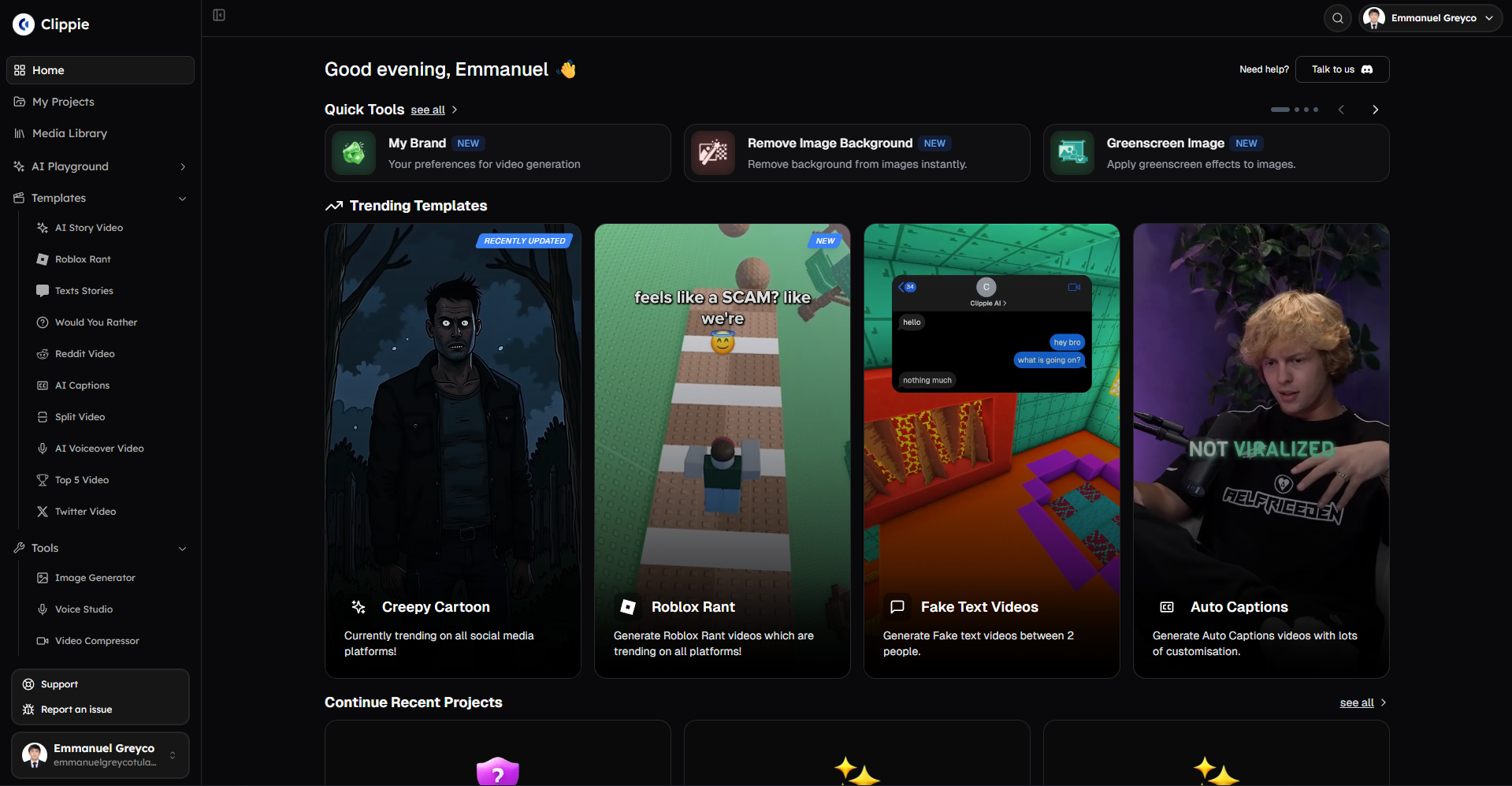
For businesses at every stage, whether direct-to-consumer brands scaling profitably through paid traffic, service businesses generating qualified leads through video advertising, ecommerce companies testing product-market fit through rapid creative iteration, or agencies managing multiple client campaigns requiring high-volume variation production, AI video ad creation through systematic frameworks combined with Clippie AI automation removes fundamental barriers preventing effective paid advertising: the creative production bottleneck limiting testing to 3-8 monthly variations creating inability to identify winners, and the cost structure of $500-$2,500 per agency/freelancer variation making adequate testing volume economically impossible. Visit clippie.ai to explore how businesses are achieving 40-75% conversion improvements through AI video ads, scaling profitably to $50K-$500K+ monthly ad spend through systematic creative testing, and building sustainable growth engines where continuous variation production and optimization create compounding advantages impossible to replicate through static advertising or low-volume creative approaches.
Read more

Viral Storytelling Formats: 8 Story Structures for Shorts
Story structures that keep viewers past the opening seconds, from POV confessions to open loops and twist endings, each with a script outline to reuse.
Faceless YouTube Automation Ideas That Stay Monetizable
Channel concepts built for a repeatable script, voice and visuals pipeline, each checked against YouTube's July 2026 rules and where human input matters.

Anonymous Content Ideas: 30 Faceless Videos to Post in 2026
Video ideas that never need your face or your own voice, grouped by format: stories, rankings, quizzes, explainers and commentary, with the policy line.